Cryptocurrencies need knowledge of digital assets, blockchain, and trading platforms, but many investors lack financial literacy.
A Funcas-funded Spanish study of 2,000 links financial literacy bias to crypto ownership.
Cryptocurrencies have transformed the
financial landscape, captivating tech enthusiasts, investors, and regulators
worldwide. However, as digital assets gain prominence, critical questions arise
about the role of financial literacy and cognitive biases in shaping investment
behaviours.
Empirical evidence underscores that
financial literacy significantly influences financial stability by enhancing
individual decision-making. People with higher financial literacy make prudent
choices, such as budgeting effectively, saving for emergencies, and
understanding borrowing costs.
Cryptocurrencies themselves are diverse, ranging from
established names like Bitcoin and Ethereum to speculative altcoins. Without
the ability to critically assess technology stacks and market trends, investors
may fall prey to speculative bubbles or projects with little intrinsic value.
A
lack of financial literacy exacerbates these challenges, making it difficult to
comprehend the potential consequences of market fluctuations, thereby
increasing vulnerability to shocks. The connection between financial
literacy and cryptocurrency ownership is particularly significant given the
complexity of these assets compared to traditional financial instruments and
the risks they pose to financial stability.
Study Links Overconfidence to Crypto
Investments
A recent study, Cryptocurrency
Ownership and Cognitive Biases in Perceived Financial Literacy, conducted in
Spain by Santiago Carbó, Pedro J. Cuadros, and Francisco Rodríguez and funded
by Funcas, sheds light on this issue. The research investigates how financial
literacy bias—the gap between perceived and actual financial knowledge—affects
cryptocurrency ownership.
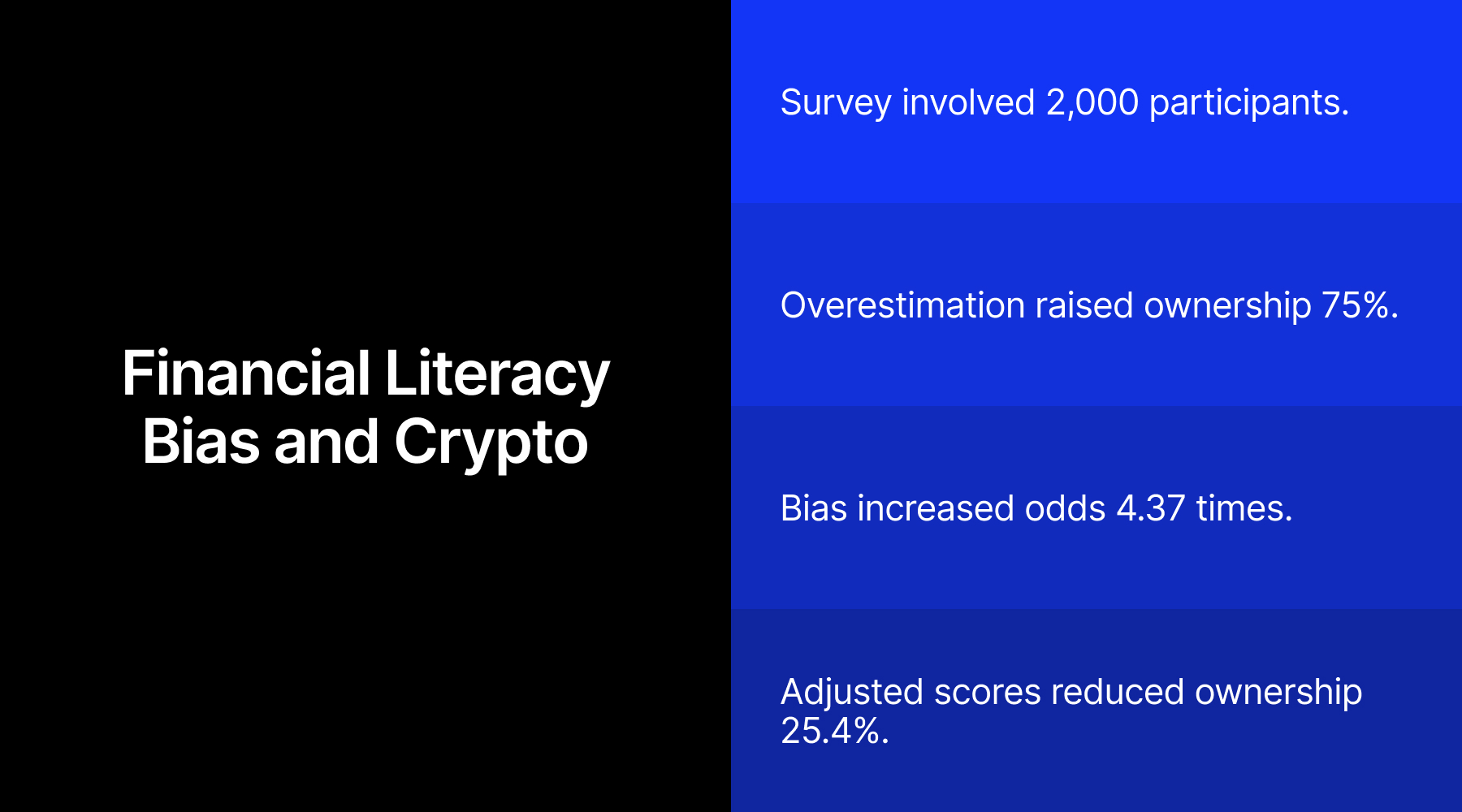
Based on a survey of over 2,000 participants, the
study identifies financial literacy bias as a critical determinant of
cryptocurrency ownership, even after controlling for variables such as age,
income, and digital activity.
Using advanced machine learning
techniques, the study reveals that individuals who overestimate their financial
knowledge are significantly more likely to invest in cryptocurrencies.
Specifically, those who overestimated their financial literacy were 75% more
likely to hold digital assets compared to those with accurate self-assessments.
For every unit increase in financial literacy bias, the odds of owning
cryptocurrencies rose by approximately 4.37 times.
If you consistently make money and lose it back to the market even when you know you are intelligent, then what is missing from your education is financial literacy.
💥What you do with your money once you make it 💥How to keep the market /people from taking the money from you…
Why does this happen? Individuals who
overestimate their financial literacy may feel overly confident in facing the
complexities of the cryptocurrency market. Cognitive biases, such as
confirmation bias, can further reinforce this confidence by leading individuals
to focus on information that validates their investment choices while
disregarding evidence of potential risks. Addressing these biases is essential
for fostering more rational and informed investment behaviour.
Cognitive Biases Fuel Crypto
Speculative Bubbles
Interestingly, the study also found
that when financial literacy scores were adjusted to account for bias, the
likelihood of cryptocurrency ownership decreased by 25.4%. This highlights the
importance of accurate self-assessment in mitigating risky investment
behaviours.
While cryptocurrency adoption is not
inherently harmful, it can pose systemic risks when driven by misinformation or
cognitive biases. Cryptocurrencies often attract individuals seeking quick
returns, potentially fueling speculative bubbles and increasing market
volatility. Such conditions also create opportunities for fraud and scams,
further destabilising the financial ecosystem.
Save for later✅ Follow for more ❤️
Since Crypto is a high risk asset and can make your investment zero too, so invest wisely and Do your proper research before investing and grow your portfolio wisely! pic.twitter.com/zU8kyUxkGl
For policymakers and regulators,
these findings emphasize the urgency of promoting financial education.
Initiatives that address cognitive biases and enhance objective financial
literacy can help mitigate risks and encourage responsible investment
behaviour. Regulators and industry leaders should collaborate to ensure that
investors have access to reliable information and safeguards against misleading
claims.
By fostering a culture of financial literacy and addressing cognitive
biases, we can help ensure that the cryptocurrency revolution is both inclusive
and sustainable. Whether as investors, educators, or policymakers, recognizing
the interplay between knowledge, perception, and behaviour is key to succeeding
in this dynamic financial landscape.
Francisco Rodríguez also contributed to this article.
Cryptocurrencies have transformed the
financial landscape, captivating tech enthusiasts, investors, and regulators
worldwide. However, as digital assets gain prominence, critical questions arise
about the role of financial literacy and cognitive biases in shaping investment
behaviours.
Empirical evidence underscores that
financial literacy significantly influences financial stability by enhancing
individual decision-making. People with higher financial literacy make prudent
choices, such as budgeting effectively, saving for emergencies, and
understanding borrowing costs.
Cryptocurrencies themselves are diverse, ranging from
established names like Bitcoin and Ethereum to speculative altcoins. Without
the ability to critically assess technology stacks and market trends, investors
may fall prey to speculative bubbles or projects with little intrinsic value.
A
lack of financial literacy exacerbates these challenges, making it difficult to
comprehend the potential consequences of market fluctuations, thereby
increasing vulnerability to shocks. The connection between financial
literacy and cryptocurrency ownership is particularly significant given the
complexity of these assets compared to traditional financial instruments and
the risks they pose to financial stability.
Study Links Overconfidence to Crypto
Investments
A recent study, Cryptocurrency
Ownership and Cognitive Biases in Perceived Financial Literacy, conducted in
Spain by Santiago Carbó, Pedro J. Cuadros, and Francisco Rodríguez and funded
by Funcas, sheds light on this issue. The research investigates how financial
literacy bias—the gap between perceived and actual financial knowledge—affects
cryptocurrency ownership.
Based on a survey of over 2,000 participants, the
study identifies financial literacy bias as a critical determinant of
cryptocurrency ownership, even after controlling for variables such as age,
income, and digital activity.
Using advanced machine learning
techniques, the study reveals that individuals who overestimate their financial
knowledge are significantly more likely to invest in cryptocurrencies.
Specifically, those who overestimated their financial literacy were 75% more
likely to hold digital assets compared to those with accurate self-assessments.
For every unit increase in financial literacy bias, the odds of owning
cryptocurrencies rose by approximately 4.37 times.
If you consistently make money and lose it back to the market even when you know you are intelligent, then what is missing from your education is financial literacy.
💥What you do with your money once you make it 💥How to keep the market /people from taking the money from you…
Why does this happen? Individuals who
overestimate their financial literacy may feel overly confident in facing the
complexities of the cryptocurrency market. Cognitive biases, such as
confirmation bias, can further reinforce this confidence by leading individuals
to focus on information that validates their investment choices while
disregarding evidence of potential risks. Addressing these biases is essential
for fostering more rational and informed investment behaviour.
Cognitive Biases Fuel Crypto
Speculative Bubbles
Interestingly, the study also found
that when financial literacy scores were adjusted to account for bias, the
likelihood of cryptocurrency ownership decreased by 25.4%. This highlights the
importance of accurate self-assessment in mitigating risky investment
behaviours.
While cryptocurrency adoption is not
inherently harmful, it can pose systemic risks when driven by misinformation or
cognitive biases. Cryptocurrencies often attract individuals seeking quick
returns, potentially fueling speculative bubbles and increasing market
volatility. Such conditions also create opportunities for fraud and scams,
further destabilising the financial ecosystem.
Save for later✅ Follow for more ❤️
Since Crypto is a high risk asset and can make your investment zero too, so invest wisely and Do your proper research before investing and grow your portfolio wisely! pic.twitter.com/zU8kyUxkGl
For policymakers and regulators,
these findings emphasize the urgency of promoting financial education.
Initiatives that address cognitive biases and enhance objective financial
literacy can help mitigate risks and encourage responsible investment
behaviour. Regulators and industry leaders should collaborate to ensure that
investors have access to reliable information and safeguards against misleading
claims.
By fostering a culture of financial literacy and addressing cognitive
biases, we can help ensure that the cryptocurrency revolution is both inclusive
and sustainable. Whether as investors, educators, or policymakers, recognizing
the interplay between knowledge, perception, and behaviour is key to succeeding
in this dynamic financial landscape.
Francisco Rodríguez also contributed to this article.
Associate (tenured) professor at CUNEF Universidad (Madrid-Spain) and Economist af Funcas Foundation. PhD. in Economics from the University of Granada (Spain). His research interests lie in Banking and Financial Intermediation. His current research agenda revolves around three main areas: digital banking, banking supervision, and the ecological transition of financial intermediaries. His research work has been published in international journals such as the Journal of Corporate Finance, Journal of Financial Stability, Journal of International Financial Markets, Institutions & Money, European Journal of Finance, Financial Innovation, Research in International Business and Finance, International Review of Economics & Finance, Plos-ONE, and Global Policy. He has been awarded the second prize for research (twice) by the FEF (Financial Studies Foundation) and the research award for the best thesis in Economics by the RADE (Royal Academy of Doctors in Spain).
Kalshi Prediction Market and TRON Integration Bridges Traditional Finance with Crypto
Featured Videos
Executive Interview | Charlotte Bullock | Chief Product Officer, Bank of London | FMLS:25
In this interview, we sat down with Charlotte Bullock, Head of Product at The Bank of London, previously at SAP and now shaping product at one of the sector’s most ambitious new banking players.
Charlotte reflects on the Summit so far and talks about the culture inside fintech banks today. We look at the pressures that come with scaling, and how firms can hold onto the nimble approach that made them stand out early on.
We also cover the state of payments ahead of her appearance on the payments roundtable: the blockages financial firms face, the areas that still need fixing, and what a realistic solution looks like in 2026.
In this interview, we sat down with Charlotte Bullock, Head of Product at The Bank of London, previously at SAP and now shaping product at one of the sector’s most ambitious new banking players.
Charlotte reflects on the Summit so far and talks about the culture inside fintech banks today. We look at the pressures that come with scaling, and how firms can hold onto the nimble approach that made them stand out early on.
We also cover the state of payments ahead of her appearance on the payments roundtable: the blockages financial firms face, the areas that still need fixing, and what a realistic solution looks like in 2026.
In this interview, we sat down with Charlotte Bullock, Head of Product at The Bank of London, previously at SAP and now shaping product at one of the sector’s most ambitious new banking players.
Charlotte reflects on the Summit so far and talks about the culture inside fintech banks today. We look at the pressures that come with scaling, and how firms can hold onto the nimble approach that made them stand out early on.
We also cover the state of payments ahead of her appearance on the payments roundtable: the blockages financial firms face, the areas that still need fixing, and what a realistic solution looks like in 2026.
In this interview, we sat down with Charlotte Bullock, Head of Product at The Bank of London, previously at SAP and now shaping product at one of the sector’s most ambitious new banking players.
Charlotte reflects on the Summit so far and talks about the culture inside fintech banks today. We look at the pressures that come with scaling, and how firms can hold onto the nimble approach that made them stand out early on.
We also cover the state of payments ahead of her appearance on the payments roundtable: the blockages financial firms face, the areas that still need fixing, and what a realistic solution looks like in 2026.
In this conversation, we sit down with Drew Niv, CSO at ATFX Connect and one of the most influential figures in modern FX.
We speak about market structure, the institutional view on liquidity, and the sharp rise of prop trading, a sector Drew has been commenting on in recent months. Drew explains why he once dismissed prop trading, why his view changed, and what he now thinks the model means for brokers, clients and risk managers.
We explore subscription-fee dependency, the high reneging rate, and the long-term challenge: how brokers can build a more stable and honest version of the model. Drew also talks about the traffic advantage standalone prop firms have built and why brokers may still win in the long run if they take the right approach.
In this conversation, we sit down with Drew Niv, CSO at ATFX Connect and one of the most influential figures in modern FX.
We speak about market structure, the institutional view on liquidity, and the sharp rise of prop trading, a sector Drew has been commenting on in recent months. Drew explains why he once dismissed prop trading, why his view changed, and what he now thinks the model means for brokers, clients and risk managers.
We explore subscription-fee dependency, the high reneging rate, and the long-term challenge: how brokers can build a more stable and honest version of the model. Drew also talks about the traffic advantage standalone prop firms have built and why brokers may still win in the long run if they take the right approach.
In this conversation, we sit down with Drew Niv, CSO at ATFX Connect and one of the most influential figures in modern FX.
We speak about market structure, the institutional view on liquidity, and the sharp rise of prop trading, a sector Drew has been commenting on in recent months. Drew explains why he once dismissed prop trading, why his view changed, and what he now thinks the model means for brokers, clients and risk managers.
We explore subscription-fee dependency, the high reneging rate, and the long-term challenge: how brokers can build a more stable and honest version of the model. Drew also talks about the traffic advantage standalone prop firms have built and why brokers may still win in the long run if they take the right approach.
In this conversation, we sit down with Drew Niv, CSO at ATFX Connect and one of the most influential figures in modern FX.
We speak about market structure, the institutional view on liquidity, and the sharp rise of prop trading, a sector Drew has been commenting on in recent months. Drew explains why he once dismissed prop trading, why his view changed, and what he now thinks the model means for brokers, clients and risk managers.
We explore subscription-fee dependency, the high reneging rate, and the long-term challenge: how brokers can build a more stable and honest version of the model. Drew also talks about the traffic advantage standalone prop firms have built and why brokers may still win in the long run if they take the right approach.
In this conversation, we sit down with Drew Niv, CSO at ATFX Connect and one of the most influential figures in modern FX.
We speak about market structure, the institutional view on liquidity, and the sharp rise of prop trading, a sector Drew has been commenting on in recent months. Drew explains why he once dismissed prop trading, why his view changed, and what he now thinks the model means for brokers, clients and risk managers.
We explore subscription-fee dependency, the high reneging rate, and the long-term challenge: how brokers can build a more stable and honest version of the model. Drew also talks about the traffic advantage standalone prop firms have built and why brokers may still win in the long run if they take the right approach.
In this conversation, we sit down with Drew Niv, CSO at ATFX Connect and one of the most influential figures in modern FX.
We speak about market structure, the institutional view on liquidity, and the sharp rise of prop trading, a sector Drew has been commenting on in recent months. Drew explains why he once dismissed prop trading, why his view changed, and what he now thinks the model means for brokers, clients and risk managers.
We explore subscription-fee dependency, the high reneging rate, and the long-term challenge: how brokers can build a more stable and honest version of the model. Drew also talks about the traffic advantage standalone prop firms have built and why brokers may still win in the long run if they take the right approach.
Executive Interview | Remonda Z. Kirketerp Møller| CEO & Founder Muinmos | FMLS:25
In this interview, Remonda Z. Kirketerp Møller, founder of Muinmos, breaks down the state of AI in regtech and what responsible adoption really looks like for brokers. We talk about rising fragmentation, the pressures around compliance accuracy, and why most firms are still in the early stages of AI maturity.
Ramanda also shares insights on regulator sandboxes, shifting expectations around accountability, and the current reality of MiCA licensing and passporting in Europe.
A concise look at where compliance, onboarding, and AI-driven processes are heading next.
In this interview, Remonda Z. Kirketerp Møller, founder of Muinmos, breaks down the state of AI in regtech and what responsible adoption really looks like for brokers. We talk about rising fragmentation, the pressures around compliance accuracy, and why most firms are still in the early stages of AI maturity.
Ramanda also shares insights on regulator sandboxes, shifting expectations around accountability, and the current reality of MiCA licensing and passporting in Europe.
A concise look at where compliance, onboarding, and AI-driven processes are heading next.
In this interview, Remonda Z. Kirketerp Møller, founder of Muinmos, breaks down the state of AI in regtech and what responsible adoption really looks like for brokers. We talk about rising fragmentation, the pressures around compliance accuracy, and why most firms are still in the early stages of AI maturity.
Ramanda also shares insights on regulator sandboxes, shifting expectations around accountability, and the current reality of MiCA licensing and passporting in Europe.
A concise look at where compliance, onboarding, and AI-driven processes are heading next.
In this interview, Remonda Z. Kirketerp Møller, founder of Muinmos, breaks down the state of AI in regtech and what responsible adoption really looks like for brokers. We talk about rising fragmentation, the pressures around compliance accuracy, and why most firms are still in the early stages of AI maturity.
Ramanda also shares insights on regulator sandboxes, shifting expectations around accountability, and the current reality of MiCA licensing and passporting in Europe.
A concise look at where compliance, onboarding, and AI-driven processes are heading next.
In this interview, Remonda Z. Kirketerp Møller, founder of Muinmos, breaks down the state of AI in regtech and what responsible adoption really looks like for brokers. We talk about rising fragmentation, the pressures around compliance accuracy, and why most firms are still in the early stages of AI maturity.
Ramanda also shares insights on regulator sandboxes, shifting expectations around accountability, and the current reality of MiCA licensing and passporting in Europe.
A concise look at where compliance, onboarding, and AI-driven processes are heading next.
In this interview, Remonda Z. Kirketerp Møller, founder of Muinmos, breaks down the state of AI in regtech and what responsible adoption really looks like for brokers. We talk about rising fragmentation, the pressures around compliance accuracy, and why most firms are still in the early stages of AI maturity.
Ramanda also shares insights on regulator sandboxes, shifting expectations around accountability, and the current reality of MiCA licensing and passporting in Europe.
A concise look at where compliance, onboarding, and AI-driven processes are heading next.
In this conversation, we speak with Aydin Bonabi, CEO and co-founder of Surveill, a firm focused on fraud detection and AI-driven compliance tools for financial institutions.
We start with Aydin’s view of the Summit and the challenges brokers face as fraud tactics grow more complex. He explains how firms can stay ahead through real-time signals, data patterns, and early-stage detection.
We also talk about AI training and why compliance teams often struggle to keep models accurate, fair, and aligned with regulatory expectations. Aydin breaks down what “good” AI training looks like inside a financial environment, including the importance of clean data, domain expertise, and human oversight.
He closes with a clear message: fraud is scaling, and so must the tools that stop it.
In this conversation, we speak with Aydin Bonabi, CEO and co-founder of Surveill, a firm focused on fraud detection and AI-driven compliance tools for financial institutions.
We start with Aydin’s view of the Summit and the challenges brokers face as fraud tactics grow more complex. He explains how firms can stay ahead through real-time signals, data patterns, and early-stage detection.
We also talk about AI training and why compliance teams often struggle to keep models accurate, fair, and aligned with regulatory expectations. Aydin breaks down what “good” AI training looks like inside a financial environment, including the importance of clean data, domain expertise, and human oversight.
He closes with a clear message: fraud is scaling, and so must the tools that stop it.
In this conversation, we speak with Aydin Bonabi, CEO and co-founder of Surveill, a firm focused on fraud detection and AI-driven compliance tools for financial institutions.
We start with Aydin’s view of the Summit and the challenges brokers face as fraud tactics grow more complex. He explains how firms can stay ahead through real-time signals, data patterns, and early-stage detection.
We also talk about AI training and why compliance teams often struggle to keep models accurate, fair, and aligned with regulatory expectations. Aydin breaks down what “good” AI training looks like inside a financial environment, including the importance of clean data, domain expertise, and human oversight.
He closes with a clear message: fraud is scaling, and so must the tools that stop it.
In this conversation, we speak with Aydin Bonabi, CEO and co-founder of Surveill, a firm focused on fraud detection and AI-driven compliance tools for financial institutions.
We start with Aydin’s view of the Summit and the challenges brokers face as fraud tactics grow more complex. He explains how firms can stay ahead through real-time signals, data patterns, and early-stage detection.
We also talk about AI training and why compliance teams often struggle to keep models accurate, fair, and aligned with regulatory expectations. Aydin breaks down what “good” AI training looks like inside a financial environment, including the importance of clean data, domain expertise, and human oversight.
He closes with a clear message: fraud is scaling, and so must the tools that stop it.
In this conversation, we speak with Aydin Bonabi, CEO and co-founder of Surveill, a firm focused on fraud detection and AI-driven compliance tools for financial institutions.
We start with Aydin’s view of the Summit and the challenges brokers face as fraud tactics grow more complex. He explains how firms can stay ahead through real-time signals, data patterns, and early-stage detection.
We also talk about AI training and why compliance teams often struggle to keep models accurate, fair, and aligned with regulatory expectations. Aydin breaks down what “good” AI training looks like inside a financial environment, including the importance of clean data, domain expertise, and human oversight.
He closes with a clear message: fraud is scaling, and so must the tools that stop it.
In this conversation, we speak with Aydin Bonabi, CEO and co-founder of Surveill, a firm focused on fraud detection and AI-driven compliance tools for financial institutions.
We start with Aydin’s view of the Summit and the challenges brokers face as fraud tactics grow more complex. He explains how firms can stay ahead through real-time signals, data patterns, and early-stage detection.
We also talk about AI training and why compliance teams often struggle to keep models accurate, fair, and aligned with regulatory expectations. Aydin breaks down what “good” AI training looks like inside a financial environment, including the importance of clean data, domain expertise, and human oversight.
He closes with a clear message: fraud is scaling, and so must the tools that stop it.
Exness expands its presence in Africa: Inside our interview with Paul Margarites in Cape Town
Finance Magnates met with Paul Margarites, Exness regional commercial director for Sub-Saharan Africa, during a visit to the firm’s office opening in Cape Town. In this talk, led by Andrea Badiola Mateos, Co-CEO at Finance Magnates, Paul shares views on the South African trading space, local user behavior, mobile trends, regulation, team growth, and how Exness plans to grow in more markets across the region. @Exness
Read the article at: https://www.financemagnates.com/thought-leadership/exness-expands-its-presence-in-africa-inside-our-interview-with-paul-margarites/
#exness #financemagnates #exnesstrading #CFDtrading #tradeonline #africanews #capetown
Finance Magnates met with Paul Margarites, Exness regional commercial director for Sub-Saharan Africa, during a visit to the firm’s office opening in Cape Town. In this talk, led by Andrea Badiola Mateos, Co-CEO at Finance Magnates, Paul shares views on the South African trading space, local user behavior, mobile trends, regulation, team growth, and how Exness plans to grow in more markets across the region. @Exness
Read the article at: https://www.financemagnates.com/thought-leadership/exness-expands-its-presence-in-africa-inside-our-interview-with-paul-margarites/
#exness #financemagnates #exnesstrading #CFDtrading #tradeonline #africanews #capetown
Finance Magnates met with Paul Margarites, Exness regional commercial director for Sub-Saharan Africa, during a visit to the firm’s office opening in Cape Town. In this talk, led by Andrea Badiola Mateos, Co-CEO at Finance Magnates, Paul shares views on the South African trading space, local user behavior, mobile trends, regulation, team growth, and how Exness plans to grow in more markets across the region. @Exness
Read the article at: https://www.financemagnates.com/thought-leadership/exness-expands-its-presence-in-africa-inside-our-interview-with-paul-margarites/
#exness #financemagnates #exnesstrading #CFDtrading #tradeonline #africanews #capetown
Finance Magnates met with Paul Margarites, Exness regional commercial director for Sub-Saharan Africa, during a visit to the firm’s office opening in Cape Town. In this talk, led by Andrea Badiola Mateos, Co-CEO at Finance Magnates, Paul shares views on the South African trading space, local user behavior, mobile trends, regulation, team growth, and how Exness plans to grow in more markets across the region. @Exness
Read the article at: https://www.financemagnates.com/thought-leadership/exness-expands-its-presence-in-africa-inside-our-interview-with-paul-margarites/
#exness #financemagnates #exnesstrading #CFDtrading #tradeonline #africanews #capetown
Finance Magnates met with Paul Margarites, Exness regional commercial director for Sub-Saharan Africa, during a visit to the firm’s office opening in Cape Town. In this talk, led by Andrea Badiola Mateos, Co-CEO at Finance Magnates, Paul shares views on the South African trading space, local user behavior, mobile trends, regulation, team growth, and how Exness plans to grow in more markets across the region. @Exness
Read the article at: https://www.financemagnates.com/thought-leadership/exness-expands-its-presence-in-africa-inside-our-interview-with-paul-margarites/
#exness #financemagnates #exnesstrading #CFDtrading #tradeonline #africanews #capetown
Finance Magnates met with Paul Margarites, Exness regional commercial director for Sub-Saharan Africa, during a visit to the firm’s office opening in Cape Town. In this talk, led by Andrea Badiola Mateos, Co-CEO at Finance Magnates, Paul shares views on the South African trading space, local user behavior, mobile trends, regulation, team growth, and how Exness plans to grow in more markets across the region. @Exness
Read the article at: https://www.financemagnates.com/thought-leadership/exness-expands-its-presence-in-africa-inside-our-interview-with-paul-margarites/
#exness #financemagnates #exnesstrading #CFDtrading #tradeonline #africanews #capetown