>
Is Nvidia the Most Valuable Company in the World for Good?
Disclaimer
Is Nvidia the Most Valuable Company in the World for Good?
Wednesday,19/06/2024|06:40GMTby
FM
Disclaimer
This week, investors should brace for potential volatility in Nvidia,
On June 5th, 2024, Nvidia's stock price shattered records, reaching a staggering $1,219.93. This surge propelled their market cap to a historic $3 trillion, placing them alongside tech giants like Microsoft and Apple. But Nvidia's stellar performance didn't stop there.
A few days later, it surpassed Apple to become the world's second-largest company. Then, on June 18th, Nvidia achieved another remarkable feat – dethroning all competitors to become the most valuable company in the world! This astonishing 180% surge since the beginning of 2024 underscores the immense potential investors still see in Nvidia's future.
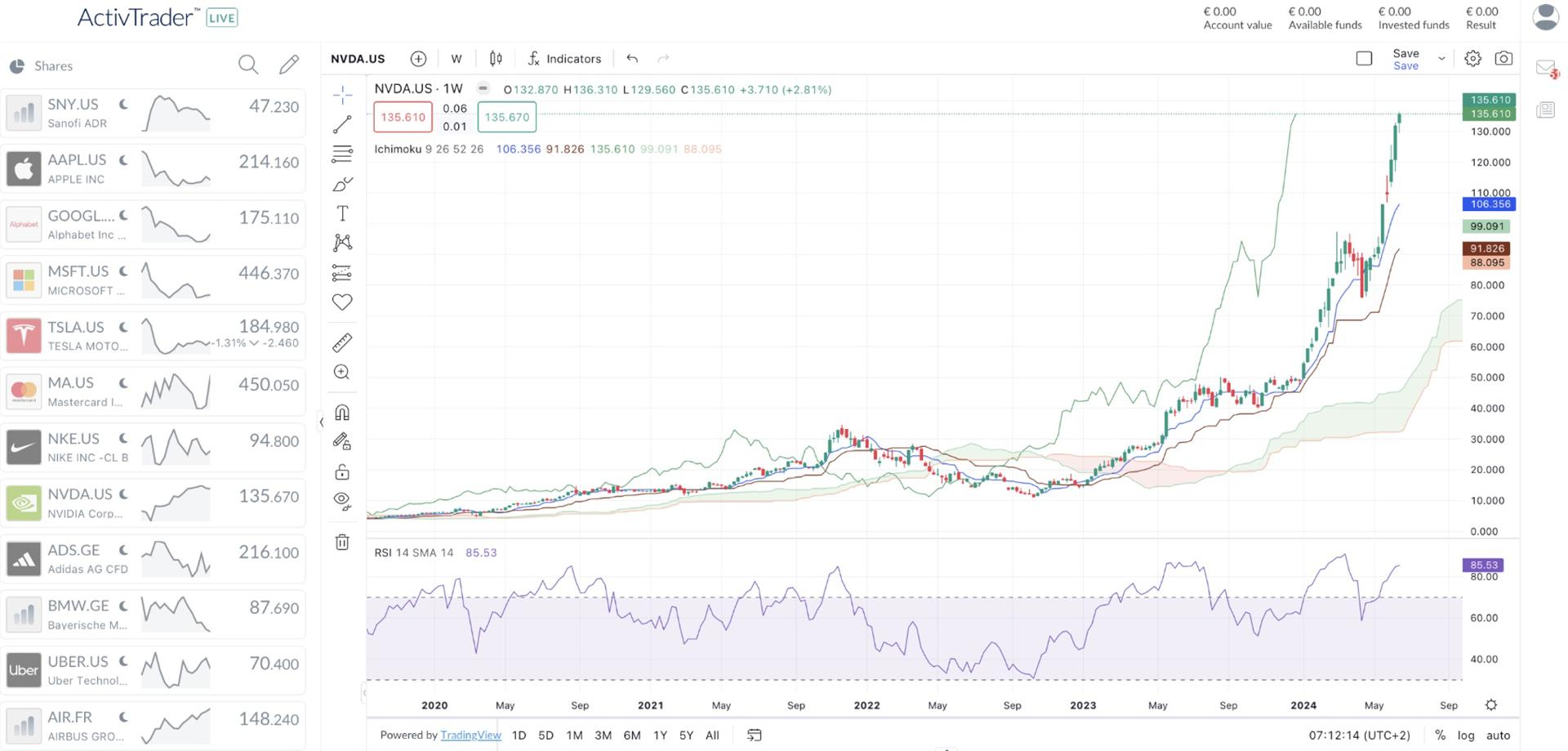
Weekly Nvidia Chart - Source: ActivTrader
While Gold has long been considered a safe haven during inflation, a growing number of investors are turning to big tech stocks like Nvidia. A recent Bloomberg survey revealed a shift in sentiment, with 46% of respondents still favouring gold, but a significant 33% now viewing large technology companies as a more effective hedge against inflation.
Nvidia and other tech stocks are propelling major indexes like the S&P 500 and Nasdaq to record highs. However, a closer look reveals an interesting trend. Will Nvidia's reign at the top last? What are the other factors driving the markets to record highs? Will this stock’s market growth continue? Let’s take a closer look.
Investors Power Up Chipmaker's Future
Nvidia published very strong and better-than-expected Q1 2024 performance, cementing their status as the undisputed kingpin of the AI era. Revenue skyrocketed 262% year-over-year, reaching an unprecedented $26 billion, which translates into a staggering 600% profit increase compared to the same period in 2023.
Fueling this explosive performance is the red-hot data centre segment. Driven by the insatiable demand for AI and high-performance computing, data centre sales reached a historic quarterly high of $22.6 billion, a significant 23% growth from the previous quarter and a jaw-dropping 427% surge compared to Q1 2023.
In June 2024, Nvidia announced a 10-to-1 stock split, following a similar move in July 2021 with a 4-to-1 split. This decision aims to make the company's stock more accessible to a broader range of investors.
While the total value of the company remains the same after a split, it increases the number of shares available. This often translates to lower individual share prices, potentially attracting more investors that can now afford to invest in Nvidia and boosting overall trading activity (liquidity).
Selective Surge: Tech Optimism Masks Broader Market Lag
While the S&P 500 and Nasdaq reached new highs on Tuesday, the Dow Jones barely budged. This follows a trend of the Dow underperforming other major U.S. indices this year. Since January 2024, the Dow has only gained around 3%, compared to the S&P 500's impressive 16% increase and the Nasdaq's surge of nearly 21%.
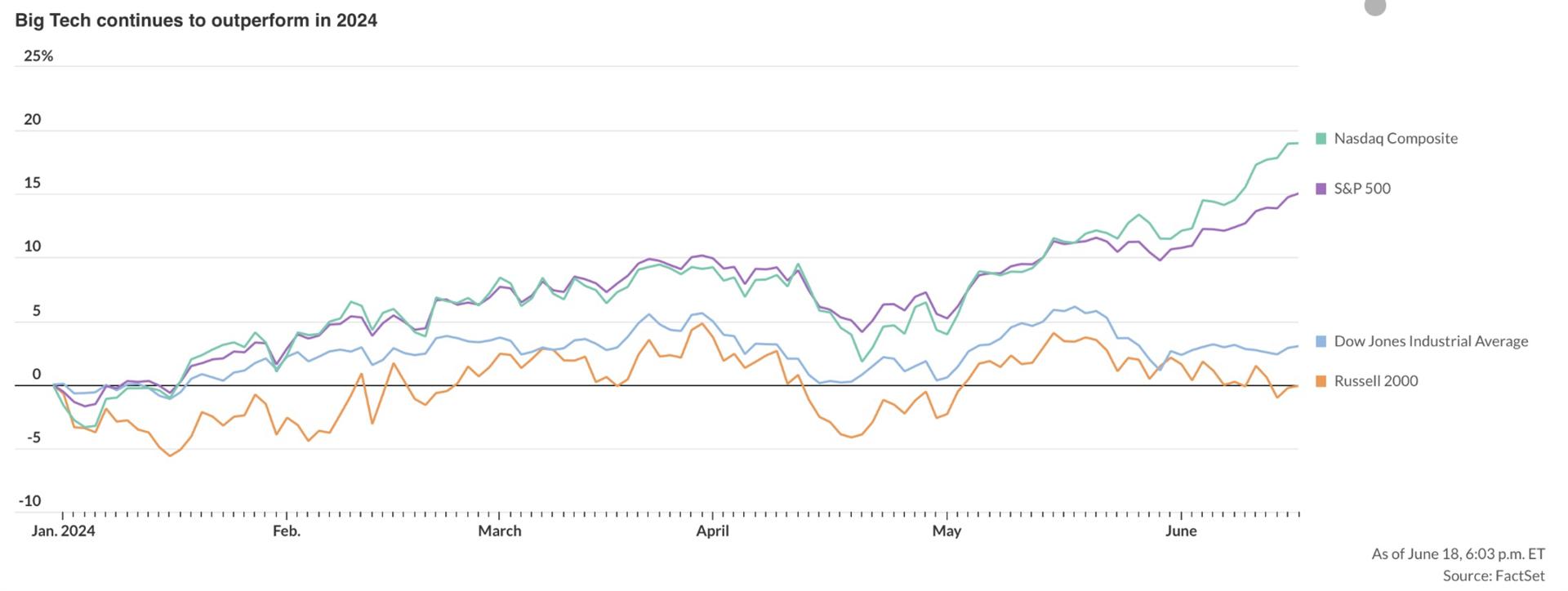
Over the past 20 trading sessions, despite the overall market gains, a majority of individual S&P 500 companies have actually closed lower. This has only happened a handful of times in the past three decades, highlighting the concentration of recent growth in a select few heavyweight stocks.
So, what's driving the US stock performance of the S&P500 and the Nasdaq? Several factors are at play.
Investors are increasingly optimistic about the Federal Reserve implementing multiple interest rate cuts this year, despite hawkish communication from FOMC members, who decided to hold interest rates at its current level (5.25% to 5.50%) for the seventh time in a row, while signaling fewer rate cuts than previously estimated.
Still, investors are growing more optimistic about the prospect of the Federal Reserve implementing multiple interest rate cuts this year with each piece of positive news released, despite the hawkish rhetoric from FOMC members.
This sentiment has been bolstered by recent comments from Fed Governor Adriana Kugler, who stated yesterday that she believes the current monetary policy stance is "sufficiently restrictive."
Kugler's assessment suggests that the existing policy measures are sufficient to alleviate inflationary pressures without triggering a substantial downturn in the labour market. Her remarks provide a nuanced view amidst the predominantly hawkish communication from the Federal Reserve, highlighting a potential pathway for easing rates if economic conditions allow for it.
Additionally, excitement surrounding AI advancements and robust earnings reports from other tech players are fueling market enthusiasm. But these gains haven't been evenly distributed, with a small number of heavily weighted stocks leading the charge.
Early signs of massive investments in generative AI are fueling a surge in the stock prices of major tech companies. Since January 2024, shares of tech giants like Apple, Amazon, Alphabet, and Meta Platforms have skyrocketed, with gains exceeding 15%, 21%, and 44% respectively. The trend extends beyond household names, with chipmakers like Applied Materials and Qualcomm witnessing impressive growth of over 60% each.
The widespread rally in tech stocks reflects a surge in investor confidence in regards to the transformative potential of generative AI. This optimism isn't just driving stock prices higher; it's also prompting leading financial institutions to revise their market outlooks upwards.
Last week, Goldman Sachs' equity strategy team upped their year-end target for the S&P 500 to 5,600, a significant increase from their previous estimate of 5,200. This week, Citigroup followed suit, raising their own year-end target to 5,600 from 5,100. These upward revisions highlight the belief that the momentum in the tech sector, fueled by AI advancements, is likely to continue propelling the broader market.
This week, investors should brace for potential volatility in Nvidia and other major tech stocks, particularly Apple. The Technology Select Sector SPDR Fund (XLK), one of the largest tech-focused ETFs in the US, is undergoing its quarterly rebalancing on Friday. This process may involve buying or selling billions of dollars worth of these stocks, potentially exerting significant bullish or bearish pressure on their share prices.
The information provided does not constitute investment research. The material has not been prepared in accordance with the legal requirements designed to promote the independence of investment research and as such is to be considered to be a marketing communication.
All information has been prepared by ActivTrades (“AT”). The information does not contain a record of AT’s prices, or an offer of or solicitation for a transaction in any financial instrument. No representation or warranty is given as to the accuracy or completeness of this information.
Any material provided does not have regard to the specific investment objective and financial situation of any person who may receive it. Past performance is not a reliable indicator of future performance. AT provides an execution-only service. Consequently, any person acting on the information provided does so at their own risk.
On June 5th, 2024, Nvidia's stock price shattered records, reaching a staggering $1,219.93. This surge propelled their market cap to a historic $3 trillion, placing them alongside tech giants like Microsoft and Apple. But Nvidia's stellar performance didn't stop there.
A few days later, it surpassed Apple to become the world's second-largest company. Then, on June 18th, Nvidia achieved another remarkable feat – dethroning all competitors to become the most valuable company in the world! This astonishing 180% surge since the beginning of 2024 underscores the immense potential investors still see in Nvidia's future.
Weekly Nvidia Chart - Source: ActivTrader
While Gold has long been considered a safe haven during inflation, a growing number of investors are turning to big tech stocks like Nvidia. A recent Bloomberg survey revealed a shift in sentiment, with 46% of respondents still favouring gold, but a significant 33% now viewing large technology companies as a more effective hedge against inflation.
Nvidia and other tech stocks are propelling major indexes like the S&P 500 and Nasdaq to record highs. However, a closer look reveals an interesting trend. Will Nvidia's reign at the top last? What are the other factors driving the markets to record highs? Will this stock’s market growth continue? Let’s take a closer look.
Investors Power Up Chipmaker's Future
Nvidia published very strong and better-than-expected Q1 2024 performance, cementing their status as the undisputed kingpin of the AI era. Revenue skyrocketed 262% year-over-year, reaching an unprecedented $26 billion, which translates into a staggering 600% profit increase compared to the same period in 2023.
Fueling this explosive performance is the red-hot data centre segment. Driven by the insatiable demand for AI and high-performance computing, data centre sales reached a historic quarterly high of $22.6 billion, a significant 23% growth from the previous quarter and a jaw-dropping 427% surge compared to Q1 2023.
In June 2024, Nvidia announced a 10-to-1 stock split, following a similar move in July 2021 with a 4-to-1 split. This decision aims to make the company's stock more accessible to a broader range of investors.
While the total value of the company remains the same after a split, it increases the number of shares available. This often translates to lower individual share prices, potentially attracting more investors that can now afford to invest in Nvidia and boosting overall trading activity (liquidity).
Selective Surge: Tech Optimism Masks Broader Market Lag
While the S&P 500 and Nasdaq reached new highs on Tuesday, the Dow Jones barely budged. This follows a trend of the Dow underperforming other major U.S. indices this year. Since January 2024, the Dow has only gained around 3%, compared to the S&P 500's impressive 16% increase and the Nasdaq's surge of nearly 21%.
Over the past 20 trading sessions, despite the overall market gains, a majority of individual S&P 500 companies have actually closed lower. This has only happened a handful of times in the past three decades, highlighting the concentration of recent growth in a select few heavyweight stocks.
So, what's driving the US stock performance of the S&P500 and the Nasdaq? Several factors are at play.
Investors are increasingly optimistic about the Federal Reserve implementing multiple interest rate cuts this year, despite hawkish communication from FOMC members, who decided to hold interest rates at its current level (5.25% to 5.50%) for the seventh time in a row, while signaling fewer rate cuts than previously estimated.
Still, investors are growing more optimistic about the prospect of the Federal Reserve implementing multiple interest rate cuts this year with each piece of positive news released, despite the hawkish rhetoric from FOMC members.
This sentiment has been bolstered by recent comments from Fed Governor Adriana Kugler, who stated yesterday that she believes the current monetary policy stance is "sufficiently restrictive."
Kugler's assessment suggests that the existing policy measures are sufficient to alleviate inflationary pressures without triggering a substantial downturn in the labour market. Her remarks provide a nuanced view amidst the predominantly hawkish communication from the Federal Reserve, highlighting a potential pathway for easing rates if economic conditions allow for it.
Additionally, excitement surrounding AI advancements and robust earnings reports from other tech players are fueling market enthusiasm. But these gains haven't been evenly distributed, with a small number of heavily weighted stocks leading the charge.
Early signs of massive investments in generative AI are fueling a surge in the stock prices of major tech companies. Since January 2024, shares of tech giants like Apple, Amazon, Alphabet, and Meta Platforms have skyrocketed, with gains exceeding 15%, 21%, and 44% respectively. The trend extends beyond household names, with chipmakers like Applied Materials and Qualcomm witnessing impressive growth of over 60% each.
The widespread rally in tech stocks reflects a surge in investor confidence in regards to the transformative potential of generative AI. This optimism isn't just driving stock prices higher; it's also prompting leading financial institutions to revise their market outlooks upwards.
Last week, Goldman Sachs' equity strategy team upped their year-end target for the S&P 500 to 5,600, a significant increase from their previous estimate of 5,200. This week, Citigroup followed suit, raising their own year-end target to 5,600 from 5,100. These upward revisions highlight the belief that the momentum in the tech sector, fueled by AI advancements, is likely to continue propelling the broader market.
This week, investors should brace for potential volatility in Nvidia and other major tech stocks, particularly Apple. The Technology Select Sector SPDR Fund (XLK), one of the largest tech-focused ETFs in the US, is undergoing its quarterly rebalancing on Friday. This process may involve buying or selling billions of dollars worth of these stocks, potentially exerting significant bullish or bearish pressure on their share prices.
The information provided does not constitute investment research. The material has not been prepared in accordance with the legal requirements designed to promote the independence of investment research and as such is to be considered to be a marketing communication.
All information has been prepared by ActivTrades (“AT”). The information does not contain a record of AT’s prices, or an offer of or solicitation for a transaction in any financial instrument. No representation or warranty is given as to the accuracy or completeness of this information.
Any material provided does not have regard to the specific investment objective and financial situation of any person who may receive it. Past performance is not a reliable indicator of future performance. AT provides an execution-only service. Consequently, any person acting on the information provided does so at their own risk.
The Trader’s Holiday Checklist: 7 Smart Habits for Ending the Year Strong
Featured Videos
Executive Interview | Charlotte Bullock | Chief Product Officer, Bank of London | FMLS:25
In this interview, we sat down with Charlotte Bullock, Head of Product at The Bank of London, previously at SAP and now shaping product at one of the sector’s most ambitious new banking players.
Charlotte reflects on the Summit so far and talks about the culture inside fintech banks today. We look at the pressures that come with scaling, and how firms can hold onto the nimble approach that made them stand out early on.
We also cover the state of payments ahead of her appearance on the payments roundtable: the blockages financial firms face, the areas that still need fixing, and what a realistic solution looks like in 2026.
In this interview, we sat down with Charlotte Bullock, Head of Product at The Bank of London, previously at SAP and now shaping product at one of the sector’s most ambitious new banking players.
Charlotte reflects on the Summit so far and talks about the culture inside fintech banks today. We look at the pressures that come with scaling, and how firms can hold onto the nimble approach that made them stand out early on.
We also cover the state of payments ahead of her appearance on the payments roundtable: the blockages financial firms face, the areas that still need fixing, and what a realistic solution looks like in 2026.
In this interview, we sat down with Charlotte Bullock, Head of Product at The Bank of London, previously at SAP and now shaping product at one of the sector’s most ambitious new banking players.
Charlotte reflects on the Summit so far and talks about the culture inside fintech banks today. We look at the pressures that come with scaling, and how firms can hold onto the nimble approach that made them stand out early on.
We also cover the state of payments ahead of her appearance on the payments roundtable: the blockages financial firms face, the areas that still need fixing, and what a realistic solution looks like in 2026.
In this interview, we sat down with Charlotte Bullock, Head of Product at The Bank of London, previously at SAP and now shaping product at one of the sector’s most ambitious new banking players.
Charlotte reflects on the Summit so far and talks about the culture inside fintech banks today. We look at the pressures that come with scaling, and how firms can hold onto the nimble approach that made them stand out early on.
We also cover the state of payments ahead of her appearance on the payments roundtable: the blockages financial firms face, the areas that still need fixing, and what a realistic solution looks like in 2026.
In this conversation, we sit down with Drew Niv, CSO at ATFX Connect and one of the most influential figures in modern FX.
We speak about market structure, the institutional view on liquidity, and the sharp rise of prop trading, a sector Drew has been commenting on in recent months. Drew explains why he once dismissed prop trading, why his view changed, and what he now thinks the model means for brokers, clients and risk managers.
We explore subscription-fee dependency, the high reneging rate, and the long-term challenge: how brokers can build a more stable and honest version of the model. Drew also talks about the traffic advantage standalone prop firms have built and why brokers may still win in the long run if they take the right approach.
In this conversation, we sit down with Drew Niv, CSO at ATFX Connect and one of the most influential figures in modern FX.
We speak about market structure, the institutional view on liquidity, and the sharp rise of prop trading, a sector Drew has been commenting on in recent months. Drew explains why he once dismissed prop trading, why his view changed, and what he now thinks the model means for brokers, clients and risk managers.
We explore subscription-fee dependency, the high reneging rate, and the long-term challenge: how brokers can build a more stable and honest version of the model. Drew also talks about the traffic advantage standalone prop firms have built and why brokers may still win in the long run if they take the right approach.
In this conversation, we sit down with Drew Niv, CSO at ATFX Connect and one of the most influential figures in modern FX.
We speak about market structure, the institutional view on liquidity, and the sharp rise of prop trading, a sector Drew has been commenting on in recent months. Drew explains why he once dismissed prop trading, why his view changed, and what he now thinks the model means for brokers, clients and risk managers.
We explore subscription-fee dependency, the high reneging rate, and the long-term challenge: how brokers can build a more stable and honest version of the model. Drew also talks about the traffic advantage standalone prop firms have built and why brokers may still win in the long run if they take the right approach.
In this conversation, we sit down with Drew Niv, CSO at ATFX Connect and one of the most influential figures in modern FX.
We speak about market structure, the institutional view on liquidity, and the sharp rise of prop trading, a sector Drew has been commenting on in recent months. Drew explains why he once dismissed prop trading, why his view changed, and what he now thinks the model means for brokers, clients and risk managers.
We explore subscription-fee dependency, the high reneging rate, and the long-term challenge: how brokers can build a more stable and honest version of the model. Drew also talks about the traffic advantage standalone prop firms have built and why brokers may still win in the long run if they take the right approach.
In this conversation, we sit down with Drew Niv, CSO at ATFX Connect and one of the most influential figures in modern FX.
We speak about market structure, the institutional view on liquidity, and the sharp rise of prop trading, a sector Drew has been commenting on in recent months. Drew explains why he once dismissed prop trading, why his view changed, and what he now thinks the model means for brokers, clients and risk managers.
We explore subscription-fee dependency, the high reneging rate, and the long-term challenge: how brokers can build a more stable and honest version of the model. Drew also talks about the traffic advantage standalone prop firms have built and why brokers may still win in the long run if they take the right approach.
In this conversation, we sit down with Drew Niv, CSO at ATFX Connect and one of the most influential figures in modern FX.
We speak about market structure, the institutional view on liquidity, and the sharp rise of prop trading, a sector Drew has been commenting on in recent months. Drew explains why he once dismissed prop trading, why his view changed, and what he now thinks the model means for brokers, clients and risk managers.
We explore subscription-fee dependency, the high reneging rate, and the long-term challenge: how brokers can build a more stable and honest version of the model. Drew also talks about the traffic advantage standalone prop firms have built and why brokers may still win in the long run if they take the right approach.
Executive Interview | Remonda Z. Kirketerp Møller| CEO & Founder Muinmos | FMLS:25
In this interview, Remonda Z. Kirketerp Møller, founder of Muinmos, breaks down the state of AI in regtech and what responsible adoption really looks like for brokers. We talk about rising fragmentation, the pressures around compliance accuracy, and why most firms are still in the early stages of AI maturity.
Ramanda also shares insights on regulator sandboxes, shifting expectations around accountability, and the current reality of MiCA licensing and passporting in Europe.
A concise look at where compliance, onboarding, and AI-driven processes are heading next.
In this interview, Remonda Z. Kirketerp Møller, founder of Muinmos, breaks down the state of AI in regtech and what responsible adoption really looks like for brokers. We talk about rising fragmentation, the pressures around compliance accuracy, and why most firms are still in the early stages of AI maturity.
Ramanda also shares insights on regulator sandboxes, shifting expectations around accountability, and the current reality of MiCA licensing and passporting in Europe.
A concise look at where compliance, onboarding, and AI-driven processes are heading next.
In this interview, Remonda Z. Kirketerp Møller, founder of Muinmos, breaks down the state of AI in regtech and what responsible adoption really looks like for brokers. We talk about rising fragmentation, the pressures around compliance accuracy, and why most firms are still in the early stages of AI maturity.
Ramanda also shares insights on regulator sandboxes, shifting expectations around accountability, and the current reality of MiCA licensing and passporting in Europe.
A concise look at where compliance, onboarding, and AI-driven processes are heading next.
In this interview, Remonda Z. Kirketerp Møller, founder of Muinmos, breaks down the state of AI in regtech and what responsible adoption really looks like for brokers. We talk about rising fragmentation, the pressures around compliance accuracy, and why most firms are still in the early stages of AI maturity.
Ramanda also shares insights on regulator sandboxes, shifting expectations around accountability, and the current reality of MiCA licensing and passporting in Europe.
A concise look at where compliance, onboarding, and AI-driven processes are heading next.
In this interview, Remonda Z. Kirketerp Møller, founder of Muinmos, breaks down the state of AI in regtech and what responsible adoption really looks like for brokers. We talk about rising fragmentation, the pressures around compliance accuracy, and why most firms are still in the early stages of AI maturity.
Ramanda also shares insights on regulator sandboxes, shifting expectations around accountability, and the current reality of MiCA licensing and passporting in Europe.
A concise look at where compliance, onboarding, and AI-driven processes are heading next.
In this interview, Remonda Z. Kirketerp Møller, founder of Muinmos, breaks down the state of AI in regtech and what responsible adoption really looks like for brokers. We talk about rising fragmentation, the pressures around compliance accuracy, and why most firms are still in the early stages of AI maturity.
Ramanda also shares insights on regulator sandboxes, shifting expectations around accountability, and the current reality of MiCA licensing and passporting in Europe.
A concise look at where compliance, onboarding, and AI-driven processes are heading next.
In this conversation, we speak with Aydin Bonabi, CEO and co-founder of Surveill, a firm focused on fraud detection and AI-driven compliance tools for financial institutions.
We start with Aydin’s view of the Summit and the challenges brokers face as fraud tactics grow more complex. He explains how firms can stay ahead through real-time signals, data patterns, and early-stage detection.
We also talk about AI training and why compliance teams often struggle to keep models accurate, fair, and aligned with regulatory expectations. Aydin breaks down what “good” AI training looks like inside a financial environment, including the importance of clean data, domain expertise, and human oversight.
He closes with a clear message: fraud is scaling, and so must the tools that stop it.
In this conversation, we speak with Aydin Bonabi, CEO and co-founder of Surveill, a firm focused on fraud detection and AI-driven compliance tools for financial institutions.
We start with Aydin’s view of the Summit and the challenges brokers face as fraud tactics grow more complex. He explains how firms can stay ahead through real-time signals, data patterns, and early-stage detection.
We also talk about AI training and why compliance teams often struggle to keep models accurate, fair, and aligned with regulatory expectations. Aydin breaks down what “good” AI training looks like inside a financial environment, including the importance of clean data, domain expertise, and human oversight.
He closes with a clear message: fraud is scaling, and so must the tools that stop it.
In this conversation, we speak with Aydin Bonabi, CEO and co-founder of Surveill, a firm focused on fraud detection and AI-driven compliance tools for financial institutions.
We start with Aydin’s view of the Summit and the challenges brokers face as fraud tactics grow more complex. He explains how firms can stay ahead through real-time signals, data patterns, and early-stage detection.
We also talk about AI training and why compliance teams often struggle to keep models accurate, fair, and aligned with regulatory expectations. Aydin breaks down what “good” AI training looks like inside a financial environment, including the importance of clean data, domain expertise, and human oversight.
He closes with a clear message: fraud is scaling, and so must the tools that stop it.
In this conversation, we speak with Aydin Bonabi, CEO and co-founder of Surveill, a firm focused on fraud detection and AI-driven compliance tools for financial institutions.
We start with Aydin’s view of the Summit and the challenges brokers face as fraud tactics grow more complex. He explains how firms can stay ahead through real-time signals, data patterns, and early-stage detection.
We also talk about AI training and why compliance teams often struggle to keep models accurate, fair, and aligned with regulatory expectations. Aydin breaks down what “good” AI training looks like inside a financial environment, including the importance of clean data, domain expertise, and human oversight.
He closes with a clear message: fraud is scaling, and so must the tools that stop it.
In this conversation, we speak with Aydin Bonabi, CEO and co-founder of Surveill, a firm focused on fraud detection and AI-driven compliance tools for financial institutions.
We start with Aydin’s view of the Summit and the challenges brokers face as fraud tactics grow more complex. He explains how firms can stay ahead through real-time signals, data patterns, and early-stage detection.
We also talk about AI training and why compliance teams often struggle to keep models accurate, fair, and aligned with regulatory expectations. Aydin breaks down what “good” AI training looks like inside a financial environment, including the importance of clean data, domain expertise, and human oversight.
He closes with a clear message: fraud is scaling, and so must the tools that stop it.
In this conversation, we speak with Aydin Bonabi, CEO and co-founder of Surveill, a firm focused on fraud detection and AI-driven compliance tools for financial institutions.
We start with Aydin’s view of the Summit and the challenges brokers face as fraud tactics grow more complex. He explains how firms can stay ahead through real-time signals, data patterns, and early-stage detection.
We also talk about AI training and why compliance teams often struggle to keep models accurate, fair, and aligned with regulatory expectations. Aydin breaks down what “good” AI training looks like inside a financial environment, including the importance of clean data, domain expertise, and human oversight.
He closes with a clear message: fraud is scaling, and so must the tools that stop it.
Exness expands its presence in Africa: Inside our interview with Paul Margarites in Cape Town
Finance Magnates met with Paul Margarites, Exness regional commercial director for Sub-Saharan Africa, during a visit to the firm’s office opening in Cape Town. In this talk, led by Andrea Badiola Mateos, Co-CEO at Finance Magnates, Paul shares views on the South African trading space, local user behavior, mobile trends, regulation, team growth, and how Exness plans to grow in more markets across the region. @Exness
Read the article at: https://www.financemagnates.com/thought-leadership/exness-expands-its-presence-in-africa-inside-our-interview-with-paul-margarites/
#exness #financemagnates #exnesstrading #CFDtrading #tradeonline #africanews #capetown
Finance Magnates met with Paul Margarites, Exness regional commercial director for Sub-Saharan Africa, during a visit to the firm’s office opening in Cape Town. In this talk, led by Andrea Badiola Mateos, Co-CEO at Finance Magnates, Paul shares views on the South African trading space, local user behavior, mobile trends, regulation, team growth, and how Exness plans to grow in more markets across the region. @Exness
Read the article at: https://www.financemagnates.com/thought-leadership/exness-expands-its-presence-in-africa-inside-our-interview-with-paul-margarites/
#exness #financemagnates #exnesstrading #CFDtrading #tradeonline #africanews #capetown
Finance Magnates met with Paul Margarites, Exness regional commercial director for Sub-Saharan Africa, during a visit to the firm’s office opening in Cape Town. In this talk, led by Andrea Badiola Mateos, Co-CEO at Finance Magnates, Paul shares views on the South African trading space, local user behavior, mobile trends, regulation, team growth, and how Exness plans to grow in more markets across the region. @Exness
Read the article at: https://www.financemagnates.com/thought-leadership/exness-expands-its-presence-in-africa-inside-our-interview-with-paul-margarites/
#exness #financemagnates #exnesstrading #CFDtrading #tradeonline #africanews #capetown
Finance Magnates met with Paul Margarites, Exness regional commercial director for Sub-Saharan Africa, during a visit to the firm’s office opening in Cape Town. In this talk, led by Andrea Badiola Mateos, Co-CEO at Finance Magnates, Paul shares views on the South African trading space, local user behavior, mobile trends, regulation, team growth, and how Exness plans to grow in more markets across the region. @Exness
Read the article at: https://www.financemagnates.com/thought-leadership/exness-expands-its-presence-in-africa-inside-our-interview-with-paul-margarites/
#exness #financemagnates #exnesstrading #CFDtrading #tradeonline #africanews #capetown
Finance Magnates met with Paul Margarites, Exness regional commercial director for Sub-Saharan Africa, during a visit to the firm’s office opening in Cape Town. In this talk, led by Andrea Badiola Mateos, Co-CEO at Finance Magnates, Paul shares views on the South African trading space, local user behavior, mobile trends, regulation, team growth, and how Exness plans to grow in more markets across the region. @Exness
Read the article at: https://www.financemagnates.com/thought-leadership/exness-expands-its-presence-in-africa-inside-our-interview-with-paul-margarites/
#exness #financemagnates #exnesstrading #CFDtrading #tradeonline #africanews #capetown
Finance Magnates met with Paul Margarites, Exness regional commercial director for Sub-Saharan Africa, during a visit to the firm’s office opening in Cape Town. In this talk, led by Andrea Badiola Mateos, Co-CEO at Finance Magnates, Paul shares views on the South African trading space, local user behavior, mobile trends, regulation, team growth, and how Exness plans to grow in more markets across the region. @Exness
Read the article at: https://www.financemagnates.com/thought-leadership/exness-expands-its-presence-in-africa-inside-our-interview-with-paul-margarites/
#exness #financemagnates #exnesstrading #CFDtrading #tradeonline #africanews #capetown