


As global trading audiences become more sophisticated, brokers are being forced to rethink what “product quality” really means. Competitive spreads and leverage are no longer differentiators on their own. What increasingly defines a broker’s credibility is execution quality, infrastructure resilience, and the ability to serve very different trader profiles under one technological framework.
According to Oleksii Dubovyk, Head of Trading at Versus Trade, modern brokerage is less about marketing promises and more about architectural decisions — from liquidity aggregation and account design to margin mechanics and swap policies.
In this interview, Oleksii explains the key challenges facing the industry today and how Versus Trade addresses them at a platform level.
1) Oleksii, welcome. Let’s start with the fundamentals. For years, brokers relied on one or two liquidity providers. Why has that model stopped working in today’s market?
Well, in the past, one or two liquidity providers could cover most execution needs. Today, that approach is outdated. The market has become more fragmented, volatility is more frequent, and traders — especially experienced ones — expect consistently tight pricing and stable execution across all conditions.
To deliver that, a broker must aggregate liquidity from multiple providers. By combining several liquidity pools, you can always take the best available bid and ask from different sources and offer a more competitive spread to the client.
At Versus Trade, we operate a true multi-LP environment because our goal is not just good pricing in theory, but consistent execution quality in real market conditions. By reducing dependency on a single liquidity source, we can offer more predictable execution even during periods of elevated volatility.
2) You often describe the bridge as a critical part of execution quality. Why?
Because liquidity alone doesn’t solve execution problems. Without a strong bridge, even the best liquidity setup becomes ineffective.
The bridge is the central nervous system of the trading infrastructure. It aggregates quotes, routes orders, manages latency, and applies smart order routing logic. If it’s slow or poorly optimised, traders will see slippage, requotes, or delayed execution — regardless of how many liquidity providers are connected.
What we do differently at Versus Trade is treating the bridge as mission-critical technology. A lot of our infrastructure decisions are driven by one key objective: predictable, low-latency execution, especially during high-impact market events. That focus allows us to maintain stable spreads, reduce execution friction, and deliver the kind of reliability traders associate with institutional environments.
3) In your opinion, how important is account segmentation for a modern broker?
It’s absolutely essential. A single account type simply cannot serve everyone effectively. A beginner trading with a small deposit has very different needs from a professional trader running advanced or algorithmic strategies.
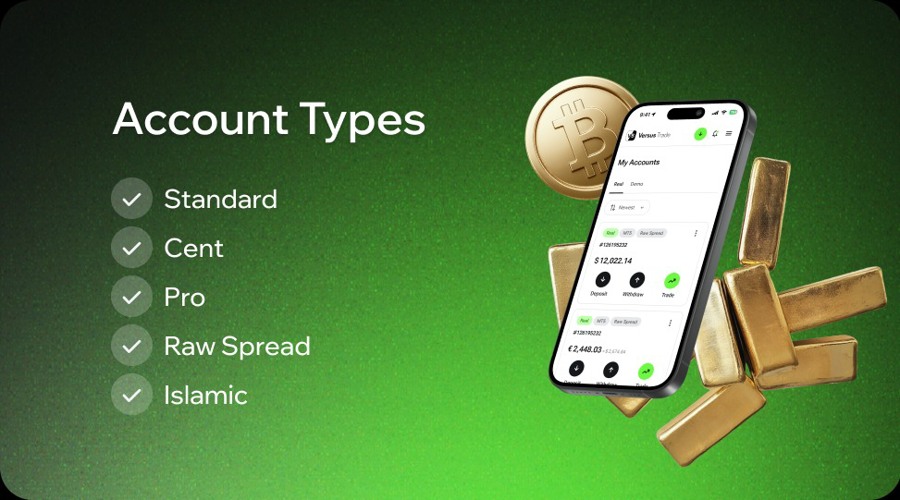
That’s why product segmentation is a core part of how we think about platform design at Versus Trade. Each account type is built around a specific trading behaviour and stage in the trader’s journey.
For beginners, we offer Cent accounts, which are designed specifically for learning and strategy testing. They allow traders to operate with very small position sizes, keeping risk and emotional pressure low while they build confidence. For us, this is a natural and important entry point into the Versus Trade ecosystem.
The Standard account is our classic mass-market product. All trading costs are built directly into the spread, with no separate commissions, which makes the model simple and intuitive. It’s well suited to the majority of retail traders who value clarity and ease of use over complex pricing structures.
For more advanced clients, we provide Raw Spread accounts, which are aimed at professional traders, scalpers, and algorithmic strategies. Here, clients receive interbank-level spreads combined with a transparent commission. For this segment, execution cost and spread accuracy are often decisive factors, and the account is built specifically around those priorities.
At the top end, we offer Pro accounts, designed for traders with larger deposits and professional requirements. In this segment, pricing is important, but so is priority execution, platform stability, and personalized service. These clients expect institutional-grade conditions, and the account structure reflects that expectation.
One of Versus Trade’s key goals is to ensure that clients don’t outgrow the platform as their experience, strategies, and capital develop — instead, the platform grows with them.
4) Swap-free and Islamic accounts are often discussed solely as regional products. How do you see their role today?
For a global broker, swap-free and Islamic accounts are no longer optional. In regions such as MENA and parts of APAC, they are an industry standard.
For Muslim traders, swaps are considered interest, which makes conventional accounts incompatible with Sharia principles. Offering Islamic accounts is therefore not a feature but a requirement if you want to serve those markets properly.
Versus Trade provides fully compliant Islamic accounts as part of its core offering. For us, this is about inclusivity and accessibility. We want traders from different regions and backgrounds to access global markets without compromising their principles or execution quality.
5) Having said that, can zero-swap conditions be relevant for non-Islamic traders as well?
In certain cases, yes. If a broker already has the infrastructure and risk-management framework to support swap-free models, it becomes possible to extend zero-swap conditions beyond Islamic trading — for example, on specific instruments or within tailored account setups.
At Versus Trade, swap-free conditions are available not only through Shariah-compliant Islamic accounts, but also to non-Muslim clients who prefer to eliminate overnight financing charges altogether. This approach reflects how many traders actually operate, particularly those using swing and position strategies.
For these traders, overnight costs can have a meaningful impact on long-term profitability. By offering swap-free levels more broadly, we allow clients to optimise their strategies without being constrained by financing mechanics. From a platform perspective, this flexibility is part of our wider goal: aligning trading conditions with real trading behaviour, rather than forcing everyone into a single cost model.
6) One of the most discussed features at Versus Trade is the 0% stop-out level. Why take that approach?
The stop-out level defines when the platform forcibly closes a trader’s positions. Many brokers set this at 50% or even 100% of margin level. With higher leverage, that often means positions are closed due to short-term market noise rather than a genuine failure of the trading strategy.
At Versus Trade, the stop-out level is set at 0%, and this is a very conscious decision from both a technological and value-based standpoint.
This approach gives traders maximum control over their positions. It allows strategies to withstand deeper drawdowns and play out according to their logic, especially for swing traders, algorithmic strategies, and portfolio-based approaches. We deliberately avoid aggressive, mechanical liquidation rules because we believe the platform should support the trader’s decision-making and not override it prematurely.
Final Thoughts
The modern broker is no longer defined by leverage or spreads alone — rather by infrastructure, flexibility, and execution philosophy.
At Versus Trade, a multi-LP environment with a robust bridge delivers institutional-level execution. A carefully segmented account structure supports traders at every stage of their journey. Flexible swap policies and a 0% stop-out level reflect a platform built around trader control, not platform convenience.
In a market where technology increasingly determines outcomes, Versus Trade’s goal is clear: to ensure that trading strategies are supported by infrastructure — not limited by it.


