
>
BOJ Under the Spotlight: Speculation Surrounds Monetary Policy Changes
Disclaimer
BOJ Under the Spotlight: Speculation Surrounds Monetary Policy Changes
Monday,30/10/2023|13:51GMTby
FM
Disclaimer
What may influence the decisions of the BoJ this week and what do the experts have to say?
The Bank of Japan is due to meet again this week, with the Decision Statement to be released at 3:00 AM GMT on Tuesday along with the Quarterly Outlook Report.
Japan has remained an outlier against its peers in recent times for being the only major central bank that has continued to implement accommodative monetary policies, while other central banks have adopted a more aggressive approach by raising interest rates to curb inflation.
There have, however, been rumblings of impending changes since the value of the yen fell below ¥150 per US dollar once again last week, which raised the possibility of official intervention in the currency market and increased the amount of pressure on the BoJ to make changes to its monetary policy.
Below we’ll take a look at what may influence the decisions of the BoJ this week, and what the experts have to say about it too.
Weighing currency risks
The BoJ is confronted with a challenging policy choice this week, especially since there is a possibility of the yen experiencing more depreciation if the anticipated policy adjustment is not implemented as predicted by some participants in the financial markets.
Nevertheless, its widely anticipated that the current ultralow interest rates and the recently established 1% threshold for 10-year Japanese government bond yields will be upheld this week. Which holds true even in the event that the central bank revises its inflation projections for fiscal years 2023 and 2024, as projected in its forthcoming quarterly outlook report scheduled for release following the meeting.
The BoJ endeavors to maintain low borrowing rates in order to attain stable inflation supported by wage growth. However, there has been a recent upward trend in 10-year yields, approaching 1%, and U.S. Treasury yields have also seen an increase due to the stickiness of inflation.
As a result of the BOJ's divergent easing policy, the Japanese yen has been hovering close to and recently breached the psychological barrier of ¥150 per US dollar. This weakening trend is fueled in part by rising U.S. Treasury yields, and it also keeps financial markets on alert about a potential new round of yen purchases by Japanese authorities.
Within the framework of its yield curve management initiative, the central bank establishes short-term interest rates at a rate of negative 0.1%, while simultaneously guiding 10-year yields to about 0%. However, the BoJ has implemented measures to encourage some flexibility, enabling 10-year rates to more accurately reflect economic fundamentals, provided that the yield stays below 1%.
The central bank made the decision to widen the trading band in July as they recognised the need to confront the reality that the yield cap program was hastening the devaluation of the yen. This was mostly owing to the program's lack of synchronization with the Federal Reserve and the European Central Bank, as well as other international counterparts, who had quickly started a cycle of increasing interest rates.
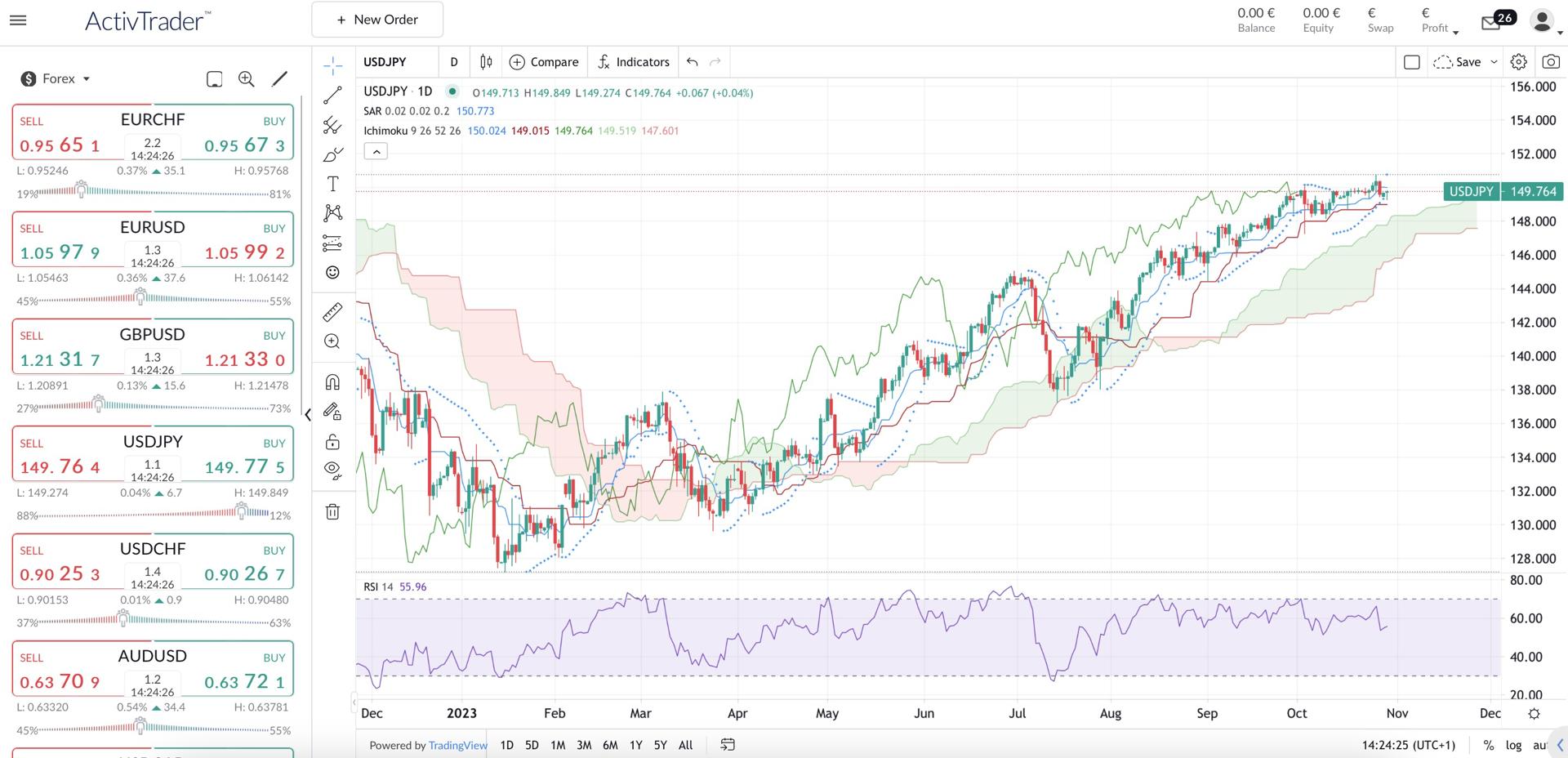
USD/JPY Daily Chart - Source: ActivTrader
Inflation and Employment
In September, the annual inflation rate in Japan saw a small decline to 3.0% from the previous month's figure of 3.2%, indicating the lowest recorded value since September 2022.
The core inflation rate also decreased to its lowest level in 13 months, reaching 2.8%. This figure was slightly higher than the market expected, and it remains well above the BoJ’s 2% target for the 18th consecutive month. On a monthly basis, consumer prices showed an increase of 0.3% in September, after a 0.2% growth seen in August.
The Tokyo Consumer Price Index figure from last Thursday, which was above expectations at 3.3%, is anticipated to serve as a cautionary signal for the BoJ. Even if a policy adjustment isn't implemented at the October meeting, its anticipated that the bank will modify its perspective on inflation.
The BoJ has maintained that rising import costs are the primary driver of price increases across the country and that, in order to prevent the country's economy from plunging back into decades of deflation, it must wait for more consistent wage growth indicators.
Fresh Employment data is due out later today, however, last month the Unemployment Rate in Japan remained constant at 2.7%, against market expectations of 2.6%. While the number of employed rose by 50,000 to 67.50 million, the number of unemployed rose by the same amount, to 1.85 million, maintaining the highest unemployment rate since March this year.
In conclusion
At its previous policy meeting in September, the BoJ indicated it was not seeking to wind down its stimulus program any time soon by maintaining its exceptionally low interest rates, and it reiterated its commitment to aid the economy until inflation consistently reaches its 2% target.
According to a recent poll conducted by Reuters, 25 out of the 28 economists predict that there will be no changes to the existing policies at the next meeting. Nonetheless, around two-thirds anticipate that the bank will terminate its negative interest rate policy during the next year.
The information provided does not constitute investment research. The material has not been prepared in accordance with the legal requirements designed to promote the independence of investment research and as such is to be considered to be a marketing communication.
All information has been prepared by ActivTrades (“AT”). The information does not contain a record of AT’s prices, or an offer of or solicitation for a transaction in any financial instrument. No representation or warranty is given as to the accuracy or completeness of this information.
Any material provided does not have regard to the specific investment objective and financial situation of any person who may receive it. Past performance is not a reliable indicator of future performance. AT provides an execution-only service. Consequently, any person acting on the information provided does so at their own risk.
The Bank of Japan is due to meet again this week, with the Decision Statement to be released at 3:00 AM GMT on Tuesday along with the Quarterly Outlook Report.
Japan has remained an outlier against its peers in recent times for being the only major central bank that has continued to implement accommodative monetary policies, while other central banks have adopted a more aggressive approach by raising interest rates to curb inflation.
There have, however, been rumblings of impending changes since the value of the yen fell below ¥150 per US dollar once again last week, which raised the possibility of official intervention in the currency market and increased the amount of pressure on the BoJ to make changes to its monetary policy.
Below we’ll take a look at what may influence the decisions of the BoJ this week, and what the experts have to say about it too.
Weighing currency risks
The BoJ is confronted with a challenging policy choice this week, especially since there is a possibility of the yen experiencing more depreciation if the anticipated policy adjustment is not implemented as predicted by some participants in the financial markets.
Nevertheless, its widely anticipated that the current ultralow interest rates and the recently established 1% threshold for 10-year Japanese government bond yields will be upheld this week. Which holds true even in the event that the central bank revises its inflation projections for fiscal years 2023 and 2024, as projected in its forthcoming quarterly outlook report scheduled for release following the meeting.
The BoJ endeavors to maintain low borrowing rates in order to attain stable inflation supported by wage growth. However, there has been a recent upward trend in 10-year yields, approaching 1%, and U.S. Treasury yields have also seen an increase due to the stickiness of inflation.
As a result of the BOJ's divergent easing policy, the Japanese yen has been hovering close to and recently breached the psychological barrier of ¥150 per US dollar. This weakening trend is fueled in part by rising U.S. Treasury yields, and it also keeps financial markets on alert about a potential new round of yen purchases by Japanese authorities.
Within the framework of its yield curve management initiative, the central bank establishes short-term interest rates at a rate of negative 0.1%, while simultaneously guiding 10-year yields to about 0%. However, the BoJ has implemented measures to encourage some flexibility, enabling 10-year rates to more accurately reflect economic fundamentals, provided that the yield stays below 1%.
The central bank made the decision to widen the trading band in July as they recognised the need to confront the reality that the yield cap program was hastening the devaluation of the yen. This was mostly owing to the program's lack of synchronization with the Federal Reserve and the European Central Bank, as well as other international counterparts, who had quickly started a cycle of increasing interest rates.
USD/JPY Daily Chart - Source: ActivTrader
Inflation and Employment
In September, the annual inflation rate in Japan saw a small decline to 3.0% from the previous month's figure of 3.2%, indicating the lowest recorded value since September 2022.
The core inflation rate also decreased to its lowest level in 13 months, reaching 2.8%. This figure was slightly higher than the market expected, and it remains well above the BoJ’s 2% target for the 18th consecutive month. On a monthly basis, consumer prices showed an increase of 0.3% in September, after a 0.2% growth seen in August.
The Tokyo Consumer Price Index figure from last Thursday, which was above expectations at 3.3%, is anticipated to serve as a cautionary signal for the BoJ. Even if a policy adjustment isn't implemented at the October meeting, its anticipated that the bank will modify its perspective on inflation.
The BoJ has maintained that rising import costs are the primary driver of price increases across the country and that, in order to prevent the country's economy from plunging back into decades of deflation, it must wait for more consistent wage growth indicators.
Fresh Employment data is due out later today, however, last month the Unemployment Rate in Japan remained constant at 2.7%, against market expectations of 2.6%. While the number of employed rose by 50,000 to 67.50 million, the number of unemployed rose by the same amount, to 1.85 million, maintaining the highest unemployment rate since March this year.
In conclusion
At its previous policy meeting in September, the BoJ indicated it was not seeking to wind down its stimulus program any time soon by maintaining its exceptionally low interest rates, and it reiterated its commitment to aid the economy until inflation consistently reaches its 2% target.
According to a recent poll conducted by Reuters, 25 out of the 28 economists predict that there will be no changes to the existing policies at the next meeting. Nonetheless, around two-thirds anticipate that the bank will terminate its negative interest rate policy during the next year.
The information provided does not constitute investment research. The material has not been prepared in accordance with the legal requirements designed to promote the independence of investment research and as such is to be considered to be a marketing communication.
All information has been prepared by ActivTrades (“AT”). The information does not contain a record of AT’s prices, or an offer of or solicitation for a transaction in any financial instrument. No representation or warranty is given as to the accuracy or completeness of this information.
Any material provided does not have regard to the specific investment objective and financial situation of any person who may receive it. Past performance is not a reliable indicator of future performance. AT provides an execution-only service. Consequently, any person acting on the information provided does so at their own risk.
SMX's 1900% Surge Since November Is Not a Momentum Trade; It's Based on Transformative and Deliverable Techology
Featured Videos
Executive Interview | Charlotte Bullock | Chief Product Officer, Bank of London | FMLS:25
In this interview, we sat down with Charlotte Bullock, Head of Product at The Bank of London, previously at SAP and now shaping product at one of the sector’s most ambitious new banking players.
Charlotte reflects on the Summit so far and talks about the culture inside fintech banks today. We look at the pressures that come with scaling, and how firms can hold onto the nimble approach that made them stand out early on.
We also cover the state of payments ahead of her appearance on the payments roundtable: the blockages financial firms face, the areas that still need fixing, and what a realistic solution looks like in 2026.
In this interview, we sat down with Charlotte Bullock, Head of Product at The Bank of London, previously at SAP and now shaping product at one of the sector’s most ambitious new banking players.
Charlotte reflects on the Summit so far and talks about the culture inside fintech banks today. We look at the pressures that come with scaling, and how firms can hold onto the nimble approach that made them stand out early on.
We also cover the state of payments ahead of her appearance on the payments roundtable: the blockages financial firms face, the areas that still need fixing, and what a realistic solution looks like in 2026.
In this interview, we sat down with Charlotte Bullock, Head of Product at The Bank of London, previously at SAP and now shaping product at one of the sector’s most ambitious new banking players.
Charlotte reflects on the Summit so far and talks about the culture inside fintech banks today. We look at the pressures that come with scaling, and how firms can hold onto the nimble approach that made them stand out early on.
We also cover the state of payments ahead of her appearance on the payments roundtable: the blockages financial firms face, the areas that still need fixing, and what a realistic solution looks like in 2026.
In this interview, we sat down with Charlotte Bullock, Head of Product at The Bank of London, previously at SAP and now shaping product at one of the sector’s most ambitious new banking players.
Charlotte reflects on the Summit so far and talks about the culture inside fintech banks today. We look at the pressures that come with scaling, and how firms can hold onto the nimble approach that made them stand out early on.
We also cover the state of payments ahead of her appearance on the payments roundtable: the blockages financial firms face, the areas that still need fixing, and what a realistic solution looks like in 2026.
In this conversation, we sit down with Drew Niv, CSO at ATFX Connect and one of the most influential figures in modern FX.
We speak about market structure, the institutional view on liquidity, and the sharp rise of prop trading, a sector Drew has been commenting on in recent months. Drew explains why he once dismissed prop trading, why his view changed, and what he now thinks the model means for brokers, clients and risk managers.
We explore subscription-fee dependency, the high reneging rate, and the long-term challenge: how brokers can build a more stable and honest version of the model. Drew also talks about the traffic advantage standalone prop firms have built and why brokers may still win in the long run if they take the right approach.
In this conversation, we sit down with Drew Niv, CSO at ATFX Connect and one of the most influential figures in modern FX.
We speak about market structure, the institutional view on liquidity, and the sharp rise of prop trading, a sector Drew has been commenting on in recent months. Drew explains why he once dismissed prop trading, why his view changed, and what he now thinks the model means for brokers, clients and risk managers.
We explore subscription-fee dependency, the high reneging rate, and the long-term challenge: how brokers can build a more stable and honest version of the model. Drew also talks about the traffic advantage standalone prop firms have built and why brokers may still win in the long run if they take the right approach.
In this conversation, we sit down with Drew Niv, CSO at ATFX Connect and one of the most influential figures in modern FX.
We speak about market structure, the institutional view on liquidity, and the sharp rise of prop trading, a sector Drew has been commenting on in recent months. Drew explains why he once dismissed prop trading, why his view changed, and what he now thinks the model means for brokers, clients and risk managers.
We explore subscription-fee dependency, the high reneging rate, and the long-term challenge: how brokers can build a more stable and honest version of the model. Drew also talks about the traffic advantage standalone prop firms have built and why brokers may still win in the long run if they take the right approach.
In this conversation, we sit down with Drew Niv, CSO at ATFX Connect and one of the most influential figures in modern FX.
We speak about market structure, the institutional view on liquidity, and the sharp rise of prop trading, a sector Drew has been commenting on in recent months. Drew explains why he once dismissed prop trading, why his view changed, and what he now thinks the model means for brokers, clients and risk managers.
We explore subscription-fee dependency, the high reneging rate, and the long-term challenge: how brokers can build a more stable and honest version of the model. Drew also talks about the traffic advantage standalone prop firms have built and why brokers may still win in the long run if they take the right approach.
In this conversation, we sit down with Drew Niv, CSO at ATFX Connect and one of the most influential figures in modern FX.
We speak about market structure, the institutional view on liquidity, and the sharp rise of prop trading, a sector Drew has been commenting on in recent months. Drew explains why he once dismissed prop trading, why his view changed, and what he now thinks the model means for brokers, clients and risk managers.
We explore subscription-fee dependency, the high reneging rate, and the long-term challenge: how brokers can build a more stable and honest version of the model. Drew also talks about the traffic advantage standalone prop firms have built and why brokers may still win in the long run if they take the right approach.
In this conversation, we sit down with Drew Niv, CSO at ATFX Connect and one of the most influential figures in modern FX.
We speak about market structure, the institutional view on liquidity, and the sharp rise of prop trading, a sector Drew has been commenting on in recent months. Drew explains why he once dismissed prop trading, why his view changed, and what he now thinks the model means for brokers, clients and risk managers.
We explore subscription-fee dependency, the high reneging rate, and the long-term challenge: how brokers can build a more stable and honest version of the model. Drew also talks about the traffic advantage standalone prop firms have built and why brokers may still win in the long run if they take the right approach.
Executive Interview | Remonda Z. Kirketerp Møller| CEO & Founder Muinmos | FMLS:25
In this interview, Remonda Z. Kirketerp Møller, founder of Muinmos, breaks down the state of AI in regtech and what responsible adoption really looks like for brokers. We talk about rising fragmentation, the pressures around compliance accuracy, and why most firms are still in the early stages of AI maturity.
Ramanda also shares insights on regulator sandboxes, shifting expectations around accountability, and the current reality of MiCA licensing and passporting in Europe.
A concise look at where compliance, onboarding, and AI-driven processes are heading next.
In this interview, Remonda Z. Kirketerp Møller, founder of Muinmos, breaks down the state of AI in regtech and what responsible adoption really looks like for brokers. We talk about rising fragmentation, the pressures around compliance accuracy, and why most firms are still in the early stages of AI maturity.
Ramanda also shares insights on regulator sandboxes, shifting expectations around accountability, and the current reality of MiCA licensing and passporting in Europe.
A concise look at where compliance, onboarding, and AI-driven processes are heading next.
In this interview, Remonda Z. Kirketerp Møller, founder of Muinmos, breaks down the state of AI in regtech and what responsible adoption really looks like for brokers. We talk about rising fragmentation, the pressures around compliance accuracy, and why most firms are still in the early stages of AI maturity.
Ramanda also shares insights on regulator sandboxes, shifting expectations around accountability, and the current reality of MiCA licensing and passporting in Europe.
A concise look at where compliance, onboarding, and AI-driven processes are heading next.
In this interview, Remonda Z. Kirketerp Møller, founder of Muinmos, breaks down the state of AI in regtech and what responsible adoption really looks like for brokers. We talk about rising fragmentation, the pressures around compliance accuracy, and why most firms are still in the early stages of AI maturity.
Ramanda also shares insights on regulator sandboxes, shifting expectations around accountability, and the current reality of MiCA licensing and passporting in Europe.
A concise look at where compliance, onboarding, and AI-driven processes are heading next.
In this interview, Remonda Z. Kirketerp Møller, founder of Muinmos, breaks down the state of AI in regtech and what responsible adoption really looks like for brokers. We talk about rising fragmentation, the pressures around compliance accuracy, and why most firms are still in the early stages of AI maturity.
Ramanda also shares insights on regulator sandboxes, shifting expectations around accountability, and the current reality of MiCA licensing and passporting in Europe.
A concise look at where compliance, onboarding, and AI-driven processes are heading next.
In this interview, Remonda Z. Kirketerp Møller, founder of Muinmos, breaks down the state of AI in regtech and what responsible adoption really looks like for brokers. We talk about rising fragmentation, the pressures around compliance accuracy, and why most firms are still in the early stages of AI maturity.
Ramanda also shares insights on regulator sandboxes, shifting expectations around accountability, and the current reality of MiCA licensing and passporting in Europe.
A concise look at where compliance, onboarding, and AI-driven processes are heading next.
In this conversation, we speak with Aydin Bonabi, CEO and co-founder of Surveill, a firm focused on fraud detection and AI-driven compliance tools for financial institutions.
We start with Aydin’s view of the Summit and the challenges brokers face as fraud tactics grow more complex. He explains how firms can stay ahead through real-time signals, data patterns, and early-stage detection.
We also talk about AI training and why compliance teams often struggle to keep models accurate, fair, and aligned with regulatory expectations. Aydin breaks down what “good” AI training looks like inside a financial environment, including the importance of clean data, domain expertise, and human oversight.
He closes with a clear message: fraud is scaling, and so must the tools that stop it.
In this conversation, we speak with Aydin Bonabi, CEO and co-founder of Surveill, a firm focused on fraud detection and AI-driven compliance tools for financial institutions.
We start with Aydin’s view of the Summit and the challenges brokers face as fraud tactics grow more complex. He explains how firms can stay ahead through real-time signals, data patterns, and early-stage detection.
We also talk about AI training and why compliance teams often struggle to keep models accurate, fair, and aligned with regulatory expectations. Aydin breaks down what “good” AI training looks like inside a financial environment, including the importance of clean data, domain expertise, and human oversight.
He closes with a clear message: fraud is scaling, and so must the tools that stop it.
In this conversation, we speak with Aydin Bonabi, CEO and co-founder of Surveill, a firm focused on fraud detection and AI-driven compliance tools for financial institutions.
We start with Aydin’s view of the Summit and the challenges brokers face as fraud tactics grow more complex. He explains how firms can stay ahead through real-time signals, data patterns, and early-stage detection.
We also talk about AI training and why compliance teams often struggle to keep models accurate, fair, and aligned with regulatory expectations. Aydin breaks down what “good” AI training looks like inside a financial environment, including the importance of clean data, domain expertise, and human oversight.
He closes with a clear message: fraud is scaling, and so must the tools that stop it.
In this conversation, we speak with Aydin Bonabi, CEO and co-founder of Surveill, a firm focused on fraud detection and AI-driven compliance tools for financial institutions.
We start with Aydin’s view of the Summit and the challenges brokers face as fraud tactics grow more complex. He explains how firms can stay ahead through real-time signals, data patterns, and early-stage detection.
We also talk about AI training and why compliance teams often struggle to keep models accurate, fair, and aligned with regulatory expectations. Aydin breaks down what “good” AI training looks like inside a financial environment, including the importance of clean data, domain expertise, and human oversight.
He closes with a clear message: fraud is scaling, and so must the tools that stop it.
In this conversation, we speak with Aydin Bonabi, CEO and co-founder of Surveill, a firm focused on fraud detection and AI-driven compliance tools for financial institutions.
We start with Aydin’s view of the Summit and the challenges brokers face as fraud tactics grow more complex. He explains how firms can stay ahead through real-time signals, data patterns, and early-stage detection.
We also talk about AI training and why compliance teams often struggle to keep models accurate, fair, and aligned with regulatory expectations. Aydin breaks down what “good” AI training looks like inside a financial environment, including the importance of clean data, domain expertise, and human oversight.
He closes with a clear message: fraud is scaling, and so must the tools that stop it.
In this conversation, we speak with Aydin Bonabi, CEO and co-founder of Surveill, a firm focused on fraud detection and AI-driven compliance tools for financial institutions.
We start with Aydin’s view of the Summit and the challenges brokers face as fraud tactics grow more complex. He explains how firms can stay ahead through real-time signals, data patterns, and early-stage detection.
We also talk about AI training and why compliance teams often struggle to keep models accurate, fair, and aligned with regulatory expectations. Aydin breaks down what “good” AI training looks like inside a financial environment, including the importance of clean data, domain expertise, and human oversight.
He closes with a clear message: fraud is scaling, and so must the tools that stop it.
Exness expands its presence in Africa: Inside our interview with Paul Margarites in Cape Town
Finance Magnates met with Paul Margarites, Exness regional commercial director for Sub-Saharan Africa, during a visit to the firm’s office opening in Cape Town. In this talk, led by Andrea Badiola Mateos, Co-CEO at Finance Magnates, Paul shares views on the South African trading space, local user behavior, mobile trends, regulation, team growth, and how Exness plans to grow in more markets across the region. @Exness
Read the article at: https://www.financemagnates.com/thought-leadership/exness-expands-its-presence-in-africa-inside-our-interview-with-paul-margarites/
#exness #financemagnates #exnesstrading #CFDtrading #tradeonline #africanews #capetown
Finance Magnates met with Paul Margarites, Exness regional commercial director for Sub-Saharan Africa, during a visit to the firm’s office opening in Cape Town. In this talk, led by Andrea Badiola Mateos, Co-CEO at Finance Magnates, Paul shares views on the South African trading space, local user behavior, mobile trends, regulation, team growth, and how Exness plans to grow in more markets across the region. @Exness
Read the article at: https://www.financemagnates.com/thought-leadership/exness-expands-its-presence-in-africa-inside-our-interview-with-paul-margarites/
#exness #financemagnates #exnesstrading #CFDtrading #tradeonline #africanews #capetown
Finance Magnates met with Paul Margarites, Exness regional commercial director for Sub-Saharan Africa, during a visit to the firm’s office opening in Cape Town. In this talk, led by Andrea Badiola Mateos, Co-CEO at Finance Magnates, Paul shares views on the South African trading space, local user behavior, mobile trends, regulation, team growth, and how Exness plans to grow in more markets across the region. @Exness
Read the article at: https://www.financemagnates.com/thought-leadership/exness-expands-its-presence-in-africa-inside-our-interview-with-paul-margarites/
#exness #financemagnates #exnesstrading #CFDtrading #tradeonline #africanews #capetown
Finance Magnates met with Paul Margarites, Exness regional commercial director for Sub-Saharan Africa, during a visit to the firm’s office opening in Cape Town. In this talk, led by Andrea Badiola Mateos, Co-CEO at Finance Magnates, Paul shares views on the South African trading space, local user behavior, mobile trends, regulation, team growth, and how Exness plans to grow in more markets across the region. @Exness
Read the article at: https://www.financemagnates.com/thought-leadership/exness-expands-its-presence-in-africa-inside-our-interview-with-paul-margarites/
#exness #financemagnates #exnesstrading #CFDtrading #tradeonline #africanews #capetown
Finance Magnates met with Paul Margarites, Exness regional commercial director for Sub-Saharan Africa, during a visit to the firm’s office opening in Cape Town. In this talk, led by Andrea Badiola Mateos, Co-CEO at Finance Magnates, Paul shares views on the South African trading space, local user behavior, mobile trends, regulation, team growth, and how Exness plans to grow in more markets across the region. @Exness
Read the article at: https://www.financemagnates.com/thought-leadership/exness-expands-its-presence-in-africa-inside-our-interview-with-paul-margarites/
#exness #financemagnates #exnesstrading #CFDtrading #tradeonline #africanews #capetown
Finance Magnates met with Paul Margarites, Exness regional commercial director for Sub-Saharan Africa, during a visit to the firm’s office opening in Cape Town. In this talk, led by Andrea Badiola Mateos, Co-CEO at Finance Magnates, Paul shares views on the South African trading space, local user behavior, mobile trends, regulation, team growth, and how Exness plans to grow in more markets across the region. @Exness
Read the article at: https://www.financemagnates.com/thought-leadership/exness-expands-its-presence-in-africa-inside-our-interview-with-paul-margarites/
#exness #financemagnates #exnesstrading #CFDtrading #tradeonline #africanews #capetown