TipRanks shared exclusive data with Finance Magnates, revealing crypto investment trends.
The total number of users holding cryptocurrencies in portfolios jumped 2.6 percent.
FM
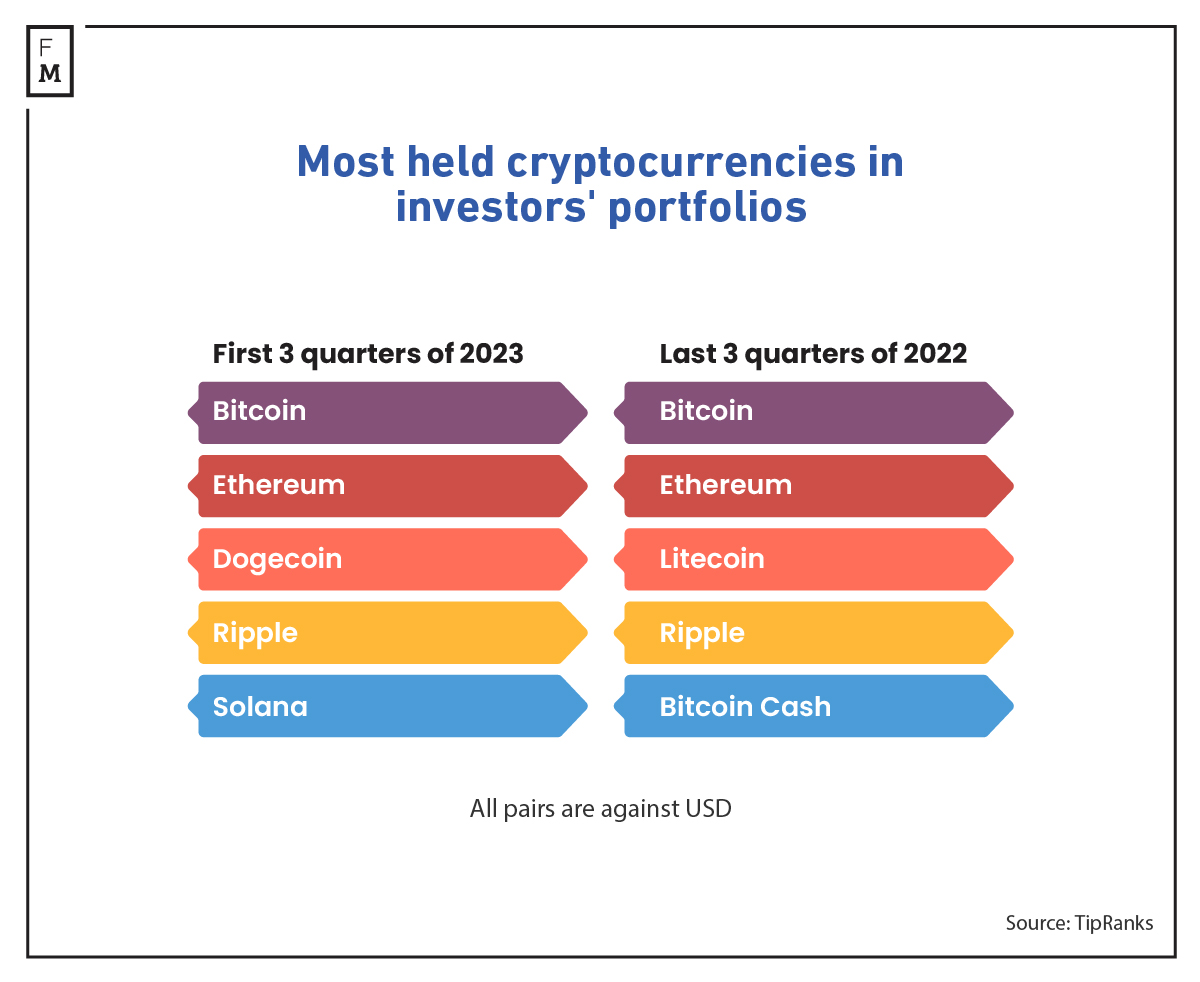
Despite being based on an internet meme, Dogecoin was the third-largest crypto in the portfolio of inventors, according to the exclusive data from TipRanks shared with Finance Magnates. Bitcoin topped the list, followed by Ethereum, the second-largest cryptocurrency in market capitalization.
While DOGE managed to be in the top three cryptocurrencies in investors' portfolios in the first three quarters of 2023, it was not even in the top five in the last three quarters of 2022.
The Dominance of Meme Coins
Meme coins like DOGE always had a cult-like following. Billionaire entrepreneur Elon Musk also endorsed Doge on multiple occasions and even briefly changed the logo of X (previously Twitter) to the dog face of Doge. Musk's tweets even make Doge swing in double digits.
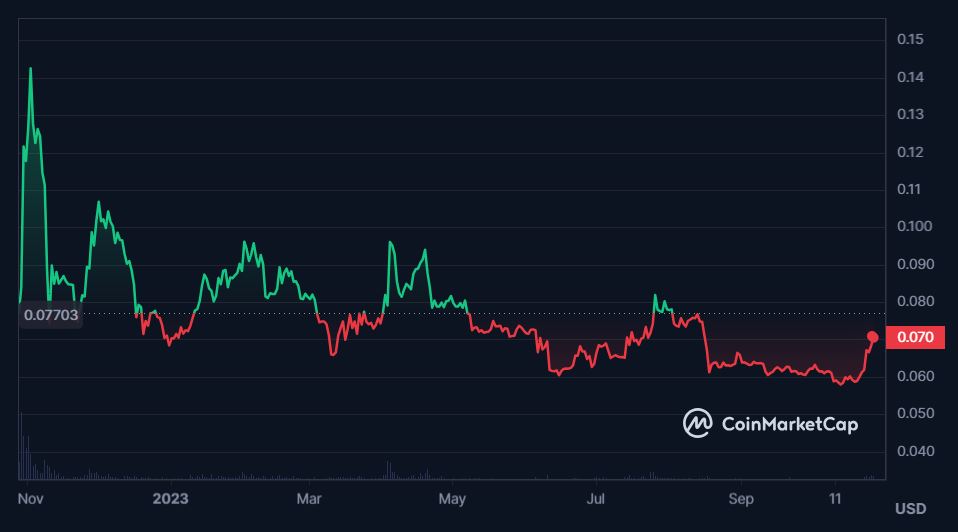
The value of DOGE peaked in May 2021, reaching nearly $0.57. However, the value has plummeted significantly since then, as Dodge is currently trading at $0.071, about 87.5 percent below the peak. Although Doge remained volatile in 2023, its value did not change much over the past ten months but rallied 20 percent in the past week.
Apart from DOGE, the names of Ripple appeared in the list of top five crypto holdings.
Price movement of Dogecoin in 2023, Source: Coinmarketcap.com
Robbie Dayan, Head of Product at TipRanks
"Many market factors influence traders' decisions when it comes to investing in or avoiding cryptocurrency," Robbie Dayan, the Head of Product at TipRanks, told Finance Magnates. "Factors like high volatility can be enticing to some traders seeking short-term gains while discouraging those with a more conservative approach."
Rise in Crypto Holders
The data from TipRanks revealed that From January 1, 2023, until October 25, 2023, 1,183 unique users held cryptocurrencies in their portfolios. With this addition, the total number of users holding cryptocurrencies jumped 2.6 percent to 45,218. The numbers of users holding cryptos in the first three quarters of the ongoing year is 1,080, a significant jump from only 95 in the last three quarters of 2022.
TipRanks provides data and research tools to retail traders. It has partnered with dozens of brokers and trading platforms, taking its services to even more traders. Most recently, the company launched an Expert Advisory plugin for MetaTrader 5, which CFI has first incorporated. The cryptocurrency portfolio data were collected from the individual investors who use TipRanks' smart portfolio to record their holdings.
The data shared with Finance Magnates revealed that 4,298 users added crypto shares to their portfolios. Additionally, there are 2,816 users with open positions. However, 1,352 users had their shares in cryptocurrencies reduced, and 93 closed positions.
In the first three quarters of 2023, 34.8 percent of all transaction were buying crypto, while only 6.9 percent accounted for sale. In the last three quarters of 2022, these two figures were at 41.1 percent and 6.5 percent, respectively.
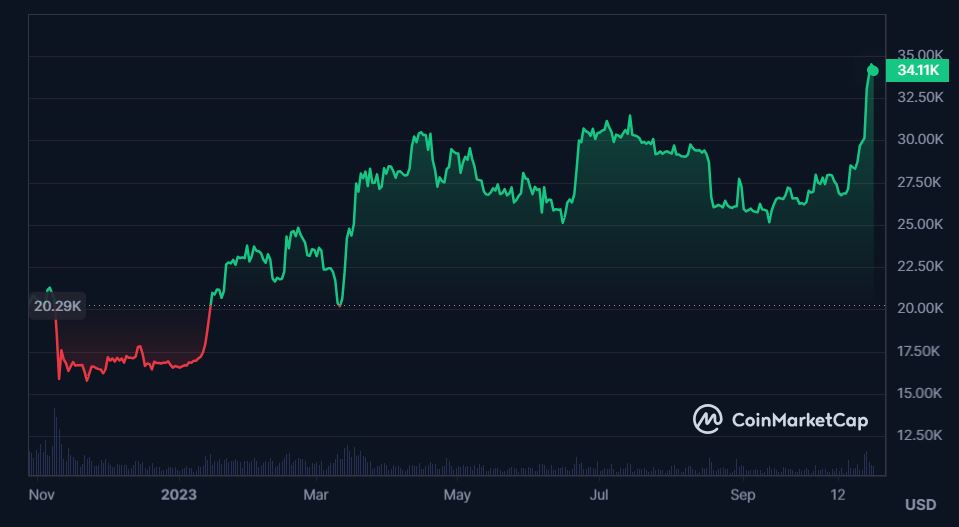
The growing demand for cryptocurrencies can be determined by the significant jump in Bitcoin and other cryptocurrency prices since the beginning of this year. The dollar value of Bitcoin has doubled since the beginning of 2023, when it bottomed out at $16,500. With the recent rally in the crypto market, BTC is trading at more than $34,100 as of press time.
Price movement of Bitcoin in 2023, Source: Coinmarketcap.com
"One primary factor that has kept traders engaged in crypto trading since its inception is the potential for high returns. Bitcoin and Ethereum returns over the years still attract traders who harbor an innate desire to earn more money or even become wealthy," Dayan added. "Conversely, the main factor that drives traders away from crypto is FUD — fear, uncertainty, and doubt... Another Factor is the Halving Cycle, an event where the miners receive half the rewards for validating and adding transactions to the blockchain."
Many factors are influencing the recent crypto rally. One of the most prominent ones is the anticipation of US regulatory approval for a Bitcoin exchange-traded fund (ETF). Although the Securities and Exchange Commission delayed the approval for years, some unofficial indications brought optimism to the market.
"I'm very optimistic about the prospects of crypto for the next two years, especially as we approach the Bitcoin halving event. I firmly believe that we will witness the approval of a Bitcoin spot ETF in the coming months, attracting a substantial influx of new traders into the world of Bitcoin," said Dayan.
"Additionally, traders and investors will likely explore other investment alternatives such as gold and Bitcoin as hedges against global inflation. Finally, if interest rates decrease in 2024 or possibly even in 2025, it will push Bitcoin's price with further upward momentum."
Despite being based on an internet meme, Dogecoin was the third-largest crypto in the portfolio of inventors, according to the exclusive data from TipRanks shared with Finance Magnates. Bitcoin topped the list, followed by Ethereum, the second-largest cryptocurrency in market capitalization.
While DOGE managed to be in the top three cryptocurrencies in investors' portfolios in the first three quarters of 2023, it was not even in the top five in the last three quarters of 2022.
The Dominance of Meme Coins
Meme coins like DOGE always had a cult-like following. Billionaire entrepreneur Elon Musk also endorsed Doge on multiple occasions and even briefly changed the logo of X (previously Twitter) to the dog face of Doge. Musk's tweets even make Doge swing in double digits.
The value of DOGE peaked in May 2021, reaching nearly $0.57. However, the value has plummeted significantly since then, as Dodge is currently trading at $0.071, about 87.5 percent below the peak. Although Doge remained volatile in 2023, its value did not change much over the past ten months but rallied 20 percent in the past week.
Apart from DOGE, the names of Ripple appeared in the list of top five crypto holdings.
Price movement of Dogecoin in 2023, Source: Coinmarketcap.com
Robbie Dayan, Head of Product at TipRanks
"Many market factors influence traders' decisions when it comes to investing in or avoiding cryptocurrency," Robbie Dayan, the Head of Product at TipRanks, told Finance Magnates. "Factors like high volatility can be enticing to some traders seeking short-term gains while discouraging those with a more conservative approach."
Rise in Crypto Holders
The data from TipRanks revealed that From January 1, 2023, until October 25, 2023, 1,183 unique users held cryptocurrencies in their portfolios. With this addition, the total number of users holding cryptocurrencies jumped 2.6 percent to 45,218. The numbers of users holding cryptos in the first three quarters of the ongoing year is 1,080, a significant jump from only 95 in the last three quarters of 2022.
TipRanks provides data and research tools to retail traders. It has partnered with dozens of brokers and trading platforms, taking its services to even more traders. Most recently, the company launched an Expert Advisory plugin for MetaTrader 5, which CFI has first incorporated. The cryptocurrency portfolio data were collected from the individual investors who use TipRanks' smart portfolio to record their holdings.
The data shared with Finance Magnates revealed that 4,298 users added crypto shares to their portfolios. Additionally, there are 2,816 users with open positions. However, 1,352 users had their shares in cryptocurrencies reduced, and 93 closed positions.
In the first three quarters of 2023, 34.8 percent of all transaction were buying crypto, while only 6.9 percent accounted for sale. In the last three quarters of 2022, these two figures were at 41.1 percent and 6.5 percent, respectively.
The growing demand for cryptocurrencies can be determined by the significant jump in Bitcoin and other cryptocurrency prices since the beginning of this year. The dollar value of Bitcoin has doubled since the beginning of 2023, when it bottomed out at $16,500. With the recent rally in the crypto market, BTC is trading at more than $34,100 as of press time.
Price movement of Bitcoin in 2023, Source: Coinmarketcap.com
"One primary factor that has kept traders engaged in crypto trading since its inception is the potential for high returns. Bitcoin and Ethereum returns over the years still attract traders who harbor an innate desire to earn more money or even become wealthy," Dayan added. "Conversely, the main factor that drives traders away from crypto is FUD — fear, uncertainty, and doubt... Another Factor is the Halving Cycle, an event where the miners receive half the rewards for validating and adding transactions to the blockchain."
Many factors are influencing the recent crypto rally. One of the most prominent ones is the anticipation of US regulatory approval for a Bitcoin exchange-traded fund (ETF). Although the Securities and Exchange Commission delayed the approval for years, some unofficial indications brought optimism to the market.
"I'm very optimistic about the prospects of crypto for the next two years, especially as we approach the Bitcoin halving event. I firmly believe that we will witness the approval of a Bitcoin spot ETF in the coming months, attracting a substantial influx of new traders into the world of Bitcoin," said Dayan.
"Additionally, traders and investors will likely explore other investment alternatives such as gold and Bitcoin as hedges against global inflation. Finally, if interest rates decrease in 2024 or possibly even in 2025, it will push Bitcoin's price with further upward momentum."
Arnab is an electronics engineer-turned-financial editor. He entered the industry covering the cryptocurrency market for Finance Magnates and later expanded his reach to forex as well. He is passionate about the changing regulatory landscape on financial markets and keenly follows the disruptions in the industry with new-age technologies.
In this conversation, we sit down with Drew Niv, CSO at ATFX Connect and one of the most influential figures in modern FX.
We speak about market structure, the institutional view on liquidity, and the sharp rise of prop trading, a sector Drew has been commenting on in recent months. Drew explains why he once dismissed prop trading, why his view changed, and what he now thinks the model means for brokers, clients and risk managers.
We explore subscription-fee dependency, the high reneging rate, and the long-term challenge: how brokers can build a more stable and honest version of the model. Drew also talks about the traffic advantage standalone prop firms have built and why brokers may still win in the long run if they take the right approach.
In this conversation, we sit down with Drew Niv, CSO at ATFX Connect and one of the most influential figures in modern FX.
We speak about market structure, the institutional view on liquidity, and the sharp rise of prop trading, a sector Drew has been commenting on in recent months. Drew explains why he once dismissed prop trading, why his view changed, and what he now thinks the model means for brokers, clients and risk managers.
We explore subscription-fee dependency, the high reneging rate, and the long-term challenge: how brokers can build a more stable and honest version of the model. Drew also talks about the traffic advantage standalone prop firms have built and why brokers may still win in the long run if they take the right approach.
In this conversation, we sit down with Drew Niv, CSO at ATFX Connect and one of the most influential figures in modern FX.
We speak about market structure, the institutional view on liquidity, and the sharp rise of prop trading, a sector Drew has been commenting on in recent months. Drew explains why he once dismissed prop trading, why his view changed, and what he now thinks the model means for brokers, clients and risk managers.
We explore subscription-fee dependency, the high reneging rate, and the long-term challenge: how brokers can build a more stable and honest version of the model. Drew also talks about the traffic advantage standalone prop firms have built and why brokers may still win in the long run if they take the right approach.
In this conversation, we sit down with Drew Niv, CSO at ATFX Connect and one of the most influential figures in modern FX.
We speak about market structure, the institutional view on liquidity, and the sharp rise of prop trading, a sector Drew has been commenting on in recent months. Drew explains why he once dismissed prop trading, why his view changed, and what he now thinks the model means for brokers, clients and risk managers.
We explore subscription-fee dependency, the high reneging rate, and the long-term challenge: how brokers can build a more stable and honest version of the model. Drew also talks about the traffic advantage standalone prop firms have built and why brokers may still win in the long run if they take the right approach.
Executive Interview | Remonda Z. Kirketerp Møller| CEO & Founder Muinmos | FMLS:25
In this interview, Remonda Z. Kirketerp Møller, founder of Muinmos, breaks down the state of AI in regtech and what responsible adoption really looks like for brokers. We talk about rising fragmentation, the pressures around compliance accuracy, and why most firms are still in the early stages of AI maturity.
Ramanda also shares insights on regulator sandboxes, shifting expectations around accountability, and the current reality of MiCA licensing and passporting in Europe.
A concise look at where compliance, onboarding, and AI-driven processes are heading next.
In this interview, Remonda Z. Kirketerp Møller, founder of Muinmos, breaks down the state of AI in regtech and what responsible adoption really looks like for brokers. We talk about rising fragmentation, the pressures around compliance accuracy, and why most firms are still in the early stages of AI maturity.
Ramanda also shares insights on regulator sandboxes, shifting expectations around accountability, and the current reality of MiCA licensing and passporting in Europe.
A concise look at where compliance, onboarding, and AI-driven processes are heading next.
In this interview, Remonda Z. Kirketerp Møller, founder of Muinmos, breaks down the state of AI in regtech and what responsible adoption really looks like for brokers. We talk about rising fragmentation, the pressures around compliance accuracy, and why most firms are still in the early stages of AI maturity.
Ramanda also shares insights on regulator sandboxes, shifting expectations around accountability, and the current reality of MiCA licensing and passporting in Europe.
A concise look at where compliance, onboarding, and AI-driven processes are heading next.
In this interview, Remonda Z. Kirketerp Møller, founder of Muinmos, breaks down the state of AI in regtech and what responsible adoption really looks like for brokers. We talk about rising fragmentation, the pressures around compliance accuracy, and why most firms are still in the early stages of AI maturity.
Ramanda also shares insights on regulator sandboxes, shifting expectations around accountability, and the current reality of MiCA licensing and passporting in Europe.
A concise look at where compliance, onboarding, and AI-driven processes are heading next.
In this interview, Remonda Z. Kirketerp Møller, founder of Muinmos, breaks down the state of AI in regtech and what responsible adoption really looks like for brokers. We talk about rising fragmentation, the pressures around compliance accuracy, and why most firms are still in the early stages of AI maturity.
Ramanda also shares insights on regulator sandboxes, shifting expectations around accountability, and the current reality of MiCA licensing and passporting in Europe.
A concise look at where compliance, onboarding, and AI-driven processes are heading next.
In this interview, Remonda Z. Kirketerp Møller, founder of Muinmos, breaks down the state of AI in regtech and what responsible adoption really looks like for brokers. We talk about rising fragmentation, the pressures around compliance accuracy, and why most firms are still in the early stages of AI maturity.
Ramanda also shares insights on regulator sandboxes, shifting expectations around accountability, and the current reality of MiCA licensing and passporting in Europe.
A concise look at where compliance, onboarding, and AI-driven processes are heading next.
In this conversation, we speak with Aydin Bonabi, CEO and co-founder of Surveill, a firm focused on fraud detection and AI-driven compliance tools for financial institutions.
We start with Aydin’s view of the Summit and the challenges brokers face as fraud tactics grow more complex. He explains how firms can stay ahead through real-time signals, data patterns, and early-stage detection.
We also talk about AI training and why compliance teams often struggle to keep models accurate, fair, and aligned with regulatory expectations. Aydin breaks down what “good” AI training looks like inside a financial environment, including the importance of clean data, domain expertise, and human oversight.
He closes with a clear message: fraud is scaling, and so must the tools that stop it.
In this conversation, we speak with Aydin Bonabi, CEO and co-founder of Surveill, a firm focused on fraud detection and AI-driven compliance tools for financial institutions.
We start with Aydin’s view of the Summit and the challenges brokers face as fraud tactics grow more complex. He explains how firms can stay ahead through real-time signals, data patterns, and early-stage detection.
We also talk about AI training and why compliance teams often struggle to keep models accurate, fair, and aligned with regulatory expectations. Aydin breaks down what “good” AI training looks like inside a financial environment, including the importance of clean data, domain expertise, and human oversight.
He closes with a clear message: fraud is scaling, and so must the tools that stop it.
In this conversation, we speak with Aydin Bonabi, CEO and co-founder of Surveill, a firm focused on fraud detection and AI-driven compliance tools for financial institutions.
We start with Aydin’s view of the Summit and the challenges brokers face as fraud tactics grow more complex. He explains how firms can stay ahead through real-time signals, data patterns, and early-stage detection.
We also talk about AI training and why compliance teams often struggle to keep models accurate, fair, and aligned with regulatory expectations. Aydin breaks down what “good” AI training looks like inside a financial environment, including the importance of clean data, domain expertise, and human oversight.
He closes with a clear message: fraud is scaling, and so must the tools that stop it.
In this conversation, we speak with Aydin Bonabi, CEO and co-founder of Surveill, a firm focused on fraud detection and AI-driven compliance tools for financial institutions.
We start with Aydin’s view of the Summit and the challenges brokers face as fraud tactics grow more complex. He explains how firms can stay ahead through real-time signals, data patterns, and early-stage detection.
We also talk about AI training and why compliance teams often struggle to keep models accurate, fair, and aligned with regulatory expectations. Aydin breaks down what “good” AI training looks like inside a financial environment, including the importance of clean data, domain expertise, and human oversight.
He closes with a clear message: fraud is scaling, and so must the tools that stop it.
In this conversation, we speak with Aydin Bonabi, CEO and co-founder of Surveill, a firm focused on fraud detection and AI-driven compliance tools for financial institutions.
We start with Aydin’s view of the Summit and the challenges brokers face as fraud tactics grow more complex. He explains how firms can stay ahead through real-time signals, data patterns, and early-stage detection.
We also talk about AI training and why compliance teams often struggle to keep models accurate, fair, and aligned with regulatory expectations. Aydin breaks down what “good” AI training looks like inside a financial environment, including the importance of clean data, domain expertise, and human oversight.
He closes with a clear message: fraud is scaling, and so must the tools that stop it.
In this conversation, we speak with Aydin Bonabi, CEO and co-founder of Surveill, a firm focused on fraud detection and AI-driven compliance tools for financial institutions.
We start with Aydin’s view of the Summit and the challenges brokers face as fraud tactics grow more complex. He explains how firms can stay ahead through real-time signals, data patterns, and early-stage detection.
We also talk about AI training and why compliance teams often struggle to keep models accurate, fair, and aligned with regulatory expectations. Aydin breaks down what “good” AI training looks like inside a financial environment, including the importance of clean data, domain expertise, and human oversight.
He closes with a clear message: fraud is scaling, and so must the tools that stop it.
Exness expands its presence in Africa: Inside our interview with Paul Margarites in Cape Town
Finance Magnates met with Paul Margarites, Exness regional commercial director for Sub-Saharan Africa, during a visit to the firm’s office opening in Cape Town. In this talk, led by Andrea Badiola Mateos, Co-CEO at Finance Magnates, Paul shares views on the South African trading space, local user behavior, mobile trends, regulation, team growth, and how Exness plans to grow in more markets across the region. @Exness
Read the article at: https://www.financemagnates.com/thought-leadership/exness-expands-its-presence-in-africa-inside-our-interview-with-paul-margarites/
#exness #financemagnates #exnesstrading #CFDtrading #tradeonline #africanews #capetown
Finance Magnates met with Paul Margarites, Exness regional commercial director for Sub-Saharan Africa, during a visit to the firm’s office opening in Cape Town. In this talk, led by Andrea Badiola Mateos, Co-CEO at Finance Magnates, Paul shares views on the South African trading space, local user behavior, mobile trends, regulation, team growth, and how Exness plans to grow in more markets across the region. @Exness
Read the article at: https://www.financemagnates.com/thought-leadership/exness-expands-its-presence-in-africa-inside-our-interview-with-paul-margarites/
#exness #financemagnates #exnesstrading #CFDtrading #tradeonline #africanews #capetown
Finance Magnates met with Paul Margarites, Exness regional commercial director for Sub-Saharan Africa, during a visit to the firm’s office opening in Cape Town. In this talk, led by Andrea Badiola Mateos, Co-CEO at Finance Magnates, Paul shares views on the South African trading space, local user behavior, mobile trends, regulation, team growth, and how Exness plans to grow in more markets across the region. @Exness
Read the article at: https://www.financemagnates.com/thought-leadership/exness-expands-its-presence-in-africa-inside-our-interview-with-paul-margarites/
#exness #financemagnates #exnesstrading #CFDtrading #tradeonline #africanews #capetown
Finance Magnates met with Paul Margarites, Exness regional commercial director for Sub-Saharan Africa, during a visit to the firm’s office opening in Cape Town. In this talk, led by Andrea Badiola Mateos, Co-CEO at Finance Magnates, Paul shares views on the South African trading space, local user behavior, mobile trends, regulation, team growth, and how Exness plans to grow in more markets across the region. @Exness
Read the article at: https://www.financemagnates.com/thought-leadership/exness-expands-its-presence-in-africa-inside-our-interview-with-paul-margarites/
#exness #financemagnates #exnesstrading #CFDtrading #tradeonline #africanews #capetown
Finance Magnates met with Paul Margarites, Exness regional commercial director for Sub-Saharan Africa, during a visit to the firm’s office opening in Cape Town. In this talk, led by Andrea Badiola Mateos, Co-CEO at Finance Magnates, Paul shares views on the South African trading space, local user behavior, mobile trends, regulation, team growth, and how Exness plans to grow in more markets across the region. @Exness
Read the article at: https://www.financemagnates.com/thought-leadership/exness-expands-its-presence-in-africa-inside-our-interview-with-paul-margarites/
#exness #financemagnates #exnesstrading #CFDtrading #tradeonline #africanews #capetown
Finance Magnates met with Paul Margarites, Exness regional commercial director for Sub-Saharan Africa, during a visit to the firm’s office opening in Cape Town. In this talk, led by Andrea Badiola Mateos, Co-CEO at Finance Magnates, Paul shares views on the South African trading space, local user behavior, mobile trends, regulation, team growth, and how Exness plans to grow in more markets across the region. @Exness
Read the article at: https://www.financemagnates.com/thought-leadership/exness-expands-its-presence-in-africa-inside-our-interview-with-paul-margarites/
#exness #financemagnates #exnesstrading #CFDtrading #tradeonline #africanews #capetown
Executive Interview | Jas Shah | FMLS:25
Interview with Jas Shah
Builder | Adviser | Fintech Writer | Product Strategist
In this episode, Jonathan Fine sat down with Jas Shah, one of the most thoughtful voices in global fintech. Known for his work across advisory, product, stablecoins, and his widely read writing, Jas brings a rare combination of industry insight and plain-spoken clarity.
We talk about his first impression of the Summit, the projects that keep him busy today, and how they connect to the stablecoin panel he joined. Jas shares his view on the link between fintech, wealthtech and retail brokers, especially as firms like Revolut, eToro and Trading212 blur long-standing lines in the market.
We also explore what stablecoin adoption might look like for retail investment platforms, including a few product and UX angles that are not obvious at first glance.
To close, Jas explains how he thinks about writing, and how he approaches “shipping” pieces that spark debate across the industry.
Interview with Jas Shah
Builder | Adviser | Fintech Writer | Product Strategist
In this episode, Jonathan Fine sat down with Jas Shah, one of the most thoughtful voices in global fintech. Known for his work across advisory, product, stablecoins, and his widely read writing, Jas brings a rare combination of industry insight and plain-spoken clarity.
We talk about his first impression of the Summit, the projects that keep him busy today, and how they connect to the stablecoin panel he joined. Jas shares his view on the link between fintech, wealthtech and retail brokers, especially as firms like Revolut, eToro and Trading212 blur long-standing lines in the market.
We also explore what stablecoin adoption might look like for retail investment platforms, including a few product and UX angles that are not obvious at first glance.
To close, Jas explains how he thinks about writing, and how he approaches “shipping” pieces that spark debate across the industry.
Interview with Jas Shah
Builder | Adviser | Fintech Writer | Product Strategist
In this episode, Jonathan Fine sat down with Jas Shah, one of the most thoughtful voices in global fintech. Known for his work across advisory, product, stablecoins, and his widely read writing, Jas brings a rare combination of industry insight and plain-spoken clarity.
We talk about his first impression of the Summit, the projects that keep him busy today, and how they connect to the stablecoin panel he joined. Jas shares his view on the link between fintech, wealthtech and retail brokers, especially as firms like Revolut, eToro and Trading212 blur long-standing lines in the market.
We also explore what stablecoin adoption might look like for retail investment platforms, including a few product and UX angles that are not obvious at first glance.
To close, Jas explains how he thinks about writing, and how he approaches “shipping” pieces that spark debate across the industry.
Interview with Jas Shah
Builder | Adviser | Fintech Writer | Product Strategist
In this episode, Jonathan Fine sat down with Jas Shah, one of the most thoughtful voices in global fintech. Known for his work across advisory, product, stablecoins, and his widely read writing, Jas brings a rare combination of industry insight and plain-spoken clarity.
We talk about his first impression of the Summit, the projects that keep him busy today, and how they connect to the stablecoin panel he joined. Jas shares his view on the link between fintech, wealthtech and retail brokers, especially as firms like Revolut, eToro and Trading212 blur long-standing lines in the market.
We also explore what stablecoin adoption might look like for retail investment platforms, including a few product and UX angles that are not obvious at first glance.
To close, Jas explains how he thinks about writing, and how he approaches “shipping” pieces that spark debate across the industry.
Interview with Jas Shah
Builder | Adviser | Fintech Writer | Product Strategist
In this episode, Jonathan Fine sat down with Jas Shah, one of the most thoughtful voices in global fintech. Known for his work across advisory, product, stablecoins, and his widely read writing, Jas brings a rare combination of industry insight and plain-spoken clarity.
We talk about his first impression of the Summit, the projects that keep him busy today, and how they connect to the stablecoin panel he joined. Jas shares his view on the link between fintech, wealthtech and retail brokers, especially as firms like Revolut, eToro and Trading212 blur long-standing lines in the market.
We also explore what stablecoin adoption might look like for retail investment platforms, including a few product and UX angles that are not obvious at first glance.
To close, Jas explains how he thinks about writing, and how he approaches “shipping” pieces that spark debate across the industry.
Interview with Jas Shah
Builder | Adviser | Fintech Writer | Product Strategist
In this episode, Jonathan Fine sat down with Jas Shah, one of the most thoughtful voices in global fintech. Known for his work across advisory, product, stablecoins, and his widely read writing, Jas brings a rare combination of industry insight and plain-spoken clarity.
We talk about his first impression of the Summit, the projects that keep him busy today, and how they connect to the stablecoin panel he joined. Jas shares his view on the link between fintech, wealthtech and retail brokers, especially as firms like Revolut, eToro and Trading212 blur long-standing lines in the market.
We also explore what stablecoin adoption might look like for retail investment platforms, including a few product and UX angles that are not obvious at first glance.
To close, Jas explains how he thinks about writing, and how he approaches “shipping” pieces that spark debate across the industry.