With €17.5 million in the pot, the Cypriot Investors Compensation Fund is there for traders of insolvent firms. The fund has several ways to make up the difference but ultimately the cost is paid by brokers.
Bloomberg, The CIFs Investor Compensation Fund is likely to get a boost
But it was the decision to activate the Investors Compensation Fund (ICF) that touches on a little discussed, yet immensely important topic for the local industry.
A CySEC license allows Cyprus Investment Firms (CIFs) to operate throughout the European Union. Much like its European counterparts, it carries certain obligations towards clients, one of which, and arguably the most important, pertains to compensation in the case of insolvency.
While a lot has been written about the British Financial Services Compensation Scheme (FSCS) in the aftermath of the Alpari UK bankruptcy, the ICF has not attracted too much media attention.
With clients of certain brokers still waiting for their withdrawals, and European regulators forcing CySEC to act more diligently, a big question for the ICF is whether it can meet clients' demands in the case of a big brokerage failing to meet its client obligations.
Since CySEC took the first steps in what is to be a systemic approach to supervising regulated brokers more actively, clients of regulated CIFs who have been affected with several compliance issues wonder what would it take to trigger a payment from the ICF.
Organizational structure and broker contributions
Xenia Kalogirou, a senior member of Cyprus-based AGP Law Firm, has helped to shed some light on the details of the scheme, explaining how brokers contribute to the fund’s resources.
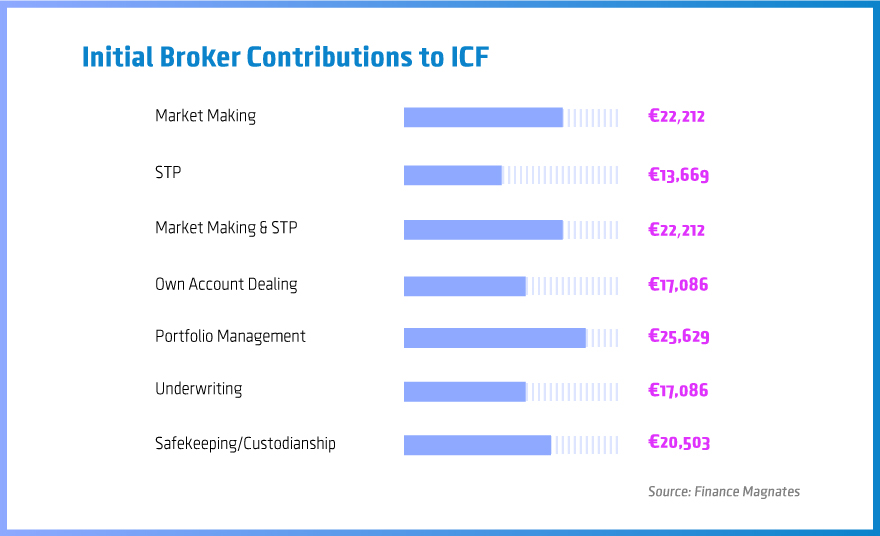
In addition, if the brokerage deals with its own account it pays an additional €17,086 fee, while if it manages portfolios it must provide an additional sum totaling €25,629. If the brokerage also underwrites financial instruments and/or places financial instruments on a commitment basis, it has to pay an additional €17,086.
Initial ICF contributions by brokers can vary depending on the specific needs of their business
For CIFs offering the service of safekeeping and administration of financial instruments for client accounts, including custodianship and related services such as cash/collateral management, the additional fee is €20,503.
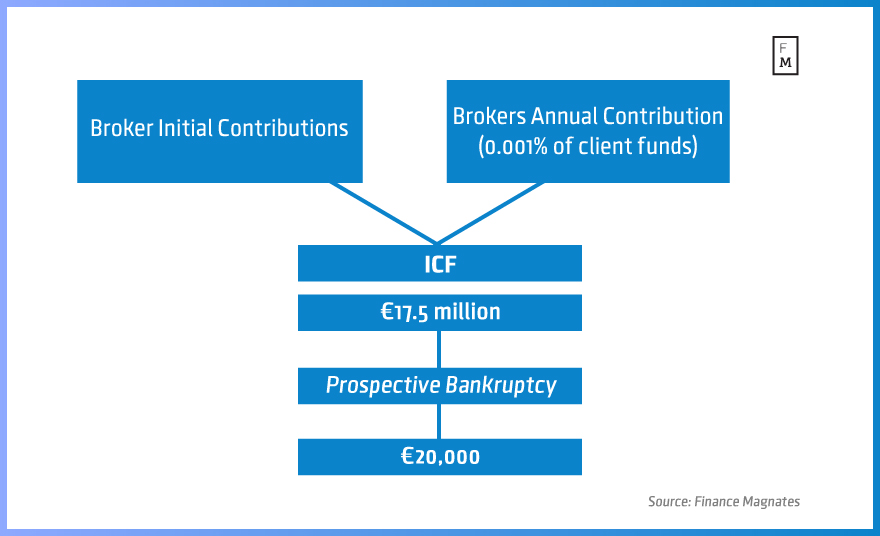
Separately, each CIF is required to pay up to one per mille of the eligible client funds which it holds.
As far as compensation for traders is concerned, maximum levels are much lower than in other regulatory jurisdictions, with a €20,000 ceiling. While this should satisfy most clients’ demands, how CySEC evaluates the conditions under which clients are entitled to compensation remains a mystery, as the fund has rarely been used up until now.
How is an ICF payout procedure triggered?
CySEC and Cyprus courts have the authority to trigger an ICF payout event
According to Ms. Kalougirou, there are two ways in which a payout from the ICF can be triggered. The first is based on a CySEC decision, determined either by the board of CySEC or upon a request submitted to it by a covered client or a member of the ICF.
The second way is if a competent supervisory authority or any other person with a legitimate interest, such as the Official Receiver or the liquidator of the bankrupt brokerage, files a case according to the provisions of the Company Law in Cyprus.
What if ICF funds are insufficient?
Finance Magnates understands that the funds currently held at the ICF in Cyprus total close to €17.5 million ($19.3 million). Looking at the figures of some CySEC regulated brokers, it is quite clear that a scenario where client demands might exceed the fund’s resources is not unrealistic.
According to provisions in the law, if the ICF does not hold sufficient finds to meet all client claims, there are several ways for CySEC to fill the gap. The regulator may call on members of the ICF to commit extraordinary additional resources, or borrow funds from banks in Cyprus or abroad and ask the ICF members to pay up a supplementary contribution to fill the gap afterwards.
A third option is conditional on an insurance company having insured the ICF for up to a certain amount in case a policy event is triggered. Finance Magnates understands that at present this seems to be the least likely option, as CySEC has not disclosed whether the fund is insured with a specific company.
Disclaimer: This article and the opinions expressed in it do not constitute a legal opinion.
But it was the decision to activate the Investors Compensation Fund (ICF) that touches on a little discussed, yet immensely important topic for the local industry.
A CySEC license allows Cyprus Investment Firms (CIFs) to operate throughout the European Union. Much like its European counterparts, it carries certain obligations towards clients, one of which, and arguably the most important, pertains to compensation in the case of insolvency.
While a lot has been written about the British Financial Services Compensation Scheme (FSCS) in the aftermath of the Alpari UK bankruptcy, the ICF has not attracted too much media attention.
With clients of certain brokers still waiting for their withdrawals, and European regulators forcing CySEC to act more diligently, a big question for the ICF is whether it can meet clients' demands in the case of a big brokerage failing to meet its client obligations.
Since CySEC took the first steps in what is to be a systemic approach to supervising regulated brokers more actively, clients of regulated CIFs who have been affected with several compliance issues wonder what would it take to trigger a payment from the ICF.
Organizational structure and broker contributions
Xenia Kalogirou, a senior member of Cyprus-based AGP Law Firm, has helped to shed some light on the details of the scheme, explaining how brokers contribute to the fund’s resources.
In addition, if the brokerage deals with its own account it pays an additional €17,086 fee, while if it manages portfolios it must provide an additional sum totaling €25,629. If the brokerage also underwrites financial instruments and/or places financial instruments on a commitment basis, it has to pay an additional €17,086.
Initial ICF contributions by brokers can vary depending on the specific needs of their business
For CIFs offering the service of safekeeping and administration of financial instruments for client accounts, including custodianship and related services such as cash/collateral management, the additional fee is €20,503.
Separately, each CIF is required to pay up to one per mille of the eligible client funds which it holds.
As far as compensation for traders is concerned, maximum levels are much lower than in other regulatory jurisdictions, with a €20,000 ceiling. While this should satisfy most clients’ demands, how CySEC evaluates the conditions under which clients are entitled to compensation remains a mystery, as the fund has rarely been used up until now.
How is an ICF payout procedure triggered?
CySEC and Cyprus courts have the authority to trigger an ICF payout event
According to Ms. Kalougirou, there are two ways in which a payout from the ICF can be triggered. The first is based on a CySEC decision, determined either by the board of CySEC or upon a request submitted to it by a covered client or a member of the ICF.
The second way is if a competent supervisory authority or any other person with a legitimate interest, such as the Official Receiver or the liquidator of the bankrupt brokerage, files a case according to the provisions of the Company Law in Cyprus.
What if ICF funds are insufficient?
Finance Magnates understands that the funds currently held at the ICF in Cyprus total close to €17.5 million ($19.3 million). Looking at the figures of some CySEC regulated brokers, it is quite clear that a scenario where client demands might exceed the fund’s resources is not unrealistic.
According to provisions in the law, if the ICF does not hold sufficient finds to meet all client claims, there are several ways for CySEC to fill the gap. The regulator may call on members of the ICF to commit extraordinary additional resources, or borrow funds from banks in Cyprus or abroad and ask the ICF members to pay up a supplementary contribution to fill the gap afterwards.
A third option is conditional on an insurance company having insured the ICF for up to a certain amount in case a policy event is triggered. Finance Magnates understands that at present this seems to be the least likely option, as CySEC has not disclosed whether the fund is insured with a specific company.
Disclaimer: This article and the opinions expressed in it do not constitute a legal opinion.
iFOREX Adds Saudi and South Korean Equity CFDs as IPO Is Delayed
Featured Videos
Executive Interview | Charlotte Bullock | Chief Product Officer, Bank of London | FMLS:25
In this interview, we sat down with Charlotte Bullock, Head of Product at The Bank of London, previously at SAP and now shaping product at one of the sector’s most ambitious new banking players.
Charlotte reflects on the Summit so far and talks about the culture inside fintech banks today. We look at the pressures that come with scaling, and how firms can hold onto the nimble approach that made them stand out early on.
We also cover the state of payments ahead of her appearance on the payments roundtable: the blockages financial firms face, the areas that still need fixing, and what a realistic solution looks like in 2026.
In this interview, we sat down with Charlotte Bullock, Head of Product at The Bank of London, previously at SAP and now shaping product at one of the sector’s most ambitious new banking players.
Charlotte reflects on the Summit so far and talks about the culture inside fintech banks today. We look at the pressures that come with scaling, and how firms can hold onto the nimble approach that made them stand out early on.
We also cover the state of payments ahead of her appearance on the payments roundtable: the blockages financial firms face, the areas that still need fixing, and what a realistic solution looks like in 2026.
In this interview, we sat down with Charlotte Bullock, Head of Product at The Bank of London, previously at SAP and now shaping product at one of the sector’s most ambitious new banking players.
Charlotte reflects on the Summit so far and talks about the culture inside fintech banks today. We look at the pressures that come with scaling, and how firms can hold onto the nimble approach that made them stand out early on.
We also cover the state of payments ahead of her appearance on the payments roundtable: the blockages financial firms face, the areas that still need fixing, and what a realistic solution looks like in 2026.
In this interview, we sat down with Charlotte Bullock, Head of Product at The Bank of London, previously at SAP and now shaping product at one of the sector’s most ambitious new banking players.
Charlotte reflects on the Summit so far and talks about the culture inside fintech banks today. We look at the pressures that come with scaling, and how firms can hold onto the nimble approach that made them stand out early on.
We also cover the state of payments ahead of her appearance on the payments roundtable: the blockages financial firms face, the areas that still need fixing, and what a realistic solution looks like in 2026.
In this conversation, we sit down with Drew Niv, CSO at ATFX Connect and one of the most influential figures in modern FX.
We speak about market structure, the institutional view on liquidity, and the sharp rise of prop trading, a sector Drew has been commenting on in recent months. Drew explains why he once dismissed prop trading, why his view changed, and what he now thinks the model means for brokers, clients and risk managers.
We explore subscription-fee dependency, the high reneging rate, and the long-term challenge: how brokers can build a more stable and honest version of the model. Drew also talks about the traffic advantage standalone prop firms have built and why brokers may still win in the long run if they take the right approach.
In this conversation, we sit down with Drew Niv, CSO at ATFX Connect and one of the most influential figures in modern FX.
We speak about market structure, the institutional view on liquidity, and the sharp rise of prop trading, a sector Drew has been commenting on in recent months. Drew explains why he once dismissed prop trading, why his view changed, and what he now thinks the model means for brokers, clients and risk managers.
We explore subscription-fee dependency, the high reneging rate, and the long-term challenge: how brokers can build a more stable and honest version of the model. Drew also talks about the traffic advantage standalone prop firms have built and why brokers may still win in the long run if they take the right approach.
In this conversation, we sit down with Drew Niv, CSO at ATFX Connect and one of the most influential figures in modern FX.
We speak about market structure, the institutional view on liquidity, and the sharp rise of prop trading, a sector Drew has been commenting on in recent months. Drew explains why he once dismissed prop trading, why his view changed, and what he now thinks the model means for brokers, clients and risk managers.
We explore subscription-fee dependency, the high reneging rate, and the long-term challenge: how brokers can build a more stable and honest version of the model. Drew also talks about the traffic advantage standalone prop firms have built and why brokers may still win in the long run if they take the right approach.
In this conversation, we sit down with Drew Niv, CSO at ATFX Connect and one of the most influential figures in modern FX.
We speak about market structure, the institutional view on liquidity, and the sharp rise of prop trading, a sector Drew has been commenting on in recent months. Drew explains why he once dismissed prop trading, why his view changed, and what he now thinks the model means for brokers, clients and risk managers.
We explore subscription-fee dependency, the high reneging rate, and the long-term challenge: how brokers can build a more stable and honest version of the model. Drew also talks about the traffic advantage standalone prop firms have built and why brokers may still win in the long run if they take the right approach.
In this conversation, we sit down with Drew Niv, CSO at ATFX Connect and one of the most influential figures in modern FX.
We speak about market structure, the institutional view on liquidity, and the sharp rise of prop trading, a sector Drew has been commenting on in recent months. Drew explains why he once dismissed prop trading, why his view changed, and what he now thinks the model means for brokers, clients and risk managers.
We explore subscription-fee dependency, the high reneging rate, and the long-term challenge: how brokers can build a more stable and honest version of the model. Drew also talks about the traffic advantage standalone prop firms have built and why brokers may still win in the long run if they take the right approach.
In this conversation, we sit down with Drew Niv, CSO at ATFX Connect and one of the most influential figures in modern FX.
We speak about market structure, the institutional view on liquidity, and the sharp rise of prop trading, a sector Drew has been commenting on in recent months. Drew explains why he once dismissed prop trading, why his view changed, and what he now thinks the model means for brokers, clients and risk managers.
We explore subscription-fee dependency, the high reneging rate, and the long-term challenge: how brokers can build a more stable and honest version of the model. Drew also talks about the traffic advantage standalone prop firms have built and why brokers may still win in the long run if they take the right approach.
Executive Interview | Remonda Z. Kirketerp Møller| CEO & Founder Muinmos | FMLS:25
In this interview, Remonda Z. Kirketerp Møller, founder of Muinmos, breaks down the state of AI in regtech and what responsible adoption really looks like for brokers. We talk about rising fragmentation, the pressures around compliance accuracy, and why most firms are still in the early stages of AI maturity.
Ramanda also shares insights on regulator sandboxes, shifting expectations around accountability, and the current reality of MiCA licensing and passporting in Europe.
A concise look at where compliance, onboarding, and AI-driven processes are heading next.
In this interview, Remonda Z. Kirketerp Møller, founder of Muinmos, breaks down the state of AI in regtech and what responsible adoption really looks like for brokers. We talk about rising fragmentation, the pressures around compliance accuracy, and why most firms are still in the early stages of AI maturity.
Ramanda also shares insights on regulator sandboxes, shifting expectations around accountability, and the current reality of MiCA licensing and passporting in Europe.
A concise look at where compliance, onboarding, and AI-driven processes are heading next.
In this interview, Remonda Z. Kirketerp Møller, founder of Muinmos, breaks down the state of AI in regtech and what responsible adoption really looks like for brokers. We talk about rising fragmentation, the pressures around compliance accuracy, and why most firms are still in the early stages of AI maturity.
Ramanda also shares insights on regulator sandboxes, shifting expectations around accountability, and the current reality of MiCA licensing and passporting in Europe.
A concise look at where compliance, onboarding, and AI-driven processes are heading next.
In this interview, Remonda Z. Kirketerp Møller, founder of Muinmos, breaks down the state of AI in regtech and what responsible adoption really looks like for brokers. We talk about rising fragmentation, the pressures around compliance accuracy, and why most firms are still in the early stages of AI maturity.
Ramanda also shares insights on regulator sandboxes, shifting expectations around accountability, and the current reality of MiCA licensing and passporting in Europe.
A concise look at where compliance, onboarding, and AI-driven processes are heading next.
In this interview, Remonda Z. Kirketerp Møller, founder of Muinmos, breaks down the state of AI in regtech and what responsible adoption really looks like for brokers. We talk about rising fragmentation, the pressures around compliance accuracy, and why most firms are still in the early stages of AI maturity.
Ramanda also shares insights on regulator sandboxes, shifting expectations around accountability, and the current reality of MiCA licensing and passporting in Europe.
A concise look at where compliance, onboarding, and AI-driven processes are heading next.
In this interview, Remonda Z. Kirketerp Møller, founder of Muinmos, breaks down the state of AI in regtech and what responsible adoption really looks like for brokers. We talk about rising fragmentation, the pressures around compliance accuracy, and why most firms are still in the early stages of AI maturity.
Ramanda also shares insights on regulator sandboxes, shifting expectations around accountability, and the current reality of MiCA licensing and passporting in Europe.
A concise look at where compliance, onboarding, and AI-driven processes are heading next.
In this conversation, we speak with Aydin Bonabi, CEO and co-founder of Surveill, a firm focused on fraud detection and AI-driven compliance tools for financial institutions.
We start with Aydin’s view of the Summit and the challenges brokers face as fraud tactics grow more complex. He explains how firms can stay ahead through real-time signals, data patterns, and early-stage detection.
We also talk about AI training and why compliance teams often struggle to keep models accurate, fair, and aligned with regulatory expectations. Aydin breaks down what “good” AI training looks like inside a financial environment, including the importance of clean data, domain expertise, and human oversight.
He closes with a clear message: fraud is scaling, and so must the tools that stop it.
In this conversation, we speak with Aydin Bonabi, CEO and co-founder of Surveill, a firm focused on fraud detection and AI-driven compliance tools for financial institutions.
We start with Aydin’s view of the Summit and the challenges brokers face as fraud tactics grow more complex. He explains how firms can stay ahead through real-time signals, data patterns, and early-stage detection.
We also talk about AI training and why compliance teams often struggle to keep models accurate, fair, and aligned with regulatory expectations. Aydin breaks down what “good” AI training looks like inside a financial environment, including the importance of clean data, domain expertise, and human oversight.
He closes with a clear message: fraud is scaling, and so must the tools that stop it.
In this conversation, we speak with Aydin Bonabi, CEO and co-founder of Surveill, a firm focused on fraud detection and AI-driven compliance tools for financial institutions.
We start with Aydin’s view of the Summit and the challenges brokers face as fraud tactics grow more complex. He explains how firms can stay ahead through real-time signals, data patterns, and early-stage detection.
We also talk about AI training and why compliance teams often struggle to keep models accurate, fair, and aligned with regulatory expectations. Aydin breaks down what “good” AI training looks like inside a financial environment, including the importance of clean data, domain expertise, and human oversight.
He closes with a clear message: fraud is scaling, and so must the tools that stop it.
In this conversation, we speak with Aydin Bonabi, CEO and co-founder of Surveill, a firm focused on fraud detection and AI-driven compliance tools for financial institutions.
We start with Aydin’s view of the Summit and the challenges brokers face as fraud tactics grow more complex. He explains how firms can stay ahead through real-time signals, data patterns, and early-stage detection.
We also talk about AI training and why compliance teams often struggle to keep models accurate, fair, and aligned with regulatory expectations. Aydin breaks down what “good” AI training looks like inside a financial environment, including the importance of clean data, domain expertise, and human oversight.
He closes with a clear message: fraud is scaling, and so must the tools that stop it.
In this conversation, we speak with Aydin Bonabi, CEO and co-founder of Surveill, a firm focused on fraud detection and AI-driven compliance tools for financial institutions.
We start with Aydin’s view of the Summit and the challenges brokers face as fraud tactics grow more complex. He explains how firms can stay ahead through real-time signals, data patterns, and early-stage detection.
We also talk about AI training and why compliance teams often struggle to keep models accurate, fair, and aligned with regulatory expectations. Aydin breaks down what “good” AI training looks like inside a financial environment, including the importance of clean data, domain expertise, and human oversight.
He closes with a clear message: fraud is scaling, and so must the tools that stop it.
In this conversation, we speak with Aydin Bonabi, CEO and co-founder of Surveill, a firm focused on fraud detection and AI-driven compliance tools for financial institutions.
We start with Aydin’s view of the Summit and the challenges brokers face as fraud tactics grow more complex. He explains how firms can stay ahead through real-time signals, data patterns, and early-stage detection.
We also talk about AI training and why compliance teams often struggle to keep models accurate, fair, and aligned with regulatory expectations. Aydin breaks down what “good” AI training looks like inside a financial environment, including the importance of clean data, domain expertise, and human oversight.
He closes with a clear message: fraud is scaling, and so must the tools that stop it.
Exness expands its presence in Africa: Inside our interview with Paul Margarites in Cape Town
Finance Magnates met with Paul Margarites, Exness regional commercial director for Sub-Saharan Africa, during a visit to the firm’s office opening in Cape Town. In this talk, led by Andrea Badiola Mateos, Co-CEO at Finance Magnates, Paul shares views on the South African trading space, local user behavior, mobile trends, regulation, team growth, and how Exness plans to grow in more markets across the region. @Exness
Read the article at: https://www.financemagnates.com/thought-leadership/exness-expands-its-presence-in-africa-inside-our-interview-with-paul-margarites/
#exness #financemagnates #exnesstrading #CFDtrading #tradeonline #africanews #capetown
Finance Magnates met with Paul Margarites, Exness regional commercial director for Sub-Saharan Africa, during a visit to the firm’s office opening in Cape Town. In this talk, led by Andrea Badiola Mateos, Co-CEO at Finance Magnates, Paul shares views on the South African trading space, local user behavior, mobile trends, regulation, team growth, and how Exness plans to grow in more markets across the region. @Exness
Read the article at: https://www.financemagnates.com/thought-leadership/exness-expands-its-presence-in-africa-inside-our-interview-with-paul-margarites/
#exness #financemagnates #exnesstrading #CFDtrading #tradeonline #africanews #capetown
Finance Magnates met with Paul Margarites, Exness regional commercial director for Sub-Saharan Africa, during a visit to the firm’s office opening in Cape Town. In this talk, led by Andrea Badiola Mateos, Co-CEO at Finance Magnates, Paul shares views on the South African trading space, local user behavior, mobile trends, regulation, team growth, and how Exness plans to grow in more markets across the region. @Exness
Read the article at: https://www.financemagnates.com/thought-leadership/exness-expands-its-presence-in-africa-inside-our-interview-with-paul-margarites/
#exness #financemagnates #exnesstrading #CFDtrading #tradeonline #africanews #capetown
Finance Magnates met with Paul Margarites, Exness regional commercial director for Sub-Saharan Africa, during a visit to the firm’s office opening in Cape Town. In this talk, led by Andrea Badiola Mateos, Co-CEO at Finance Magnates, Paul shares views on the South African trading space, local user behavior, mobile trends, regulation, team growth, and how Exness plans to grow in more markets across the region. @Exness
Read the article at: https://www.financemagnates.com/thought-leadership/exness-expands-its-presence-in-africa-inside-our-interview-with-paul-margarites/
#exness #financemagnates #exnesstrading #CFDtrading #tradeonline #africanews #capetown
Finance Magnates met with Paul Margarites, Exness regional commercial director for Sub-Saharan Africa, during a visit to the firm’s office opening in Cape Town. In this talk, led by Andrea Badiola Mateos, Co-CEO at Finance Magnates, Paul shares views on the South African trading space, local user behavior, mobile trends, regulation, team growth, and how Exness plans to grow in more markets across the region. @Exness
Read the article at: https://www.financemagnates.com/thought-leadership/exness-expands-its-presence-in-africa-inside-our-interview-with-paul-margarites/
#exness #financemagnates #exnesstrading #CFDtrading #tradeonline #africanews #capetown
Finance Magnates met with Paul Margarites, Exness regional commercial director for Sub-Saharan Africa, during a visit to the firm’s office opening in Cape Town. In this talk, led by Andrea Badiola Mateos, Co-CEO at Finance Magnates, Paul shares views on the South African trading space, local user behavior, mobile trends, regulation, team growth, and how Exness plans to grow in more markets across the region. @Exness
Read the article at: https://www.financemagnates.com/thought-leadership/exness-expands-its-presence-in-africa-inside-our-interview-with-paul-margarites/
#exness #financemagnates #exnesstrading #CFDtrading #tradeonline #africanews #capetown