OPEC members may try to keep prices elevated over the coming weeks, but the talk of an output freeze is a mere distraction.
Bloomberg
This article was written by Idan Levitov, head analyst for anyoption.com.
Although jawboning from OPEC member states has been enough to squeeze market shorts and bring oil prices back above $40.00 per barrel over the last few weeks, these remarks remain a minor distraction in the bigger picture outlook for the energy complex. Ignoring the commentary and focusing on the fundamentals shows that inventories remain significantly elevated across the globe, with a new glut emerging in refined products as the impact of Chinese teapot refining exports are felt at ports around the world.
Now that inventories are back on the rise following traditional summer stockpile drawdowns, the threat of an output freeze has been enough to dissuade oil shorts at least temporarily. However, on a more medium-term basis, lack of cohesion amongst OPEC members combined with rising US production and the possibility of resurgent Nigerian output could derail recent price gains, forcing crude back to the downside.
Discord Remains in Abundance
Markets have been preparing for the possibility of another discussion of a production ceiling amongst OPEC and select non-OPEC members in an effort to put a floor in prices that have remained volatile over the last few months. Although rumors about production freezes neatly coincided with a steep drop off in crude oil prices, trying to find a consensus amongst OPEC members these days is nearly impossible.
Despite Saudi Arabia torpedoing the last output freeze talks Doha, it could very well be Iran that walks away from the table during the upcoming round of negotiations as the Islamic Republic works to restore production to pre-sanctions levels.
Meanwhile, Saudi Arabian output continues to climb after reaching a record of 10.67 million barrels per day (bpd) in production during July. Furthermore, they are expected to show further gains in August towards 10.90 million bpd, overtaking Russia’s 10.85 million bpd as the globe’s largest producer.
While part of this could be attributed to higher seasonal demand domestically, it could be intended as a move to maintain and grow market share during a time of extreme market turbulence. Nevertheless, bringing all the parties, both OPEC and non-OPEC to the table and enforcing an agreement remains a distant possibility.
Outside of OPEC is the resurgent American growth and rising global inventories. In the US, inventories rose by an astounding 2.501 million barrels last week after falling by a similar amount the prior week, marking the biggest stockpile build in 3 months. Rising inventories have also been accompanied by increased domestic production, which was rising at the fastest pace since May of 2015 until falling by 57,000 bpd last week to 8.548 million bpd. Additionally, a rising rig count could further complicate the outlook.
According to Baker Hughes data, from Friday August 19th, the oil drill rig count rose by 10 rigs, marking 8-straight weeks of increases, leading to higher production potential over coming weeks. Considering all these factors with the possibility of a revival of 700,000 bpd in output from Nigeria, the stage remains set for oversupply to persist for the second half of 2016.
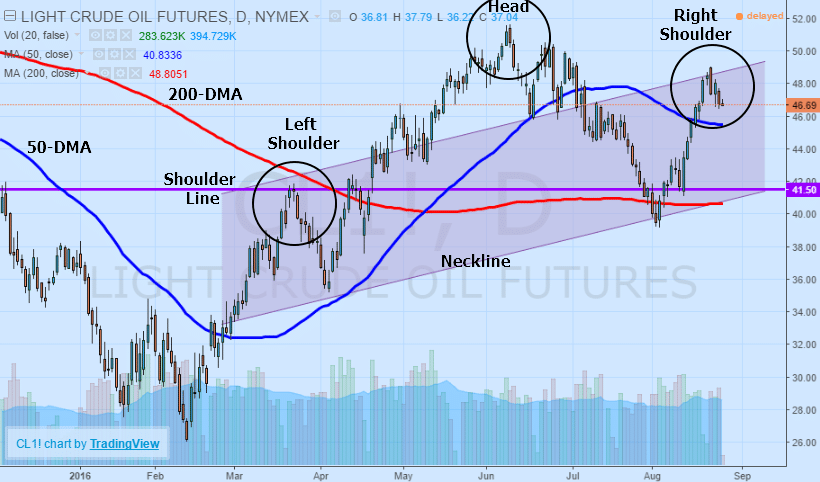
Another downturn in prices might be slowed by support from both the 50 and 200-day moving averages. However, an emerging head and shoulders bearish pattern may add to any downside momentum. With the right shoulder of the pattern forming, the next major stop for price action may be $41.50 on the downside if the 50-day moving average, paving the way towards support at the 200-day moving average coinciding with the neck line of the head and shoulders pattern.
Looking Ahead
Although OPEC members may release more tape bombs over the coming weeks to keep prices elevated, the smokescreen that is output freeze jawboning should be appreciated for what it is, namely a distraction. With production levels rising globally and the possibility of rebounding Nigerian production in the fold, the major developments that could seriously derail recent gains in oil prices remains data related to output and stockpiling.
Should Nigeria manage to come to an agreement with the Niger Delta Avengers, it could see output revived, endangering any hope of a market equilibrium that keeps prices elevated. With very few upside catalysts and significant downside risks, the most recent rally in oil prices may be nothing more than a short squeeze as the speculators reload short positions at higher prices.
This article was written by Idan Levitov, head analyst for anyoption.com.
Although jawboning from OPEC member states has been enough to squeeze market shorts and bring oil prices back above $40.00 per barrel over the last few weeks, these remarks remain a minor distraction in the bigger picture outlook for the energy complex. Ignoring the commentary and focusing on the fundamentals shows that inventories remain significantly elevated across the globe, with a new glut emerging in refined products as the impact of Chinese teapot refining exports are felt at ports around the world.
Now that inventories are back on the rise following traditional summer stockpile drawdowns, the threat of an output freeze has been enough to dissuade oil shorts at least temporarily. However, on a more medium-term basis, lack of cohesion amongst OPEC members combined with rising US production and the possibility of resurgent Nigerian output could derail recent price gains, forcing crude back to the downside.
Discord Remains in Abundance
Markets have been preparing for the possibility of another discussion of a production ceiling amongst OPEC and select non-OPEC members in an effort to put a floor in prices that have remained volatile over the last few months. Although rumors about production freezes neatly coincided with a steep drop off in crude oil prices, trying to find a consensus amongst OPEC members these days is nearly impossible.
Despite Saudi Arabia torpedoing the last output freeze talks Doha, it could very well be Iran that walks away from the table during the upcoming round of negotiations as the Islamic Republic works to restore production to pre-sanctions levels.
Meanwhile, Saudi Arabian output continues to climb after reaching a record of 10.67 million barrels per day (bpd) in production during July. Furthermore, they are expected to show further gains in August towards 10.90 million bpd, overtaking Russia’s 10.85 million bpd as the globe’s largest producer.
While part of this could be attributed to higher seasonal demand domestically, it could be intended as a move to maintain and grow market share during a time of extreme market turbulence. Nevertheless, bringing all the parties, both OPEC and non-OPEC to the table and enforcing an agreement remains a distant possibility.
Outside of OPEC is the resurgent American growth and rising global inventories. In the US, inventories rose by an astounding 2.501 million barrels last week after falling by a similar amount the prior week, marking the biggest stockpile build in 3 months. Rising inventories have also been accompanied by increased domestic production, which was rising at the fastest pace since May of 2015 until falling by 57,000 bpd last week to 8.548 million bpd. Additionally, a rising rig count could further complicate the outlook.
According to Baker Hughes data, from Friday August 19th, the oil drill rig count rose by 10 rigs, marking 8-straight weeks of increases, leading to higher production potential over coming weeks. Considering all these factors with the possibility of a revival of 700,000 bpd in output from Nigeria, the stage remains set for oversupply to persist for the second half of 2016.
Another downturn in prices might be slowed by support from both the 50 and 200-day moving averages. However, an emerging head and shoulders bearish pattern may add to any downside momentum. With the right shoulder of the pattern forming, the next major stop for price action may be $41.50 on the downside if the 50-day moving average, paving the way towards support at the 200-day moving average coinciding with the neck line of the head and shoulders pattern.
Looking Ahead
Although OPEC members may release more tape bombs over the coming weeks to keep prices elevated, the smokescreen that is output freeze jawboning should be appreciated for what it is, namely a distraction. With production levels rising globally and the possibility of rebounding Nigerian production in the fold, the major developments that could seriously derail recent gains in oil prices remains data related to output and stockpiling.
Should Nigeria manage to come to an agreement with the Niger Delta Avengers, it could see output revived, endangering any hope of a market equilibrium that keeps prices elevated. With very few upside catalysts and significant downside risks, the most recent rally in oil prices may be nothing more than a short squeeze as the speculators reload short positions at higher prices.
Idan is the VP trading for anyoption.com. He is a seasoned professional with years of experience trading and has a vast knowledge of the financial markets. An expert in the binary options hedging field - Idan provides insights, guidance and coordination in business planning, risk management and technology strategies. He holds a BA in Economics Management and is now busy finishing his MBA in Finance. Idan is the VP trading for anyoption.com. He is a seasoned professional with years of experience and a vast knowledge of the financial markets. An expert in the binary options hedging field - Idan provides insights, guidance and coordination in business planning, risk management and technology strategies. He holds a BA in Economics Management and is now busy finishing his MBA in Finance.
Retail Trading & Prop Firms in 2025: Five Defining Trends - And One Prediction for 2026
Featured Videos
Executive Interview | Charlotte Bullock | Chief Product Officer, Bank of London | FMLS:25
In this interview, we sat down with Charlotte Bullock, Head of Product at The Bank of London, previously at SAP and now shaping product at one of the sector’s most ambitious new banking players.
Charlotte reflects on the Summit so far and talks about the culture inside fintech banks today. We look at the pressures that come with scaling, and how firms can hold onto the nimble approach that made them stand out early on.
We also cover the state of payments ahead of her appearance on the payments roundtable: the blockages financial firms face, the areas that still need fixing, and what a realistic solution looks like in 2026.
In this interview, we sat down with Charlotte Bullock, Head of Product at The Bank of London, previously at SAP and now shaping product at one of the sector’s most ambitious new banking players.
Charlotte reflects on the Summit so far and talks about the culture inside fintech banks today. We look at the pressures that come with scaling, and how firms can hold onto the nimble approach that made them stand out early on.
We also cover the state of payments ahead of her appearance on the payments roundtable: the blockages financial firms face, the areas that still need fixing, and what a realistic solution looks like in 2026.
In this interview, we sat down with Charlotte Bullock, Head of Product at The Bank of London, previously at SAP and now shaping product at one of the sector’s most ambitious new banking players.
Charlotte reflects on the Summit so far and talks about the culture inside fintech banks today. We look at the pressures that come with scaling, and how firms can hold onto the nimble approach that made them stand out early on.
We also cover the state of payments ahead of her appearance on the payments roundtable: the blockages financial firms face, the areas that still need fixing, and what a realistic solution looks like in 2026.
In this interview, we sat down with Charlotte Bullock, Head of Product at The Bank of London, previously at SAP and now shaping product at one of the sector’s most ambitious new banking players.
Charlotte reflects on the Summit so far and talks about the culture inside fintech banks today. We look at the pressures that come with scaling, and how firms can hold onto the nimble approach that made them stand out early on.
We also cover the state of payments ahead of her appearance on the payments roundtable: the blockages financial firms face, the areas that still need fixing, and what a realistic solution looks like in 2026.
In this conversation, we sit down with Drew Niv, CSO at ATFX Connect and one of the most influential figures in modern FX.
We speak about market structure, the institutional view on liquidity, and the sharp rise of prop trading, a sector Drew has been commenting on in recent months. Drew explains why he once dismissed prop trading, why his view changed, and what he now thinks the model means for brokers, clients and risk managers.
We explore subscription-fee dependency, the high reneging rate, and the long-term challenge: how brokers can build a more stable and honest version of the model. Drew also talks about the traffic advantage standalone prop firms have built and why brokers may still win in the long run if they take the right approach.
In this conversation, we sit down with Drew Niv, CSO at ATFX Connect and one of the most influential figures in modern FX.
We speak about market structure, the institutional view on liquidity, and the sharp rise of prop trading, a sector Drew has been commenting on in recent months. Drew explains why he once dismissed prop trading, why his view changed, and what he now thinks the model means for brokers, clients and risk managers.
We explore subscription-fee dependency, the high reneging rate, and the long-term challenge: how brokers can build a more stable and honest version of the model. Drew also talks about the traffic advantage standalone prop firms have built and why brokers may still win in the long run if they take the right approach.
In this conversation, we sit down with Drew Niv, CSO at ATFX Connect and one of the most influential figures in modern FX.
We speak about market structure, the institutional view on liquidity, and the sharp rise of prop trading, a sector Drew has been commenting on in recent months. Drew explains why he once dismissed prop trading, why his view changed, and what he now thinks the model means for brokers, clients and risk managers.
We explore subscription-fee dependency, the high reneging rate, and the long-term challenge: how brokers can build a more stable and honest version of the model. Drew also talks about the traffic advantage standalone prop firms have built and why brokers may still win in the long run if they take the right approach.
In this conversation, we sit down with Drew Niv, CSO at ATFX Connect and one of the most influential figures in modern FX.
We speak about market structure, the institutional view on liquidity, and the sharp rise of prop trading, a sector Drew has been commenting on in recent months. Drew explains why he once dismissed prop trading, why his view changed, and what he now thinks the model means for brokers, clients and risk managers.
We explore subscription-fee dependency, the high reneging rate, and the long-term challenge: how brokers can build a more stable and honest version of the model. Drew also talks about the traffic advantage standalone prop firms have built and why brokers may still win in the long run if they take the right approach.
In this conversation, we sit down with Drew Niv, CSO at ATFX Connect and one of the most influential figures in modern FX.
We speak about market structure, the institutional view on liquidity, and the sharp rise of prop trading, a sector Drew has been commenting on in recent months. Drew explains why he once dismissed prop trading, why his view changed, and what he now thinks the model means for brokers, clients and risk managers.
We explore subscription-fee dependency, the high reneging rate, and the long-term challenge: how brokers can build a more stable and honest version of the model. Drew also talks about the traffic advantage standalone prop firms have built and why brokers may still win in the long run if they take the right approach.
In this conversation, we sit down with Drew Niv, CSO at ATFX Connect and one of the most influential figures in modern FX.
We speak about market structure, the institutional view on liquidity, and the sharp rise of prop trading, a sector Drew has been commenting on in recent months. Drew explains why he once dismissed prop trading, why his view changed, and what he now thinks the model means for brokers, clients and risk managers.
We explore subscription-fee dependency, the high reneging rate, and the long-term challenge: how brokers can build a more stable and honest version of the model. Drew also talks about the traffic advantage standalone prop firms have built and why brokers may still win in the long run if they take the right approach.
Executive Interview | Remonda Z. Kirketerp Møller| CEO & Founder Muinmos | FMLS:25
In this interview, Remonda Z. Kirketerp Møller, founder of Muinmos, breaks down the state of AI in regtech and what responsible adoption really looks like for brokers. We talk about rising fragmentation, the pressures around compliance accuracy, and why most firms are still in the early stages of AI maturity.
Ramanda also shares insights on regulator sandboxes, shifting expectations around accountability, and the current reality of MiCA licensing and passporting in Europe.
A concise look at where compliance, onboarding, and AI-driven processes are heading next.
In this interview, Remonda Z. Kirketerp Møller, founder of Muinmos, breaks down the state of AI in regtech and what responsible adoption really looks like for brokers. We talk about rising fragmentation, the pressures around compliance accuracy, and why most firms are still in the early stages of AI maturity.
Ramanda also shares insights on regulator sandboxes, shifting expectations around accountability, and the current reality of MiCA licensing and passporting in Europe.
A concise look at where compliance, onboarding, and AI-driven processes are heading next.
In this interview, Remonda Z. Kirketerp Møller, founder of Muinmos, breaks down the state of AI in regtech and what responsible adoption really looks like for brokers. We talk about rising fragmentation, the pressures around compliance accuracy, and why most firms are still in the early stages of AI maturity.
Ramanda also shares insights on regulator sandboxes, shifting expectations around accountability, and the current reality of MiCA licensing and passporting in Europe.
A concise look at where compliance, onboarding, and AI-driven processes are heading next.
In this interview, Remonda Z. Kirketerp Møller, founder of Muinmos, breaks down the state of AI in regtech and what responsible adoption really looks like for brokers. We talk about rising fragmentation, the pressures around compliance accuracy, and why most firms are still in the early stages of AI maturity.
Ramanda also shares insights on regulator sandboxes, shifting expectations around accountability, and the current reality of MiCA licensing and passporting in Europe.
A concise look at where compliance, onboarding, and AI-driven processes are heading next.
In this interview, Remonda Z. Kirketerp Møller, founder of Muinmos, breaks down the state of AI in regtech and what responsible adoption really looks like for brokers. We talk about rising fragmentation, the pressures around compliance accuracy, and why most firms are still in the early stages of AI maturity.
Ramanda also shares insights on regulator sandboxes, shifting expectations around accountability, and the current reality of MiCA licensing and passporting in Europe.
A concise look at where compliance, onboarding, and AI-driven processes are heading next.
In this interview, Remonda Z. Kirketerp Møller, founder of Muinmos, breaks down the state of AI in regtech and what responsible adoption really looks like for brokers. We talk about rising fragmentation, the pressures around compliance accuracy, and why most firms are still in the early stages of AI maturity.
Ramanda also shares insights on regulator sandboxes, shifting expectations around accountability, and the current reality of MiCA licensing and passporting in Europe.
A concise look at where compliance, onboarding, and AI-driven processes are heading next.
In this conversation, we speak with Aydin Bonabi, CEO and co-founder of Surveill, a firm focused on fraud detection and AI-driven compliance tools for financial institutions.
We start with Aydin’s view of the Summit and the challenges brokers face as fraud tactics grow more complex. He explains how firms can stay ahead through real-time signals, data patterns, and early-stage detection.
We also talk about AI training and why compliance teams often struggle to keep models accurate, fair, and aligned with regulatory expectations. Aydin breaks down what “good” AI training looks like inside a financial environment, including the importance of clean data, domain expertise, and human oversight.
He closes with a clear message: fraud is scaling, and so must the tools that stop it.
In this conversation, we speak with Aydin Bonabi, CEO and co-founder of Surveill, a firm focused on fraud detection and AI-driven compliance tools for financial institutions.
We start with Aydin’s view of the Summit and the challenges brokers face as fraud tactics grow more complex. He explains how firms can stay ahead through real-time signals, data patterns, and early-stage detection.
We also talk about AI training and why compliance teams often struggle to keep models accurate, fair, and aligned with regulatory expectations. Aydin breaks down what “good” AI training looks like inside a financial environment, including the importance of clean data, domain expertise, and human oversight.
He closes with a clear message: fraud is scaling, and so must the tools that stop it.
In this conversation, we speak with Aydin Bonabi, CEO and co-founder of Surveill, a firm focused on fraud detection and AI-driven compliance tools for financial institutions.
We start with Aydin’s view of the Summit and the challenges brokers face as fraud tactics grow more complex. He explains how firms can stay ahead through real-time signals, data patterns, and early-stage detection.
We also talk about AI training and why compliance teams often struggle to keep models accurate, fair, and aligned with regulatory expectations. Aydin breaks down what “good” AI training looks like inside a financial environment, including the importance of clean data, domain expertise, and human oversight.
He closes with a clear message: fraud is scaling, and so must the tools that stop it.
In this conversation, we speak with Aydin Bonabi, CEO and co-founder of Surveill, a firm focused on fraud detection and AI-driven compliance tools for financial institutions.
We start with Aydin’s view of the Summit and the challenges brokers face as fraud tactics grow more complex. He explains how firms can stay ahead through real-time signals, data patterns, and early-stage detection.
We also talk about AI training and why compliance teams often struggle to keep models accurate, fair, and aligned with regulatory expectations. Aydin breaks down what “good” AI training looks like inside a financial environment, including the importance of clean data, domain expertise, and human oversight.
He closes with a clear message: fraud is scaling, and so must the tools that stop it.
In this conversation, we speak with Aydin Bonabi, CEO and co-founder of Surveill, a firm focused on fraud detection and AI-driven compliance tools for financial institutions.
We start with Aydin’s view of the Summit and the challenges brokers face as fraud tactics grow more complex. He explains how firms can stay ahead through real-time signals, data patterns, and early-stage detection.
We also talk about AI training and why compliance teams often struggle to keep models accurate, fair, and aligned with regulatory expectations. Aydin breaks down what “good” AI training looks like inside a financial environment, including the importance of clean data, domain expertise, and human oversight.
He closes with a clear message: fraud is scaling, and so must the tools that stop it.
In this conversation, we speak with Aydin Bonabi, CEO and co-founder of Surveill, a firm focused on fraud detection and AI-driven compliance tools for financial institutions.
We start with Aydin’s view of the Summit and the challenges brokers face as fraud tactics grow more complex. He explains how firms can stay ahead through real-time signals, data patterns, and early-stage detection.
We also talk about AI training and why compliance teams often struggle to keep models accurate, fair, and aligned with regulatory expectations. Aydin breaks down what “good” AI training looks like inside a financial environment, including the importance of clean data, domain expertise, and human oversight.
He closes with a clear message: fraud is scaling, and so must the tools that stop it.
Exness expands its presence in Africa: Inside our interview with Paul Margarites in Cape Town
Finance Magnates met with Paul Margarites, Exness regional commercial director for Sub-Saharan Africa, during a visit to the firm’s office opening in Cape Town. In this talk, led by Andrea Badiola Mateos, Co-CEO at Finance Magnates, Paul shares views on the South African trading space, local user behavior, mobile trends, regulation, team growth, and how Exness plans to grow in more markets across the region. @Exness
Read the article at: https://www.financemagnates.com/thought-leadership/exness-expands-its-presence-in-africa-inside-our-interview-with-paul-margarites/
#exness #financemagnates #exnesstrading #CFDtrading #tradeonline #africanews #capetown
Finance Magnates met with Paul Margarites, Exness regional commercial director for Sub-Saharan Africa, during a visit to the firm’s office opening in Cape Town. In this talk, led by Andrea Badiola Mateos, Co-CEO at Finance Magnates, Paul shares views on the South African trading space, local user behavior, mobile trends, regulation, team growth, and how Exness plans to grow in more markets across the region. @Exness
Read the article at: https://www.financemagnates.com/thought-leadership/exness-expands-its-presence-in-africa-inside-our-interview-with-paul-margarites/
#exness #financemagnates #exnesstrading #CFDtrading #tradeonline #africanews #capetown
Finance Magnates met with Paul Margarites, Exness regional commercial director for Sub-Saharan Africa, during a visit to the firm’s office opening in Cape Town. In this talk, led by Andrea Badiola Mateos, Co-CEO at Finance Magnates, Paul shares views on the South African trading space, local user behavior, mobile trends, regulation, team growth, and how Exness plans to grow in more markets across the region. @Exness
Read the article at: https://www.financemagnates.com/thought-leadership/exness-expands-its-presence-in-africa-inside-our-interview-with-paul-margarites/
#exness #financemagnates #exnesstrading #CFDtrading #tradeonline #africanews #capetown
Finance Magnates met with Paul Margarites, Exness regional commercial director for Sub-Saharan Africa, during a visit to the firm’s office opening in Cape Town. In this talk, led by Andrea Badiola Mateos, Co-CEO at Finance Magnates, Paul shares views on the South African trading space, local user behavior, mobile trends, regulation, team growth, and how Exness plans to grow in more markets across the region. @Exness
Read the article at: https://www.financemagnates.com/thought-leadership/exness-expands-its-presence-in-africa-inside-our-interview-with-paul-margarites/
#exness #financemagnates #exnesstrading #CFDtrading #tradeonline #africanews #capetown
Finance Magnates met with Paul Margarites, Exness regional commercial director for Sub-Saharan Africa, during a visit to the firm’s office opening in Cape Town. In this talk, led by Andrea Badiola Mateos, Co-CEO at Finance Magnates, Paul shares views on the South African trading space, local user behavior, mobile trends, regulation, team growth, and how Exness plans to grow in more markets across the region. @Exness
Read the article at: https://www.financemagnates.com/thought-leadership/exness-expands-its-presence-in-africa-inside-our-interview-with-paul-margarites/
#exness #financemagnates #exnesstrading #CFDtrading #tradeonline #africanews #capetown
Finance Magnates met with Paul Margarites, Exness regional commercial director for Sub-Saharan Africa, during a visit to the firm’s office opening in Cape Town. In this talk, led by Andrea Badiola Mateos, Co-CEO at Finance Magnates, Paul shares views on the South African trading space, local user behavior, mobile trends, regulation, team growth, and how Exness plans to grow in more markets across the region. @Exness
Read the article at: https://www.financemagnates.com/thought-leadership/exness-expands-its-presence-in-africa-inside-our-interview-with-paul-margarites/
#exness #financemagnates #exnesstrading #CFDtrading #tradeonline #africanews #capetown