FXCM ended a strong week by continuing its rally on Friday. This article examines the factors that may have helped.
Finance Magnates
Shares of embattled broker FXCM, finally experienced some love from investors after months of negative sentiment. The positive move began last Monday as shares rose over 50% to close at $8.08. The impetus was a statement from the broker that FXCM and Leucadia, which had provided $300 million in emergency funding in January, “remain committed to restructuring their existing Letter Agreement in a manner that is consistent with a sustainable long-term and value-enhancing strategy for both companies”.
In addition, the statement revealed the intentions of FXCM’s senior management to participate in stock purchases, along with the company’s own stock repurchase program. Putting their money where their mouth is, SEC statements showed that the management, headed by CEO and CFO Drew Niv and Robert Lande respectively, did in fact engage in stock purchases. This news led FXCM shares higher again on Wednesday, with the stock closing at $9.16 after briefly appearing above $10.00 for the first time since October.
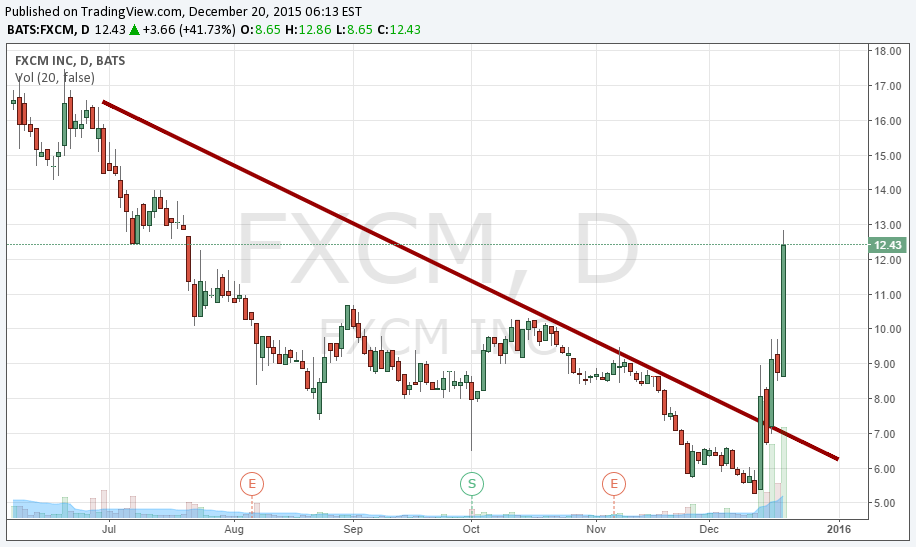
The week culminated in the largest dollar move on Friday as shares rallied $3.66, or 42% to close the week at $12.43. Unlike the week’s previous moves, the rally occurred without any specific company announcements. In addition, the performance was in contrast to the overall market, which saw the Dow Jones shed 367 points (2.1%).
Option expiration and technicals
In order to explain what triggered Friday’s move, we can look to two possible reasons: the day’s option expiries, and positive technical for the stock. In terms of the latter, the stock cleared several resistance levels such as the $8.72 and $10 mark that were viewed as key points by retail traders. Having earlier in the week popped out of a negative downtrend, the continued move higher is believed to have gained momentum, causing additional systems to become bullish on FXCM.
Beyond the technical momentum, Friday also represented Quadruple Witching for the stock markets. Occurring on the third Friday of March, June, September and December, these days see stock options, stock futures, index options and index futures all expire on the same day. The result is historically higher volatilities caused by the intra-day moves of traders adjusting portfolios to reflect expirations.
In terms of FXCM, the week’s move may have caught bearish traders who had sold calls or shorted the stock and led them to aggressively buy shares to cover option or margin obligations. In this regard, FXCM’s stock did see a spike in volumes, with over 2 million shares trading compared to their three month average of just below 200,000.
BATS IPO Plans
One fundamental driver that could be in play and may lead to value players becoming interested in FXCM was news that BATS Global Markets has filed intentions to go public. With their $365 million acquisition of Hotspot FX from KCG earlier in the year, the IPO filing provided more clarity on that deal. With FXCM putting its 35% stake of FastMatch, a Hotspot rival, on the market to cover a portion of its Leucadia debt, the BATS filing provides more clarity on valuations.
Among the key items revealed by BATS:
Hotspot 2014 revenues: $47.1 million
Hotspot 2014 Net Income: $12.3 million (Implies valuation of nearly 30x trailing income)
2015 Hotspot revenue capture: $3.01 per million traded (similar to FastMatch’s core commission)
Pipeline plans: May launch SEF to enter swap market and launch MTF in the UK
2015 results: $4 million net loss on $23.2 million in revenues for Hotspot since March acquisition
The figures point to a rich valuation put on Hotspot’s business with much of the paid value based on the FX ECN’s relationships and potential growth when combined with BATS. For FXCM, the Hotspot deal can be used as a proxy to value FastMatch. Using similar valuations, FXCM’s stake is FastMatch in slated to be worth between $45-$55 million.
Worth noting is that even after last week’s rally, the stock remains well below its post-SNB crisis level, let alone the $170 level it had traded around during the same period last year. However, the current momentum could see further gains thanks to improving fundamentals in the forex market.
Following a dull November, volumes have finally picked up again during December, in what is typically a weaker month. Public figures of trading from both FastMatch and Hotspot reveal that both venues are on pace to report a strong month of trading. For Hotspot, at an average of just above $30 billion in daily volumes, December is on pace to be the best month since May. At FastMatch, the venue is currently averaging over $10 billion in daily volume for the first time this year, with an average of $11.8 billion. If the figure holds, it would be the best month since November 2014.
For FXCM and other brokers, the volume increases taking place at publicly reporting venues bode well for their retail businesses. Due to a lack of clarity on the Fed’s coming actions, as well as whether the ECB would continue to be apply monetary stimulus policies, forex speculation among traders has declined.
However, with the ECB continuing to cut rates, and the Fed raising them for the first time since 2006 and signalling for further hikes in 2016, there is a clearer picture for traders. As such, we could see renewed speculation among traders for carry trades and other currency rate arbitrage strategies as they become more comfortable with the near term direction of global interest rates.
Shares of embattled broker FXCM, finally experienced some love from investors after months of negative sentiment. The positive move began last Monday as shares rose over 50% to close at $8.08. The impetus was a statement from the broker that FXCM and Leucadia, which had provided $300 million in emergency funding in January, “remain committed to restructuring their existing Letter Agreement in a manner that is consistent with a sustainable long-term and value-enhancing strategy for both companies”.
In addition, the statement revealed the intentions of FXCM’s senior management to participate in stock purchases, along with the company’s own stock repurchase program. Putting their money where their mouth is, SEC statements showed that the management, headed by CEO and CFO Drew Niv and Robert Lande respectively, did in fact engage in stock purchases. This news led FXCM shares higher again on Wednesday, with the stock closing at $9.16 after briefly appearing above $10.00 for the first time since October.
The week culminated in the largest dollar move on Friday as shares rallied $3.66, or 42% to close the week at $12.43. Unlike the week’s previous moves, the rally occurred without any specific company announcements. In addition, the performance was in contrast to the overall market, which saw the Dow Jones shed 367 points (2.1%).
Option expiration and technicals
In order to explain what triggered Friday’s move, we can look to two possible reasons: the day’s option expiries, and positive technical for the stock. In terms of the latter, the stock cleared several resistance levels such as the $8.72 and $10 mark that were viewed as key points by retail traders. Having earlier in the week popped out of a negative downtrend, the continued move higher is believed to have gained momentum, causing additional systems to become bullish on FXCM.
Beyond the technical momentum, Friday also represented Quadruple Witching for the stock markets. Occurring on the third Friday of March, June, September and December, these days see stock options, stock futures, index options and index futures all expire on the same day. The result is historically higher volatilities caused by the intra-day moves of traders adjusting portfolios to reflect expirations.
In terms of FXCM, the week’s move may have caught bearish traders who had sold calls or shorted the stock and led them to aggressively buy shares to cover option or margin obligations. In this regard, FXCM’s stock did see a spike in volumes, with over 2 million shares trading compared to their three month average of just below 200,000.
BATS IPO Plans
One fundamental driver that could be in play and may lead to value players becoming interested in FXCM was news that BATS Global Markets has filed intentions to go public. With their $365 million acquisition of Hotspot FX from KCG earlier in the year, the IPO filing provided more clarity on that deal. With FXCM putting its 35% stake of FastMatch, a Hotspot rival, on the market to cover a portion of its Leucadia debt, the BATS filing provides more clarity on valuations.
Among the key items revealed by BATS:
Hotspot 2014 revenues: $47.1 million
Hotspot 2014 Net Income: $12.3 million (Implies valuation of nearly 30x trailing income)
2015 Hotspot revenue capture: $3.01 per million traded (similar to FastMatch’s core commission)
Pipeline plans: May launch SEF to enter swap market and launch MTF in the UK
2015 results: $4 million net loss on $23.2 million in revenues for Hotspot since March acquisition
The figures point to a rich valuation put on Hotspot’s business with much of the paid value based on the FX ECN’s relationships and potential growth when combined with BATS. For FXCM, the Hotspot deal can be used as a proxy to value FastMatch. Using similar valuations, FXCM’s stake is FastMatch in slated to be worth between $45-$55 million.
Worth noting is that even after last week’s rally, the stock remains well below its post-SNB crisis level, let alone the $170 level it had traded around during the same period last year. However, the current momentum could see further gains thanks to improving fundamentals in the forex market.
Following a dull November, volumes have finally picked up again during December, in what is typically a weaker month. Public figures of trading from both FastMatch and Hotspot reveal that both venues are on pace to report a strong month of trading. For Hotspot, at an average of just above $30 billion in daily volumes, December is on pace to be the best month since May. At FastMatch, the venue is currently averaging over $10 billion in daily volume for the first time this year, with an average of $11.8 billion. If the figure holds, it would be the best month since November 2014.
For FXCM and other brokers, the volume increases taking place at publicly reporting venues bode well for their retail businesses. Due to a lack of clarity on the Fed’s coming actions, as well as whether the ECB would continue to be apply monetary stimulus policies, forex speculation among traders has declined.
However, with the ECB continuing to cut rates, and the Fed raising them for the first time since 2006 and signalling for further hikes in 2016, there is a clearer picture for traders. As such, we could see renewed speculation among traders for carry trades and other currency rate arbitrage strategies as they become more comfortable with the near term direction of global interest rates.
In this video, we review @AxiOfficialChannel , a multi-asset broker offering access to forex and CFD markets through MetaTrader 4, MetaTrader 5, the Axi Trading App, and copy trading solutions.
We examine the broker’s regulatory framework, platform offering, market coverage, and customer support structure. We also explore key features such as available trading instruments, swap-free account options, funding considerations, and multilingual support.
Watch the full video for a clear, fact-based overview of Axi’s products, trading tools, and overall broker offering.
#Axi #ForexBroker #CFDTrading #FinanceMagnates #Trading #BrokerReview #OnlineTrading
In this video, we review @AxiOfficialChannel , a multi-asset broker offering access to forex and CFD markets through MetaTrader 4, MetaTrader 5, the Axi Trading App, and copy trading solutions.
We examine the broker’s regulatory framework, platform offering, market coverage, and customer support structure. We also explore key features such as available trading instruments, swap-free account options, funding considerations, and multilingual support.
Watch the full video for a clear, fact-based overview of Axi’s products, trading tools, and overall broker offering.
#Axi #ForexBroker #CFDTrading #FinanceMagnates #Trading #BrokerReview #OnlineTrading
In this video, we review @AxiOfficialChannel , a multi-asset broker offering access to forex and CFD markets through MetaTrader 4, MetaTrader 5, the Axi Trading App, and copy trading solutions.
We examine the broker’s regulatory framework, platform offering, market coverage, and customer support structure. We also explore key features such as available trading instruments, swap-free account options, funding considerations, and multilingual support.
Watch the full video for a clear, fact-based overview of Axi’s products, trading tools, and overall broker offering.
#Axi #ForexBroker #CFDTrading #FinanceMagnates #Trading #BrokerReview #OnlineTrading
In this video, we review @AxiOfficialChannel , a multi-asset broker offering access to forex and CFD markets through MetaTrader 4, MetaTrader 5, the Axi Trading App, and copy trading solutions.
We examine the broker’s regulatory framework, platform offering, market coverage, and customer support structure. We also explore key features such as available trading instruments, swap-free account options, funding considerations, and multilingual support.
Watch the full video for a clear, fact-based overview of Axi’s products, trading tools, and overall broker offering.
#Axi #ForexBroker #CFDTrading #FinanceMagnates #Trading #BrokerReview #OnlineTrading
In this video, we review @AxiOfficialChannel , a multi-asset broker offering access to forex and CFD markets through MetaTrader 4, MetaTrader 5, the Axi Trading App, and copy trading solutions.
We examine the broker’s regulatory framework, platform offering, market coverage, and customer support structure. We also explore key features such as available trading instruments, swap-free account options, funding considerations, and multilingual support.
Watch the full video for a clear, fact-based overview of Axi’s products, trading tools, and overall broker offering.
#Axi #ForexBroker #CFDTrading #FinanceMagnates #Trading #BrokerReview #OnlineTrading
In this video, we review @AxiOfficialChannel , a multi-asset broker offering access to forex and CFD markets through MetaTrader 4, MetaTrader 5, the Axi Trading App, and copy trading solutions.
We examine the broker’s regulatory framework, platform offering, market coverage, and customer support structure. We also explore key features such as available trading instruments, swap-free account options, funding considerations, and multilingual support.
Watch the full video for a clear, fact-based overview of Axi’s products, trading tools, and overall broker offering.
#Axi #ForexBroker #CFDTrading #FinanceMagnates #Trading #BrokerReview #OnlineTrading
Multi-Asset or Die: The New Brokerage Playbook
Multi-Asset or Die: The New Brokerage Playbook
Multi-Asset or Die: The New Brokerage Playbook
Multi-Asset or Die: The New Brokerage Playbook
Multi-Asset or Die: The New Brokerage Playbook
Multi-Asset or Die: The New Brokerage Playbook
This panel will explore how firms are moving beyond CFDs into crypto, perpetuals, equities, and multi‑asset offerings, and the challenges they face across regulation, technology, liquidity, and risk management. It examines what is driving the shift, what it takes to execute it successfully, and how brokers can position themselves for the next phase of growth.
This panel will explore how firms are moving beyond CFDs into crypto, perpetuals, equities, and multi‑asset offerings, and the challenges they face across regulation, technology, liquidity, and risk management. It examines what is driving the shift, what it takes to execute it successfully, and how brokers can position themselves for the next phase of growth.
This panel will explore how firms are moving beyond CFDs into crypto, perpetuals, equities, and multi‑asset offerings, and the challenges they face across regulation, technology, liquidity, and risk management. It examines what is driving the shift, what it takes to execute it successfully, and how brokers can position themselves for the next phase of growth.
This panel will explore how firms are moving beyond CFDs into crypto, perpetuals, equities, and multi‑asset offerings, and the challenges they face across regulation, technology, liquidity, and risk management. It examines what is driving the shift, what it takes to execute it successfully, and how brokers can position themselves for the next phase of growth.
This panel will explore how firms are moving beyond CFDs into crypto, perpetuals, equities, and multi‑asset offerings, and the challenges they face across regulation, technology, liquidity, and risk management. It examines what is driving the shift, what it takes to execute it successfully, and how brokers can position themselves for the next phase of growth.
This panel will explore how firms are moving beyond CFDs into crypto, perpetuals, equities, and multi‑asset offerings, and the challenges they face across regulation, technology, liquidity, and risk management. It examines what is driving the shift, what it takes to execute it successfully, and how brokers can position themselves for the next phase of growth.
Beyond Reach? Retail Investor Acquisition Across APAC
Beyond Reach? Retail Investor Acquisition Across APAC
Beyond Reach? Retail Investor Acquisition Across APAC
Beyond Reach? Retail Investor Acquisition Across APAC
Beyond Reach? Retail Investor Acquisition Across APAC
Beyond Reach? Retail Investor Acquisition Across APAC
APAC accounts for two-thirds of global retail trading traffic, but with differences of language, regulation, and trader profile, the region's growth is ag great as complexity.
This session gathers CMOs, heads of acquisition, and IB relationship managers to examine what actually works, channel by channel, market by market.
Attendees will walk away with:
A clear view of which channels deliver funded, retained traders across Singapore, Japan, and Southeast Asia
Understanding of how to structure IB partnerships for LTV, not first deposit
Insight into what localization actually costs beyond the translation budget
Perspective on how ad restrictions, crypto promotion limits, and bundling rules differ across APAC jurisdictions
A read on whether the super-app model changes acquisition economics for retail investing platforms
APAC accounts for two-thirds of global retail trading traffic, but with differences of language, regulation, and trader profile, the region's growth is ag great as complexity.
This session gathers CMOs, heads of acquisition, and IB relationship managers to examine what actually works, channel by channel, market by market.
Attendees will walk away with:
A clear view of which channels deliver funded, retained traders across Singapore, Japan, and Southeast Asia
Understanding of how to structure IB partnerships for LTV, not first deposit
Insight into what localization actually costs beyond the translation budget
Perspective on how ad restrictions, crypto promotion limits, and bundling rules differ across APAC jurisdictions
A read on whether the super-app model changes acquisition economics for retail investing platforms
APAC accounts for two-thirds of global retail trading traffic, but with differences of language, regulation, and trader profile, the region's growth is ag great as complexity.
This session gathers CMOs, heads of acquisition, and IB relationship managers to examine what actually works, channel by channel, market by market.
Attendees will walk away with:
A clear view of which channels deliver funded, retained traders across Singapore, Japan, and Southeast Asia
Understanding of how to structure IB partnerships for LTV, not first deposit
Insight into what localization actually costs beyond the translation budget
Perspective on how ad restrictions, crypto promotion limits, and bundling rules differ across APAC jurisdictions
A read on whether the super-app model changes acquisition economics for retail investing platforms
APAC accounts for two-thirds of global retail trading traffic, but with differences of language, regulation, and trader profile, the region's growth is ag great as complexity.
This session gathers CMOs, heads of acquisition, and IB relationship managers to examine what actually works, channel by channel, market by market.
Attendees will walk away with:
A clear view of which channels deliver funded, retained traders across Singapore, Japan, and Southeast Asia
Understanding of how to structure IB partnerships for LTV, not first deposit
Insight into what localization actually costs beyond the translation budget
Perspective on how ad restrictions, crypto promotion limits, and bundling rules differ across APAC jurisdictions
A read on whether the super-app model changes acquisition economics for retail investing platforms
APAC accounts for two-thirds of global retail trading traffic, but with differences of language, regulation, and trader profile, the region's growth is ag great as complexity.
This session gathers CMOs, heads of acquisition, and IB relationship managers to examine what actually works, channel by channel, market by market.
Attendees will walk away with:
A clear view of which channels deliver funded, retained traders across Singapore, Japan, and Southeast Asia
Understanding of how to structure IB partnerships for LTV, not first deposit
Insight into what localization actually costs beyond the translation budget
Perspective on how ad restrictions, crypto promotion limits, and bundling rules differ across APAC jurisdictions
A read on whether the super-app model changes acquisition economics for retail investing platforms
APAC accounts for two-thirds of global retail trading traffic, but with differences of language, regulation, and trader profile, the region's growth is ag great as complexity.
This session gathers CMOs, heads of acquisition, and IB relationship managers to examine what actually works, channel by channel, market by market.
Attendees will walk away with:
A clear view of which channels deliver funded, retained traders across Singapore, Japan, and Southeast Asia
Understanding of how to structure IB partnerships for LTV, not first deposit
Insight into what localization actually costs beyond the translation budget
Perspective on how ad restrictions, crypto promotion limits, and bundling rules differ across APAC jurisdictions
A read on whether the super-app model changes acquisition economics for retail investing platforms
Buy, Build or Both? Trading Tech for Brokers, Banks & Beyond
Buy, Build or Both? Trading Tech for Brokers, Banks & Beyond
Buy, Build or Both? Trading Tech for Brokers, Banks & Beyond
Buy, Build or Both? Trading Tech for Brokers, Banks & Beyond
Buy, Build or Both? Trading Tech for Brokers, Banks & Beyond
Buy, Build or Both? Trading Tech for Brokers, Banks & Beyond
For every feature and product, someone has to decide: build it in-house or buy from a vendor. In Singapore and across APAC, local banks and global players face the same question with very different constraints.
This session gathers heads of technology and e-trading to compare how client demand and cost structures shape their choices, and how long it actually takes to ship in each.
Attendees will walk away with:
First-hand view of how client feedback informs decision-making across different market participants.
Understanding pain points and benefits of working with 3rd party integrations at scale.
Insight into products and innovation banks’ retail and trading heads will look for in 2026.
For every feature and product, someone has to decide: build it in-house or buy from a vendor. In Singapore and across APAC, local banks and global players face the same question with very different constraints.
This session gathers heads of technology and e-trading to compare how client demand and cost structures shape their choices, and how long it actually takes to ship in each.
Attendees will walk away with:
First-hand view of how client feedback informs decision-making across different market participants.
Understanding pain points and benefits of working with 3rd party integrations at scale.
Insight into products and innovation banks’ retail and trading heads will look for in 2026.
For every feature and product, someone has to decide: build it in-house or buy from a vendor. In Singapore and across APAC, local banks and global players face the same question with very different constraints.
This session gathers heads of technology and e-trading to compare how client demand and cost structures shape their choices, and how long it actually takes to ship in each.
Attendees will walk away with:
First-hand view of how client feedback informs decision-making across different market participants.
Understanding pain points and benefits of working with 3rd party integrations at scale.
Insight into products and innovation banks’ retail and trading heads will look for in 2026.
For every feature and product, someone has to decide: build it in-house or buy from a vendor. In Singapore and across APAC, local banks and global players face the same question with very different constraints.
This session gathers heads of technology and e-trading to compare how client demand and cost structures shape their choices, and how long it actually takes to ship in each.
Attendees will walk away with:
First-hand view of how client feedback informs decision-making across different market participants.
Understanding pain points and benefits of working with 3rd party integrations at scale.
Insight into products and innovation banks’ retail and trading heads will look for in 2026.
For every feature and product, someone has to decide: build it in-house or buy from a vendor. In Singapore and across APAC, local banks and global players face the same question with very different constraints.
This session gathers heads of technology and e-trading to compare how client demand and cost structures shape their choices, and how long it actually takes to ship in each.
Attendees will walk away with:
First-hand view of how client feedback informs decision-making across different market participants.
Understanding pain points and benefits of working with 3rd party integrations at scale.
Insight into products and innovation banks’ retail and trading heads will look for in 2026.
For every feature and product, someone has to decide: build it in-house or buy from a vendor. In Singapore and across APAC, local banks and global players face the same question with very different constraints.
This session gathers heads of technology and e-trading to compare how client demand and cost structures shape their choices, and how long it actually takes to ship in each.
Attendees will walk away with:
First-hand view of how client feedback informs decision-making across different market participants.
Understanding pain points and benefits of working with 3rd party integrations at scale.
Insight into products and innovation banks’ retail and trading heads will look for in 2026.