Gold has two primary functions in investors’ portfolios: as a risk management vehicle and as a source of capital preservation.[1]
Gold As a Risk-Management Vehicle:
1. Gold provides excellent portfolio diversification due to its lack of correlation with traditional asset classes. As changes in the gold price are not significantly correlated with changes in the price of other mainstream asset classes, gold brings considerable diversification benefits to an investor’s portfolio. Importantly, this is a relationship that has been shown to hold across markets and over time.[2]
Modern Portfolio Theory suggests that investors should hold a combination of assets in their portfolio that achieves the least volatility for a given return, or achieves the maximum return for a given exposure to volatility.[3] Portfolio diversification allows investors to reduce the likelihood of substantial losses that may be caused by a change in economic conditions that negatively affects one or more asset classes.
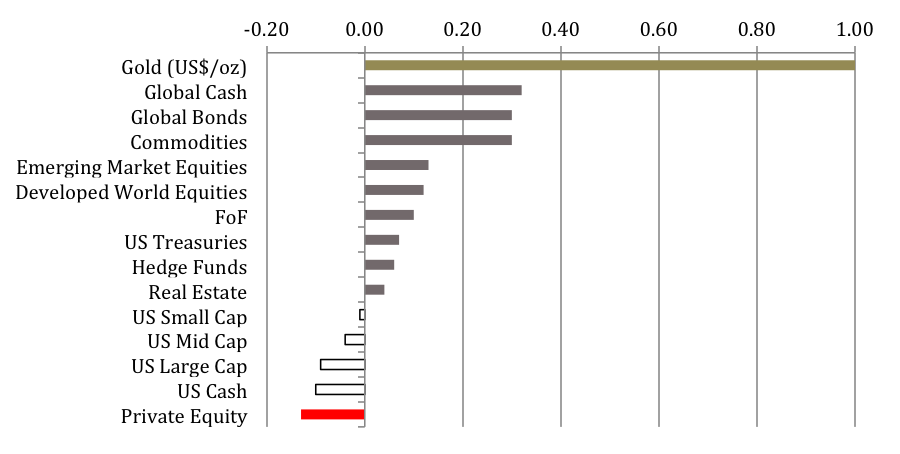
The following graph shows the correlation of the monthly performance of gold to a variety of traditional and alternative asset classes and illustrates the diversification benefits of gold.
Chart 1: Correlation of gold vs. other asset classes in US dollar terms
The table below shows the year-on-year performance of five individual asset classes, which are widely considered to be relevant to Australian investors, compared with a diversified portfolio containing gold priced in Australian dollars. The red dashed line passes through the returns of a portfolio that consists of 100% Australian equities. The white dashed line passes through the returns of a portfolio that is arbitrarily diversified among property (22.5%), cash (22.5%), fixed interest (22.5%), equities (22.5%), and an allocation of 10% in Australian dollar-denominated gold, illustrating the decreased volatility achieved through diversification.
Chart 2: Improved long term average return and lower volatility through diversification
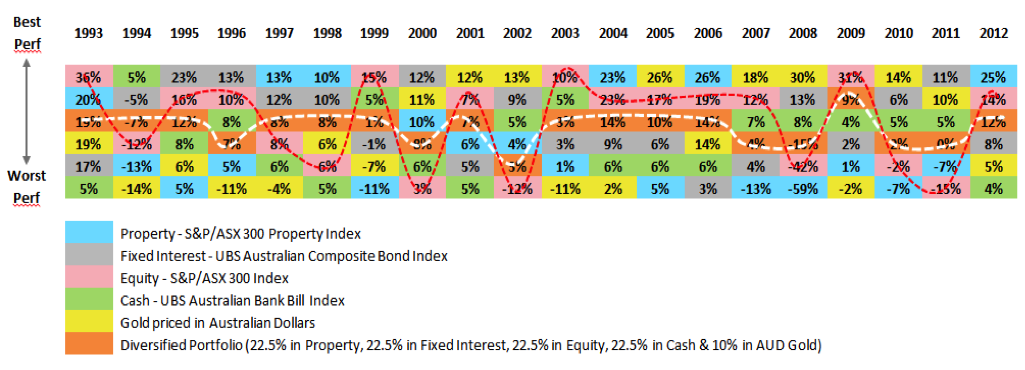
Data source: Thomson Reuters, UBS AG, Investment Solutions
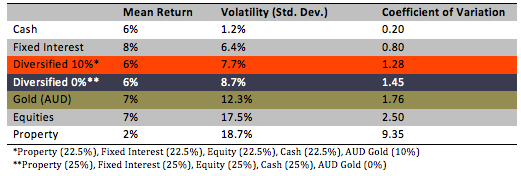
The table below shows the returns and volatility of the example portfolio as discussed above. The diversified portfolio with a ten percent gold allocation has an equal return and less volatility than the diversified portfolio with no gold allocation.
Our calculations show that the example portfolio would have achieved a better risk-return with a coefficient of variation[4] of 1.28, compared with 1.45 for a portfolio of zero percent gold allocation. In other words, for the same average return, the portfolio would have had less risk as measured by the standard deviations.
December 1993 - December 2012

The table below shows how the diversified portfolios with and without gold would have performed against other traditional asset classes over the same period.
December 1993 - December 2012
2. Gold provides tail-risk protection by consistently reducing portfolio losses incurred in extreme circumstances. Gold helps manage risk more effectively by protecting against infrequent or unlikely but consequential negative events, often referred to as “tail risks”.[5]
Short- and medium-term holders can take advantage of the lack of correlation of gold to other assets to achieve better returns during times of turmoil. Long-term holders can manage risk through an allocation to gold, without necessarily sacrificing returns.[6]
Gold returns tend to outperform other assets during periods of economic and financial turmoil, allowing investors to reduce risk when it is most needed.[7] This allows investors to use gold as an asset to hedge risk and reduce losses under extreme market conditions, such as during periods of fiscal or monetary mismanagement, crises of various kinds, or a fundamental change in their dominant currency.[8]
Ultimately, gold can be used to manage risk more effectively and protect an investor’s capital against potential losses during negative economic conditions.[9] As can be seen in the chart below, gold consistently outperforms Real Estate and US Stocks in times of economic crisis. US Bonds had traditionally provided somewhat of a safe haven in times of crisis, however with the failing of the US financial system, this asset class became justifiably less appealing.
Chart 3: Return on alternatives during periods of turmoil, in US dollars[10]
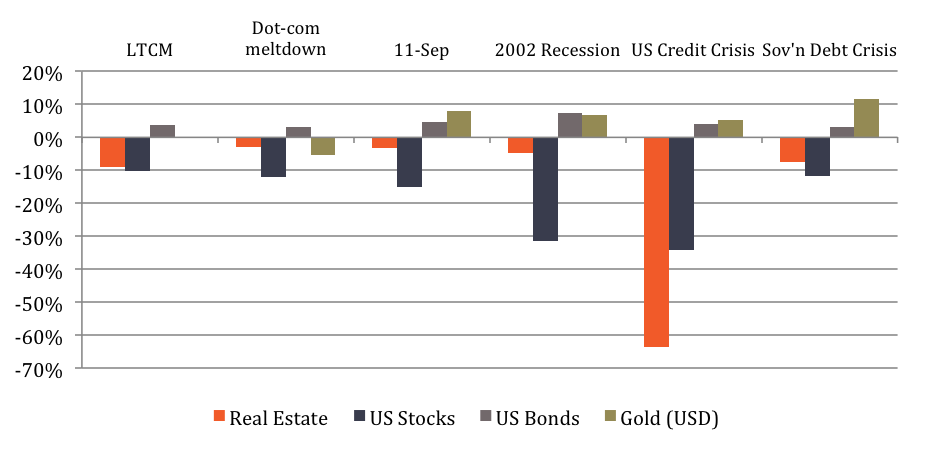
Notes: LTCM: Q3 1998, Dot-com meltdown: Q1 2001, September 11: Q3 2001, 2002 Recession: Q2/Q3 2002, US credit crisis: Q4 2008/Q1 2009, European sovereign debt crisis: Q2 2010. Data source: Thomson Reuters, World Gold Council

3. Gold is a high quality and liquid asset. According to the LBMA, 10.9bn ounces of gold worth approximately USD 15,200bn were traded in the first quarter of 2011.[11] This equates to a daily turnover of around USD 240bn and means a higher daily turnover than most liquid equities, German Bunds, UK Gilts, and most of the currency pairs.[12] By comparison, the daily turnover of Apple shares is about USD 5.5bn.[13]
Additionally, the lack of credit risk associated with holding allocated gold assists investors in balancing the risks present in their fixed income and equity allocations. Allocated physical gold is one of the very few liquid investment assets that involve neither a liability nor a creditor relationship.
[1] World Gold Council, Gold Investor: Risk management and capital preservation (2013).
[2] World Gold Council, An investor’s guide to the gold market, UK edition (2010).
[3] H.M. Markowitz, Portfolio Selection: Efficient Diversification of Investments (1959).
[4] The coefficient of variation allows an investor to determine the amount of risk (volatility) assumed in comparison to return. A lower ratio is preferred from a risk-reward perspective.
[5] World Gold Council, Gold Investor: Risk management and capital preservation (2013).
[6] World Gold Council, Gold: hedging against tail risk (2010).
[7] World Gold Council, Gold: alternative investment, foundation asset (2011).
[8] World Gold Council, Gold As A Strategic Asset (2006).
[9] World Gold Council, Gold: hedging against tail risk (2010).
[10] World Gold Council, Gold: alternative investment, foundation asset (2011).
[11] London Bullion Market Association (LMBA), Gold Turnover Survey for 2011 (2011).
[12] World Gold Council, Gold Investor: Risk management and capital preservation (2013).
[13] Erste Group Research, Goldreport 2012 (2012).
Gold has two primary functions in investors’ portfolios: as a risk management vehicle and as a source of capital preservation.[1]
Gold As a Risk-Management Vehicle:
1. Gold provides excellent portfolio diversification due to its lack of correlation with traditional asset classes. As changes in the gold price are not significantly correlated with changes in the price of other mainstream asset classes, gold brings considerable diversification benefits to an investor’s portfolio. Importantly, this is a relationship that has been shown to hold across markets and over time.[2]
Modern Portfolio Theory suggests that investors should hold a combination of assets in their portfolio that achieves the least volatility for a given return, or achieves the maximum return for a given exposure to volatility.[3] Portfolio diversification allows investors to reduce the likelihood of substantial losses that may be caused by a change in economic conditions that negatively affects one or more asset classes.
The following graph shows the correlation of the monthly performance of gold to a variety of traditional and alternative asset classes and illustrates the diversification benefits of gold.
Chart 1: Correlation of gold vs. other asset classes in US dollar terms
The table below shows the year-on-year performance of five individual asset classes, which are widely considered to be relevant to Australian investors, compared with a diversified portfolio containing gold priced in Australian dollars. The red dashed line passes through the returns of a portfolio that consists of 100% Australian equities. The white dashed line passes through the returns of a portfolio that is arbitrarily diversified among property (22.5%), cash (22.5%), fixed interest (22.5%), equities (22.5%), and an allocation of 10% in Australian dollar-denominated gold, illustrating the decreased volatility achieved through diversification.
Chart 2: Improved long term average return and lower volatility through diversification
Data source: Thomson Reuters, UBS AG, Investment Solutions
The table below shows the returns and volatility of the example portfolio as discussed above. The diversified portfolio with a ten percent gold allocation has an equal return and less volatility than the diversified portfolio with no gold allocation.
Our calculations show that the example portfolio would have achieved a better risk-return with a coefficient of variation[4] of 1.28, compared with 1.45 for a portfolio of zero percent gold allocation. In other words, for the same average return, the portfolio would have had less risk as measured by the standard deviations.
December 1993 - December 2012
The table below shows how the diversified portfolios with and without gold would have performed against other traditional asset classes over the same period.
December 1993 - December 2012
2. Gold provides tail-risk protection by consistently reducing portfolio losses incurred in extreme circumstances. Gold helps manage risk more effectively by protecting against infrequent or unlikely but consequential negative events, often referred to as “tail risks”.[5]
Short- and medium-term holders can take advantage of the lack of correlation of gold to other assets to achieve better returns during times of turmoil. Long-term holders can manage risk through an allocation to gold, without necessarily sacrificing returns.[6]
Gold returns tend to outperform other assets during periods of economic and financial turmoil, allowing investors to reduce risk when it is most needed.[7] This allows investors to use gold as an asset to hedge risk and reduce losses under extreme market conditions, such as during periods of fiscal or monetary mismanagement, crises of various kinds, or a fundamental change in their dominant currency.[8]
Ultimately, gold can be used to manage risk more effectively and protect an investor’s capital against potential losses during negative economic conditions.[9] As can be seen in the chart below, gold consistently outperforms Real Estate and US Stocks in times of economic crisis. US Bonds had traditionally provided somewhat of a safe haven in times of crisis, however with the failing of the US financial system, this asset class became justifiably less appealing.
Chart 3: Return on alternatives during periods of turmoil, in US dollars[10]
Notes: LTCM: Q3 1998, Dot-com meltdown: Q1 2001, September 11: Q3 2001, 2002 Recession: Q2/Q3 2002, US credit crisis: Q4 2008/Q1 2009, European sovereign debt crisis: Q2 2010. Data source: Thomson Reuters, World Gold Council
3. Gold is a high quality and liquid asset. According to the LBMA, 10.9bn ounces of gold worth approximately USD 15,200bn were traded in the first quarter of 2011.[11] This equates to a daily turnover of around USD 240bn and means a higher daily turnover than most liquid equities, German Bunds, UK Gilts, and most of the currency pairs.[12] By comparison, the daily turnover of Apple shares is about USD 5.5bn.[13]
Additionally, the lack of credit risk associated with holding allocated gold assists investors in balancing the risks present in their fixed income and equity allocations. Allocated physical gold is one of the very few liquid investment assets that involve neither a liability nor a creditor relationship.
[1] World Gold Council, Gold Investor: Risk management and capital preservation (2013).
[2] World Gold Council, An investor’s guide to the gold market, UK edition (2010).
[3] H.M. Markowitz, Portfolio Selection: Efficient Diversification of Investments (1959).
[4] The coefficient of variation allows an investor to determine the amount of risk (volatility) assumed in comparison to return. A lower ratio is preferred from a risk-reward perspective.
[5] World Gold Council, Gold Investor: Risk management and capital preservation (2013).
[6] World Gold Council, Gold: hedging against tail risk (2010).
[7] World Gold Council, Gold: alternative investment, foundation asset (2011).
[8] World Gold Council, Gold As A Strategic Asset (2006).
[9] World Gold Council, Gold: hedging against tail risk (2010).
[10] World Gold Council, Gold: alternative investment, foundation asset (2011).
[11] London Bullion Market Association (LMBA), Gold Turnover Survey for 2011 (2011).
[12] World Gold Council, Gold Investor: Risk management and capital preservation (2013).
[13] Erste Group Research, Goldreport 2012 (2012).
Thomas has worked in the investment, funds management and bullion industries for approximately fifteen years. His professional portfolio management career spans the foundation of the boutique investment company, TRAC Financial, to the establishment of a highly successful Absolute Return Fund. Thomas has worked collaboratively in building the complex systems of a cross-border international bullion market with an extensive global network of central bankers, bankers, brokers, fund managers and advisers. His experience, extensive network and broad knowledge of capital markets, enable him to deliver exceptional value and insight to all stakeholders. Thomas has worked in the investment, funds management and bullion industries for approximately fifteen years. His professional portfolio management career spans the foundation of the boutique investment company, TRAC Financial, to the establishment of a highly successful Absolute Return Fund. Thomas has worked collaboratively in building the complex systems of a cross-border international bullion market with an extensive global network of central bankers, bankers, brokers, fund managers and advisers. His experience, extensive network and broad knowledge of capital markets, enable him to deliver exceptional value and insight to all stakeholders.
In this conversation, we sit down with Drew Niv, CSO at ATFX Connect and one of the most influential figures in modern FX.
We speak about market structure, the institutional view on liquidity, and the sharp rise of prop trading, a sector Drew has been commenting on in recent months. Drew explains why he once dismissed prop trading, why his view changed, and what he now thinks the model means for brokers, clients and risk managers.
We explore subscription-fee dependency, the high reneging rate, and the long-term challenge: how brokers can build a more stable and honest version of the model. Drew also talks about the traffic advantage standalone prop firms have built and why brokers may still win in the long run if they take the right approach.
In this conversation, we sit down with Drew Niv, CSO at ATFX Connect and one of the most influential figures in modern FX.
We speak about market structure, the institutional view on liquidity, and the sharp rise of prop trading, a sector Drew has been commenting on in recent months. Drew explains why he once dismissed prop trading, why his view changed, and what he now thinks the model means for brokers, clients and risk managers.
We explore subscription-fee dependency, the high reneging rate, and the long-term challenge: how brokers can build a more stable and honest version of the model. Drew also talks about the traffic advantage standalone prop firms have built and why brokers may still win in the long run if they take the right approach.
In this conversation, we sit down with Drew Niv, CSO at ATFX Connect and one of the most influential figures in modern FX.
We speak about market structure, the institutional view on liquidity, and the sharp rise of prop trading, a sector Drew has been commenting on in recent months. Drew explains why he once dismissed prop trading, why his view changed, and what he now thinks the model means for brokers, clients and risk managers.
We explore subscription-fee dependency, the high reneging rate, and the long-term challenge: how brokers can build a more stable and honest version of the model. Drew also talks about the traffic advantage standalone prop firms have built and why brokers may still win in the long run if they take the right approach.
In this conversation, we sit down with Drew Niv, CSO at ATFX Connect and one of the most influential figures in modern FX.
We speak about market structure, the institutional view on liquidity, and the sharp rise of prop trading, a sector Drew has been commenting on in recent months. Drew explains why he once dismissed prop trading, why his view changed, and what he now thinks the model means for brokers, clients and risk managers.
We explore subscription-fee dependency, the high reneging rate, and the long-term challenge: how brokers can build a more stable and honest version of the model. Drew also talks about the traffic advantage standalone prop firms have built and why brokers may still win in the long run if they take the right approach.
Executive Interview | Remonda Z. Kirketerp Møller| CEO & Founder Muinmos | FMLS:25
In this interview, Remonda Z. Kirketerp Møller, founder of Muinmos, breaks down the state of AI in regtech and what responsible adoption really looks like for brokers. We talk about rising fragmentation, the pressures around compliance accuracy, and why most firms are still in the early stages of AI maturity.
Ramanda also shares insights on regulator sandboxes, shifting expectations around accountability, and the current reality of MiCA licensing and passporting in Europe.
A concise look at where compliance, onboarding, and AI-driven processes are heading next.
In this interview, Remonda Z. Kirketerp Møller, founder of Muinmos, breaks down the state of AI in regtech and what responsible adoption really looks like for brokers. We talk about rising fragmentation, the pressures around compliance accuracy, and why most firms are still in the early stages of AI maturity.
Ramanda also shares insights on regulator sandboxes, shifting expectations around accountability, and the current reality of MiCA licensing and passporting in Europe.
A concise look at where compliance, onboarding, and AI-driven processes are heading next.
In this interview, Remonda Z. Kirketerp Møller, founder of Muinmos, breaks down the state of AI in regtech and what responsible adoption really looks like for brokers. We talk about rising fragmentation, the pressures around compliance accuracy, and why most firms are still in the early stages of AI maturity.
Ramanda also shares insights on regulator sandboxes, shifting expectations around accountability, and the current reality of MiCA licensing and passporting in Europe.
A concise look at where compliance, onboarding, and AI-driven processes are heading next.
In this interview, Remonda Z. Kirketerp Møller, founder of Muinmos, breaks down the state of AI in regtech and what responsible adoption really looks like for brokers. We talk about rising fragmentation, the pressures around compliance accuracy, and why most firms are still in the early stages of AI maturity.
Ramanda also shares insights on regulator sandboxes, shifting expectations around accountability, and the current reality of MiCA licensing and passporting in Europe.
A concise look at where compliance, onboarding, and AI-driven processes are heading next.
In this interview, Remonda Z. Kirketerp Møller, founder of Muinmos, breaks down the state of AI in regtech and what responsible adoption really looks like for brokers. We talk about rising fragmentation, the pressures around compliance accuracy, and why most firms are still in the early stages of AI maturity.
Ramanda also shares insights on regulator sandboxes, shifting expectations around accountability, and the current reality of MiCA licensing and passporting in Europe.
A concise look at where compliance, onboarding, and AI-driven processes are heading next.
In this interview, Remonda Z. Kirketerp Møller, founder of Muinmos, breaks down the state of AI in regtech and what responsible adoption really looks like for brokers. We talk about rising fragmentation, the pressures around compliance accuracy, and why most firms are still in the early stages of AI maturity.
Ramanda also shares insights on regulator sandboxes, shifting expectations around accountability, and the current reality of MiCA licensing and passporting in Europe.
A concise look at where compliance, onboarding, and AI-driven processes are heading next.
In this conversation, we speak with Aydin Bonabi, CEO and co-founder of Surveill, a firm focused on fraud detection and AI-driven compliance tools for financial institutions.
We start with Aydin’s view of the Summit and the challenges brokers face as fraud tactics grow more complex. He explains how firms can stay ahead through real-time signals, data patterns, and early-stage detection.
We also talk about AI training and why compliance teams often struggle to keep models accurate, fair, and aligned with regulatory expectations. Aydin breaks down what “good” AI training looks like inside a financial environment, including the importance of clean data, domain expertise, and human oversight.
He closes with a clear message: fraud is scaling, and so must the tools that stop it.
In this conversation, we speak with Aydin Bonabi, CEO and co-founder of Surveill, a firm focused on fraud detection and AI-driven compliance tools for financial institutions.
We start with Aydin’s view of the Summit and the challenges brokers face as fraud tactics grow more complex. He explains how firms can stay ahead through real-time signals, data patterns, and early-stage detection.
We also talk about AI training and why compliance teams often struggle to keep models accurate, fair, and aligned with regulatory expectations. Aydin breaks down what “good” AI training looks like inside a financial environment, including the importance of clean data, domain expertise, and human oversight.
He closes with a clear message: fraud is scaling, and so must the tools that stop it.
In this conversation, we speak with Aydin Bonabi, CEO and co-founder of Surveill, a firm focused on fraud detection and AI-driven compliance tools for financial institutions.
We start with Aydin’s view of the Summit and the challenges brokers face as fraud tactics grow more complex. He explains how firms can stay ahead through real-time signals, data patterns, and early-stage detection.
We also talk about AI training and why compliance teams often struggle to keep models accurate, fair, and aligned with regulatory expectations. Aydin breaks down what “good” AI training looks like inside a financial environment, including the importance of clean data, domain expertise, and human oversight.
He closes with a clear message: fraud is scaling, and so must the tools that stop it.
In this conversation, we speak with Aydin Bonabi, CEO and co-founder of Surveill, a firm focused on fraud detection and AI-driven compliance tools for financial institutions.
We start with Aydin’s view of the Summit and the challenges brokers face as fraud tactics grow more complex. He explains how firms can stay ahead through real-time signals, data patterns, and early-stage detection.
We also talk about AI training and why compliance teams often struggle to keep models accurate, fair, and aligned with regulatory expectations. Aydin breaks down what “good” AI training looks like inside a financial environment, including the importance of clean data, domain expertise, and human oversight.
He closes with a clear message: fraud is scaling, and so must the tools that stop it.
In this conversation, we speak with Aydin Bonabi, CEO and co-founder of Surveill, a firm focused on fraud detection and AI-driven compliance tools for financial institutions.
We start with Aydin’s view of the Summit and the challenges brokers face as fraud tactics grow more complex. He explains how firms can stay ahead through real-time signals, data patterns, and early-stage detection.
We also talk about AI training and why compliance teams often struggle to keep models accurate, fair, and aligned with regulatory expectations. Aydin breaks down what “good” AI training looks like inside a financial environment, including the importance of clean data, domain expertise, and human oversight.
He closes with a clear message: fraud is scaling, and so must the tools that stop it.
In this conversation, we speak with Aydin Bonabi, CEO and co-founder of Surveill, a firm focused on fraud detection and AI-driven compliance tools for financial institutions.
We start with Aydin’s view of the Summit and the challenges brokers face as fraud tactics grow more complex. He explains how firms can stay ahead through real-time signals, data patterns, and early-stage detection.
We also talk about AI training and why compliance teams often struggle to keep models accurate, fair, and aligned with regulatory expectations. Aydin breaks down what “good” AI training looks like inside a financial environment, including the importance of clean data, domain expertise, and human oversight.
He closes with a clear message: fraud is scaling, and so must the tools that stop it.
Exness expands its presence in Africa: Inside our interview with Paul Margarites in Cape Town
Finance Magnates met with Paul Margarites, Exness regional commercial director for Sub-Saharan Africa, during a visit to the firm’s office opening in Cape Town. In this talk, led by Andrea Badiola Mateos, Co-CEO at Finance Magnates, Paul shares views on the South African trading space, local user behavior, mobile trends, regulation, team growth, and how Exness plans to grow in more markets across the region. @Exness
Read the article at: https://www.financemagnates.com/thought-leadership/exness-expands-its-presence-in-africa-inside-our-interview-with-paul-margarites/
#exness #financemagnates #exnesstrading #CFDtrading #tradeonline #africanews #capetown
Finance Magnates met with Paul Margarites, Exness regional commercial director for Sub-Saharan Africa, during a visit to the firm’s office opening in Cape Town. In this talk, led by Andrea Badiola Mateos, Co-CEO at Finance Magnates, Paul shares views on the South African trading space, local user behavior, mobile trends, regulation, team growth, and how Exness plans to grow in more markets across the region. @Exness
Read the article at: https://www.financemagnates.com/thought-leadership/exness-expands-its-presence-in-africa-inside-our-interview-with-paul-margarites/
#exness #financemagnates #exnesstrading #CFDtrading #tradeonline #africanews #capetown
Finance Magnates met with Paul Margarites, Exness regional commercial director for Sub-Saharan Africa, during a visit to the firm’s office opening in Cape Town. In this talk, led by Andrea Badiola Mateos, Co-CEO at Finance Magnates, Paul shares views on the South African trading space, local user behavior, mobile trends, regulation, team growth, and how Exness plans to grow in more markets across the region. @Exness
Read the article at: https://www.financemagnates.com/thought-leadership/exness-expands-its-presence-in-africa-inside-our-interview-with-paul-margarites/
#exness #financemagnates #exnesstrading #CFDtrading #tradeonline #africanews #capetown
Finance Magnates met with Paul Margarites, Exness regional commercial director for Sub-Saharan Africa, during a visit to the firm’s office opening in Cape Town. In this talk, led by Andrea Badiola Mateos, Co-CEO at Finance Magnates, Paul shares views on the South African trading space, local user behavior, mobile trends, regulation, team growth, and how Exness plans to grow in more markets across the region. @Exness
Read the article at: https://www.financemagnates.com/thought-leadership/exness-expands-its-presence-in-africa-inside-our-interview-with-paul-margarites/
#exness #financemagnates #exnesstrading #CFDtrading #tradeonline #africanews #capetown
Finance Magnates met with Paul Margarites, Exness regional commercial director for Sub-Saharan Africa, during a visit to the firm’s office opening in Cape Town. In this talk, led by Andrea Badiola Mateos, Co-CEO at Finance Magnates, Paul shares views on the South African trading space, local user behavior, mobile trends, regulation, team growth, and how Exness plans to grow in more markets across the region. @Exness
Read the article at: https://www.financemagnates.com/thought-leadership/exness-expands-its-presence-in-africa-inside-our-interview-with-paul-margarites/
#exness #financemagnates #exnesstrading #CFDtrading #tradeonline #africanews #capetown
Finance Magnates met with Paul Margarites, Exness regional commercial director for Sub-Saharan Africa, during a visit to the firm’s office opening in Cape Town. In this talk, led by Andrea Badiola Mateos, Co-CEO at Finance Magnates, Paul shares views on the South African trading space, local user behavior, mobile trends, regulation, team growth, and how Exness plans to grow in more markets across the region. @Exness
Read the article at: https://www.financemagnates.com/thought-leadership/exness-expands-its-presence-in-africa-inside-our-interview-with-paul-margarites/
#exness #financemagnates #exnesstrading #CFDtrading #tradeonline #africanews #capetown
Executive Interview | Jas Shah | FMLS:25
Interview with Jas Shah
Builder | Adviser | Fintech Writer | Product Strategist
In this episode, Jonathan Fine sat down with Jas Shah, one of the most thoughtful voices in global fintech. Known for his work across advisory, product, stablecoins, and his widely read writing, Jas brings a rare combination of industry insight and plain-spoken clarity.
We talk about his first impression of the Summit, the projects that keep him busy today, and how they connect to the stablecoin panel he joined. Jas shares his view on the link between fintech, wealthtech and retail brokers, especially as firms like Revolut, eToro and Trading212 blur long-standing lines in the market.
We also explore what stablecoin adoption might look like for retail investment platforms, including a few product and UX angles that are not obvious at first glance.
To close, Jas explains how he thinks about writing, and how he approaches “shipping” pieces that spark debate across the industry.
Interview with Jas Shah
Builder | Adviser | Fintech Writer | Product Strategist
In this episode, Jonathan Fine sat down with Jas Shah, one of the most thoughtful voices in global fintech. Known for his work across advisory, product, stablecoins, and his widely read writing, Jas brings a rare combination of industry insight and plain-spoken clarity.
We talk about his first impression of the Summit, the projects that keep him busy today, and how they connect to the stablecoin panel he joined. Jas shares his view on the link between fintech, wealthtech and retail brokers, especially as firms like Revolut, eToro and Trading212 blur long-standing lines in the market.
We also explore what stablecoin adoption might look like for retail investment platforms, including a few product and UX angles that are not obvious at first glance.
To close, Jas explains how he thinks about writing, and how he approaches “shipping” pieces that spark debate across the industry.
Interview with Jas Shah
Builder | Adviser | Fintech Writer | Product Strategist
In this episode, Jonathan Fine sat down with Jas Shah, one of the most thoughtful voices in global fintech. Known for his work across advisory, product, stablecoins, and his widely read writing, Jas brings a rare combination of industry insight and plain-spoken clarity.
We talk about his first impression of the Summit, the projects that keep him busy today, and how they connect to the stablecoin panel he joined. Jas shares his view on the link between fintech, wealthtech and retail brokers, especially as firms like Revolut, eToro and Trading212 blur long-standing lines in the market.
We also explore what stablecoin adoption might look like for retail investment platforms, including a few product and UX angles that are not obvious at first glance.
To close, Jas explains how he thinks about writing, and how he approaches “shipping” pieces that spark debate across the industry.
Interview with Jas Shah
Builder | Adviser | Fintech Writer | Product Strategist
In this episode, Jonathan Fine sat down with Jas Shah, one of the most thoughtful voices in global fintech. Known for his work across advisory, product, stablecoins, and his widely read writing, Jas brings a rare combination of industry insight and plain-spoken clarity.
We talk about his first impression of the Summit, the projects that keep him busy today, and how they connect to the stablecoin panel he joined. Jas shares his view on the link between fintech, wealthtech and retail brokers, especially as firms like Revolut, eToro and Trading212 blur long-standing lines in the market.
We also explore what stablecoin adoption might look like for retail investment platforms, including a few product and UX angles that are not obvious at first glance.
To close, Jas explains how he thinks about writing, and how he approaches “shipping” pieces that spark debate across the industry.
Interview with Jas Shah
Builder | Adviser | Fintech Writer | Product Strategist
In this episode, Jonathan Fine sat down with Jas Shah, one of the most thoughtful voices in global fintech. Known for his work across advisory, product, stablecoins, and his widely read writing, Jas brings a rare combination of industry insight and plain-spoken clarity.
We talk about his first impression of the Summit, the projects that keep him busy today, and how they connect to the stablecoin panel he joined. Jas shares his view on the link between fintech, wealthtech and retail brokers, especially as firms like Revolut, eToro and Trading212 blur long-standing lines in the market.
We also explore what stablecoin adoption might look like for retail investment platforms, including a few product and UX angles that are not obvious at first glance.
To close, Jas explains how he thinks about writing, and how he approaches “shipping” pieces that spark debate across the industry.
Interview with Jas Shah
Builder | Adviser | Fintech Writer | Product Strategist
In this episode, Jonathan Fine sat down with Jas Shah, one of the most thoughtful voices in global fintech. Known for his work across advisory, product, stablecoins, and his widely read writing, Jas brings a rare combination of industry insight and plain-spoken clarity.
We talk about his first impression of the Summit, the projects that keep him busy today, and how they connect to the stablecoin panel he joined. Jas shares his view on the link between fintech, wealthtech and retail brokers, especially as firms like Revolut, eToro and Trading212 blur long-standing lines in the market.
We also explore what stablecoin adoption might look like for retail investment platforms, including a few product and UX angles that are not obvious at first glance.
To close, Jas explains how he thinks about writing, and how he approaches “shipping” pieces that spark debate across the industry.