XRP trades at $2.058 on January 13, 2026, after seven consecutive declining sessions from $2.357 peak, the worst losing streak since November 2025.
It could fall as much as 40% from current levels to ultimate bearish target of $1.25, with intermediate targets at $1.90, $1.80, and $1.61.
However in the longerm the crypto token may reach $8, according to big institutional players and their XRP price predictions.
Why XRP price is going down today? Check the current XRP/USDT technical analysis
XRP trades
at $2.058 on Tuesday, January 13, 2026, facing its seventh consecutive session
of declines, the worst losing streak in two months. The cryptocurrency has
fallen 13% from its $2.357 peak reached on January 6, when CNBC called it
"the hottest crypto trade of the year" with analysts predicting
$8 targets for 2026.
Now XRP moves
near a critical $2.00 support after rejecting the 200-day EMA at $2.56 for the
third time, a pattern that has consistently preceded multi-week corrections.
According
to my technical analysis, XRP has broken below the 50-day EMA at $2.07,
signaling a deeper correction is unfolding. The immediate target is the round
$2.00 level, followed by November lows around $1.90, December lows at $1.80,
April minimums at $1.61, and an ultimate bearish target of $1.25, representing
potential 40% decline from current levels.
Why XRP Price Is Going
Down? Seven-Session Losing Streak
Although
XRP prices rose 0.31% during today's session, Tuesday, January 13, 2026, and
are defending the $2.05 level, they have behind them a series of seven
consecutive declining sessions, the worst such sequence in two months.
The
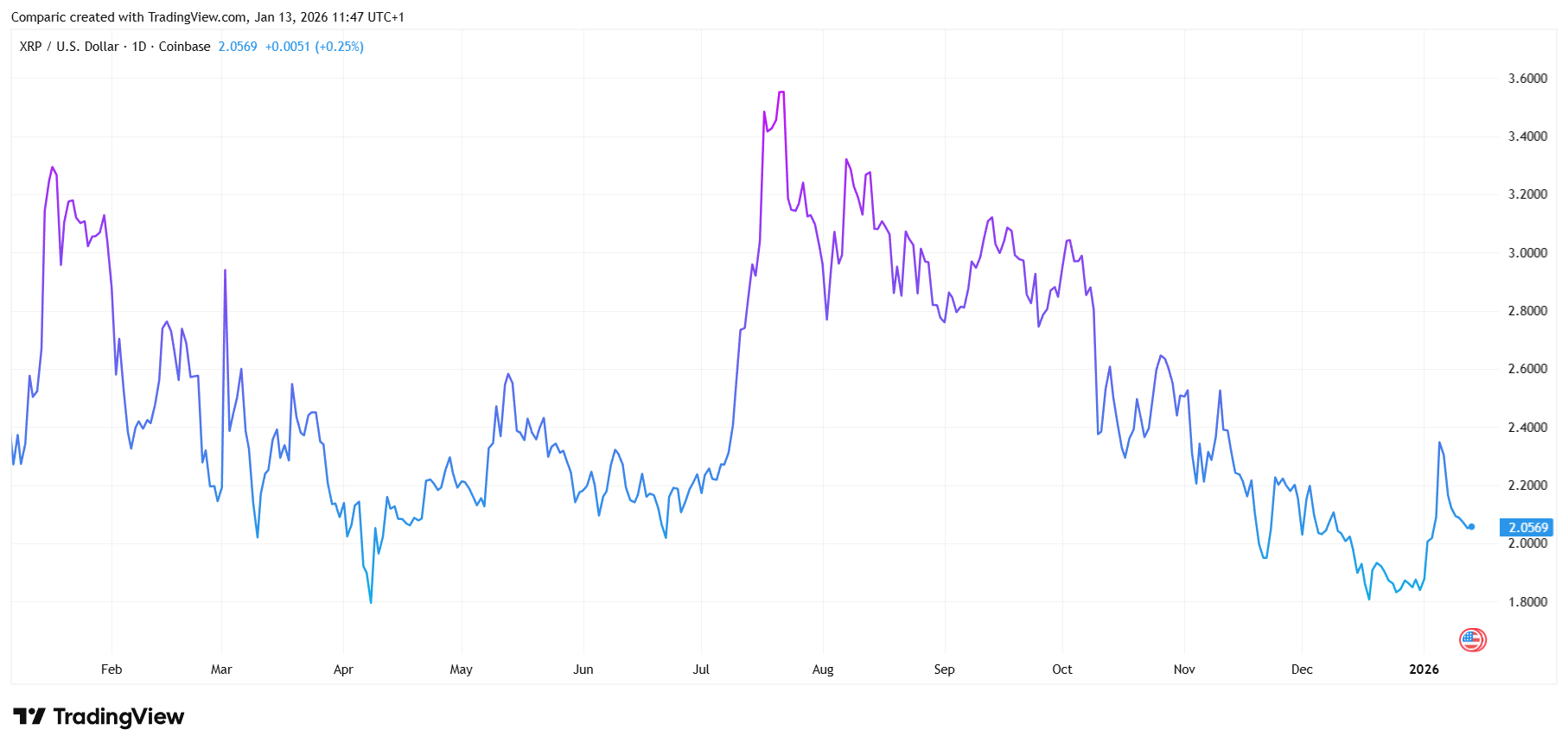
depreciation follows after XRP entered 2026 strongly, rising five consecutive
sessions from $1.84 to $2.357 on January 6, testing nine-week highs. Just one
week ago, I reported XRP
"crushed Bitcoin and Ethereum returns" with 25% January gains and bullish $8
predictions.
However,
the cryptocurrency met stronger supply resistance at the 200-day exponential
moving average around $2.56, the third rejection at this critical level in
recent months.
As shown by
my technical analysis, we are falling below the 50 EMA at $2.02, as a result of
which a correction is about to unfold. The breakdown of this key support
signals momentum has shifted decisively bearish.
Key
technical levels:
Current price: $2.058 (down 13% from
January 6 peak)
The first
short-term target is obviously the round level of $2.00. MEXC notes "$2.00
has acted as a formidable barrier that has capped rallies in previous
cycles". Losing $2.00 opens the door to $1.90 and $1.80 December lows.
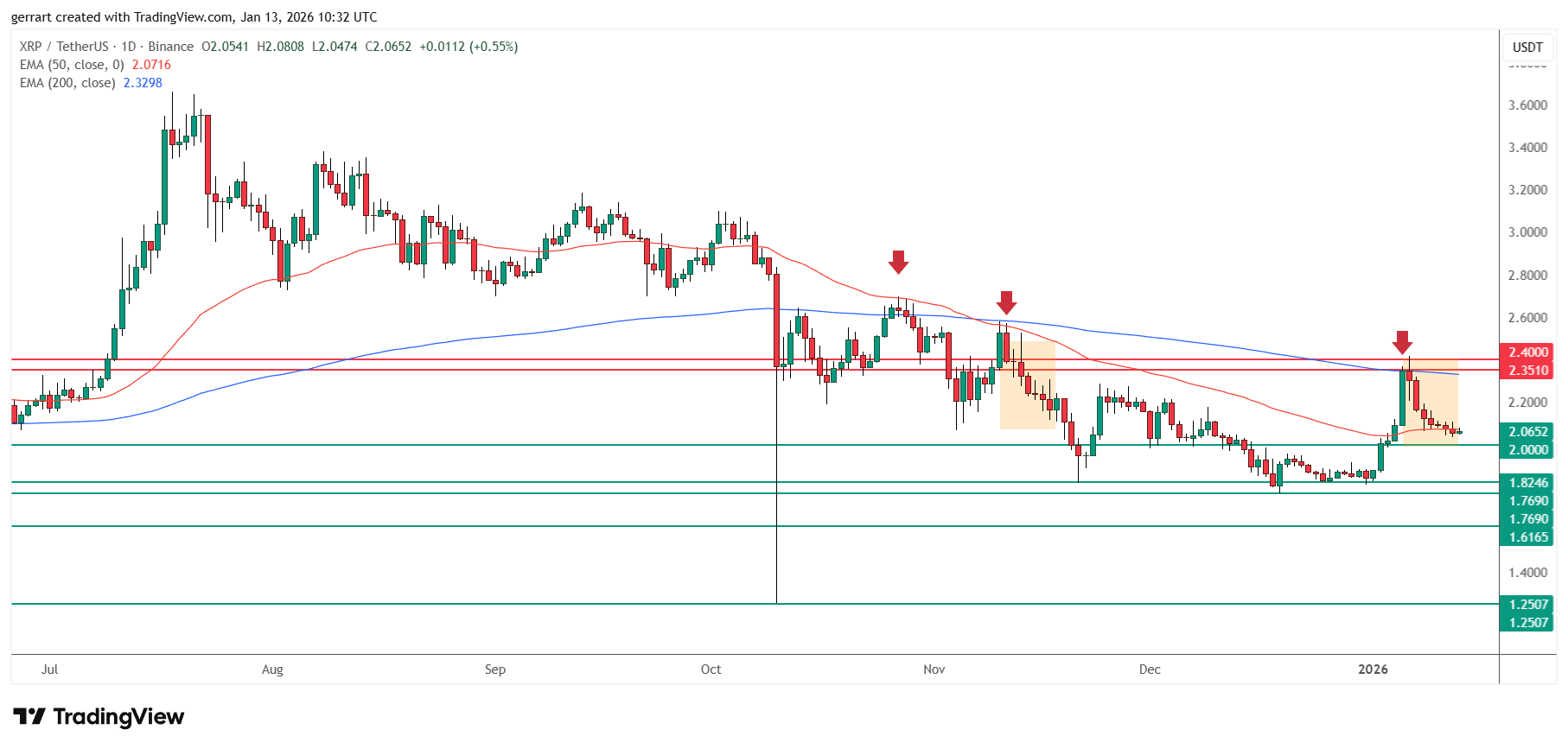
XRP price technical analysis on a daily chart. Source: Tradingview.com
The next
two medium-term decline levels are $1.61, matching the year low, and my ultimate
target level is $1.25 per XRP, the flash crash low from October 10. As a
result, from current levels, XRP could fall by as much as 40%.
CFD brokers like Axi recently expanded offerings to over 150 crypto perpetual contracts, enabling retail traders to access leveraged exposure to tokens, including XRP.
Crypto Market Sentiment
Weighs on XRP
Broader
crypto market weakness explains much of XRP's decline. "Crypto markets are
trading sideways and sentiment is quite low. BTC Price action has been stuck in
the $84,000-$95,000 range," explains James Harris, CEO of Tesseract Group.
"So
borrowing rates are lower, with lenders having to drop rates to find borrowing
demand," visible in both OTC lending markets and across DeFi platforms.
Despite
Federal Reserve rate cuts, three in 2025 with two more expected in 2026
bringing rates to around 3.25%, the anticipated boost to risk assets hasn't
arrived. "It is hoped that with this lower 'risk free rate' crypto markets
will begin to look more attractive and encourage bullish, risk taking
behaviour," Harris observes. "This hasn't materialised yet
though."
For
real-time XRP technical updates follow me on X (Twitter) @ChmielDk. I provide moving average analysis,
support/resistance levels, and crypto sentiment insights.
XRP Price Analysis, FAQ
Why is XRP falling today?
XRP fell
seven consecutive sessions from $2.357 (January 6) to $2.058 (January 13), worst
streak since November 2025. According to my technical analysis, XRP rejected
200 EMA at $2.56 for the third time and broke below 50 EMA at $2.02, signaling
correction with $2.00 support critical.
What is XRP price today?
XRP trades
at $2.058 on January 13, 2026, down 13% from $2.357 peak reached January 6.
Price defending $2.00 psychological support after rejecting 200-day moving
average resistance for third time in recent months.
How low can XRP go?
According
to my technical analysis, XRP targets: $2.00 (immediate), $1.90 (November
lows), $1.80 (December lows), $1.61 (April minimums), and $1.25 (October Flash
Crash, 40% decline from current). Break below $2.00 activates deeper correction
toward $1.80-$1.90 zone.
XRP trades
at $2.058 on Tuesday, January 13, 2026, facing its seventh consecutive session
of declines, the worst losing streak in two months. The cryptocurrency has
fallen 13% from its $2.357 peak reached on January 6, when CNBC called it
"the hottest crypto trade of the year" with analysts predicting
$8 targets for 2026.
Now XRP moves
near a critical $2.00 support after rejecting the 200-day EMA at $2.56 for the
third time, a pattern that has consistently preceded multi-week corrections.
According
to my technical analysis, XRP has broken below the 50-day EMA at $2.07,
signaling a deeper correction is unfolding. The immediate target is the round
$2.00 level, followed by November lows around $1.90, December lows at $1.80,
April minimums at $1.61, and an ultimate bearish target of $1.25, representing
potential 40% decline from current levels.
Why XRP Price Is Going
Down? Seven-Session Losing Streak
Although
XRP prices rose 0.31% during today's session, Tuesday, January 13, 2026, and
are defending the $2.05 level, they have behind them a series of seven
consecutive declining sessions, the worst such sequence in two months.
The
depreciation follows after XRP entered 2026 strongly, rising five consecutive
sessions from $1.84 to $2.357 on January 6, testing nine-week highs. Just one
week ago, I reported XRP
"crushed Bitcoin and Ethereum returns" with 25% January gains and bullish $8
predictions.
However,
the cryptocurrency met stronger supply resistance at the 200-day exponential
moving average around $2.56, the third rejection at this critical level in
recent months.
As shown by
my technical analysis, we are falling below the 50 EMA at $2.02, as a result of
which a correction is about to unfold. The breakdown of this key support
signals momentum has shifted decisively bearish.
Key
technical levels:
Current price: $2.058 (down 13% from
January 6 peak)
The first
short-term target is obviously the round level of $2.00. MEXC notes "$2.00
has acted as a formidable barrier that has capped rallies in previous
cycles". Losing $2.00 opens the door to $1.90 and $1.80 December lows.
XRP price technical analysis on a daily chart. Source: Tradingview.com
The next
two medium-term decline levels are $1.61, matching the year low, and my ultimate
target level is $1.25 per XRP, the flash crash low from October 10. As a
result, from current levels, XRP could fall by as much as 40%.
CFD brokers like Axi recently expanded offerings to over 150 crypto perpetual contracts, enabling retail traders to access leveraged exposure to tokens, including XRP.
Crypto Market Sentiment
Weighs on XRP
Broader
crypto market weakness explains much of XRP's decline. "Crypto markets are
trading sideways and sentiment is quite low. BTC Price action has been stuck in
the $84,000-$95,000 range," explains James Harris, CEO of Tesseract Group.
"So
borrowing rates are lower, with lenders having to drop rates to find borrowing
demand," visible in both OTC lending markets and across DeFi platforms.
Despite
Federal Reserve rate cuts, three in 2025 with two more expected in 2026
bringing rates to around 3.25%, the anticipated boost to risk assets hasn't
arrived. "It is hoped that with this lower 'risk free rate' crypto markets
will begin to look more attractive and encourage bullish, risk taking
behaviour," Harris observes. "This hasn't materialised yet
though."
For
real-time XRP technical updates follow me on X (Twitter) @ChmielDk. I provide moving average analysis,
support/resistance levels, and crypto sentiment insights.
XRP Price Analysis, FAQ
Why is XRP falling today?
XRP fell
seven consecutive sessions from $2.357 (January 6) to $2.058 (January 13), worst
streak since November 2025. According to my technical analysis, XRP rejected
200 EMA at $2.56 for the third time and broke below 50 EMA at $2.02, signaling
correction with $2.00 support critical.
What is XRP price today?
XRP trades
at $2.058 on January 13, 2026, down 13% from $2.357 peak reached January 6.
Price defending $2.00 psychological support after rejecting 200-day moving
average resistance for third time in recent months.
How low can XRP go?
According
to my technical analysis, XRP targets: $2.00 (immediate), $1.90 (November
lows), $1.80 (December lows), $1.61 (April minimums), and $1.25 (October Flash
Crash, 40% decline from current). Break below $2.00 activates deeper correction
toward $1.80-$1.90 zone.
Damian Chmiel is a Senior Analyst & Editor at Finance Magnates with more than 15 years of experience in the CFD and online trading industry. Active as both a trader and journalist since 2010, he focuses on broker coverage, fintech innovation, and regulatory developments across Europe, the Middle East, and Asia.
His work includes interviews with C-level leaders at major brokerages and fintech platforms, as well as co-authoring Finance Magnates’ quarterly industry benchmarking reports. Damian’s reporting is data-driven, market-aware, and grounded in direct industry engagement. His analysis and commentary have also been cited by external media outlets, including Investing.com, Binance, The Asset, Stockhead, and Dispatch.
Education:
MA in Finance and Accounting, Cracow University of Economics
Why Is Gold Going Down? Gold Price Falls Below 200 EMA And This XAU/USD Forecasts Shows -20% Target
Featured Videos
FM Daily Brief – 11 June 2026
Today’s Thursday, the 11th of June 2026, and these are our main stories: Spain moves to classify certain futures products as CFDs for retail investors, IUX reports more than $1.5 trillion in monthly trading volume, and a closer look at why crypto still struggles to reach the mainstream.
In this video, we review @AxiOfficialChannel , a multi-asset broker offering access to forex and CFD markets through MetaTrader 4, MetaTrader 5, the Axi Trading App, and copy trading solutions.
We examine the broker’s regulatory framework, platform offering, market coverage, and customer support structure. We also explore key features such as available trading instruments, swap-free account options, funding considerations, and multilingual support.
Watch the full video for a clear, fact-based overview of Axi’s products, trading tools, and overall broker offering.
#Axi #ForexBroker #CFDTrading #FinanceMagnates #Trading #BrokerReview #OnlineTrading
In this video, we review @AxiOfficialChannel , a multi-asset broker offering access to forex and CFD markets through MetaTrader 4, MetaTrader 5, the Axi Trading App, and copy trading solutions.
We examine the broker’s regulatory framework, platform offering, market coverage, and customer support structure. We also explore key features such as available trading instruments, swap-free account options, funding considerations, and multilingual support.
Watch the full video for a clear, fact-based overview of Axi’s products, trading tools, and overall broker offering.
#Axi #ForexBroker #CFDTrading #FinanceMagnates #Trading #BrokerReview #OnlineTrading
In this video, we review @AxiOfficialChannel , a multi-asset broker offering access to forex and CFD markets through MetaTrader 4, MetaTrader 5, the Axi Trading App, and copy trading solutions.
We examine the broker’s regulatory framework, platform offering, market coverage, and customer support structure. We also explore key features such as available trading instruments, swap-free account options, funding considerations, and multilingual support.
Watch the full video for a clear, fact-based overview of Axi’s products, trading tools, and overall broker offering.
#Axi #ForexBroker #CFDTrading #FinanceMagnates #Trading #BrokerReview #OnlineTrading
In this video, we review @AxiOfficialChannel , a multi-asset broker offering access to forex and CFD markets through MetaTrader 4, MetaTrader 5, the Axi Trading App, and copy trading solutions.
We examine the broker’s regulatory framework, platform offering, market coverage, and customer support structure. We also explore key features such as available trading instruments, swap-free account options, funding considerations, and multilingual support.
Watch the full video for a clear, fact-based overview of Axi’s products, trading tools, and overall broker offering.
#Axi #ForexBroker #CFDTrading #FinanceMagnates #Trading #BrokerReview #OnlineTrading
In this video, we review @AxiOfficialChannel , a multi-asset broker offering access to forex and CFD markets through MetaTrader 4, MetaTrader 5, the Axi Trading App, and copy trading solutions.
We examine the broker’s regulatory framework, platform offering, market coverage, and customer support structure. We also explore key features such as available trading instruments, swap-free account options, funding considerations, and multilingual support.
Watch the full video for a clear, fact-based overview of Axi’s products, trading tools, and overall broker offering.
#Axi #ForexBroker #CFDTrading #FinanceMagnates #Trading #BrokerReview #OnlineTrading
In this video, we review @AxiOfficialChannel , a multi-asset broker offering access to forex and CFD markets through MetaTrader 4, MetaTrader 5, the Axi Trading App, and copy trading solutions.
We examine the broker’s regulatory framework, platform offering, market coverage, and customer support structure. We also explore key features such as available trading instruments, swap-free account options, funding considerations, and multilingual support.
Watch the full video for a clear, fact-based overview of Axi’s products, trading tools, and overall broker offering.
#Axi #ForexBroker #CFDTrading #FinanceMagnates #Trading #BrokerReview #OnlineTrading
Multi-Asset or Die: The New Brokerage Playbook
This panel will explore how firms are moving beyond CFDs into crypto, perpetuals, equities, and multi‑asset offerings, and the challenges they face across regulation, technology, liquidity, and risk management. It examines what is driving the shift, what it takes to execute it successfully, and how brokers can position themselves for the next phase of growth.
Beyond Reach? Retail Investor Acquisition Across APAC
APAC accounts for two-thirds of global retail trading traffic, but with differences of language, regulation, and trader profile, the region's growth is ag great as complexity.
This session gathers CMOs, heads of acquisition, and IB relationship managers to examine what actually works, channel by channel, market by market.
Attendees will walk away with:
A clear view of which channels deliver funded, retained traders across Singapore, Japan, and Southeast Asia
Understanding of how to structure IB partnerships for LTV, not first deposit
Insight into what localization actually costs beyond the translation budget
Perspective on how ad restrictions, crypto promotion limits, and bundling rules differ across APAC jurisdictions
A read on whether the super-app model changes acquisition economics for retail investing platforms
APAC accounts for two-thirds of global retail trading traffic, but with differences of language, regulation, and trader profile, the region's growth is ag great as complexity.
This session gathers CMOs, heads of acquisition, and IB relationship managers to examine what actually works, channel by channel, market by market.
Attendees will walk away with:
A clear view of which channels deliver funded, retained traders across Singapore, Japan, and Southeast Asia
Understanding of how to structure IB partnerships for LTV, not first deposit
Insight into what localization actually costs beyond the translation budget
Perspective on how ad restrictions, crypto promotion limits, and bundling rules differ across APAC jurisdictions
A read on whether the super-app model changes acquisition economics for retail investing platforms
APAC accounts for two-thirds of global retail trading traffic, but with differences of language, regulation, and trader profile, the region's growth is ag great as complexity.
This session gathers CMOs, heads of acquisition, and IB relationship managers to examine what actually works, channel by channel, market by market.
Attendees will walk away with:
A clear view of which channels deliver funded, retained traders across Singapore, Japan, and Southeast Asia
Understanding of how to structure IB partnerships for LTV, not first deposit
Insight into what localization actually costs beyond the translation budget
Perspective on how ad restrictions, crypto promotion limits, and bundling rules differ across APAC jurisdictions
A read on whether the super-app model changes acquisition economics for retail investing platforms
APAC accounts for two-thirds of global retail trading traffic, but with differences of language, regulation, and trader profile, the region's growth is ag great as complexity.
This session gathers CMOs, heads of acquisition, and IB relationship managers to examine what actually works, channel by channel, market by market.
Attendees will walk away with:
A clear view of which channels deliver funded, retained traders across Singapore, Japan, and Southeast Asia
Understanding of how to structure IB partnerships for LTV, not first deposit
Insight into what localization actually costs beyond the translation budget
Perspective on how ad restrictions, crypto promotion limits, and bundling rules differ across APAC jurisdictions
A read on whether the super-app model changes acquisition economics for retail investing platforms
APAC accounts for two-thirds of global retail trading traffic, but with differences of language, regulation, and trader profile, the region's growth is ag great as complexity.
This session gathers CMOs, heads of acquisition, and IB relationship managers to examine what actually works, channel by channel, market by market.
Attendees will walk away with:
A clear view of which channels deliver funded, retained traders across Singapore, Japan, and Southeast Asia
Understanding of how to structure IB partnerships for LTV, not first deposit
Insight into what localization actually costs beyond the translation budget
Perspective on how ad restrictions, crypto promotion limits, and bundling rules differ across APAC jurisdictions
A read on whether the super-app model changes acquisition economics for retail investing platforms
APAC accounts for two-thirds of global retail trading traffic, but with differences of language, regulation, and trader profile, the region's growth is ag great as complexity.
This session gathers CMOs, heads of acquisition, and IB relationship managers to examine what actually works, channel by channel, market by market.
Attendees will walk away with:
A clear view of which channels deliver funded, retained traders across Singapore, Japan, and Southeast Asia
Understanding of how to structure IB partnerships for LTV, not first deposit
Insight into what localization actually costs beyond the translation budget
Perspective on how ad restrictions, crypto promotion limits, and bundling rules differ across APAC jurisdictions
A read on whether the super-app model changes acquisition economics for retail investing platforms