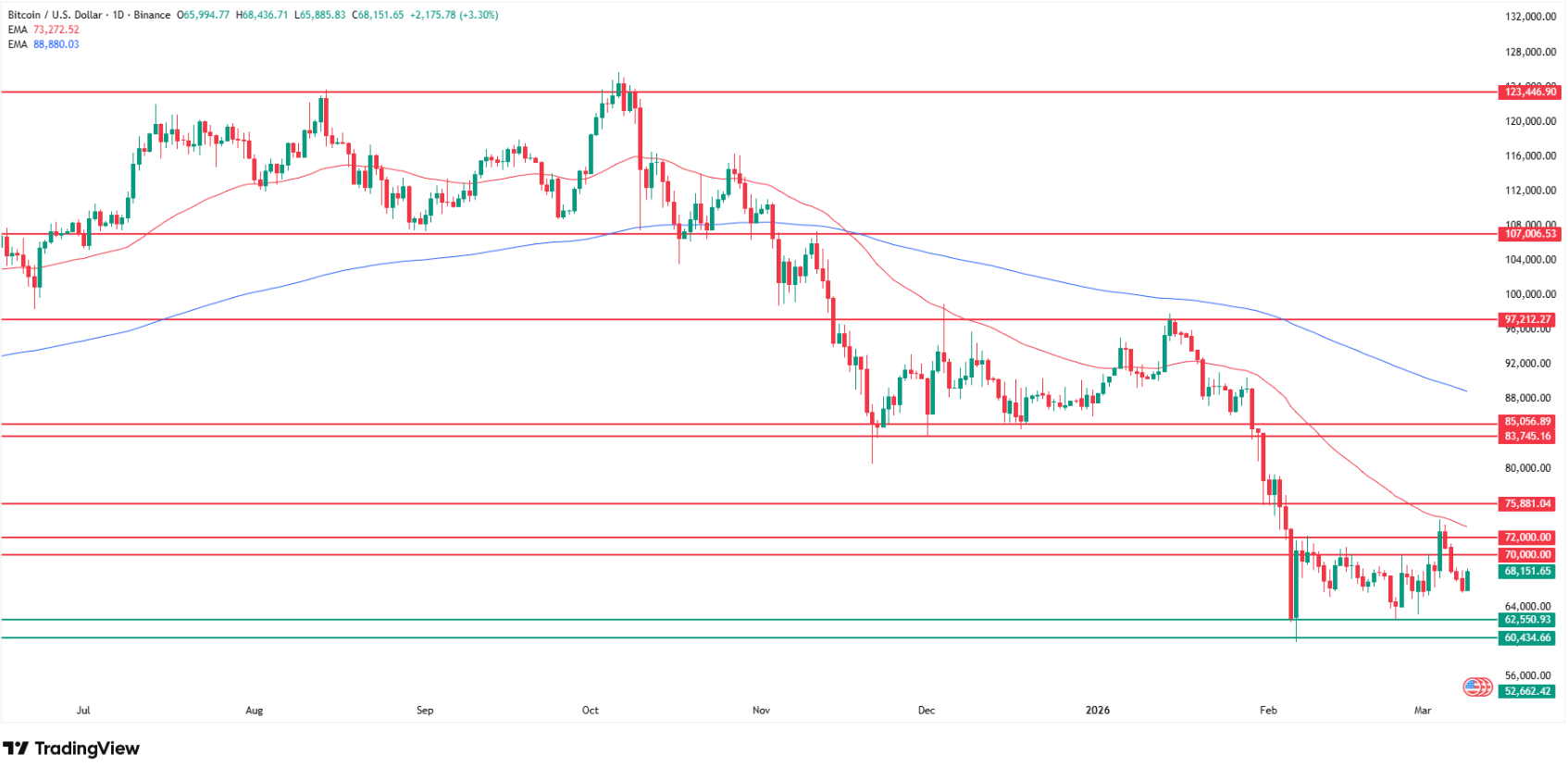
Bitcoin fell for four consecutive sessions from $73,000 to $66,100 before rebounding 3.7% to $68,404 on Monday March 9.
The technical analysis shows BTC still trapped in the same consolidation, with the 200 EMA near $88,000 required to confirm any trend reversal.
A structural shift in the Bitcoin options market - with options OI overtaking futures at $74.1B vs $65.2B - is changing how institutions hedge.
Why Bitcoin is going down today? Let's check current BTC price technical analysis and forecasts
Bitcoin (BTC) price dropped
for four straight sessions last week, sliding from around $73,000
to as low as $66,100, its sharpest losing streak in over a month. On Monday,
March 9, it is bouncing back, up 3.7% to $68,404 , but as my
technical analysis shows, this changes very little about the bigger picture. We
are still inside the same consolidation box we have been watching since late
2024, and the macro forces that produced last week's selloff have not
disappeared.
In this article, I will explain why Bitcoin is going down,
break down BTC/USDT technical chart, and examine what the structural shift in
Bitcoin's options market means for BTC price prediction in 2026. Based on my
over 15 years of experience as an analyst and retail investor, here is what I
am watching.
Follow me on X for real-time crypto market
analysis: @ChmielDk
Tariffs compounded the picture. Trump's global tariff
announcements have established a consistent pattern in this cycle: every major
escalation triggers a Bitcoin selloff, with correlation to the S&P 500
running at 0.5-0.88 during periods of macro stress. The previous analysis covering Bitcoin's $72K test noted
exactly this dynamic: BTC remains deeply sensitive to liquidity conditions, and
every tariff announcement tightens those conditions by pushing rate cut
expectations further out.
The mechanics accelerated the fundamental picture. $240
million in forced long liquidations on a single Monday, continued ETF
outflows, and whale selling - on-chain data showed large holders moving
significant BTC to exchanges - turned what might have been a contained dip into
a four-session grind lower. Bitcoin miners with AI and HPC data center exposure
also sold BTC to manage balance sheet stress as tech stocks corrected
simultaneously.
Bitcoin Technical Analysis: The Same Box, Again
As my technical analysis shows, Bitcoin has dropped four
consecutive sessions in a row - its worst such streak in a month - falling from
around $73,000 to $66,100 in direct response to the geopolitical pressures
described above. Monday's session is bringing a recovery, and as of March 9,
2026, BTC is up 3.7% and trading at $68,404. Technically, however,
very little has changed.
We remain inside the same consolidation that has defined
this market since late 2024. The lower boundary sits at $60,000-$62,000,
a level I have been monitoring as the critical floor - a break there, as
the February 26 analysis warned, opens the path to $50,000.
The upper boundary runs between $70,000 and $72,000, reinforced by
the 50 EMA pressing down from above. Every rally attempt in this range has
stalled at that ceiling.
Why Bitcoin price is going down? Source: Tradingview.com
The level I need to see for any conviction about a
structural recovery is $88,000 - the 200 EMA (blue line on my
chart). Until Bitcoin reclaims that level, we are not in a bull market. We are
in a bear consolidation at the lowest levels since 2024, and Monday's bounce is
a relief move, not a trend change.
Level
Type
Notes
$126,000
All-time high (Oct 2025)
BTC down 46% from here
$88,000
200 EMA (bull signal)
Must reclaim for trend reversal
$70,000-$72,000
Upper consolidation band
50 EMA resistance zone
$68,404
Current price (Mar 9)
+3.7% Monday, fourth red session ended
$60,000-$62,000
Lower consolidation band
Critical floor since late 2024
$50,000
Primary bear target
August 2024 lows, 30% further downside
Bitcoin Options OI Flips Futures: What It Actually Means
One of the most significant structural stories in Bitcoin's
market this year is the one receiving the least attention. In January
2026, Bitcoin options open interest surpassed futures for the first
time ever, reaching $74.1 billion versus $65.2 billion in futures. IBIT now
accounts for 52% of total Bitcoin options open interest, having overtaken
Deribit as the largest single venue.
Adam Haeems of Tesseract Group cuts through the noise:
"IBIT is the mechanism, not the distortion." Five years ago, Deribit
held over 90% of Bitcoin options open interest. Today it holds less than 39%,
not because crypto-native traders switched venues, but because "an
entirely new class of participant - RIAs, pension allocators, and
multi-strategy funds - entered the market through IBIT, bringing their toolkit
with them." That toolkit includes longer tenors, call-heavy positioning, and
put/call ratios around 0.3 versus Deribit's 0.5-0.6.
Paul Howard of Wincent adds a macro dimension: "Options
have long been a far more capital efficient vehicle for Bitcoin exposure than
futures, particularly for those wanting exposure without risking margin."
He notes the current optins market growth is "perhaps more
seasonal/geopolitical than attributable to the IBIT trade," but expects
the trend to continue as institutions look to hedge Bitcoin volatility in an
uncertain geopolitical environment.
Maxime Seiler, CEO at STS Digital, frames the shift clearly: "Institutions increasingly prefer spot exposure through ETFs because it's operationally simple and doesn't require rolling or active margin management like futures." IBIT is a contributor, he adds, "but the bigger signal is that options are becoming the primary tool to express views and manage risk around a spot core holding."
Can Options Flow Actually Work as Bitcoin Price Predictions?
This is the question that matters most for anyone trying to
read the market - and the honest answer is that the options market's most
commonly cited signal has become increasingly unreliable. The put/call ratio
sat at 0.38 heading into the December expiry, with calls outnumbering puts
nearly three to one. BTC then fell 52% from its all-time high to $60,000.
Paul Howard of Wincent is equally direct: "Options flow
data primarily reflects how HNWIs and institutions are hedging." It is
"a helpful indicator for reflecting broader positioning but typically lags
in predicting events." The directional signal that mattered in the
December-February drawdown was not in options at all - it was in leveraged
futures and perpetual swaps, where cascading long liquidations drove the move
from $126,000 to $60,000.
What the options market does tell you
reliably is where institutional tail risk hedging sits. The $60,000 put
strike carries $1.5 billion in open interest across expiries - that is
where institutional holders are pricing the floor. The $40,000 put, which
carried $490 million at the February expiry, marks where catastrophic insurance
is concentrated. Those levels are more informative than any headline ratio.
How Low Can Bitcoin Go? The Bear Cases
The previous $50,000 bear case remains the primary
downside target, coinciding with the August 2024 lows and representing a
further 27% decline from Monday's $68,404. That scenario activates on a
decisive break below the $60,000-$62,000 support zone. Canary Capital's Steve
McClurg has argued that 2026 is the "bear leg" of Bitcoin's four-year
cycle, which historically produces 60-80% drawdowns from the peak. From
$126,000, a 60% drawdown targets $50,400 - almost exactly the primary bear
target.
Deutsche Bank's Marion Laboure identified the three drivers
sustaining the bearish pressure: "hawkish Fed signals, institutional
outflows and thinning liquidity, and stalled regulatory momentum". All
three remain active.
The Fed is on hold at 3.5%-3.75%, the Strait of Hormuz
closure is keeping oil prices elevated and inflation expectations high, and the
Clarity Act has not yet passed. Until one of those three changes materially,
the structural case for a sustained Bitcoin recovery above $88,000 remains
theoretical.
The institutional bull case requires Bitcoin to first
reclaim $88,000 (200 EMA), then build above $90,000 to
confirm a genuine trend reversal - a scenario that requires either a Fed pivot,
Clarity Act passage, or a material de-escalation in Middle East tensions. None
of those are imminent.
The XRP analysis published Friday examining the DTCC-Ripple integration noted
that the same institutional infrastructure being built around Bitcoin options
will eventually extend across the altcoin complex - but that maturation helps
altcoins only after Bitcoin first stabilises.
Source
BTC 2026 Target
Notes
CoinCodex technical model
$75,000-$76,000
Near-term upside resistance
AInvest consensus bull
$80,000-$90,000
Requires Fed pivot
Deutsche Bank bear
$50,000-$56,000
Hawkish Fed + outflows
Canary Capital bear
$47,000-$50,000
Four-year cycle bear leg
Eric Trump (bull extreme)
$1,000,000
Long-term 10-year thesis
My bear target (chart)
$50,000
August 2024 lows, -27% from current
FAQ
Why is Bitcoin going down in 2026?
Bitcoin has fallen 46% from its October 2025 all-time high
of $126,000, driven by a combination of Trump tariff announcements, escalating
US-Iran geopolitical tensions, $240M+ in forced long liquidations, and the
Federal Reserve pausing rate cuts at 3.5%-3.75%. Gold has outperformed Bitcoin
by roughly 17% year-to-date, challenging the digital gold narrative. The
four-day slide last week from $73,000 to $66,100 was the most recent episode in
a trend that has been in place since October 2025.
How low can Bitcoin go in 2026?
As shown on my chart, the critical support zone sits at
$60,000-$62,000. A decisive break below those lows opens the path to $50,000 -
the August 2024 lows and the primary downside target, representing
approximately 27% further decline from Monday's $68,404. Canary Capital's
four-year cycle bear leg thesis and Deutsche Bank's structural bear case both
converge near that $50,000 level. The $40,000 put strike carries $490 million
in institutional insurance, marking the catastrophic tail scenario.
What is the Bitcoin price prediction for March 2026?
My technical analysis shows Bitcoin trapped between
$60,000-$62,000 support and $70,000-$72,000 resistance, with the 50 EMA
pressing down from above. The March 18 Fed decision is the key catalyst that
could either extend the consolidation or trigger a breakout. A return
above $88,000 (200 EMA) is the signal I need to confirm that
bulls are back in control. Until then, CoinCodex's technical model targets
$75,000-$76,000 as near-term upside resistance, with $50,000 as the primary
bear case.
Bitcoin (BTC) price dropped
for four straight sessions last week, sliding from around $73,000
to as low as $66,100, its sharpest losing streak in over a month. On Monday,
March 9, it is bouncing back, up 3.7% to $68,404 , but as my
technical analysis shows, this changes very little about the bigger picture. We
are still inside the same consolidation box we have been watching since late
2024, and the macro forces that produced last week's selloff have not
disappeared.
In this article, I will explain why Bitcoin is going down,
break down BTC/USDT technical chart, and examine what the structural shift in
Bitcoin's options market means for BTC price prediction in 2026. Based on my
over 15 years of experience as an analyst and retail investor, here is what I
am watching.
Follow me on X for real-time crypto market
analysis: @ChmielDk
Tariffs compounded the picture. Trump's global tariff
announcements have established a consistent pattern in this cycle: every major
escalation triggers a Bitcoin selloff, with correlation to the S&P 500
running at 0.5-0.88 during periods of macro stress. The previous analysis covering Bitcoin's $72K test noted
exactly this dynamic: BTC remains deeply sensitive to liquidity conditions, and
every tariff announcement tightens those conditions by pushing rate cut
expectations further out.
The mechanics accelerated the fundamental picture. $240
million in forced long liquidations on a single Monday, continued ETF
outflows, and whale selling - on-chain data showed large holders moving
significant BTC to exchanges - turned what might have been a contained dip into
a four-session grind lower. Bitcoin miners with AI and HPC data center exposure
also sold BTC to manage balance sheet stress as tech stocks corrected
simultaneously.
Bitcoin Technical Analysis: The Same Box, Again
As my technical analysis shows, Bitcoin has dropped four
consecutive sessions in a row - its worst such streak in a month - falling from
around $73,000 to $66,100 in direct response to the geopolitical pressures
described above. Monday's session is bringing a recovery, and as of March 9,
2026, BTC is up 3.7% and trading at $68,404. Technically, however,
very little has changed.
We remain inside the same consolidation that has defined
this market since late 2024. The lower boundary sits at $60,000-$62,000,
a level I have been monitoring as the critical floor - a break there, as
the February 26 analysis warned, opens the path to $50,000.
The upper boundary runs between $70,000 and $72,000, reinforced by
the 50 EMA pressing down from above. Every rally attempt in this range has
stalled at that ceiling.
Why Bitcoin price is going down? Source: Tradingview.com
The level I need to see for any conviction about a
structural recovery is $88,000 - the 200 EMA (blue line on my
chart). Until Bitcoin reclaims that level, we are not in a bull market. We are
in a bear consolidation at the lowest levels since 2024, and Monday's bounce is
a relief move, not a trend change.
Level
Type
Notes
$126,000
All-time high (Oct 2025)
BTC down 46% from here
$88,000
200 EMA (bull signal)
Must reclaim for trend reversal
$70,000-$72,000
Upper consolidation band
50 EMA resistance zone
$68,404
Current price (Mar 9)
+3.7% Monday, fourth red session ended
$60,000-$62,000
Lower consolidation band
Critical floor since late 2024
$50,000
Primary bear target
August 2024 lows, 30% further downside
Bitcoin Options OI Flips Futures: What It Actually Means
One of the most significant structural stories in Bitcoin's
market this year is the one receiving the least attention. In January
2026, Bitcoin options open interest surpassed futures for the first
time ever, reaching $74.1 billion versus $65.2 billion in futures. IBIT now
accounts for 52% of total Bitcoin options open interest, having overtaken
Deribit as the largest single venue.
Adam Haeems of Tesseract Group cuts through the noise:
"IBIT is the mechanism, not the distortion." Five years ago, Deribit
held over 90% of Bitcoin options open interest. Today it holds less than 39%,
not because crypto-native traders switched venues, but because "an
entirely new class of participant - RIAs, pension allocators, and
multi-strategy funds - entered the market through IBIT, bringing their toolkit
with them." That toolkit includes longer tenors, call-heavy positioning, and
put/call ratios around 0.3 versus Deribit's 0.5-0.6.
Paul Howard of Wincent adds a macro dimension: "Options
have long been a far more capital efficient vehicle for Bitcoin exposure than
futures, particularly for those wanting exposure without risking margin."
He notes the current optins market growth is "perhaps more
seasonal/geopolitical than attributable to the IBIT trade," but expects
the trend to continue as institutions look to hedge Bitcoin volatility in an
uncertain geopolitical environment.
Maxime Seiler, CEO at STS Digital, frames the shift clearly: "Institutions increasingly prefer spot exposure through ETFs because it's operationally simple and doesn't require rolling or active margin management like futures." IBIT is a contributor, he adds, "but the bigger signal is that options are becoming the primary tool to express views and manage risk around a spot core holding."
Can Options Flow Actually Work as Bitcoin Price Predictions?
This is the question that matters most for anyone trying to
read the market - and the honest answer is that the options market's most
commonly cited signal has become increasingly unreliable. The put/call ratio
sat at 0.38 heading into the December expiry, with calls outnumbering puts
nearly three to one. BTC then fell 52% from its all-time high to $60,000.
Paul Howard of Wincent is equally direct: "Options flow
data primarily reflects how HNWIs and institutions are hedging." It is
"a helpful indicator for reflecting broader positioning but typically lags
in predicting events." The directional signal that mattered in the
December-February drawdown was not in options at all - it was in leveraged
futures and perpetual swaps, where cascading long liquidations drove the move
from $126,000 to $60,000.
What the options market does tell you
reliably is where institutional tail risk hedging sits. The $60,000 put
strike carries $1.5 billion in open interest across expiries - that is
where institutional holders are pricing the floor. The $40,000 put, which
carried $490 million at the February expiry, marks where catastrophic insurance
is concentrated. Those levels are more informative than any headline ratio.
How Low Can Bitcoin Go? The Bear Cases
The previous $50,000 bear case remains the primary
downside target, coinciding with the August 2024 lows and representing a
further 27% decline from Monday's $68,404. That scenario activates on a
decisive break below the $60,000-$62,000 support zone. Canary Capital's Steve
McClurg has argued that 2026 is the "bear leg" of Bitcoin's four-year
cycle, which historically produces 60-80% drawdowns from the peak. From
$126,000, a 60% drawdown targets $50,400 - almost exactly the primary bear
target.
Deutsche Bank's Marion Laboure identified the three drivers
sustaining the bearish pressure: "hawkish Fed signals, institutional
outflows and thinning liquidity, and stalled regulatory momentum". All
three remain active.
The Fed is on hold at 3.5%-3.75%, the Strait of Hormuz
closure is keeping oil prices elevated and inflation expectations high, and the
Clarity Act has not yet passed. Until one of those three changes materially,
the structural case for a sustained Bitcoin recovery above $88,000 remains
theoretical.
The institutional bull case requires Bitcoin to first
reclaim $88,000 (200 EMA), then build above $90,000 to
confirm a genuine trend reversal - a scenario that requires either a Fed pivot,
Clarity Act passage, or a material de-escalation in Middle East tensions. None
of those are imminent.
The XRP analysis published Friday examining the DTCC-Ripple integration noted
that the same institutional infrastructure being built around Bitcoin options
will eventually extend across the altcoin complex - but that maturation helps
altcoins only after Bitcoin first stabilises.
Source
BTC 2026 Target
Notes
CoinCodex technical model
$75,000-$76,000
Near-term upside resistance
AInvest consensus bull
$80,000-$90,000
Requires Fed pivot
Deutsche Bank bear
$50,000-$56,000
Hawkish Fed + outflows
Canary Capital bear
$47,000-$50,000
Four-year cycle bear leg
Eric Trump (bull extreme)
$1,000,000
Long-term 10-year thesis
My bear target (chart)
$50,000
August 2024 lows, -27% from current
FAQ
Why is Bitcoin going down in 2026?
Bitcoin has fallen 46% from its October 2025 all-time high
of $126,000, driven by a combination of Trump tariff announcements, escalating
US-Iran geopolitical tensions, $240M+ in forced long liquidations, and the
Federal Reserve pausing rate cuts at 3.5%-3.75%. Gold has outperformed Bitcoin
by roughly 17% year-to-date, challenging the digital gold narrative. The
four-day slide last week from $73,000 to $66,100 was the most recent episode in
a trend that has been in place since October 2025.
How low can Bitcoin go in 2026?
As shown on my chart, the critical support zone sits at
$60,000-$62,000. A decisive break below those lows opens the path to $50,000 -
the August 2024 lows and the primary downside target, representing
approximately 27% further decline from Monday's $68,404. Canary Capital's
four-year cycle bear leg thesis and Deutsche Bank's structural bear case both
converge near that $50,000 level. The $40,000 put strike carries $490 million
in institutional insurance, marking the catastrophic tail scenario.
What is the Bitcoin price prediction for March 2026?
My technical analysis shows Bitcoin trapped between
$60,000-$62,000 support and $70,000-$72,000 resistance, with the 50 EMA
pressing down from above. The March 18 Fed decision is the key catalyst that
could either extend the consolidation or trigger a breakout. A return
above $88,000 (200 EMA) is the signal I need to confirm that
bulls are back in control. Until then, CoinCodex's technical model targets
$75,000-$76,000 as near-term upside resistance, with $50,000 as the primary
bear case.
Damian's adventure with financial markets began at the Cracow University of Economics, where he obtained his MA in finance and accounting. Starting from the retail trader perspective, he collaborated with brokerage houses and financial portals in Poland as an independent editor and content manager. His adventure with Finance Magnates began in 2016, where he is working as a business intelligence analyst.
Gold Price Tests $5,400, Oil Jumps 13% as Strait of Hormuz Shuts: Iran War Rocks Markets
Featured Videos
Altima CTO Sunil Jadhav: Solving Data Fragmentation & Lag for Brokers & Prop Firms
Altima CTO Sunil Jadhav: Solving Data Fragmentation & Lag for Brokers & Prop Firms
Altima CTO Sunil Jadhav: Solving Data Fragmentation & Lag for Brokers & Prop Firms
Altima CTO Sunil Jadhav: Solving Data Fragmentation & Lag for Brokers & Prop Firms
Altima CTO Sunil Jadhav sits down with Finance Magnates to discuss the core technology challenges facing CFD brokers and proprietary trading firms today.
Jadhav explains how the industry's reliance on batch processing and fragmented systems (where CRMs, risk tools, and trading platforms operate with separate 'sources of truth') leads to delayed data and inconsistent operational decisions. He argues that real-time event processing is essential for managing fast-moving trading activity and risk.
Learn how Altima's unified, event-driven architecture, connecting Altima CRM, Altima Prop, IB systems, and risk management through a single backbone, is designed to provide synchronous data and better operational coordination for modern brokerage and prop firm stacks.
Key Topics:
- Broker and Prop Firm Data Challenges
- The problem of delayed data processing (batch processing vs. real-time events)
- Fragmented systems and conflicting data sources
- Altima's unified, event-driven solution architecture
- The concept of a "risk-aware CRM"
- Built-in risk management in Altima Prop
#Altima #financemagnates #iFXDubai #FinTech #BrokerTech #PropFirm #CFDBroker #TradingTechnology #RealTimeData #RiskManagement #CRM #FinancialMarkets #EventDrivenArchitecture
Altima CTO Sunil Jadhav sits down with Finance Magnates to discuss the core technology challenges facing CFD brokers and proprietary trading firms today.
Jadhav explains how the industry's reliance on batch processing and fragmented systems (where CRMs, risk tools, and trading platforms operate with separate 'sources of truth') leads to delayed data and inconsistent operational decisions. He argues that real-time event processing is essential for managing fast-moving trading activity and risk.
Learn how Altima's unified, event-driven architecture, connecting Altima CRM, Altima Prop, IB systems, and risk management through a single backbone, is designed to provide synchronous data and better operational coordination for modern brokerage and prop firm stacks.
Key Topics:
- Broker and Prop Firm Data Challenges
- The problem of delayed data processing (batch processing vs. real-time events)
- Fragmented systems and conflicting data sources
- Altima's unified, event-driven solution architecture
- The concept of a "risk-aware CRM"
- Built-in risk management in Altima Prop
#Altima #financemagnates #iFXDubai #FinTech #BrokerTech #PropFirm #CFDBroker #TradingTechnology #RealTimeData #RiskManagement #CRM #FinancialMarkets #EventDrivenArchitecture
Altima CTO Sunil Jadhav sits down with Finance Magnates to discuss the core technology challenges facing CFD brokers and proprietary trading firms today.
Jadhav explains how the industry's reliance on batch processing and fragmented systems (where CRMs, risk tools, and trading platforms operate with separate 'sources of truth') leads to delayed data and inconsistent operational decisions. He argues that real-time event processing is essential for managing fast-moving trading activity and risk.
Learn how Altima's unified, event-driven architecture, connecting Altima CRM, Altima Prop, IB systems, and risk management through a single backbone, is designed to provide synchronous data and better operational coordination for modern brokerage and prop firm stacks.
Key Topics:
- Broker and Prop Firm Data Challenges
- The problem of delayed data processing (batch processing vs. real-time events)
- Fragmented systems and conflicting data sources
- Altima's unified, event-driven solution architecture
- The concept of a "risk-aware CRM"
- Built-in risk management in Altima Prop
#Altima #financemagnates #iFXDubai #FinTech #BrokerTech #PropFirm #CFDBroker #TradingTechnology #RealTimeData #RiskManagement #CRM #FinancialMarkets #EventDrivenArchitecture
Altima CTO Sunil Jadhav sits down with Finance Magnates to discuss the core technology challenges facing CFD brokers and proprietary trading firms today.
Jadhav explains how the industry's reliance on batch processing and fragmented systems (where CRMs, risk tools, and trading platforms operate with separate 'sources of truth') leads to delayed data and inconsistent operational decisions. He argues that real-time event processing is essential for managing fast-moving trading activity and risk.
Learn how Altima's unified, event-driven architecture, connecting Altima CRM, Altima Prop, IB systems, and risk management through a single backbone, is designed to provide synchronous data and better operational coordination for modern brokerage and prop firm stacks.
Key Topics:
- Broker and Prop Firm Data Challenges
- The problem of delayed data processing (batch processing vs. real-time events)
- Fragmented systems and conflicting data sources
- Altima's unified, event-driven solution architecture
- The concept of a "risk-aware CRM"
- Built-in risk management in Altima Prop
#Altima #financemagnates #iFXDubai #FinTech #BrokerTech #PropFirm #CFDBroker #TradingTechnology #RealTimeData #RiskManagement #CRM #FinancialMarkets #EventDrivenArchitecture
Why Brokers Choose Modular Platforms: Scale Trade on Fast Launch & 'Control Without Complexity'
Why Brokers Choose Modular Platforms: Scale Trade on Fast Launch & 'Control Without Complexity'
Why Brokers Choose Modular Platforms: Scale Trade on Fast Launch & 'Control Without Complexity'
Why Brokers Choose Modular Platforms: Scale Trade on Fast Launch & 'Control Without Complexity'
Why Brokers Choose Modular Platforms: Scale Trade on Fast Launch & 'Control Without Complexity'
Why Brokers Choose Modular Platforms: Scale Trade on Fast Launch & 'Control Without Complexity'
At iFX Dubai, Scale Trade CEO Arutyun Iskandaryan and Senior Sales Manager Daniel Kovalenko break down why brokerages are ditching the "build-it-yourself" approach for modular, self-hosted trading platforms like ST Trader. @scaletrade2101
Discover what the fastest route to market looks like for new and established brokers seeking control without complexity.
In this executive interview, you'll learn:
- Why the demand for multi-asset trading and tighter regulation is forcing brokers to adopt flexible, scalable platforms.
- How Scale Trade ensures fast launch (1-2 weeks) and seamless migration without operational downtime.
- The key regional differences driving platform requirements (Compliance in Europe, Mobile in Asia, Payments in the Middle East).
- Scale Trade's four major trends shaping broker technology, including the role of AI in risk management.
Scale Trade's ready-made, self-hosted ecosystem delivers everything a broker needs—from price feeds and risk management to flexible liquidity, allowing them to focus on business growth, not becoming a software company.
#financemagnates #ScaleTrade #BrokerTechnology #TradingPlatform #FinTech #ModularPlatform #STTrader #GoToMarket
At iFX Dubai, Scale Trade CEO Arutyun Iskandaryan and Senior Sales Manager Daniel Kovalenko break down why brokerages are ditching the "build-it-yourself" approach for modular, self-hosted trading platforms like ST Trader. @scaletrade2101
Discover what the fastest route to market looks like for new and established brokers seeking control without complexity.
In this executive interview, you'll learn:
- Why the demand for multi-asset trading and tighter regulation is forcing brokers to adopt flexible, scalable platforms.
- How Scale Trade ensures fast launch (1-2 weeks) and seamless migration without operational downtime.
- The key regional differences driving platform requirements (Compliance in Europe, Mobile in Asia, Payments in the Middle East).
- Scale Trade's four major trends shaping broker technology, including the role of AI in risk management.
Scale Trade's ready-made, self-hosted ecosystem delivers everything a broker needs—from price feeds and risk management to flexible liquidity, allowing them to focus on business growth, not becoming a software company.
#financemagnates #ScaleTrade #BrokerTechnology #TradingPlatform #FinTech #ModularPlatform #STTrader #GoToMarket
At iFX Dubai, Scale Trade CEO Arutyun Iskandaryan and Senior Sales Manager Daniel Kovalenko break down why brokerages are ditching the "build-it-yourself" approach for modular, self-hosted trading platforms like ST Trader. @scaletrade2101
Discover what the fastest route to market looks like for new and established brokers seeking control without complexity.
In this executive interview, you'll learn:
- Why the demand for multi-asset trading and tighter regulation is forcing brokers to adopt flexible, scalable platforms.
- How Scale Trade ensures fast launch (1-2 weeks) and seamless migration without operational downtime.
- The key regional differences driving platform requirements (Compliance in Europe, Mobile in Asia, Payments in the Middle East).
- Scale Trade's four major trends shaping broker technology, including the role of AI in risk management.
Scale Trade's ready-made, self-hosted ecosystem delivers everything a broker needs—from price feeds and risk management to flexible liquidity, allowing them to focus on business growth, not becoming a software company.
#financemagnates #ScaleTrade #BrokerTechnology #TradingPlatform #FinTech #ModularPlatform #STTrader #GoToMarket
At iFX Dubai, Scale Trade CEO Arutyun Iskandaryan and Senior Sales Manager Daniel Kovalenko break down why brokerages are ditching the "build-it-yourself" approach for modular, self-hosted trading platforms like ST Trader. @scaletrade2101
Discover what the fastest route to market looks like for new and established brokers seeking control without complexity.
In this executive interview, you'll learn:
- Why the demand for multi-asset trading and tighter regulation is forcing brokers to adopt flexible, scalable platforms.
- How Scale Trade ensures fast launch (1-2 weeks) and seamless migration without operational downtime.
- The key regional differences driving platform requirements (Compliance in Europe, Mobile in Asia, Payments in the Middle East).
- Scale Trade's four major trends shaping broker technology, including the role of AI in risk management.
Scale Trade's ready-made, self-hosted ecosystem delivers everything a broker needs—from price feeds and risk management to flexible liquidity, allowing them to focus on business growth, not becoming a software company.
#financemagnates #ScaleTrade #BrokerTechnology #TradingPlatform #FinTech #ModularPlatform #STTrader #GoToMarket
At iFX Dubai, Scale Trade CEO Arutyun Iskandaryan and Senior Sales Manager Daniel Kovalenko break down why brokerages are ditching the "build-it-yourself" approach for modular, self-hosted trading platforms like ST Trader. @scaletrade2101
Discover what the fastest route to market looks like for new and established brokers seeking control without complexity.
In this executive interview, you'll learn:
- Why the demand for multi-asset trading and tighter regulation is forcing brokers to adopt flexible, scalable platforms.
- How Scale Trade ensures fast launch (1-2 weeks) and seamless migration without operational downtime.
- The key regional differences driving platform requirements (Compliance in Europe, Mobile in Asia, Payments in the Middle East).
- Scale Trade's four major trends shaping broker technology, including the role of AI in risk management.
Scale Trade's ready-made, self-hosted ecosystem delivers everything a broker needs—from price feeds and risk management to flexible liquidity, allowing them to focus on business growth, not becoming a software company.
#financemagnates #ScaleTrade #BrokerTechnology #TradingPlatform #FinTech #ModularPlatform #STTrader #GoToMarket
At iFX Dubai, Scale Trade CEO Arutyun Iskandaryan and Senior Sales Manager Daniel Kovalenko break down why brokerages are ditching the "build-it-yourself" approach for modular, self-hosted trading platforms like ST Trader. @scaletrade2101
Discover what the fastest route to market looks like for new and established brokers seeking control without complexity.
In this executive interview, you'll learn:
- Why the demand for multi-asset trading and tighter regulation is forcing brokers to adopt flexible, scalable platforms.
- How Scale Trade ensures fast launch (1-2 weeks) and seamless migration without operational downtime.
- The key regional differences driving platform requirements (Compliance in Europe, Mobile in Asia, Payments in the Middle East).
- Scale Trade's four major trends shaping broker technology, including the role of AI in risk management.
Scale Trade's ready-made, self-hosted ecosystem delivers everything a broker needs—from price feeds and risk management to flexible liquidity, allowing them to focus on business growth, not becoming a software company.
#financemagnates #ScaleTrade #BrokerTechnology #TradingPlatform #FinTech #ModularPlatform #STTrader #GoToMarket
How Prop Firms Scale Without Breaking Tech Stacks | Axcera Executive Interview
How Prop Firms Scale Without Breaking Tech Stacks | Axcera Executive Interview
How Prop Firms Scale Without Breaking Tech Stacks | Axcera Executive Interview
How Prop Firms Scale Without Breaking Tech Stacks | Axcera Executive Interview
How Prop Firms Scale Without Breaking Tech Stacks | Axcera Executive Interview
How Prop Firms Scale Without Breaking Tech Stacks | Axcera Executive Interview
In this Finance Magnates executive interview, Dora Christofi, Head of Marketing at Finance Magnates, speaks with Herman Shaho, Co-Founder & CPO at Axcera, about what prop firms often get wrong when scaling, and how the right CRM infrastructure can support growth.
Shaho explains why many prop firms break once they grow beyond the early stage, after stacking too many disconnected tools. He also shares how Axcera approaches customisation, with technology that fits the firm’s needs rather than forcing the firm to fit a template.
“The firm doesn’t need to adapt to the software, our software adapts to the firm,” Shaho says.
The interview follows Axcera’s recognition at the Finance Magnates Awards 2025, where the company won Best Prop Trading Technology Provider.
#FinanceMagnates #axcera #PropTrading #ProprietaryTrading #PropFirms #Fintech #TradingTechnology #CRM #Brokerage #WhiteLabel #Automation #AIinFintech #RiskManagement #DubaiFintech #CyprusFintech
In this Finance Magnates executive interview, Dora Christofi, Head of Marketing at Finance Magnates, speaks with Herman Shaho, Co-Founder & CPO at Axcera, about what prop firms often get wrong when scaling, and how the right CRM infrastructure can support growth.
Shaho explains why many prop firms break once they grow beyond the early stage, after stacking too many disconnected tools. He also shares how Axcera approaches customisation, with technology that fits the firm’s needs rather than forcing the firm to fit a template.
“The firm doesn’t need to adapt to the software, our software adapts to the firm,” Shaho says.
The interview follows Axcera’s recognition at the Finance Magnates Awards 2025, where the company won Best Prop Trading Technology Provider.
#FinanceMagnates #axcera #PropTrading #ProprietaryTrading #PropFirms #Fintech #TradingTechnology #CRM #Brokerage #WhiteLabel #Automation #AIinFintech #RiskManagement #DubaiFintech #CyprusFintech
In this Finance Magnates executive interview, Dora Christofi, Head of Marketing at Finance Magnates, speaks with Herman Shaho, Co-Founder & CPO at Axcera, about what prop firms often get wrong when scaling, and how the right CRM infrastructure can support growth.
Shaho explains why many prop firms break once they grow beyond the early stage, after stacking too many disconnected tools. He also shares how Axcera approaches customisation, with technology that fits the firm’s needs rather than forcing the firm to fit a template.
“The firm doesn’t need to adapt to the software, our software adapts to the firm,” Shaho says.
The interview follows Axcera’s recognition at the Finance Magnates Awards 2025, where the company won Best Prop Trading Technology Provider.
#FinanceMagnates #axcera #PropTrading #ProprietaryTrading #PropFirms #Fintech #TradingTechnology #CRM #Brokerage #WhiteLabel #Automation #AIinFintech #RiskManagement #DubaiFintech #CyprusFintech
In this Finance Magnates executive interview, Dora Christofi, Head of Marketing at Finance Magnates, speaks with Herman Shaho, Co-Founder & CPO at Axcera, about what prop firms often get wrong when scaling, and how the right CRM infrastructure can support growth.
Shaho explains why many prop firms break once they grow beyond the early stage, after stacking too many disconnected tools. He also shares how Axcera approaches customisation, with technology that fits the firm’s needs rather than forcing the firm to fit a template.
“The firm doesn’t need to adapt to the software, our software adapts to the firm,” Shaho says.
The interview follows Axcera’s recognition at the Finance Magnates Awards 2025, where the company won Best Prop Trading Technology Provider.
#FinanceMagnates #axcera #PropTrading #ProprietaryTrading #PropFirms #Fintech #TradingTechnology #CRM #Brokerage #WhiteLabel #Automation #AIinFintech #RiskManagement #DubaiFintech #CyprusFintech
In this Finance Magnates executive interview, Dora Christofi, Head of Marketing at Finance Magnates, speaks with Herman Shaho, Co-Founder & CPO at Axcera, about what prop firms often get wrong when scaling, and how the right CRM infrastructure can support growth.
Shaho explains why many prop firms break once they grow beyond the early stage, after stacking too many disconnected tools. He also shares how Axcera approaches customisation, with technology that fits the firm’s needs rather than forcing the firm to fit a template.
“The firm doesn’t need to adapt to the software, our software adapts to the firm,” Shaho says.
The interview follows Axcera’s recognition at the Finance Magnates Awards 2025, where the company won Best Prop Trading Technology Provider.
#FinanceMagnates #axcera #PropTrading #ProprietaryTrading #PropFirms #Fintech #TradingTechnology #CRM #Brokerage #WhiteLabel #Automation #AIinFintech #RiskManagement #DubaiFintech #CyprusFintech
In this Finance Magnates executive interview, Dora Christofi, Head of Marketing at Finance Magnates, speaks with Herman Shaho, Co-Founder & CPO at Axcera, about what prop firms often get wrong when scaling, and how the right CRM infrastructure can support growth.
Shaho explains why many prop firms break once they grow beyond the early stage, after stacking too many disconnected tools. He also shares how Axcera approaches customisation, with technology that fits the firm’s needs rather than forcing the firm to fit a template.
“The firm doesn’t need to adapt to the software, our software adapts to the firm,” Shaho says.
The interview follows Axcera’s recognition at the Finance Magnates Awards 2025, where the company won Best Prop Trading Technology Provider.
#FinanceMagnates #axcera #PropTrading #ProprietaryTrading #PropFirms #Fintech #TradingTechnology #CRM #Brokerage #WhiteLabel #Automation #AIinFintech #RiskManagement #DubaiFintech #CyprusFintech
Sami Saleh from Hola Prime on Fast Payouts and Full Transparency @HolaPrime_Global
Sami Saleh from Hola Prime on Fast Payouts and Full Transparency @HolaPrime_Global
Sami Saleh from Hola Prime on Fast Payouts and Full Transparency @HolaPrime_Global
Sami Saleh from Hola Prime on Fast Payouts and Full Transparency @HolaPrime_Global
Sami Saleh from Hola Prime on Fast Payouts and Full Transparency @HolaPrime_Global
Sami Saleh from Hola Prime on Fast Payouts and Full Transparency @HolaPrime_Global
In this Finance Magnates interview, Sami Saleh, Director of Growth at Hola Prime, shares what sets the firm apart, with a strong focus on one-hour payouts. @HolaPrime_Global
Sami Saleh also explains Hola Prime’s recently introduced Payout Transparency Report, giving traders clear, date-wise visibility into payout processing timings.
Watch the full interview to learn how Hola Prime approaches payout speed, transparency, and trader experience.
#FinanceMagnates #HolaPrime #SamiSaleh #PropTrading #Trading #Traders #Payouts #FastPayouts #Transparency #Forex #CFDTrading #Fintech #OnlineTrading #TradingCommunity #Interview
In this Finance Magnates interview, Sami Saleh, Director of Growth at Hola Prime, shares what sets the firm apart, with a strong focus on one-hour payouts. @HolaPrime_Global
Sami Saleh also explains Hola Prime’s recently introduced Payout Transparency Report, giving traders clear, date-wise visibility into payout processing timings.
Watch the full interview to learn how Hola Prime approaches payout speed, transparency, and trader experience.
#FinanceMagnates #HolaPrime #SamiSaleh #PropTrading #Trading #Traders #Payouts #FastPayouts #Transparency #Forex #CFDTrading #Fintech #OnlineTrading #TradingCommunity #Interview
In this Finance Magnates interview, Sami Saleh, Director of Growth at Hola Prime, shares what sets the firm apart, with a strong focus on one-hour payouts. @HolaPrime_Global
Sami Saleh also explains Hola Prime’s recently introduced Payout Transparency Report, giving traders clear, date-wise visibility into payout processing timings.
Watch the full interview to learn how Hola Prime approaches payout speed, transparency, and trader experience.
#FinanceMagnates #HolaPrime #SamiSaleh #PropTrading #Trading #Traders #Payouts #FastPayouts #Transparency #Forex #CFDTrading #Fintech #OnlineTrading #TradingCommunity #Interview
In this Finance Magnates interview, Sami Saleh, Director of Growth at Hola Prime, shares what sets the firm apart, with a strong focus on one-hour payouts. @HolaPrime_Global
Sami Saleh also explains Hola Prime’s recently introduced Payout Transparency Report, giving traders clear, date-wise visibility into payout processing timings.
Watch the full interview to learn how Hola Prime approaches payout speed, transparency, and trader experience.
#FinanceMagnates #HolaPrime #SamiSaleh #PropTrading #Trading #Traders #Payouts #FastPayouts #Transparency #Forex #CFDTrading #Fintech #OnlineTrading #TradingCommunity #Interview
In this Finance Magnates interview, Sami Saleh, Director of Growth at Hola Prime, shares what sets the firm apart, with a strong focus on one-hour payouts. @HolaPrime_Global
Sami Saleh also explains Hola Prime’s recently introduced Payout Transparency Report, giving traders clear, date-wise visibility into payout processing timings.
Watch the full interview to learn how Hola Prime approaches payout speed, transparency, and trader experience.
#FinanceMagnates #HolaPrime #SamiSaleh #PropTrading #Trading #Traders #Payouts #FastPayouts #Transparency #Forex #CFDTrading #Fintech #OnlineTrading #TradingCommunity #Interview
In this Finance Magnates interview, Sami Saleh, Director of Growth at Hola Prime, shares what sets the firm apart, with a strong focus on one-hour payouts. @HolaPrime_Global
Sami Saleh also explains Hola Prime’s recently introduced Payout Transparency Report, giving traders clear, date-wise visibility into payout processing timings.
Watch the full interview to learn how Hola Prime approaches payout speed, transparency, and trader experience.
#FinanceMagnates #HolaPrime #SamiSaleh #PropTrading #Trading #Traders #Payouts #FastPayouts #Transparency #Forex #CFDTrading #Fintech #OnlineTrading #TradingCommunity #Interview
Nikola Broceta: Discipline, Risk Rules and the Pro Trader Mindset | FX Doctor
Nikola Broceta: Discipline, Risk Rules and the Pro Trader Mindset | FX Doctor
Nikola Broceta: Discipline, Risk Rules and the Pro Trader Mindset | FX Doctor
Nikola Broceta: Discipline, Risk Rules and the Pro Trader Mindset | FX Doctor
Nikola Broceta: Discipline, Risk Rules and the Pro Trader Mindset | FX Doctor
Nikola Broceta: Discipline, Risk Rules and the Pro Trader Mindset | FX Doctor
In this interview, Nikola Broceta explains the principles behind the FX Doctor CORE trading community, focusing on discipline, emotional control, and strict risk rules. We talk about what it takes to think like a professional trader, build consistency, and stay accountable over time. @fxdoctorpro
This video is for educational purposes only and does not provide financial advice or guarantees.
Website: www.fxdoctorcore.com
#FXDoctorCORE #NikolaBroceta #TradingDiscipline #RiskManagement #TradingPsychology #ForexTrading #TraderMindset #TradingEducation #PropTrading #TradingCommunity
In this interview, Nikola Broceta explains the principles behind the FX Doctor CORE trading community, focusing on discipline, emotional control, and strict risk rules. We talk about what it takes to think like a professional trader, build consistency, and stay accountable over time. @fxdoctorpro
This video is for educational purposes only and does not provide financial advice or guarantees.
Website: www.fxdoctorcore.com
#FXDoctorCORE #NikolaBroceta #TradingDiscipline #RiskManagement #TradingPsychology #ForexTrading #TraderMindset #TradingEducation #PropTrading #TradingCommunity
In this interview, Nikola Broceta explains the principles behind the FX Doctor CORE trading community, focusing on discipline, emotional control, and strict risk rules. We talk about what it takes to think like a professional trader, build consistency, and stay accountable over time. @fxdoctorpro
This video is for educational purposes only and does not provide financial advice or guarantees.
Website: www.fxdoctorcore.com
#FXDoctorCORE #NikolaBroceta #TradingDiscipline #RiskManagement #TradingPsychology #ForexTrading #TraderMindset #TradingEducation #PropTrading #TradingCommunity
In this interview, Nikola Broceta explains the principles behind the FX Doctor CORE trading community, focusing on discipline, emotional control, and strict risk rules. We talk about what it takes to think like a professional trader, build consistency, and stay accountable over time. @fxdoctorpro
This video is for educational purposes only and does not provide financial advice or guarantees.
Website: www.fxdoctorcore.com
#FXDoctorCORE #NikolaBroceta #TradingDiscipline #RiskManagement #TradingPsychology #ForexTrading #TraderMindset #TradingEducation #PropTrading #TradingCommunity
In this interview, Nikola Broceta explains the principles behind the FX Doctor CORE trading community, focusing on discipline, emotional control, and strict risk rules. We talk about what it takes to think like a professional trader, build consistency, and stay accountable over time. @fxdoctorpro
This video is for educational purposes only and does not provide financial advice or guarantees.
Website: www.fxdoctorcore.com
#FXDoctorCORE #NikolaBroceta #TradingDiscipline #RiskManagement #TradingPsychology #ForexTrading #TraderMindset #TradingEducation #PropTrading #TradingCommunity
In this interview, Nikola Broceta explains the principles behind the FX Doctor CORE trading community, focusing on discipline, emotional control, and strict risk rules. We talk about what it takes to think like a professional trader, build consistency, and stay accountable over time. @fxdoctorpro
This video is for educational purposes only and does not provide financial advice or guarantees.
Website: www.fxdoctorcore.com
#FXDoctorCORE #NikolaBroceta #TradingDiscipline #RiskManagement #TradingPsychology #ForexTrading #TraderMindset #TradingEducation #PropTrading #TradingCommunity