

The fintech industry has built its identity around disruption. But when it comes to gender, the data tells a different story.
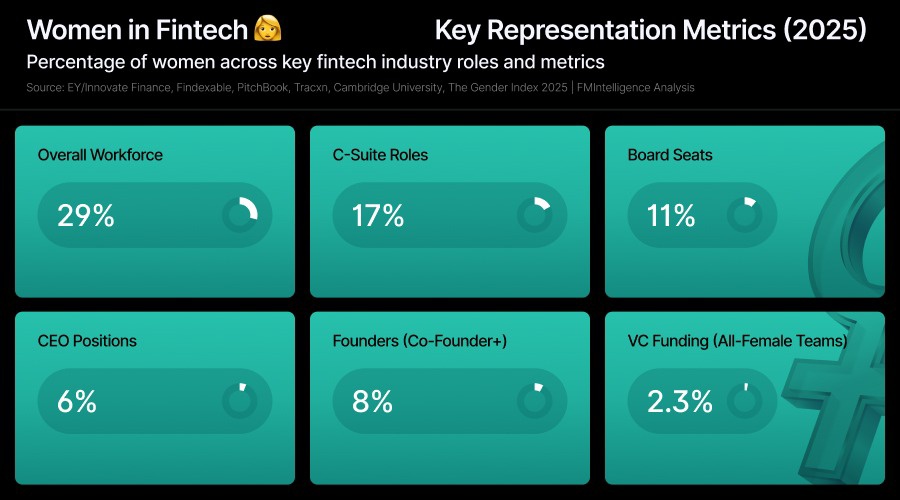
Women hold just 6% of fintech CEO positions globally and occupy only 10 to 11% of board seats across the sector, according to data gathered by FMIntelligence. The broader fintech workforce is barely 30% female, a figure that has moved only marginally in recent years, despite women making up 44% of the traditional financial services workforce.
The financial case for change is no longer debatable. Female founders generate 78 cents of revenue per dollar invested, compared to 31 cents for male founders. Yet of the $289 billion invested globally in startups in 2024, female-only founding teams received just $6.7 billion or 2.3% of the total. All-male teams captured $241.9 billion.
- CFD Brokers in Dubai: Did anything Change After February 28?
- By 2028, Retail CFD Could Rival US Stock Markets. This Metric Shows How Close We Are
- Does Web Traffic Actually Drive CFD Volumes? We Ran the Numbers
And while FMIntelligence projects that women will make up just over one-third of the fintech workforce and hold 7% of CEO positions by the end of this year, the gender pay gap shows no signs of closing quickly. And the pace of change remains far too slow.
The Pay Gap Gets Worse, Not Better
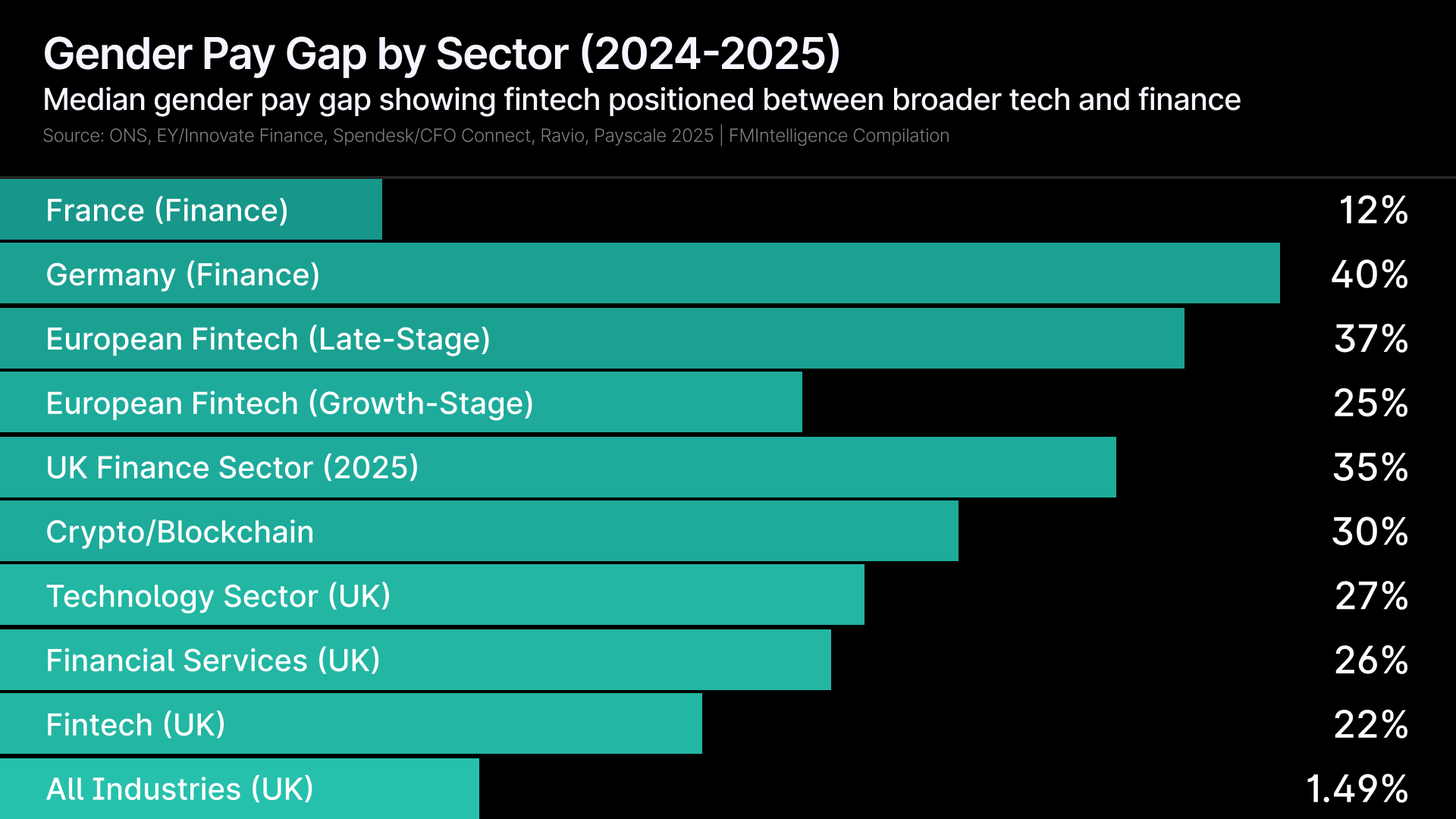
The compensation picture is equally difficult to defend. Across European fintech, Ravio data shows a 33.18% overall gender pay gap, and it widens as companies mature. Growth-stage fintechs show a 25% gap; late-stage companies reach approximately 37%. The UK finance sector's pay gap hit 35% in 2025, up from 24% the year before.
"Gender balance remains a glaring issue; women represent half the population but not half of leadership," said Sarah Barslund Lauridsen, Chief Product Officer at Nexi Group. "Real change happens fastest when it starts at the top."
Trading Floors Remain the Hardest Room to Enter
CFD and FX trading sits at the extreme end of the spectrum: 90.3% of forex and CFD traders globally are male, with the US running at 92 to 8. Crypto ownership is 69% male as of Gemini's survey, a gap that has actually widened since 2022. Performance data consistently favors women traders, who outperform men by nearly 2% annually according to Warwick Business School research. The problem isn't performance. It's access and perception.
FinanceMagnates.com previously reported that one in five women are turned off investing by the industry's patronizing language, and how "macho marketing" deters women from financial markets. These are not peripheral issues, they shape who participates, who raises capital, and who ends up in the corner office.
The Bright Spots Are Instructive
Gender-lens investing assets have crossed $122 billion globally. Sweden directs 15% of VC to women-led companies. Singapore is the only country forecast to reach parity in next-generation financial services roles by 2030. As FinanceMagnates.com has reported, Hong Kong's financial industry is edging toward 45% female leadership, proof that deliberate policy and cultural commitment can accelerate change.

"Over the course of my career, the most meaningful shift I've seen is moving away from trying to 'fix' women and toward addressing systemic barriers that limit who gets seen, trusted and promoted," said Lauridsen. "When diversity is embedded into culture, targets and ways of working, it doesn't disappear with shifting political or economic narratives."
The Founders Forum projects gender parity in VC funding will not arrive until approximately 2065. FMIntelligence's own modeling points to a fintech workforce that is 31% female by end-2026, a crypto sector approaching 22% female participation, and gender-lens AUM pushing toward $145 billion. Progress is real. The pace is not.
The complete FMIntelligence Women in Fintech report, including full 2026 projections across workforce participation, VC funding flows, pay gap trajectories, regional breakdowns, and crypto and CFD gender data, is available now on FMIntelligence DataLab.


