Binance has announced $283 million in payouts to compensate users affected by the weekend depegging.
Bitcoin had the smallest price decline of about 4% and showed the strongest stability.
The crash was sparked by a late-night tweet from former U.S. President Donald Trump threatening new tariffs on Chinese imports.
A sudden market shock on Friday sent
cryptocurrency prices tumbling, exposing which coins truly withstand pressure
and which falter under stress.
Triggered by a geopolitical tweet, this intense hour
of selling acted like a stress test, giving investors a rare look at crypto
resilience during turmoil. The crash wiped out billions, but the market’s
reaction tells a deeper story about coin performance and what could come next.
This unexpected news hit after markets closed,
reducing liquidity and intensifying volatility. Massive sell orders, stop
losses, and leveraged positions triggered liquidations across both stock and
crypto markets simultaneously, fueling a rapid price drop within just one hour.
The crypto market collectively suffered its most
severe plunge, with reportedly over $19 billion in liquidations recorded during this
period.
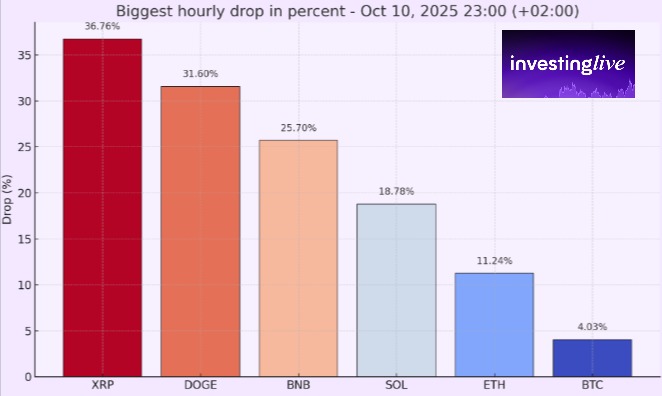
Price drops ranged from Bitcoin’s minimal 4% to XRP’s
steep 36.8% fall. Despite the initial plunge, most coins bounced back quickly,
though not all recovered equally.
Source: investinglive
Bitcoin showed the smallest decline and fastest
recovery, holding steady as a relatively stable asset during the chaos. Ethereum even closed higher than its initial price at the start of the crash hour, displaying swift resilience.
However, Binance Coin took a serious hit but steadily regained
value, finishing the next day slightly up from the crash close. Conversely, XRP and Dogecoin suffered the largest
drops and failed to maintain their rebound gains, signaling weaker market
confidence. Solana bounced sharply but lost ground by the next
day.
Binance Announces 283M Payout
Following the crash, Binance automatically sold off collateral altcoins to
cover losses, creating a feedback loop that pushed prices down rapidly. The exchange later announced that it has paid out $283 million to cover losses from Friday's depegging.
Adding to market jitters, Binance experienced a unique
technical failure. Some altcoins, like Cosmos (ATOM) and IoTeX (IOTX), briefly showed zero prices on their platforms. This flash crash occurred as the
exchange’s trading systems became overwhelmed by sell orders and collateral
liquidations tied to cross-margin positions.
At the peak of the fall, Bitcoin dropped only 4%, while
XRP crashed nearly 37%. By the time the market stabilized, nearly $380 billion
in value had been wiped out in less than 24 hours. According to Bitmine Chairman Tom Lee, the crash was a "healthy reset."
In an interview with CNBC, Bitmine Chairman Tom Lee said the latest sell-off was, in some sense, overdue: since the April lows, the market had risen 36%, and today's drop is the largest in six months. In his view, this is a healthy reset; barring structural changes, a surge in… pic.twitter.com/VNbsMxjPSt
What’s Next for Bitcoin, Ethereum, XRP, and Dogecoin?
Following the sell-off, major tokens will likely continue recovering their losses throughout the week. Top cryptocurrencies are already staging a cautious recovery after
the crash, though overall sentiment remains fragile.
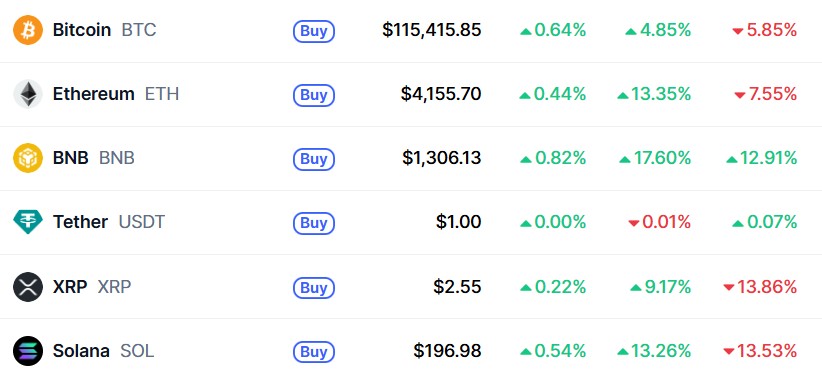
At the time of writing, BTC is up 4% over the past
24 hours, trimming its seven-day loss to around 6%. Ethereum has
rebounded more sharply with a 13% daily gain, though it still trades 8% lower
on the weekly chart.
Source: CoinMarketCap
A similar pattern is seen across large-cap altcoins. XRP has
risen 9% in the last 24 hours but remains down 13% over the week, while Solana
(SOL) has gained 13% today, yet is still 13% lower on weekly performance.
BNB Quietly Recovered—XRP and Dogecoin Struggled
BNB faced a larger intra-hour decline of over 25% but
attracted steady inflows afterward, finishing the following day slightly above
the crash close.
Not every major coin managed to repair damage. In the memecoin category, Dogecoin bounced sharply with recoveries of about 40% from the lows.
Despite the violence of the crash, analysts are not
calling it the end of the cycle. 10x Research wrote that the market flush “may
be the cleanest setup for a new rally,” arguing that forced liquidation events
remove weak leverage and reset market structure. Fear indicators support that
view—the Crypto Fear & Greed Index fell from 74 to 24 in a week, a level
often associated with market bottoms.
What if the $380 billion crypto crash wasn’t the end — but the cleanest setup for the next major rally?
Crypto just endured one of its most violent unwinds in history — nearly $19 billion in liquidations wiped out over $380 billion in market value within hours.
The crash left clear levels on every crypto chart.
Technical traders now track two price markers from the panic hour: the crash
low, which signals risk, and the opening price of the crash hour, which signals
recovery.
XRP and Dogecoin are still momentum trades with weak
follow-through. Solana needs a convincing return above its recovery line to
shake out doubts. The crash did not break the market. It exposed it. And
in that exposure, a new roadmap has emerged for anyone watching closely.
A sudden market shock on Friday sent
cryptocurrency prices tumbling, exposing which coins truly withstand pressure
and which falter under stress.
Triggered by a geopolitical tweet, this intense hour
of selling acted like a stress test, giving investors a rare look at crypto
resilience during turmoil. The crash wiped out billions, but the market’s
reaction tells a deeper story about coin performance and what could come next.
This unexpected news hit after markets closed,
reducing liquidity and intensifying volatility. Massive sell orders, stop
losses, and leveraged positions triggered liquidations across both stock and
crypto markets simultaneously, fueling a rapid price drop within just one hour.
The crypto market collectively suffered its most
severe plunge, with reportedly over $19 billion in liquidations recorded during this
period.
Price drops ranged from Bitcoin’s minimal 4% to XRP’s
steep 36.8% fall. Despite the initial plunge, most coins bounced back quickly,
though not all recovered equally.
Source: investinglive
Bitcoin showed the smallest decline and fastest
recovery, holding steady as a relatively stable asset during the chaos. Ethereum even closed higher than its initial price at the start of the crash hour, displaying swift resilience.
However, Binance Coin took a serious hit but steadily regained
value, finishing the next day slightly up from the crash close. Conversely, XRP and Dogecoin suffered the largest
drops and failed to maintain their rebound gains, signaling weaker market
confidence. Solana bounced sharply but lost ground by the next
day.
Binance Announces 283M Payout
Following the crash, Binance automatically sold off collateral altcoins to
cover losses, creating a feedback loop that pushed prices down rapidly. The exchange later announced that it has paid out $283 million to cover losses from Friday's depegging.
Adding to market jitters, Binance experienced a unique
technical failure. Some altcoins, like Cosmos (ATOM) and IoTeX (IOTX), briefly showed zero prices on their platforms. This flash crash occurred as the
exchange’s trading systems became overwhelmed by sell orders and collateral
liquidations tied to cross-margin positions.
At the peak of the fall, Bitcoin dropped only 4%, while
XRP crashed nearly 37%. By the time the market stabilized, nearly $380 billion
in value had been wiped out in less than 24 hours. According to Bitmine Chairman Tom Lee, the crash was a "healthy reset."
In an interview with CNBC, Bitmine Chairman Tom Lee said the latest sell-off was, in some sense, overdue: since the April lows, the market had risen 36%, and today's drop is the largest in six months. In his view, this is a healthy reset; barring structural changes, a surge in… pic.twitter.com/VNbsMxjPSt
What’s Next for Bitcoin, Ethereum, XRP, and Dogecoin?
Following the sell-off, major tokens will likely continue recovering their losses throughout the week. Top cryptocurrencies are already staging a cautious recovery after
the crash, though overall sentiment remains fragile.
At the time of writing, BTC is up 4% over the past
24 hours, trimming its seven-day loss to around 6%. Ethereum has
rebounded more sharply with a 13% daily gain, though it still trades 8% lower
on the weekly chart.
Source: CoinMarketCap
A similar pattern is seen across large-cap altcoins. XRP has
risen 9% in the last 24 hours but remains down 13% over the week, while Solana
(SOL) has gained 13% today, yet is still 13% lower on weekly performance.
BNB Quietly Recovered—XRP and Dogecoin Struggled
BNB faced a larger intra-hour decline of over 25% but
attracted steady inflows afterward, finishing the following day slightly above
the crash close.
Not every major coin managed to repair damage. In the memecoin category, Dogecoin bounced sharply with recoveries of about 40% from the lows.
Despite the violence of the crash, analysts are not
calling it the end of the cycle. 10x Research wrote that the market flush “may
be the cleanest setup for a new rally,” arguing that forced liquidation events
remove weak leverage and reset market structure. Fear indicators support that
view—the Crypto Fear & Greed Index fell from 74 to 24 in a week, a level
often associated with market bottoms.
What if the $380 billion crypto crash wasn’t the end — but the cleanest setup for the next major rally?
Crypto just endured one of its most violent unwinds in history — nearly $19 billion in liquidations wiped out over $380 billion in market value within hours.
The crash left clear levels on every crypto chart.
Technical traders now track two price markers from the panic hour: the crash
low, which signals risk, and the opening price of the crash hour, which signals
recovery.
XRP and Dogecoin are still momentum trades with weak
follow-through. Solana needs a convincing return above its recovery line to
shake out doubts. The crash did not break the market. It exposed it. And
in that exposure, a new roadmap has emerged for anyone watching closely.
Jared Kirui is an Editor at Finance Magnates with more than five years of experience in financial journalism. He covers online trading, fintech, payments, and crypto industries with a focus on companies, regulation and compliance, executive moves, trading technology, and market analysis.
His work has been featured in other media outlets, including Benzinga, ZyCrypto, The Distributed, and The Daily Hodl.
Education:
Bachelor of Commerce degree (Finance option), University of Nairobi
Inside the Prediction Markets: $1.6B Institutional Inflow Meets a Federal Crackdown
Featured Videos
FP Markets Winner Spotlight 🏆 | Global Broker of the Year 2025 #Trading #Broker #Innovation #Shorts
FP Markets Winner Spotlight 🏆 | Global Broker of the Year 2025 #Trading #Broker #Innovation #Shorts
FP Markets Winner Spotlight 🏆 | Global Broker of the Year 2025 #Trading #Broker #Innovation #Shorts
FP Markets Winner Spotlight 🏆 | Global Broker of the Year 2025 #Trading #Broker #Innovation #Shorts
FP Markets takes the spotlight as Global Broker of the Year 2025 at the Finance Magnates Awards.
Martin Stoilov, Head of Client Experience, shares that trust, innovation, and people played a key role in the company’s success, supported by a strong foundation of integrity and client-centricity.
Following this milestone, FP Markets continues to focus on growth, technology investment, and its core values of transparency and excellence.
👉 Be part of FM Awards 2026: https://awards.financemagnates.com/#nominate
FP Markets takes the spotlight as Global Broker of the Year 2025 at the Finance Magnates Awards.
Martin Stoilov, Head of Client Experience, shares that trust, innovation, and people played a key role in the company’s success, supported by a strong foundation of integrity and client-centricity.
Following this milestone, FP Markets continues to focus on growth, technology investment, and its core values of transparency and excellence.
👉 Be part of FM Awards 2026: https://awards.financemagnates.com/#nominate
FP Markets takes the spotlight as Global Broker of the Year 2025 at the Finance Magnates Awards.
Martin Stoilov, Head of Client Experience, shares that trust, innovation, and people played a key role in the company’s success, supported by a strong foundation of integrity and client-centricity.
Following this milestone, FP Markets continues to focus on growth, technology investment, and its core values of transparency and excellence.
👉 Be part of FM Awards 2026: https://awards.financemagnates.com/#nominate
FP Markets takes the spotlight as Global Broker of the Year 2025 at the Finance Magnates Awards.
Martin Stoilov, Head of Client Experience, shares that trust, innovation, and people played a key role in the company’s success, supported by a strong foundation of integrity and client-centricity.
Following this milestone, FP Markets continues to focus on growth, technology investment, and its core values of transparency and excellence.
👉 Be part of FM Awards 2026: https://awards.financemagnates.com/#nominate
In this video, we review @HolaPrimeMarketsOfficial, a multi-asset forex and CFDs broker offering different account types, trading platforms, and flexible trading conditions.
We cover the broker’s overall offering, including account options, trading environment, platforms like MT4 and MT5, and additional services such as managed accounts and fast withdrawals.
Watch the full video to see if Hola Prime Markets fits your trading needs.
📣 Stay up to date with the latest in finance and trading. Follow Finance Magnates for industry news, insights, and global event coverage.
Connect with us:
🔗 LinkedIn: /financemagnates
👍 Facebook: /financemagnates
📸 Instagram: https://www.instagram.com/financemagnates
🐦 X: https://x.com/financemagnates
🎥 TikTok: https://www.tiktok.com/tag/financemagnates
▶️ YouTube: /@financemagnates_official
#HolaPrime #ForexBroker #CFDTrading #FinanceMagnates #Trading #Forex #BrokerReview
In this video, we review @HolaPrimeMarketsOfficial, a multi-asset forex and CFDs broker offering different account types, trading platforms, and flexible trading conditions.
We cover the broker’s overall offering, including account options, trading environment, platforms like MT4 and MT5, and additional services such as managed accounts and fast withdrawals.
Watch the full video to see if Hola Prime Markets fits your trading needs.
📣 Stay up to date with the latest in finance and trading. Follow Finance Magnates for industry news, insights, and global event coverage.
Connect with us:
🔗 LinkedIn: /financemagnates
👍 Facebook: /financemagnates
📸 Instagram: https://www.instagram.com/financemagnates
🐦 X: https://x.com/financemagnates
🎥 TikTok: https://www.tiktok.com/tag/financemagnates
▶️ YouTube: /@financemagnates_official
#HolaPrime #ForexBroker #CFDTrading #FinanceMagnates #Trading #Forex #BrokerReview
In this video, we review @HolaPrimeMarketsOfficial, a multi-asset forex and CFDs broker offering different account types, trading platforms, and flexible trading conditions.
We cover the broker’s overall offering, including account options, trading environment, platforms like MT4 and MT5, and additional services such as managed accounts and fast withdrawals.
Watch the full video to see if Hola Prime Markets fits your trading needs.
📣 Stay up to date with the latest in finance and trading. Follow Finance Magnates for industry news, insights, and global event coverage.
Connect with us:
🔗 LinkedIn: /financemagnates
👍 Facebook: /financemagnates
📸 Instagram: https://www.instagram.com/financemagnates
🐦 X: https://x.com/financemagnates
🎥 TikTok: https://www.tiktok.com/tag/financemagnates
▶️ YouTube: /@financemagnates_official
#HolaPrime #ForexBroker #CFDTrading #FinanceMagnates #Trading #Forex #BrokerReview
In this video, we review @HolaPrimeMarketsOfficial, a multi-asset forex and CFDs broker offering different account types, trading platforms, and flexible trading conditions.
We cover the broker’s overall offering, including account options, trading environment, platforms like MT4 and MT5, and additional services such as managed accounts and fast withdrawals.
Watch the full video to see if Hola Prime Markets fits your trading needs.
📣 Stay up to date with the latest in finance and trading. Follow Finance Magnates for industry news, insights, and global event coverage.
Connect with us:
🔗 LinkedIn: /financemagnates
👍 Facebook: /financemagnates
📸 Instagram: https://www.instagram.com/financemagnates
🐦 X: https://x.com/financemagnates
🎥 TikTok: https://www.tiktok.com/tag/financemagnates
▶️ YouTube: /@financemagnates_official
#HolaPrime #ForexBroker #CFDTrading #FinanceMagnates #Trading #Forex #BrokerReview
In this video, we review @HolaPrimeMarketsOfficial, a multi-asset forex and CFDs broker offering different account types, trading platforms, and flexible trading conditions.
We cover the broker’s overall offering, including account options, trading environment, platforms like MT4 and MT5, and additional services such as managed accounts and fast withdrawals.
Watch the full video to see if Hola Prime Markets fits your trading needs.
📣 Stay up to date with the latest in finance and trading. Follow Finance Magnates for industry news, insights, and global event coverage.
Connect with us:
🔗 LinkedIn: /financemagnates
👍 Facebook: /financemagnates
📸 Instagram: https://www.instagram.com/financemagnates
🐦 X: https://x.com/financemagnates
🎥 TikTok: https://www.tiktok.com/tag/financemagnates
▶️ YouTube: /@financemagnates_official
#HolaPrime #ForexBroker #CFDTrading #FinanceMagnates #Trading #Forex #BrokerReview
In this video, we review @HolaPrimeMarketsOfficial, a multi-asset forex and CFDs broker offering different account types, trading platforms, and flexible trading conditions.
We cover the broker’s overall offering, including account options, trading environment, platforms like MT4 and MT5, and additional services such as managed accounts and fast withdrawals.
Watch the full video to see if Hola Prime Markets fits your trading needs.
📣 Stay up to date with the latest in finance and trading. Follow Finance Magnates for industry news, insights, and global event coverage.
Connect with us:
🔗 LinkedIn: /financemagnates
👍 Facebook: /financemagnates
📸 Instagram: https://www.instagram.com/financemagnates
🐦 X: https://x.com/financemagnates
🎥 TikTok: https://www.tiktok.com/tag/financemagnates
▶️ YouTube: /@financemagnates_official
#HolaPrime #ForexBroker #CFDTrading #FinanceMagnates #Trading #Forex #BrokerReview
Hola Prime Review: What You Need to Know | Full Breakdown by Finance Magnates
Hola Prime Review: What You Need to Know | Full Breakdown by Finance Magnates
Hola Prime Review: What You Need to Know | Full Breakdown by Finance Magnates
Hola Prime Review: What You Need to Know | Full Breakdown by Finance Magnates
Hola Prime Review: What You Need to Know | Full Breakdown by Finance Magnates
Hola Prime Review: What You Need to Know | Full Breakdown by Finance Magnates
In this video, we review @HolaPrime_Global, a proprietary trading firm offering evaluation programs and performance-based payouts in simulated market environments.
We cover how the challenge model works, including account types, profit splits (up to 95%), trading rules, and what it takes to reach a funded account. You’ll also learn about available platforms like MT4, MT5, cTrader, and more, along with insights into payouts, support, and trading conditions.
Watch the full video to see if Hola Prime fits your trading style.
📣 Stay up to date with the latest in finance and trading. Follow Finance Magnates for industry news, insights, and global event coverage.
Connect with us:
🔗 LinkedIn: /financemagnates
👍 Facebook: /financemagnates
📸 Instagram: https://www.instagram.com/financemagnates
🐦 X: https://x.com/financemagnates
🎥 TikTok: https://www.tiktok.com/tag/financemagnates
▶️ YouTube: /@financemagnates_official
#HolaPrime #PropFirm #Trading #FinanceMagnates #Forex #FuturesTrading #TradingReview #PropFirmReview
In this video, we review @HolaPrime_Global, a proprietary trading firm offering evaluation programs and performance-based payouts in simulated market environments.
We cover how the challenge model works, including account types, profit splits (up to 95%), trading rules, and what it takes to reach a funded account. You’ll also learn about available platforms like MT4, MT5, cTrader, and more, along with insights into payouts, support, and trading conditions.
Watch the full video to see if Hola Prime fits your trading style.
📣 Stay up to date with the latest in finance and trading. Follow Finance Magnates for industry news, insights, and global event coverage.
Connect with us:
🔗 LinkedIn: /financemagnates
👍 Facebook: /financemagnates
📸 Instagram: https://www.instagram.com/financemagnates
🐦 X: https://x.com/financemagnates
🎥 TikTok: https://www.tiktok.com/tag/financemagnates
▶️ YouTube: /@financemagnates_official
#HolaPrime #PropFirm #Trading #FinanceMagnates #Forex #FuturesTrading #TradingReview #PropFirmReview
In this video, we review @HolaPrime_Global, a proprietary trading firm offering evaluation programs and performance-based payouts in simulated market environments.
We cover how the challenge model works, including account types, profit splits (up to 95%), trading rules, and what it takes to reach a funded account. You’ll also learn about available platforms like MT4, MT5, cTrader, and more, along with insights into payouts, support, and trading conditions.
Watch the full video to see if Hola Prime fits your trading style.
📣 Stay up to date with the latest in finance and trading. Follow Finance Magnates for industry news, insights, and global event coverage.
Connect with us:
🔗 LinkedIn: /financemagnates
👍 Facebook: /financemagnates
📸 Instagram: https://www.instagram.com/financemagnates
🐦 X: https://x.com/financemagnates
🎥 TikTok: https://www.tiktok.com/tag/financemagnates
▶️ YouTube: /@financemagnates_official
#HolaPrime #PropFirm #Trading #FinanceMagnates #Forex #FuturesTrading #TradingReview #PropFirmReview
In this video, we review @HolaPrime_Global, a proprietary trading firm offering evaluation programs and performance-based payouts in simulated market environments.
We cover how the challenge model works, including account types, profit splits (up to 95%), trading rules, and what it takes to reach a funded account. You’ll also learn about available platforms like MT4, MT5, cTrader, and more, along with insights into payouts, support, and trading conditions.
Watch the full video to see if Hola Prime fits your trading style.
📣 Stay up to date with the latest in finance and trading. Follow Finance Magnates for industry news, insights, and global event coverage.
Connect with us:
🔗 LinkedIn: /financemagnates
👍 Facebook: /financemagnates
📸 Instagram: https://www.instagram.com/financemagnates
🐦 X: https://x.com/financemagnates
🎥 TikTok: https://www.tiktok.com/tag/financemagnates
▶️ YouTube: /@financemagnates_official
#HolaPrime #PropFirm #Trading #FinanceMagnates #Forex #FuturesTrading #TradingReview #PropFirmReview
In this video, we review @HolaPrime_Global, a proprietary trading firm offering evaluation programs and performance-based payouts in simulated market environments.
We cover how the challenge model works, including account types, profit splits (up to 95%), trading rules, and what it takes to reach a funded account. You’ll also learn about available platforms like MT4, MT5, cTrader, and more, along with insights into payouts, support, and trading conditions.
Watch the full video to see if Hola Prime fits your trading style.
📣 Stay up to date with the latest in finance and trading. Follow Finance Magnates for industry news, insights, and global event coverage.
Connect with us:
🔗 LinkedIn: /financemagnates
👍 Facebook: /financemagnates
📸 Instagram: https://www.instagram.com/financemagnates
🐦 X: https://x.com/financemagnates
🎥 TikTok: https://www.tiktok.com/tag/financemagnates
▶️ YouTube: /@financemagnates_official
#HolaPrime #PropFirm #Trading #FinanceMagnates #Forex #FuturesTrading #TradingReview #PropFirmReview
In this video, we review @HolaPrime_Global, a proprietary trading firm offering evaluation programs and performance-based payouts in simulated market environments.
We cover how the challenge model works, including account types, profit splits (up to 95%), trading rules, and what it takes to reach a funded account. You’ll also learn about available platforms like MT4, MT5, cTrader, and more, along with insights into payouts, support, and trading conditions.
Watch the full video to see if Hola Prime fits your trading style.
📣 Stay up to date with the latest in finance and trading. Follow Finance Magnates for industry news, insights, and global event coverage.
Connect with us:
🔗 LinkedIn: /financemagnates
👍 Facebook: /financemagnates
📸 Instagram: https://www.instagram.com/financemagnates
🐦 X: https://x.com/financemagnates
🎥 TikTok: https://www.tiktok.com/tag/financemagnates
▶️ YouTube: /@financemagnates_official
#HolaPrime #PropFirm #Trading #FinanceMagnates #Forex #FuturesTrading #TradingReview #PropFirmReview
Axi Winner Spotlight 🏆 | Global Most Innovative Broker 2025 #Innovation #Trading #Fintech #Broker
Axi Winner Spotlight 🏆 | Global Most Innovative Broker 2025 #Innovation #Trading #Fintech #Broker
Axi Winner Spotlight 🏆 | Global Most Innovative Broker 2025 #Innovation #Trading #Fintech #Broker
Axi Winner Spotlight 🏆 | Global Most Innovative Broker 2025 #Innovation #Trading #Fintech #Broker
Axi Winner Spotlight 🏆 | Global Most Innovative Broker 2025 #Innovation #Trading #Fintech #Broker
Axi Winner Spotlight 🏆 | Global Most Innovative Broker 2025 #Innovation #Trading #Fintech #Broker
Axi takes the spotlight at the Finance Magnates Awards, winning Global Most Innovative Broker 2025.
Olivia Xenofontos and Ivanna Openko share how the team will feel: proud, motivated, and ready to keep delivering.
They also describe the night as well-organized, focused, and enjoyable for all.
👉 Be part of FM Awards 2026.
Axi takes the spotlight at the Finance Magnates Awards, winning Global Most Innovative Broker 2025.
Olivia Xenofontos and Ivanna Openko share how the team will feel: proud, motivated, and ready to keep delivering.
They also describe the night as well-organized, focused, and enjoyable for all.
👉 Be part of FM Awards 2026.
Axi takes the spotlight at the Finance Magnates Awards, winning Global Most Innovative Broker 2025.
Olivia Xenofontos and Ivanna Openko share how the team will feel: proud, motivated, and ready to keep delivering.
They also describe the night as well-organized, focused, and enjoyable for all.
👉 Be part of FM Awards 2026.
Axi takes the spotlight at the Finance Magnates Awards, winning Global Most Innovative Broker 2025.
Olivia Xenofontos and Ivanna Openko share how the team will feel: proud, motivated, and ready to keep delivering.
They also describe the night as well-organized, focused, and enjoyable for all.
👉 Be part of FM Awards 2026.
Axi takes the spotlight at the Finance Magnates Awards, winning Global Most Innovative Broker 2025.
Olivia Xenofontos and Ivanna Openko share how the team will feel: proud, motivated, and ready to keep delivering.
They also describe the night as well-organized, focused, and enjoyable for all.
👉 Be part of FM Awards 2026.
Axi takes the spotlight at the Finance Magnates Awards, winning Global Most Innovative Broker 2025.
Olivia Xenofontos and Ivanna Openko share how the team will feel: proud, motivated, and ready to keep delivering.
They also describe the night as well-organized, focused, and enjoyable for all.
👉 Be part of FM Awards 2026.
Recognition that matters.
Built on transparency.
Driven by the industry.
The Finance Magnates Awards 2026.
Nominations are now open.
🔗 https://awards.financemagnates.com/?utm_source=SM&utm_medium=social&utm_campaign=recognition-matters
Recognition that matters.
Built on transparency.
Driven by the industry.
The Finance Magnates Awards 2026.
Nominations are now open.
🔗 https://awards.financemagnates.com/?utm_source=SM&utm_medium=social&utm_campaign=recognition-matters
Recognition that matters.
Built on transparency.
Driven by the industry.
The Finance Magnates Awards 2026.
Nominations are now open.
🔗 https://awards.financemagnates.com/?utm_source=SM&utm_medium=social&utm_campaign=recognition-matters
Recognition that matters.
Built on transparency.
Driven by the industry.
The Finance Magnates Awards 2026.
Nominations are now open.
🔗 https://awards.financemagnates.com/?utm_source=SM&utm_medium=social&utm_campaign=recognition-matters
Recognition that matters.
Built on transparency.
Driven by the industry.
The Finance Magnates Awards 2026.
Nominations are now open.
🔗 https://awards.financemagnates.com/?utm_source=SM&utm_medium=social&utm_campaign=recognition-matters
Recognition that matters.
Built on transparency.
Driven by the industry.
The Finance Magnates Awards 2026.
Nominations are now open.
🔗 https://awards.financemagnates.com/?utm_source=SM&utm_medium=social&utm_campaign=recognition-matters