Brent surged ~$78/bbl as US hit nuclear sites; futures dipped on global market jitters.
Iran votes to close the Strait of Hormuz, but risks cutting its own exports.
Markets assume a short conflict; if Hormuz stays open, volatility may fade.
If Iran closes the Strait of Hormuz, oil prices will certainly soar (Bloomberg).
With US strikes hitting Tehran and threats swirling around the Strait of
Hormuz, investors are weighing geopolitics against portfolio stability and the potential for soaring oil prices.
Asia wasn’t immune. Markets from Tokyo to Sydney shed modest gains as
the risk premium climbed. Japan even saw its defense sector rallying amid
renewed geopolitical concern.
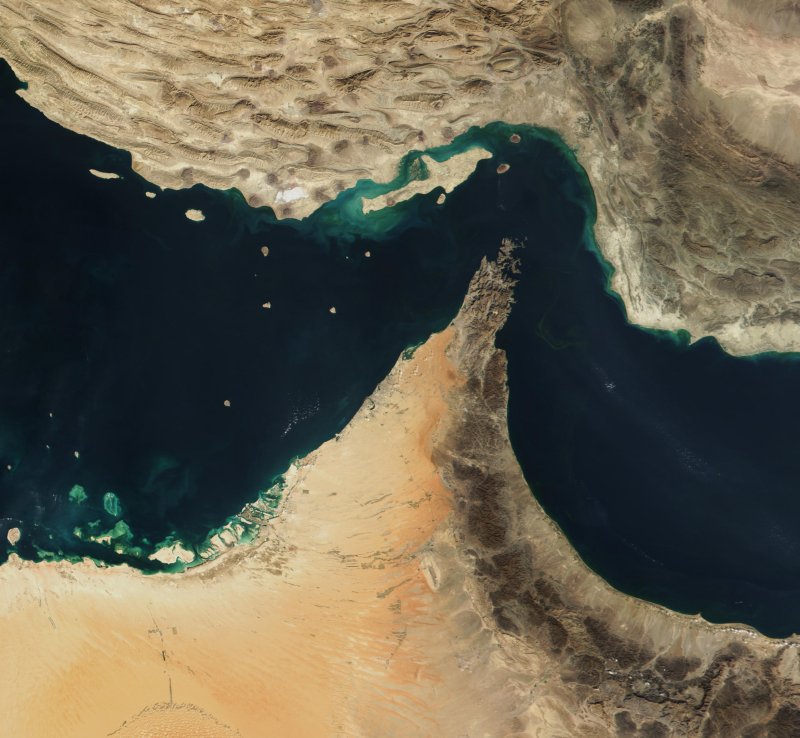
The Hormuz Card: Oil Drama or Serious Threat?
By Jacques Descloitres, MODIS Land Rapid Response Team, NASA/GSFC, Public Domain, Wikimedia Commons.
Here’s where things get spicy: Iran’s parliament backed a plan to close
the Strait of Hormuz—a chokepoint for ~20% of the world’s daily
oil movements. But approvals still require the green light from the Supreme
National Security Council. If executed, the impact would be seismic: oil would
soar, and where it ended up would be anyone’s guess. That spike would cascade
through refinery costs, insurance premiums, and consumer prices.
Yet, analysts are skeptical about whether Tehran would actually shut
the passage. This naval route is vital for Iran’s own oil exports, especially
to China—a move to close it would be economic self‑sabotage. The US and allies
have naval forces deployed nearby, and Iran lacks legal cover to block the
strait outright.
Market Outlook: Fear vs. Fundamentals
Most analysts expect this to be a short‑lived flare‑up rather than a
protracted war. “Not crazy” oil forecasts from veteran strategists suggest
prices will retreat once the initial panic fades. Defense
stocks have popped, but broader markets are trading with guarded optimism.
Plus500's Founder Has An Outlandish Piece of Advice
While the Israeli broker is expanding its presence in the US and offers extensive oil and other energy contracts in the country, its founder, Alon Gonen, has become something of an internet personality with his market moving piece of advice.
"The enemy of my enemy is my friend," he said in a video posted on LinkedIn. "The regime opponents in Iran are enemies of the Iranian regime. That means they are our friends."
"Israel should bomb the prisons in Iran — in a way that allows the prisoners to escape. This would create a wave of euphoria among the Persian people, something that could truly bring down the Persian regime."
Tech, Trade & Trendspotting
In tech-heavy sectors, firms tied to oil logistics, shipping insurance,
and semiconductor supply chains could feel ripple effects. Elevated crude
prices mean higher transportation costs—possibly pressuring margins in e‑commerce
and manufacturing sectors. Similarly, alternative energy firms or pipelines
bypassing Hormuz might draw investor attention as geopolitical insurance plays
take hold.
What Traders Should Watch
Iran’s next move: Will Tehran escalate or hold? A missile or cyber
strike could reignite volatility.
Hormuz traffic: So far, commercial shipping keeps flowing—watch
satellite data and tanker insurance premiums.
U.S. response: Additional military deployments or sanctions could tone it
down, or pour gas on the fire.
Seasonal demand: Summer fuel consumption in the northern hemisphere
could exacerbate price swings.
Brace, Don’t Panic?
Oil is in a volatility tailspin—but not a free-fall. High prices suit
defense suppliers and energy traders buying coverage. But equities, especially
in tech and manufacturing, are treading water amid uncertainty. The smart play
for now? Don’t bet the ranch—banks and big-spenders will watch Tehran more than
Trump.
With US strikes hitting Tehran and threats swirling around the Strait of
Hormuz, investors are weighing geopolitics against portfolio stability and the potential for soaring oil prices.
Asia wasn’t immune. Markets from Tokyo to Sydney shed modest gains as
the risk premium climbed. Japan even saw its defense sector rallying amid
renewed geopolitical concern.
The Hormuz Card: Oil Drama or Serious Threat?
By Jacques Descloitres, MODIS Land Rapid Response Team, NASA/GSFC, Public Domain, Wikimedia Commons.
Here’s where things get spicy: Iran’s parliament backed a plan to close
the Strait of Hormuz—a chokepoint for ~20% of the world’s daily
oil movements. But approvals still require the green light from the Supreme
National Security Council. If executed, the impact would be seismic: oil would
soar, and where it ended up would be anyone’s guess. That spike would cascade
through refinery costs, insurance premiums, and consumer prices.
Yet, analysts are skeptical about whether Tehran would actually shut
the passage. This naval route is vital for Iran’s own oil exports, especially
to China—a move to close it would be economic self‑sabotage. The US and allies
have naval forces deployed nearby, and Iran lacks legal cover to block the
strait outright.
Market Outlook: Fear vs. Fundamentals
Most analysts expect this to be a short‑lived flare‑up rather than a
protracted war. “Not crazy” oil forecasts from veteran strategists suggest
prices will retreat once the initial panic fades. Defense
stocks have popped, but broader markets are trading with guarded optimism.
Plus500's Founder Has An Outlandish Piece of Advice
While the Israeli broker is expanding its presence in the US and offers extensive oil and other energy contracts in the country, its founder, Alon Gonen, has become something of an internet personality with his market moving piece of advice.
"The enemy of my enemy is my friend," he said in a video posted on LinkedIn. "The regime opponents in Iran are enemies of the Iranian regime. That means they are our friends."
"Israel should bomb the prisons in Iran — in a way that allows the prisoners to escape. This would create a wave of euphoria among the Persian people, something that could truly bring down the Persian regime."
Tech, Trade & Trendspotting
In tech-heavy sectors, firms tied to oil logistics, shipping insurance,
and semiconductor supply chains could feel ripple effects. Elevated crude
prices mean higher transportation costs—possibly pressuring margins in e‑commerce
and manufacturing sectors. Similarly, alternative energy firms or pipelines
bypassing Hormuz might draw investor attention as geopolitical insurance plays
take hold.
What Traders Should Watch
Iran’s next move: Will Tehran escalate or hold? A missile or cyber
strike could reignite volatility.
Hormuz traffic: So far, commercial shipping keeps flowing—watch
satellite data and tanker insurance premiums.
U.S. response: Additional military deployments or sanctions could tone it
down, or pour gas on the fire.
Seasonal demand: Summer fuel consumption in the northern hemisphere
could exacerbate price swings.
Brace, Don’t Panic?
Oil is in a volatility tailspin—but not a free-fall. High prices suit
defense suppliers and energy traders buying coverage. But equities, especially
in tech and manufacturing, are treading water amid uncertainty. The smart play
for now? Don’t bet the ranch—banks and big-spenders will watch Tehran more than
Trump.
Louis Parks has lived and worked in and around the Middle East for much of his professional career. He writes about the meeting of the tech and finance worlds.
Inside the Prediction Markets: $1.6B Institutional Inflow Meets a Federal Crackdown
FP Markets Winner Spotlight 🏆 | Global Broker of the Year 2025 #Trading #Broker #Innovation #Shorts
FP Markets Winner Spotlight 🏆 | Global Broker of the Year 2025 #Trading #Broker #Innovation #Shorts
FP Markets takes the spotlight as Global Broker of the Year 2025 at the Finance Magnates Awards.
Martin Stoilov, Head of Client Experience, shares that trust, innovation, and people played a key role in the company’s success, supported by a strong foundation of integrity and client-centricity.
Following this milestone, FP Markets continues to focus on growth, technology investment, and its core values of transparency and excellence.
👉 Be part of FM Awards 2026: https://awards.financemagnates.com/#nominate
FP Markets takes the spotlight as Global Broker of the Year 2025 at the Finance Magnates Awards.
Martin Stoilov, Head of Client Experience, shares that trust, innovation, and people played a key role in the company’s success, supported by a strong foundation of integrity and client-centricity.
Following this milestone, FP Markets continues to focus on growth, technology investment, and its core values of transparency and excellence.
👉 Be part of FM Awards 2026: https://awards.financemagnates.com/#nominate
In this video, we review @HolaPrimeMarketsOfficial, a multi-asset forex and CFDs broker offering different account types, trading platforms, and flexible trading conditions.
We cover the broker’s overall offering, including account options, trading environment, platforms like MT4 and MT5, and additional services such as managed accounts and fast withdrawals.
Watch the full video to see if Hola Prime Markets fits your trading needs.
📣 Stay up to date with the latest in finance and trading. Follow Finance Magnates for industry news, insights, and global event coverage.
Connect with us:
🔗 LinkedIn: /financemagnates
👍 Facebook: /financemagnates
📸 Instagram: https://www.instagram.com/financemagnates
🐦 X: https://x.com/financemagnates
🎥 TikTok: https://www.tiktok.com/tag/financemagnates
▶️ YouTube: /@financemagnates_official
#HolaPrime #ForexBroker #CFDTrading #FinanceMagnates #Trading #Forex #BrokerReview
In this video, we review @HolaPrimeMarketsOfficial, a multi-asset forex and CFDs broker offering different account types, trading platforms, and flexible trading conditions.
We cover the broker’s overall offering, including account options, trading environment, platforms like MT4 and MT5, and additional services such as managed accounts and fast withdrawals.
Watch the full video to see if Hola Prime Markets fits your trading needs.
📣 Stay up to date with the latest in finance and trading. Follow Finance Magnates for industry news, insights, and global event coverage.
Connect with us:
🔗 LinkedIn: /financemagnates
👍 Facebook: /financemagnates
📸 Instagram: https://www.instagram.com/financemagnates
🐦 X: https://x.com/financemagnates
🎥 TikTok: https://www.tiktok.com/tag/financemagnates
▶️ YouTube: /@financemagnates_official
#HolaPrime #ForexBroker #CFDTrading #FinanceMagnates #Trading #Forex #BrokerReview
Hola Prime Review: What You Need to Know | Full Breakdown by Finance Magnates
Hola Prime Review: What You Need to Know | Full Breakdown by Finance Magnates
In this video, we review @HolaPrime_Global, a proprietary trading firm offering evaluation programs and performance-based payouts in simulated market environments.
We cover how the challenge model works, including account types, profit splits (up to 95%), trading rules, and what it takes to reach a funded account. You’ll also learn about available platforms like MT4, MT5, cTrader, and more, along with insights into payouts, support, and trading conditions.
Watch the full video to see if Hola Prime fits your trading style.
📣 Stay up to date with the latest in finance and trading. Follow Finance Magnates for industry news, insights, and global event coverage.
Connect with us:
🔗 LinkedIn: /financemagnates
👍 Facebook: /financemagnates
📸 Instagram: https://www.instagram.com/financemagnates
🐦 X: https://x.com/financemagnates
🎥 TikTok: https://www.tiktok.com/tag/financemagnates
▶️ YouTube: /@financemagnates_official
#HolaPrime #PropFirm #Trading #FinanceMagnates #Forex #FuturesTrading #TradingReview #PropFirmReview
In this video, we review @HolaPrime_Global, a proprietary trading firm offering evaluation programs and performance-based payouts in simulated market environments.
We cover how the challenge model works, including account types, profit splits (up to 95%), trading rules, and what it takes to reach a funded account. You’ll also learn about available platforms like MT4, MT5, cTrader, and more, along with insights into payouts, support, and trading conditions.
Watch the full video to see if Hola Prime fits your trading style.
📣 Stay up to date with the latest in finance and trading. Follow Finance Magnates for industry news, insights, and global event coverage.
Connect with us:
🔗 LinkedIn: /financemagnates
👍 Facebook: /financemagnates
📸 Instagram: https://www.instagram.com/financemagnates
🐦 X: https://x.com/financemagnates
🎥 TikTok: https://www.tiktok.com/tag/financemagnates
▶️ YouTube: /@financemagnates_official
#HolaPrime #PropFirm #Trading #FinanceMagnates #Forex #FuturesTrading #TradingReview #PropFirmReview
Axi Winner Spotlight 🏆 | Global Most Innovative Broker 2025 #Innovation #Trading #Fintech #Broker
Axi Winner Spotlight 🏆 | Global Most Innovative Broker 2025 #Innovation #Trading #Fintech #Broker
Axi takes the spotlight at the Finance Magnates Awards, winning Global Most Innovative Broker 2025.
Olivia Xenofontos and Ivanna Openko share how the team will feel: proud, motivated, and ready to keep delivering.
They also describe the night as well-organized, focused, and enjoyable for all.
👉 Be part of FM Awards 2026.
Axi takes the spotlight at the Finance Magnates Awards, winning Global Most Innovative Broker 2025.
Olivia Xenofontos and Ivanna Openko share how the team will feel: proud, motivated, and ready to keep delivering.
They also describe the night as well-organized, focused, and enjoyable for all.
👉 Be part of FM Awards 2026.
Recognition that matters.
Built on transparency.
Driven by the industry.
The Finance Magnates Awards 2026.
Nominations are now open.
🔗 https://awards.financemagnates.com/?utm_source=SM&utm_medium=social&utm_campaign=recognition-matters
Recognition that matters.
Built on transparency.
Driven by the industry.
The Finance Magnates Awards 2026.
Nominations are now open.
🔗 https://awards.financemagnates.com/?utm_source=SM&utm_medium=social&utm_campaign=recognition-matters