
Retail users on prediction markets are losing money at a higher rate than on traditional sportsbooks, according to a research note from Citizens JMP Securities.
Singapore Summit: Meet the largest APAC brokers you know (and those you still don't!)
The analysis, based on transaction data from Juice Reel and covering the period from July 2025 to mid-March 2026, shows that the median return for prediction market users was −8%, compared with −5% for sportsbook users over the same period.
A Different Market Structure
The gap reflects how these markets operate. Unlike sportsbooks, where the operator manages risk and can limit consistently profitable users, prediction markets match trades between participants. This allows professional traders and market makers to take the other side of retail flow.
The data reflects this dynamic. Only the highest-volume traders — those with more than $500,000 in activity — recorded positive returns, with a median ROI of +2.6%. Smaller participants consistently posted losses, with the smallest accounts showing the largest declines, down to −26.8%.
- FIS Adds Clearing for Prediction Market Contracts, Building on OTC Trading
- Pressure Builds on Sports Prediction Contracts as Indian Gaming Association Backs Senate Bill
- Rival CEOs Back New Fund Focused on Prediction Market Infrastructure
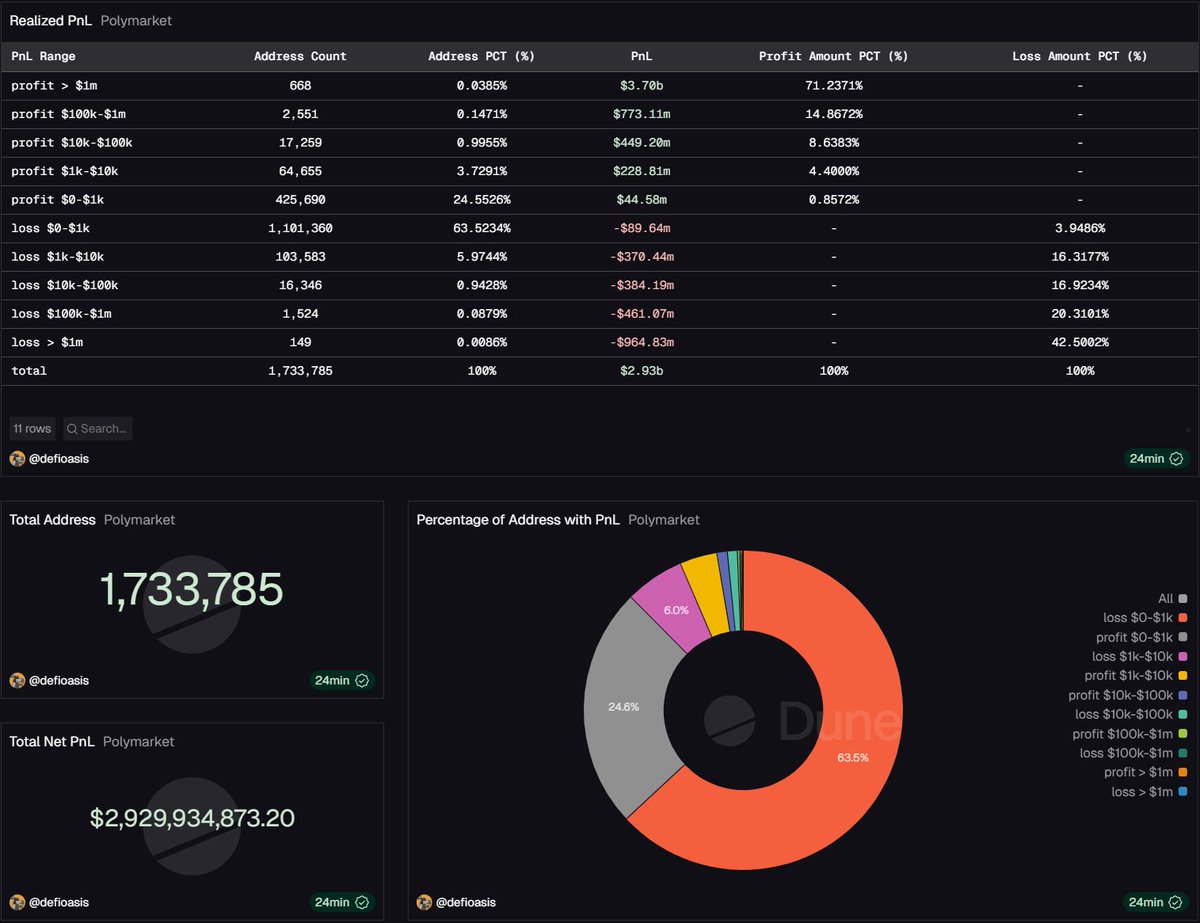
A separate analysis of Polymarket activity points to a similar distribution of outcomes. Research by DeFi Oasis, based on roughly 1.7 million addresses, found that around 70% of users recorded losses, while only about 30% were profitable.
Profits were also highly concentrated. Fewer than 0.04% of addresses accounted for more than 70% of total realised gains, indicating that a small group of participants captures most of the upside.
Retail Flow as Liquidity
Participants cited in the report said retail activity provides a consistent source of liquidity for more experienced traders. In this setup, outcomes are not only driven by event probabilities but also by differences in execution, speed and pricing across participants.
The report suggests prediction markets may not directly replace traditional sportsbooks, but they could compete for future users. The user base is skewing younger.
Around 24% of Kalshi users are under 25, compared with roughly 7% for DraftKings and FanDuel. App data shows a similar trend, with Kalshi recording 6.3 million downloads in the six months to February 2026 while sportsbook downloads declined year over year. This points to a shift in how new users enter the market, even if existing sportsbook activity remains stable.
What It Means for Brokers
For brokers, the key takeaway is structural. Prediction markets operate more like trading venues than traditional betting platforms. Performance depends on execution, liquidity and participant mix, not just forecasting outcomes.
For firms considering entry, this raises practical questions around client profiles, risk management and product design. The findings are based on a dataset skewed toward more active users and may not fully represent the broader retail population.