
Financial and Business News

How High Can Bitcoin Go? Trump's BTC Price Prediction Says It Will Hit $1 Million

Thursday, 19/02/2026 | 08:59 GMT by Damian Chmiel
  • Bitcoin trades near $67K, down 47% from its $126,198 ATH, stuck in a bearish range between $60,000 and $72,000.
  • Eric Trump predicts BTC will hit $1 million, citing a 70% average annual return over 10 years and rising institutional crypto allocations.
  • Large wallets accumulated 53,000 BTC on-chain, but ETF flows turned negative - the market is split, awaiting a macro catalyst.
Eric Trump
Eric Trump

Bitcoin (BTC) is trading at roughly $66,900 on February 19, 2026, less than half the all-time high of $126,198 set just four months ago. Yet despite one of the sharpest drawdowns in recent memory, some of the market's most prominent voices are doubling down on bullish long-term calls.

According to my technical analysis, Bitcoin has settled into a new consolidation corridor between $60,000 and $71,000-$72,000, with both the 50-period EMA and the 200 EMA sitting far above current price levels - a clear sign that the broader trend remains firmly bearish.

Based on my over a decade of experience as an analyst and trader, these accumulation zones are precisely where the next major directional move begins to take shape.

In this article, I examine why the Bitcoin price prediction of $1 million has re-entered the conversation, analyze the BTC chart, and present the newest Bitcoin price predictions from institutional analysts.

Follow me on X for more Bitcoin market analysis: @ChmielDk

Bitcoin Price Today: The Numbers

Bitcoin opened February 19, 2026 at $66,420, reaching an intraday high of $66,930 before settling around $66,900 - up a modest 0.74% on the day. That quiet session masks a brutal recent history. From the ATH of $126,198 in October 2025, BTC has shed nearly 47% in value.

The 24-hour trading volume currently stands at $33.33 billion, while Bitcoin 's total market capitalization has dropped below the psychological $2 trillion threshold to approximately $1.34 trillion, according to CoinMarketCap data.

The slide accelerated after Bitcoin began 2026 oscillating between $82,000 and $98,000 - a tight range that held for the first two months of the year. That structure collapsed. The question now is whether the new, lower range holds, or whether the next leg down has already begun.

Bitcoin Price Technical Analysis

According to my technical analysis, after a very dynamic start to 2026, Bitcoin has found a new consolidation range. Where the market previously moved sideways between $82,000 and $98,000 for roughly two months, the new channel is materially lower - bounded by $60,000 support on the downside and $71,000-$72,000 resistance on the upside. As I can see on the chart, these are the lowest price levels since October 2024.

The overall trend context remains clearly bearish. The 50-period moving average is located at $79,000 - a considerable distance from current price. The 200 EMA sits at $93,000. Only a recovery and sustained close above that 200 EMA level would signal that the Bitcoin chart is genuinely returning to a bullish trend structure.

Key technical levels as I see them right now:

  • Current price: $66,900
  • Resistance zone: $70,000-$72,000 (upper range boundary, recent rejection area)
  • 50 MA: $79,000 (distant bearish overhang)
  • 200 EMA: $93,000 (major trend reversal threshold)
  • Support: $60,000 (lower range boundary)
  • Downside target on breakdown: $52,000 (September 2024 lows)
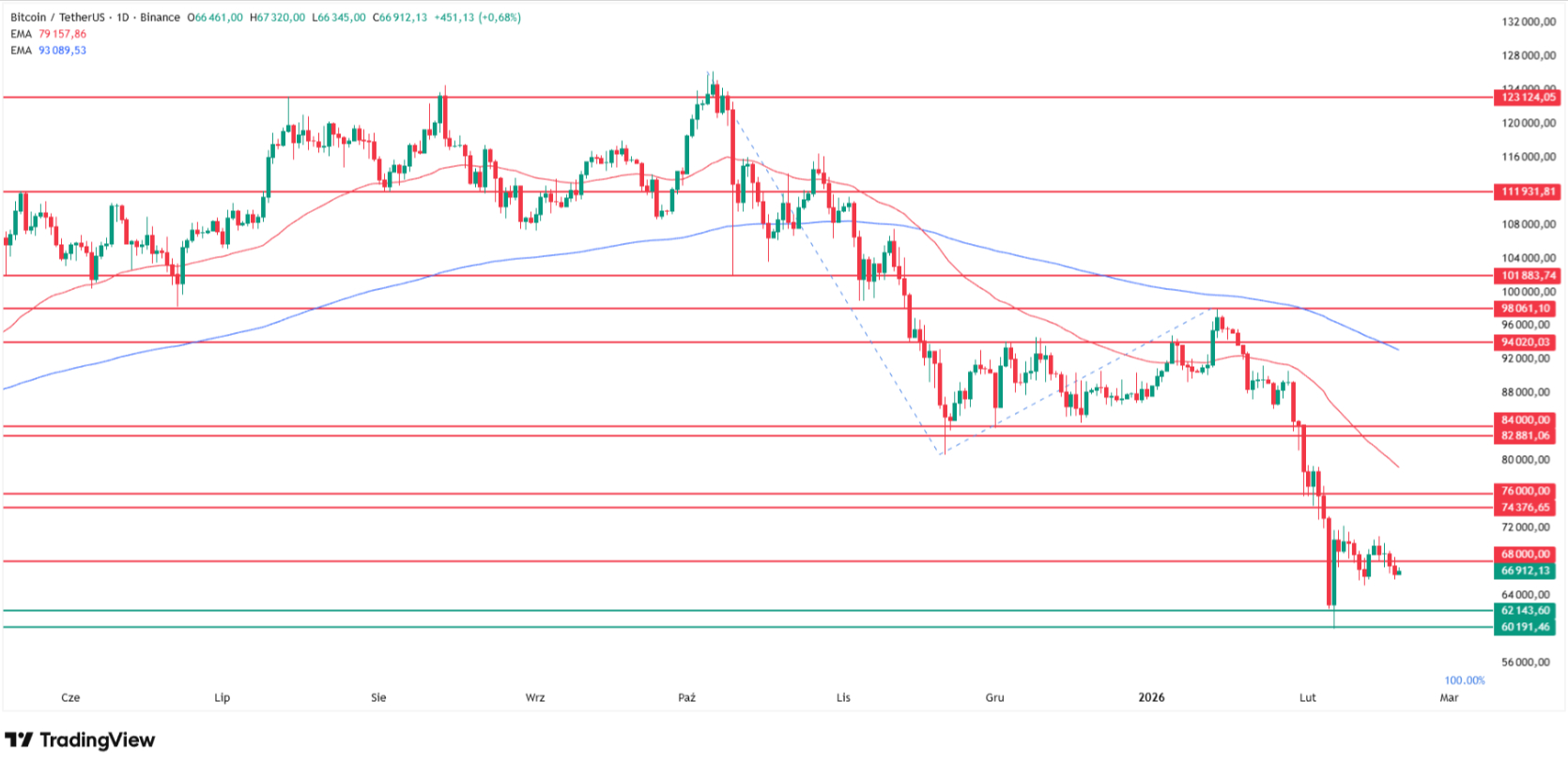
Bitcoin price technical analysis. Source: Tradingview.com

As shown on my chart, what this environment offers traders is swing trading within the range - buying near tests of $60,000 support, selling into tests of $70,000-$72,000 resistance, and waiting to see what Bitcoin does next.

If we break convincingly below $60,000, I would target $52,000 - the September 2024 floor. A breakout above $72,000, however, would demand close attention. The character of that move will determine whether the bull market is truly resuming or whether resistance simply shifted higher.

Why Is Bitcoin Falling?

The trigger was a violent deleveraging event on February 6, which sent implied volatility spiking and wiped out billions in leveraged positions before a rapid - and deceptive - recovery.

"The retreat in implied volatility since the February 6 spike is often read as stabilisation. I would characterise it differently," said Adam Saville Brown, Head of Commercial at Tesseract Group. As he described the mechanics, "What we are seeing is the mechanical aftermath of a significant deleveraging event, not a market that has found equilibrium."

The numbers are stark. Open interest across major exchanges contracted by roughly 22% in a single week. Over $2.5 billion in leveraged positions were liquidated. Funding rates have turned negative for the first time since 2023 - a signal that speculative excess has been fully purged.

Spot Bitcoin ETF flows compound the picture. The ETF complex has flipped to net negative flows for 2026. Fund-level allocators - many of whom entered at an average cost basis around $81,000 - are mechanically de-risking as drawdown thresholds are triggered.

That selling is visible, predictable, and structural. Yet at the same time, wallets holding more than 1,000 BTC have accumulated approximately 53,000 BTC over the past two weeks - the largest accumulation wave since November, representing roughly $4 billion in capital deployment. The market is not doing one thing. It is splitting between those managing quarterly benchmarks and those using the dislocation to build structural positions.

On the macro front, CPI cooling to 2.4% and the Federal Reserve in pause mode compresses real yields - historically supportive for risk assets including Bitcoin. But uncertainty around the incoming Fed chair has placed a policy overhang over institutional decision-making.

"The volatility spike observed on February 6 has now subsided, with Deribit pricing BTC implied volatility at 52. While this remains elevated relative to the 12-month average, it is still toward the lower end of the 35-65 range where volatility has oscillated over the past two years," said Paul Howard, Senior Director at Wincent.

As he added regarding the near-term setup, "This aligns with our broader thesis that we do not expect an aggressive move higher or lower in the near term. Instead, markets appear to be awaiting clearer catalysts."

Eric Trump: "I've Never Been More Bullish on Bitcoin"

Against a backdrop of carnage, Eric Trump - son of US President Donald Trump and co-founder of World Liberty Financial - delivered one of the most emphatic public endorsements of Bitcoin since the crash began. In a February 18 CNBC interview, he declared he has "never been more bullish on Bitcoin" in his life and predicted BTC will ultimately reach $1 million.

"We still are, I'm a huge proponent of Bitcoin. I do think it hits a million dollars. I think it's one of the greatest performing asset classes. I mean, go back two years, Bitcoin was at $16,000, you know, where is it at right now?" Trump said.

As he anchored the case in historical data, "If you look at the last 10 years, Bitcoin has gone up 70 per cent a year on average. Year over year for the last decade - name an asset class that has performed better than Bitcoin."

Trump pointed to the relentless march of institutional adoption as the structural driver. Fidelity, Charles Schwab, JPMorgan, Goldman Sachs - all are now allocating cryptocurrency to private wealth clients. "Before they were telling them to put exactly zero into cryptocurrency.

Then it was 2 per cent, now all of a sudden it's 5-6 per cent, and that number keeps on climbing," he said. His message to investors uncomfortable with volatility was blunt: "If you do not want volatility, go invest in some Munis, go have a great time, go invest in some Treasuries. You are going to have volatility with something that has tremendous upside."

The sentiment mirrors that of Michael Saylor, Executive Chairman of MicroStrategy - which holds one of the world's largest corporate Bitcoin reserves. When Bitcoin fell over 31% from its ATH to $86,800 back in November 2025, Saylor framed the swings as a feature rather than a bug. "Volatility is the vitality of Bitcoin," he said. As he put it to CoinDCX, "In a world where Bitcoin offered steady, predictable returns, Warren Buffett would own all of it and there wouldn't be an opportunity for us."

Bitcoin Price Prediction: What Analysts Say for 2026

Most institutional forecasts were built before the current crash deepened - which makes them useful anchors for what a recovery scenario might look like.

Institution / Analyst

Price Target

Timeframe

Analyst

World Liberty Financial

$1,000,000

Long-term

Eric Trump

Bit Mining

$225,000

End of 2026

Wei Yang, Chief Economist

Grayscale

New all-time high

Mid-2026

-

Nasdaq analysis

$150,000

End of 2026

-

Bloomberg Intelligence

$130,000-$140,000 floor

2026

Eric Balchunas

The bull case rests on three pillars: accelerating institutional adoption, a Fed pivot compressing real yields, and the structural supply squeeze driven by post-halving dynamics and continued ETF accumulation.

Bloomberg's Eric Balchunas estimated earlier this year that Bitcoin ETF inflows in 2026 could range between $20 billion and $70 billion - with the upper end conditional on Bitcoin pushing toward the $130,000-$140,000 range.

But the derivatives market tells a more cautious short-term story. As Saville Brown of Tesseract Group noted, "Negative funding and a crowded short base create the conditions for a sharp reversal if a catalyst emerges. The leverage flush cleared the board. What happens next depends on whether the macro uncertainty lifts before the operators finish accumulating."

FAQ

What is Bitcoin's price today, February 19, 2026?

Bitcoin is trading at approximately $66,900, up roughly 0.7% on the day. That remains nearly 47% below its all-time high of $126,198 set in October 2025.

Can Bitcoin really hit $1 million?

Eric Trump and long-term advocates argue yes, citing Bitcoin's decade-long average annual return of 70% and rapidly rising institutional allocation rates. Most analyst forecasts for 2026, however, are significantly more measured - ranging from $130,000 to $225,000 by year-end.

What is the Bitcoin price prediction for the end of 2026?

Analyst targets range from $130,000 (Bloomberg/Balchunas) to $225,000 (Bit Mining's Wei Yang), with Grayscale calling for a new all-time high by mid-2026. These forecasts assume macro conditions improve and ETF flows return to positive territory.

What are the key Bitcoin support and resistance levels right now?

Critical support sits at $60,000, with a confirmed breakdown targeting $52,000 (the September 2024 floor). Resistance is clustered between $70,000 and $72,000. A recovery above the 200 EMA at $93,000 would be the first genuine signal that a new bull trend is underway.


Bitcoin (BTC) is trading at roughly $66,900 on February 19, 2026, less than half the all-time high of $126,198 set just four months ago. Yet despite one of the sharpest drawdowns in recent memory, some of the market's most prominent voices are doubling down on bullish long-term calls.

According to my technical analysis, Bitcoin has settled into a new consolidation corridor between $60,000 and $71,000-$72,000, with both the 50-period EMA and the 200 EMA sitting far above current price levels - a clear sign that the broader trend remains firmly bearish.

Based on my over a decade of experience as an analyst and trader, these accumulation zones are precisely where the next major directional move begins to take shape.

In this article, I examine why the Bitcoin price prediction of $1 million has re-entered the conversation, analyze the BTC chart, and present the newest Bitcoin price predictions from institutional analysts.

Follow me on X for more Bitcoin market analysis: @ChmielDk

Bitcoin Price Today: The Numbers

Bitcoin opened February 19, 2026 at $66,420, reaching an intraday high of $66,930 before settling around $66,900 - up a modest 0.74% on the day. That quiet session masks a brutal recent history. From the ATH of $126,198 in October 2025, BTC has shed nearly 47% in value.

The 24-hour trading volume currently stands at $33.33 billion, while Bitcoin 's total market capitalization has dropped below the psychological $2 trillion threshold to approximately $1.34 trillion, according to CoinMarketCap data.

The slide accelerated after Bitcoin began 2026 oscillating between $82,000 and $98,000 - a tight range that held for the first two months of the year. That structure collapsed. The question now is whether the new, lower range holds, or whether the next leg down has already begun.

Bitcoin Price Technical Analysis

According to my technical analysis, after a very dynamic start to 2026, Bitcoin has found a new consolidation range. Where the market previously moved sideways between $82,000 and $98,000 for roughly two months, the new channel is materially lower - bounded by $60,000 support on the downside and $71,000-$72,000 resistance on the upside. As I can see on the chart, these are the lowest price levels since October 2024.

The overall trend context remains clearly bearish. The 50-period moving average is located at $79,000 - a considerable distance from current price. The 200 EMA sits at $93,000. Only a recovery and sustained close above that 200 EMA level would signal that the Bitcoin chart is genuinely returning to a bullish trend structure.

Key technical levels as I see them right now:

  • Current price: $66,900
  • Resistance zone: $70,000-$72,000 (upper range boundary, recent rejection area)
  • 50 MA: $79,000 (distant bearish overhang)
  • 200 EMA: $93,000 (major trend reversal threshold)
  • Support: $60,000 (lower range boundary)
  • Downside target on breakdown: $52,000 (September 2024 lows)
Bitcoin price technical analysis. Source: Tradingview.com

As shown on my chart, what this environment offers traders is swing trading within the range - buying near tests of $60,000 support, selling into tests of $70,000-$72,000 resistance, and waiting to see what Bitcoin does next.

If we break convincingly below $60,000, I would target $52,000 - the September 2024 floor. A breakout above $72,000, however, would demand close attention. The character of that move will determine whether the bull market is truly resuming or whether resistance simply shifted higher.

Why Is Bitcoin Falling?

The trigger was a violent deleveraging event on February 6, which sent implied volatility spiking and wiped out billions in leveraged positions before a rapid - and deceptive - recovery.

"The retreat in implied volatility since the February 6 spike is often read as stabilisation. I would characterise it differently," said Adam Saville Brown, Head of Commercial at Tesseract Group. As he described the mechanics, "What we are seeing is the mechanical aftermath of a significant deleveraging event, not a market that has found equilibrium."

The numbers are stark. Open interest across major exchanges contracted by roughly 22% in a single week. Over $2.5 billion in leveraged positions were liquidated. Funding rates have turned negative for the first time since 2023 - a signal that speculative excess has been fully purged.

Spot Bitcoin ETF flows compound the picture. The ETF complex has flipped to net negative flows for 2026. Fund-level allocators - many of whom entered at an average cost basis around $81,000 - are mechanically de-risking as drawdown thresholds are triggered.

That selling is visible, predictable, and structural. Yet at the same time, wallets holding more than 1,000 BTC have accumulated approximately 53,000 BTC over the past two weeks - the largest accumulation wave since November, representing roughly $4 billion in capital deployment. The market is not doing one thing. It is splitting between those managing quarterly benchmarks and those using the dislocation to build structural positions.

On the macro front, CPI cooling to 2.4% and the Federal Reserve in pause mode compresses real yields - historically supportive for risk assets including Bitcoin. But uncertainty around the incoming Fed chair has placed a policy overhang over institutional decision-making.

"The volatility spike observed on February 6 has now subsided, with Deribit pricing BTC implied volatility at 52. While this remains elevated relative to the 12-month average, it is still toward the lower end of the 35-65 range where volatility has oscillated over the past two years," said Paul Howard, Senior Director at Wincent.

As he added regarding the near-term setup, "This aligns with our broader thesis that we do not expect an aggressive move higher or lower in the near term. Instead, markets appear to be awaiting clearer catalysts."

Eric Trump: "I've Never Been More Bullish on Bitcoin"

Against a backdrop of carnage, Eric Trump - son of US President Donald Trump and co-founder of World Liberty Financial - delivered one of the most emphatic public endorsements of Bitcoin since the crash began. In a February 18 CNBC interview, he declared he has "never been more bullish on Bitcoin" in his life and predicted BTC will ultimately reach $1 million.

"We still are, I'm a huge proponent of Bitcoin. I do think it hits a million dollars. I think it's one of the greatest performing asset classes. I mean, go back two years, Bitcoin was at $16,000, you know, where is it at right now?" Trump said.

As he anchored the case in historical data, "If you look at the last 10 years, Bitcoin has gone up 70 per cent a year on average. Year over year for the last decade - name an asset class that has performed better than Bitcoin."

Trump pointed to the relentless march of institutional adoption as the structural driver. Fidelity, Charles Schwab, JPMorgan, Goldman Sachs - all are now allocating cryptocurrency to private wealth clients. "Before they were telling them to put exactly zero into cryptocurrency.

Then it was 2 per cent, now all of a sudden it's 5-6 per cent, and that number keeps on climbing," he said. His message to investors uncomfortable with volatility was blunt: "If you do not want volatility, go invest in some Munis, go have a great time, go invest in some Treasuries. You are going to have volatility with something that has tremendous upside."

The sentiment mirrors that of Michael Saylor, Executive Chairman of MicroStrategy - which holds one of the world's largest corporate Bitcoin reserves. When Bitcoin fell over 31% from its ATH to $86,800 back in November 2025, Saylor framed the swings as a feature rather than a bug. "Volatility is the vitality of Bitcoin," he said. As he put it to CoinDCX, "In a world where Bitcoin offered steady, predictable returns, Warren Buffett would own all of it and there wouldn't be an opportunity for us."

Bitcoin Price Prediction: What Analysts Say for 2026

Most institutional forecasts were built before the current crash deepened - which makes them useful anchors for what a recovery scenario might look like.

Institution / Analyst

Price Target

Timeframe

Analyst

World Liberty Financial

$1,000,000

Long-term

Eric Trump

Bit Mining

$225,000

End of 2026

Wei Yang, Chief Economist

Grayscale

New all-time high

Mid-2026

-

Nasdaq analysis

$150,000

End of 2026

-

Bloomberg Intelligence

$130,000-$140,000 floor

2026

Eric Balchunas

The bull case rests on three pillars: accelerating institutional adoption, a Fed pivot compressing real yields, and the structural supply squeeze driven by post-halving dynamics and continued ETF accumulation.

Bloomberg's Eric Balchunas estimated earlier this year that Bitcoin ETF inflows in 2026 could range between $20 billion and $70 billion - with the upper end conditional on Bitcoin pushing toward the $130,000-$140,000 range.

But the derivatives market tells a more cautious short-term story. As Saville Brown of Tesseract Group noted, "Negative funding and a crowded short base create the conditions for a sharp reversal if a catalyst emerges. The leverage flush cleared the board. What happens next depends on whether the macro uncertainty lifts before the operators finish accumulating."

FAQ

What is Bitcoin's price today, February 19, 2026?

Bitcoin is trading at approximately $66,900, up roughly 0.7% on the day. That remains nearly 47% below its all-time high of $126,198 set in October 2025.

Can Bitcoin really hit $1 million?

Eric Trump and long-term advocates argue yes, citing Bitcoin's decade-long average annual return of 70% and rapidly rising institutional allocation rates. Most analyst forecasts for 2026, however, are significantly more measured - ranging from $130,000 to $225,000 by year-end.

What is the Bitcoin price prediction for the end of 2026?

Analyst targets range from $130,000 (Bloomberg/Balchunas) to $225,000 (Bit Mining's Wei Yang), with Grayscale calling for a new all-time high by mid-2026. These forecasts assume macro conditions improve and ETF flows return to positive territory.

What are the key Bitcoin support and resistance levels right now?

Critical support sits at $60,000, with a confirmed breakdown targeting $52,000 (the September 2024 floor). Resistance is clustered between $70,000 and $72,000. A recovery above the 200 EMA at $93,000 would be the first genuine signal that a new bull trend is underway.

About the Author: Damian Chmiel
Damian Chmiel
  • 3262 Articles
  • 102 Followers
Damian's adventure with financial markets began at the Cracow University of Economics, where he obtained his MA in finance and accounting. Starting from the retail trader perspective, he collaborated with brokerage houses and financial portals in Poland as an independent editor and content manager. His adventure with Finance Magnates began in 2016, where he is working as a business intelligence analyst.

More from the Author

Trending