Standard Chartered forecasts a $135K target by September as ETF flows reshape halving cycle dynamics.
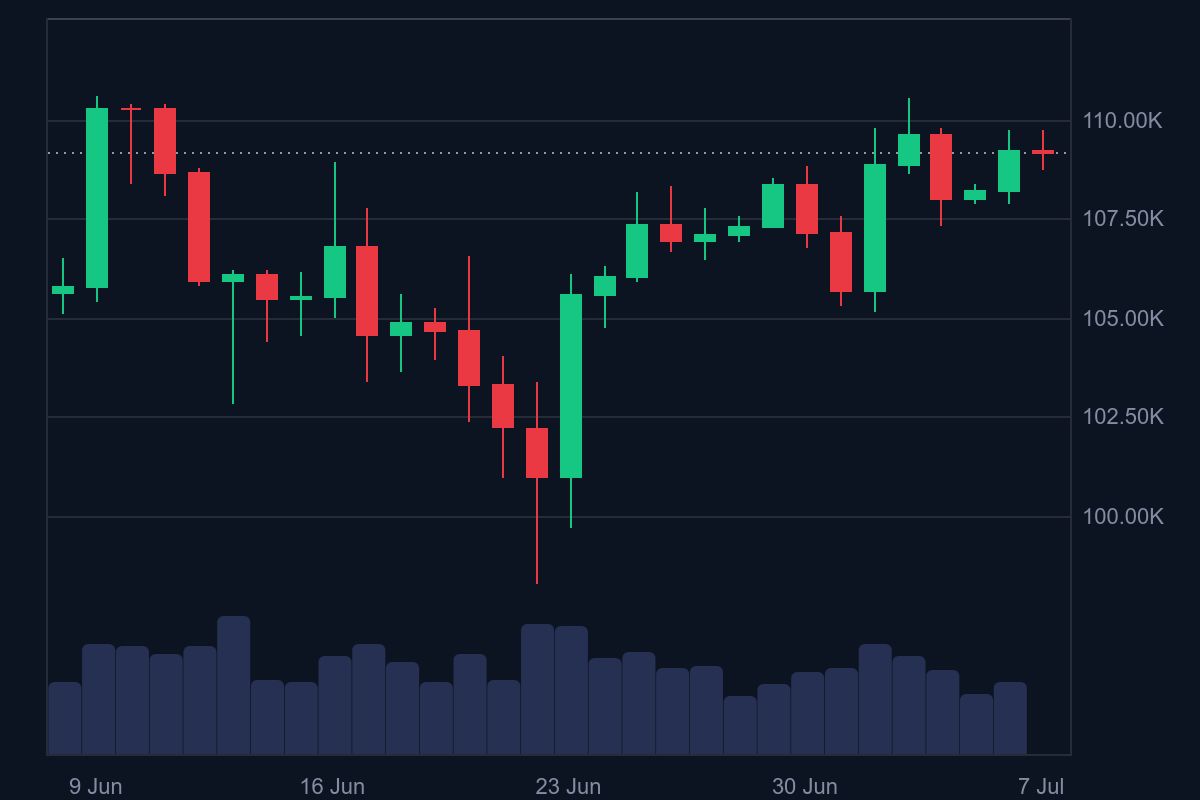
Bitcoin price today is hovering around $109,000, with the broader cryptocurrency market moving sideways.
In the longer term, StanChart predicts that Bitcoin will hit a $200K target before the end of 2025.
How high can Bitcoin go? Let's check the newest BTC price prediction
Bitcoin
(BTC) price could surge 25% from current levels to reach a new all-time high of
$135,000 by the end of the third quarter, according to a fresh price forecast
from global bank Standard Chartered that challenges traditional market
patterns.
How High Can Bitcoin Go?
New BTC Price Prediction from Standard Chartered
The British
multinational bank's digital asset research head Geoff Kendrick released the
bullish projection last week, arguing that Bitcoin has broken free from
historical post-halving price declines due to unprecedented institutional
demand through exchange-traded funds and corporate treasury purchases.
Bitcoin
currently trades around $109,000, meaning the $135,000 target would represent a
roughly 2% gain over the next two months. Standard Chartered goes even further,
predicting Bitcoin will break $200,000 by year-end before ultimately reaching
$500,000 per coin by 2028.
Geoff Kendrick from Standard Chartered
“Thanks
to increased investor flows, we believe BTC has moved beyond the previous
dynamic whereby prices fell 18 months after a ‘halving’ cycle,” Kendrick
said in the Wednesday report. The analyst noted that traditional halving
patterns would have suggested price declines in September or October 2025.
Bitcoin's
halving events occur approximately every four years, cutting mining rewards in
half and historically triggering both price spikes and subsequent corrections.
The most recent halving happened in April 2024, and previous cycles in 2016 and
2020 led to Bitcoin prices falling about 18 months afterward.
However,
Kendrick argues this cycle will play out differently because of two major
factors that weren't present during earlier halvings: massive ETF inflows and
corporate Bitcoin buying for treasury purposes.
The bank's
analysis shows Bitcoin ETF flows and corporate treasury buying totaled 245,000
BTC in the second quarter alone. “We expect that level to be exceeded in
both Q3 and Q4,” Kendrick added.
The
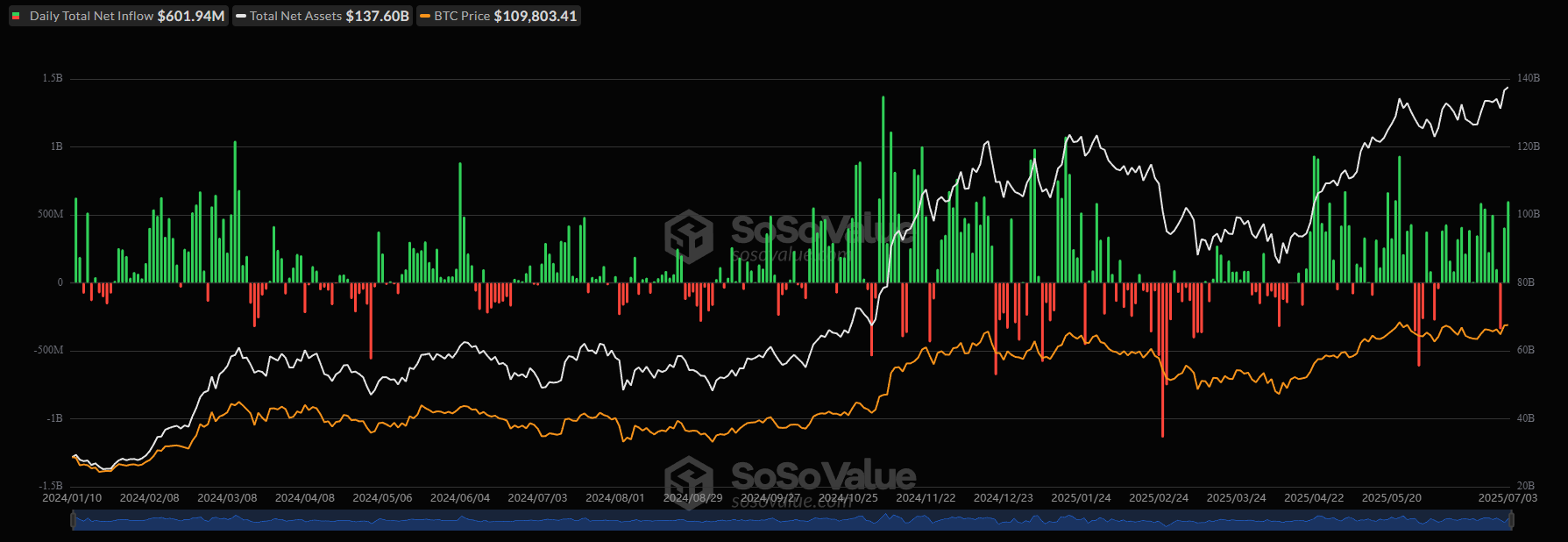
optimistic forecast comes as Bitcoin ETF flows recently turned negative after a
strong 15-day run. U.S. spot Bitcoin ETFs posted $342.3 million in outflows last Tuesday,
marking their first outflows since June 6 and representing 7% of the total $4.8
billion inflows seen during the previous two-week streak.
Source: SoSoValue.com
Despite the
recent outflow, Standard Chartered maintains that institutional demand remains
the key driver separating this cycle from previous ones. The bank acknowledges
prices could still be “somewhat choppy” in late Q3 and early Q4 due
to lingering concerns about historical correction patterns.
Bitcoin Price Predictions
for 2025 and 2028
The
cryptocurrency market has attracted significant attention from major financial
institutions, with numerous Wall Street firms and industry analysts releasing
increasingly bullish Bitcoin price forecasts. These predictions span both
near-term targets for 2025 and longer-term projections extending into 2028 and
beyond.
Standard
Chartered maintains one of the most aggressive mainstream forecasts, with the
bank's digital assets research team projecting Bitcoin could reach $200,000 by
year-end 2025.
VanEck, a
prominent asset management firm, has outlined what they call a “dual-peak
cycle” scenario for 2025. Their research team expects Bitcoin to
potentially hit approximately $180,000 during a first-half rally, followed by a
mid-year correction, before potentially establishing new highs in the latter
part of 2025.
Looking
further ahead, price projections become even more ambitious. Standard Chartered
has outlined a multi-year trajectory toward $500,000 by 2028, representing
their view of Bitcoin's potential as institutional adoption accelerates and
macroeconomic factors continue supporting alternative assets.
ARK Invest,
led by Cathie Wood, has published some of the most bullish long-term forecasts
in the industry. Their base case scenario projects Bitcoin reaching $1.2
million by 2030, with a bull case extending to $2.4 million. Even their bear
case scenario anticipates Bitcoin reaching approximately $500,000 by the
decade's end.
VanEck,
while not providing specific 2030 targets, expects Bitcoin to achieve new highs
beyond 2025, with some projections suggesting the next cycle could push prices
above $400,000.
Why Bitcoin May Not Reach
New ATH? Experts Weigh In
Not
everyone shares Standard Chartered's aggressive timeline, though many agree on
Bitcoin's long-term potential.
Kirill
Kretov from CoinPanel expressed caution about the near-term projections:
“While Bitcoin reaching $135K or even $200K by year-end is possible,
especially in a thin, sentiment-driven market, I would remain cautious about
taking such projections at face value.”
Kretov's
on-chain research shows “larger players are actively accumulating BTC in
the $100K–$110K range, while liquidity continues to be withdrawn from actively
transacting wallets.” He sees near-term fluctuations between $95K and
$115K as more realistic, calling the current environment “a structured
accumulation phase” rather than trend-chasing.
Paul Howard, Wincent
For Bitcoin
to move decisively higher, Kretov believes the market needs “clearer
macroeconomic direction,” reduced volatility exploitation by large
players, and “a flush of ‘dead weight’—long-standing holders hoping to
exit on price strength.”
Paul Howard
from Wincent offered a more optimistic but measured view: “To date, Geoff
has consistently delivered more accurate price predictions than not.”
Howard expects “tailwinds from fiat devaluation, and ETF activity will in
all likelihood propel BTC to break $150k before year end.”
However,
Howard expressed skepticism about the $200,000 target: “I will be
surprised if prices touch $200k given this would arguably need around $1Tn
additional market cap. I dont see where that money come from in the next 6
months but we do get there by 2027.”
Institutional Adoption
Continues
The debate
over Bitcoin's short-term trajectory occurs against a backdrop of continued
institutional adoption. Howard noted “genuine institutional activity in
digital assets spurred on by a more positive US regulatory environment,”
though he warned that “the macro threat of tariffs could still spoil the
recipe.”
Standard
Chartered's forecast represents one of the most aggressive near-term Bitcoin
predictions from a major traditional financial institution. The bank's
confidence stems from its belief that ETF demand and corporate buying have
fundamentally altered Bitcoin's market dynamics, potentially rendering
historical price patterns obsolete.
Whether
Bitcoin can achieve the predicted 25% jump to new highs this quarter will
largely depend on sustained institutional demand and broader macroeconomic
conditions. The cryptocurrency's ability to break free from traditional halving
cycle patterns could reshape how investors approach Bitcoin's four-year cycles
going forward.
Bitcoin News FAQ
What will BTC be worth in
2025?
Based on
current institutional forecasts, Bitcoin is expected to reach $135,000 to
$200,000 by the end of 2025, with most major financial institutions converging
around six-figure targets. Key 2025 Price Predictions:
Standard
Chartered: $200,000 by year-end, with $135,000 expected by Q3
VanEck:
Peak around $180,000 in a dual-cycle scenario
Finder.com
Expert Panel: $161,000 average forecast
Current
trajectory: Bitcoin needs approximately 25% growth to reach the $135,000 Q3
target
The bullish
outlook stems from unprecedented ETF inflows and corporate treasury adoption
that weren't present in previous Bitcoin cycles. Standard Chartered argues
these factors have broken traditional post-halving correction patterns,
potentially eliminating the 18-month price declines that historically followed
halving events.
How much will 1 Bitcoin be
worth in 2030?
Long-term
Bitcoin projections for 2030 range from $405,000 to $2.4 million, depending on
adoption scenarios and market conditions. ARK Invest provides the most detailed
2030 analysis, with their base case of $1.2 million per Bitcoin assuming
continued institutional adoption and Bitcoin's evolution as “digital gold
2.0.” Their bull case scenario of $2.4 million factors in accelerated
corporate treasury adoption and potential sovereign wealth fund allocations.
How high can Bitcoin go
realistically?
Bitcoin's
realistic long-term potential depends on its role in the global financial
system, but institutional analysis suggests $500,000 to $1.2 million represents
achievable targets based on current adoption trends.
Bitcoin
(BTC) price could surge 25% from current levels to reach a new all-time high of
$135,000 by the end of the third quarter, according to a fresh price forecast
from global bank Standard Chartered that challenges traditional market
patterns.
How High Can Bitcoin Go?
New BTC Price Prediction from Standard Chartered
The British
multinational bank's digital asset research head Geoff Kendrick released the
bullish projection last week, arguing that Bitcoin has broken free from
historical post-halving price declines due to unprecedented institutional
demand through exchange-traded funds and corporate treasury purchases.
Bitcoin
currently trades around $109,000, meaning the $135,000 target would represent a
roughly 2% gain over the next two months. Standard Chartered goes even further,
predicting Bitcoin will break $200,000 by year-end before ultimately reaching
$500,000 per coin by 2028.
Geoff Kendrick from Standard Chartered
“Thanks
to increased investor flows, we believe BTC has moved beyond the previous
dynamic whereby prices fell 18 months after a ‘halving’ cycle,” Kendrick
said in the Wednesday report. The analyst noted that traditional halving
patterns would have suggested price declines in September or October 2025.
Bitcoin's
halving events occur approximately every four years, cutting mining rewards in
half and historically triggering both price spikes and subsequent corrections.
The most recent halving happened in April 2024, and previous cycles in 2016 and
2020 led to Bitcoin prices falling about 18 months afterward.
However,
Kendrick argues this cycle will play out differently because of two major
factors that weren't present during earlier halvings: massive ETF inflows and
corporate Bitcoin buying for treasury purposes.
The bank's
analysis shows Bitcoin ETF flows and corporate treasury buying totaled 245,000
BTC in the second quarter alone. “We expect that level to be exceeded in
both Q3 and Q4,” Kendrick added.
The
optimistic forecast comes as Bitcoin ETF flows recently turned negative after a
strong 15-day run. U.S. spot Bitcoin ETFs posted $342.3 million in outflows last Tuesday,
marking their first outflows since June 6 and representing 7% of the total $4.8
billion inflows seen during the previous two-week streak.
Source: SoSoValue.com
Despite the
recent outflow, Standard Chartered maintains that institutional demand remains
the key driver separating this cycle from previous ones. The bank acknowledges
prices could still be “somewhat choppy” in late Q3 and early Q4 due
to lingering concerns about historical correction patterns.
Bitcoin Price Predictions
for 2025 and 2028
The
cryptocurrency market has attracted significant attention from major financial
institutions, with numerous Wall Street firms and industry analysts releasing
increasingly bullish Bitcoin price forecasts. These predictions span both
near-term targets for 2025 and longer-term projections extending into 2028 and
beyond.
Standard
Chartered maintains one of the most aggressive mainstream forecasts, with the
bank's digital assets research team projecting Bitcoin could reach $200,000 by
year-end 2025.
VanEck, a
prominent asset management firm, has outlined what they call a “dual-peak
cycle” scenario for 2025. Their research team expects Bitcoin to
potentially hit approximately $180,000 during a first-half rally, followed by a
mid-year correction, before potentially establishing new highs in the latter
part of 2025.
Looking
further ahead, price projections become even more ambitious. Standard Chartered
has outlined a multi-year trajectory toward $500,000 by 2028, representing
their view of Bitcoin's potential as institutional adoption accelerates and
macroeconomic factors continue supporting alternative assets.
ARK Invest,
led by Cathie Wood, has published some of the most bullish long-term forecasts
in the industry. Their base case scenario projects Bitcoin reaching $1.2
million by 2030, with a bull case extending to $2.4 million. Even their bear
case scenario anticipates Bitcoin reaching approximately $500,000 by the
decade's end.
VanEck,
while not providing specific 2030 targets, expects Bitcoin to achieve new highs
beyond 2025, with some projections suggesting the next cycle could push prices
above $400,000.
Why Bitcoin May Not Reach
New ATH? Experts Weigh In
Not
everyone shares Standard Chartered's aggressive timeline, though many agree on
Bitcoin's long-term potential.
Kirill
Kretov from CoinPanel expressed caution about the near-term projections:
“While Bitcoin reaching $135K or even $200K by year-end is possible,
especially in a thin, sentiment-driven market, I would remain cautious about
taking such projections at face value.”
Kretov's
on-chain research shows “larger players are actively accumulating BTC in
the $100K–$110K range, while liquidity continues to be withdrawn from actively
transacting wallets.” He sees near-term fluctuations between $95K and
$115K as more realistic, calling the current environment “a structured
accumulation phase” rather than trend-chasing.
Paul Howard, Wincent
For Bitcoin
to move decisively higher, Kretov believes the market needs “clearer
macroeconomic direction,” reduced volatility exploitation by large
players, and “a flush of ‘dead weight’—long-standing holders hoping to
exit on price strength.”
Paul Howard
from Wincent offered a more optimistic but measured view: “To date, Geoff
has consistently delivered more accurate price predictions than not.”
Howard expects “tailwinds from fiat devaluation, and ETF activity will in
all likelihood propel BTC to break $150k before year end.”
However,
Howard expressed skepticism about the $200,000 target: “I will be
surprised if prices touch $200k given this would arguably need around $1Tn
additional market cap. I dont see where that money come from in the next 6
months but we do get there by 2027.”
Institutional Adoption
Continues
The debate
over Bitcoin's short-term trajectory occurs against a backdrop of continued
institutional adoption. Howard noted “genuine institutional activity in
digital assets spurred on by a more positive US regulatory environment,”
though he warned that “the macro threat of tariffs could still spoil the
recipe.”
Standard
Chartered's forecast represents one of the most aggressive near-term Bitcoin
predictions from a major traditional financial institution. The bank's
confidence stems from its belief that ETF demand and corporate buying have
fundamentally altered Bitcoin's market dynamics, potentially rendering
historical price patterns obsolete.
Whether
Bitcoin can achieve the predicted 25% jump to new highs this quarter will
largely depend on sustained institutional demand and broader macroeconomic
conditions. The cryptocurrency's ability to break free from traditional halving
cycle patterns could reshape how investors approach Bitcoin's four-year cycles
going forward.
Bitcoin News FAQ
What will BTC be worth in
2025?
Based on
current institutional forecasts, Bitcoin is expected to reach $135,000 to
$200,000 by the end of 2025, with most major financial institutions converging
around six-figure targets. Key 2025 Price Predictions:
Standard
Chartered: $200,000 by year-end, with $135,000 expected by Q3
VanEck:
Peak around $180,000 in a dual-cycle scenario
Finder.com
Expert Panel: $161,000 average forecast
Current
trajectory: Bitcoin needs approximately 25% growth to reach the $135,000 Q3
target
The bullish
outlook stems from unprecedented ETF inflows and corporate treasury adoption
that weren't present in previous Bitcoin cycles. Standard Chartered argues
these factors have broken traditional post-halving correction patterns,
potentially eliminating the 18-month price declines that historically followed
halving events.
How much will 1 Bitcoin be
worth in 2030?
Long-term
Bitcoin projections for 2030 range from $405,000 to $2.4 million, depending on
adoption scenarios and market conditions. ARK Invest provides the most detailed
2030 analysis, with their base case of $1.2 million per Bitcoin assuming
continued institutional adoption and Bitcoin's evolution as “digital gold
2.0.” Their bull case scenario of $2.4 million factors in accelerated
corporate treasury adoption and potential sovereign wealth fund allocations.
How high can Bitcoin go
realistically?
Bitcoin's
realistic long-term potential depends on its role in the global financial
system, but institutional analysis suggests $500,000 to $1.2 million represents
achievable targets based on current adoption trends.
Damian Chmiel is a Senior Analyst & Editor at Finance Magnates with more than 15 years of experience in the CFD and online trading industry. Active as both a trader and journalist since 2010, he focuses on broker coverage, fintech innovation, and regulatory developments across Europe, the Middle East, and Asia.
His work includes interviews with C-level leaders at major brokerages and fintech platforms, as well as co-authoring Finance Magnates’ quarterly industry benchmarking reports. Damian’s reporting is data-driven, market-aware, and grounded in direct industry engagement. His analysis and commentary have also been cited by external media outlets, including Investing.com, Binance, The Asset, Stockhead, and Dispatch.
Education:
MA in Finance and Accounting, Cracow University of Economics
Why Is Dogecoin Going Up Today? DOGE Price Prediction Shows 25% Upside Potential
Featured Videos
AvaTrade to Acquire Most of FXCM; NAGA Raises $8M
AvaTrade to Acquire Most of FXCM; NAGA Raises $8M
AvaTrade to Acquire Most of FXCM; NAGA Raises $8M
AvaTrade to Acquire Most of FXCM; NAGA Raises $8M
Today’s financial news recap covers AvaTrade agrees to acquire most of FXCM, NAGA secures eight million dollars in new financing, and Wise seeks a tax settlement in the UK.
Finance Magnates Daily Recap brings you the latest news from forex and CFD brokers, fintech, payments, cryptocurrency, digital assets, trading platforms, financial regulation and global markets.
Get the key company news, executive moves, deals, regulatory updates and market developments of the day, in just a few minutes. New episodes published every weekday.
Read more: https://www.financemagnates.com
#FinanceMagnates #ForexNews #FintechNews
Today’s financial news recap covers AvaTrade agrees to acquire most of FXCM, NAGA secures eight million dollars in new financing, and Wise seeks a tax settlement in the UK.
Finance Magnates Daily Recap brings you the latest news from forex and CFD brokers, fintech, payments, cryptocurrency, digital assets, trading platforms, financial regulation and global markets.
Get the key company news, executive moves, deals, regulatory updates and market developments of the day, in just a few minutes. New episodes published every weekday.
Read more: https://www.financemagnates.com
#FinanceMagnates #ForexNews #FintechNews
Today’s financial news recap covers AvaTrade agrees to acquire most of FXCM, NAGA secures eight million dollars in new financing, and Wise seeks a tax settlement in the UK.
Finance Magnates Daily Recap brings you the latest news from forex and CFD brokers, fintech, payments, cryptocurrency, digital assets, trading platforms, financial regulation and global markets.
Get the key company news, executive moves, deals, regulatory updates and market developments of the day, in just a few minutes. New episodes published every weekday.
Read more: https://www.financemagnates.com
#FinanceMagnates #ForexNews #FintechNews
Today’s financial news recap covers AvaTrade agrees to acquire most of FXCM, NAGA secures eight million dollars in new financing, and Wise seeks a tax settlement in the UK.
Finance Magnates Daily Recap brings you the latest news from forex and CFD brokers, fintech, payments, cryptocurrency, digital assets, trading platforms, financial regulation and global markets.
Get the key company news, executive moves, deals, regulatory updates and market developments of the day, in just a few minutes. New episodes published every weekday.
Read more: https://www.financemagnates.com
#FinanceMagnates #ForexNews #FintechNews
XTB Adds Overnight US Stock Trading; Nasdaq Ventures Invests in One Trading
XTB Adds Overnight US Stock Trading; Nasdaq Ventures Invests in One Trading
XTB Adds Overnight US Stock Trading; Nasdaq Ventures Invests in One Trading
XTB Adds Overnight US Stock Trading; Nasdaq Ventures Invests in One Trading
XTB Adds Overnight US Stock Trading; Nasdaq Ventures Invests in One Trading
XTB Adds Overnight US Stock Trading; Nasdaq Ventures Invests in One Trading
Today’s financial news recap covers XTB expands overnight US stock trading, Fortrade reports higher revenue, Nasdaq backs One Trading, and Vest Labs raises 13 million dollars.
Finance Magnates Daily Recap brings you the latest news from forex and CFD brokers, fintech, payments, cryptocurrency, digital assets, trading platforms, financial regulation and global markets.
Get the key company news, executive moves, deals, regulatory updates and market developments of the day, in just a few minutes. New episodes published every weekday.
Read more: https://www.financemagnates.com
#FinanceMagnates #ForexNews #FintechNews
Today’s financial news recap covers XTB expands overnight US stock trading, Fortrade reports higher revenue, Nasdaq backs One Trading, and Vest Labs raises 13 million dollars.
Finance Magnates Daily Recap brings you the latest news from forex and CFD brokers, fintech, payments, cryptocurrency, digital assets, trading platforms, financial regulation and global markets.
Get the key company news, executive moves, deals, regulatory updates and market developments of the day, in just a few minutes. New episodes published every weekday.
Read more: https://www.financemagnates.com
#FinanceMagnates #ForexNews #FintechNews
Today’s financial news recap covers XTB expands overnight US stock trading, Fortrade reports higher revenue, Nasdaq backs One Trading, and Vest Labs raises 13 million dollars.
Finance Magnates Daily Recap brings you the latest news from forex and CFD brokers, fintech, payments, cryptocurrency, digital assets, trading platforms, financial regulation and global markets.
Get the key company news, executive moves, deals, regulatory updates and market developments of the day, in just a few minutes. New episodes published every weekday.
Read more: https://www.financemagnates.com
#FinanceMagnates #ForexNews #FintechNews
Today’s financial news recap covers XTB expands overnight US stock trading, Fortrade reports higher revenue, Nasdaq backs One Trading, and Vest Labs raises 13 million dollars.
Finance Magnates Daily Recap brings you the latest news from forex and CFD brokers, fintech, payments, cryptocurrency, digital assets, trading platforms, financial regulation and global markets.
Get the key company news, executive moves, deals, regulatory updates and market developments of the day, in just a few minutes. New episodes published every weekday.
Read more: https://www.financemagnates.com
#FinanceMagnates #ForexNews #FintechNews
Today’s financial news recap covers XTB expands overnight US stock trading, Fortrade reports higher revenue, Nasdaq backs One Trading, and Vest Labs raises 13 million dollars.
Finance Magnates Daily Recap brings you the latest news from forex and CFD brokers, fintech, payments, cryptocurrency, digital assets, trading platforms, financial regulation and global markets.
Get the key company news, executive moves, deals, regulatory updates and market developments of the day, in just a few minutes. New episodes published every weekday.
Read more: https://www.financemagnates.com
#FinanceMagnates #ForexNews #FintechNews
Today’s financial news recap covers XTB expands overnight US stock trading, Fortrade reports higher revenue, Nasdaq backs One Trading, and Vest Labs raises 13 million dollars.
Finance Magnates Daily Recap brings you the latest news from forex and CFD brokers, fintech, payments, cryptocurrency, digital assets, trading platforms, financial regulation and global markets.
Get the key company news, executive moves, deals, regulatory updates and market developments of the day, in just a few minutes. New episodes published every weekday.
Read more: https://www.financemagnates.com
#FinanceMagnates #ForexNews #FintechNews
CMC Founder Downplays Volatility Hit; Devexperts Names CEO
CMC Founder Downplays Volatility Hit; Devexperts Names CEO
CMC Founder Downplays Volatility Hit; Devexperts Names CEO
CMC Founder Downplays Volatility Hit; Devexperts Names CEO
CMC Founder Downplays Volatility Hit; Devexperts Names CEO
CMC Founder Downplays Volatility Hit; Devexperts Names CEO
Today’s financial news recap covers low volatility pressures brokers, Devexperts names a new CEO, Saxo cuts onboarding time, and OKX reaches a 25 billion dollar valuation.
Finance Magnates Daily Recap brings you the latest news from forex and CFD brokers, fintech, payments, cryptocurrency, digital assets, trading platforms, financial regulation and global markets.
Get the key company news, executive moves, deals, regulatory updates and market developments of the day, in just a few minutes. New episodes published every weekday.
Read more: https://www.financemagnates.com
#FinanceMagnates #ForexNews #FintechNews
Today’s financial news recap covers low volatility pressures brokers, Devexperts names a new CEO, Saxo cuts onboarding time, and OKX reaches a 25 billion dollar valuation.
Finance Magnates Daily Recap brings you the latest news from forex and CFD brokers, fintech, payments, cryptocurrency, digital assets, trading platforms, financial regulation and global markets.
Get the key company news, executive moves, deals, regulatory updates and market developments of the day, in just a few minutes. New episodes published every weekday.
Read more: https://www.financemagnates.com
#FinanceMagnates #ForexNews #FintechNews
Today’s financial news recap covers low volatility pressures brokers, Devexperts names a new CEO, Saxo cuts onboarding time, and OKX reaches a 25 billion dollar valuation.
Finance Magnates Daily Recap brings you the latest news from forex and CFD brokers, fintech, payments, cryptocurrency, digital assets, trading platforms, financial regulation and global markets.
Get the key company news, executive moves, deals, regulatory updates and market developments of the day, in just a few minutes. New episodes published every weekday.
Read more: https://www.financemagnates.com
#FinanceMagnates #ForexNews #FintechNews
Today’s financial news recap covers low volatility pressures brokers, Devexperts names a new CEO, Saxo cuts onboarding time, and OKX reaches a 25 billion dollar valuation.
Finance Magnates Daily Recap brings you the latest news from forex and CFD brokers, fintech, payments, cryptocurrency, digital assets, trading platforms, financial regulation and global markets.
Get the key company news, executive moves, deals, regulatory updates and market developments of the day, in just a few minutes. New episodes published every weekday.
Read more: https://www.financemagnates.com
#FinanceMagnates #ForexNews #FintechNews
Today’s financial news recap covers low volatility pressures brokers, Devexperts names a new CEO, Saxo cuts onboarding time, and OKX reaches a 25 billion dollar valuation.
Finance Magnates Daily Recap brings you the latest news from forex and CFD brokers, fintech, payments, cryptocurrency, digital assets, trading platforms, financial regulation and global markets.
Get the key company news, executive moves, deals, regulatory updates and market developments of the day, in just a few minutes. New episodes published every weekday.
Read more: https://www.financemagnates.com
#FinanceMagnates #ForexNews #FintechNews
Today’s financial news recap covers low volatility pressures brokers, Devexperts names a new CEO, Saxo cuts onboarding time, and OKX reaches a 25 billion dollar valuation.
Finance Magnates Daily Recap brings you the latest news from forex and CFD brokers, fintech, payments, cryptocurrency, digital assets, trading platforms, financial regulation and global markets.
Get the key company news, executive moves, deals, regulatory updates and market developments of the day, in just a few minutes. New episodes published every weekday.
Read more: https://www.financemagnates.com
#FinanceMagnates #ForexNews #FintechNews
Today’s financial news recap covers Trade Nation buys FXCM's UK client book, Trading 212 reports higher revenue, the CFTC's move to allow perpetual index futures.
Finance Magnates Daily Recap brings you the latest news from forex and CFD brokers, fintech, payments, cryptocurrency, digital assets, trading platforms, financial regulation and global markets.
Get the key company news, executive moves, deals, regulatory updates and market developments of the day, in just a few minutes. New episodes published every weekday.
Read more: https://www.financemagnates.com
#FinanceMagnates #ForexNews #FintechNews
Today’s financial news recap covers Trade Nation buys FXCM's UK client book, Trading 212 reports higher revenue, the CFTC's move to allow perpetual index futures.
Finance Magnates Daily Recap brings you the latest news from forex and CFD brokers, fintech, payments, cryptocurrency, digital assets, trading platforms, financial regulation and global markets.
Get the key company news, executive moves, deals, regulatory updates and market developments of the day, in just a few minutes. New episodes published every weekday.
Read more: https://www.financemagnates.com
#FinanceMagnates #ForexNews #FintechNews
Today’s financial news recap covers Trade Nation buys FXCM's UK client book, Trading 212 reports higher revenue, the CFTC's move to allow perpetual index futures.
Finance Magnates Daily Recap brings you the latest news from forex and CFD brokers, fintech, payments, cryptocurrency, digital assets, trading platforms, financial regulation and global markets.
Get the key company news, executive moves, deals, regulatory updates and market developments of the day, in just a few minutes. New episodes published every weekday.
Read more: https://www.financemagnates.com
#FinanceMagnates #ForexNews #FintechNews
Today’s financial news recap covers Trade Nation buys FXCM's UK client book, Trading 212 reports higher revenue, the CFTC's move to allow perpetual index futures.
Finance Magnates Daily Recap brings you the latest news from forex and CFD brokers, fintech, payments, cryptocurrency, digital assets, trading platforms, financial regulation and global markets.
Get the key company news, executive moves, deals, regulatory updates and market developments of the day, in just a few minutes. New episodes published every weekday.
Read more: https://www.financemagnates.com
#FinanceMagnates #ForexNews #FintechNews
Today’s financial news recap covers Trade Nation buys FXCM's UK client book, Trading 212 reports higher revenue, the CFTC's move to allow perpetual index futures.
Finance Magnates Daily Recap brings you the latest news from forex and CFD brokers, fintech, payments, cryptocurrency, digital assets, trading platforms, financial regulation and global markets.
Get the key company news, executive moves, deals, regulatory updates and market developments of the day, in just a few minutes. New episodes published every weekday.
Read more: https://www.financemagnates.com
#FinanceMagnates #ForexNews #FintechNews
Today’s financial news recap covers Trade Nation buys FXCM's UK client book, Trading 212 reports higher revenue, the CFTC's move to allow perpetual index futures.
Finance Magnates Daily Recap brings you the latest news from forex and CFD brokers, fintech, payments, cryptocurrency, digital assets, trading platforms, financial regulation and global markets.
Get the key company news, executive moves, deals, regulatory updates and market developments of the day, in just a few minutes. New episodes published every weekday.
Read more: https://www.financemagnates.com
#FinanceMagnates #ForexNews #FintechNews
Your career isn’t a linear path.
Your career isn’t a linear path.
Your career isn’t a linear path.
Your career isn’t a linear path.
Your career isn’t a linear path.
Your career isn’t a linear path.
Roles change. Career goals change. Sometimes you want a completely new challenge.
But the skills and knowledge you build along the way can stay with you and give you something to build on.
For Jeff Patterson, that continued growth is key to long-term career development.
You bring the skills. FM Academy helps you build the knowledge.
#FMAcademy #FinanceMagnates #FinanceCareers #ProfessionalDevelopment #Fintech
Roles change. Career goals change. Sometimes you want a completely new challenge.
But the skills and knowledge you build along the way can stay with you and give you something to build on.
For Jeff Patterson, that continued growth is key to long-term career development.
You bring the skills. FM Academy helps you build the knowledge.
#FMAcademy #FinanceMagnates #FinanceCareers #ProfessionalDevelopment #Fintech
Roles change. Career goals change. Sometimes you want a completely new challenge.
But the skills and knowledge you build along the way can stay with you and give you something to build on.
For Jeff Patterson, that continued growth is key to long-term career development.
You bring the skills. FM Academy helps you build the knowledge.
#FMAcademy #FinanceMagnates #FinanceCareers #ProfessionalDevelopment #Fintech
Roles change. Career goals change. Sometimes you want a completely new challenge.
But the skills and knowledge you build along the way can stay with you and give you something to build on.
For Jeff Patterson, that continued growth is key to long-term career development.
You bring the skills. FM Academy helps you build the knowledge.
#FMAcademy #FinanceMagnates #FinanceCareers #ProfessionalDevelopment #Fintech
Roles change. Career goals change. Sometimes you want a completely new challenge.
But the skills and knowledge you build along the way can stay with you and give you something to build on.
For Jeff Patterson, that continued growth is key to long-term career development.
You bring the skills. FM Academy helps you build the knowledge.
#FMAcademy #FinanceMagnates #FinanceCareers #ProfessionalDevelopment #Fintech
Roles change. Career goals change. Sometimes you want a completely new challenge.
But the skills and knowledge you build along the way can stay with you and give you something to build on.
For Jeff Patterson, that continued growth is key to long-term career development.
You bring the skills. FM Academy helps you build the knowledge.
#FMAcademy #FinanceMagnates #FinanceCareers #ProfessionalDevelopment #Fintech