A funding uptick in Q1 fuels hopes in the Israeli tech community.
But without certainty, how can it move forward?
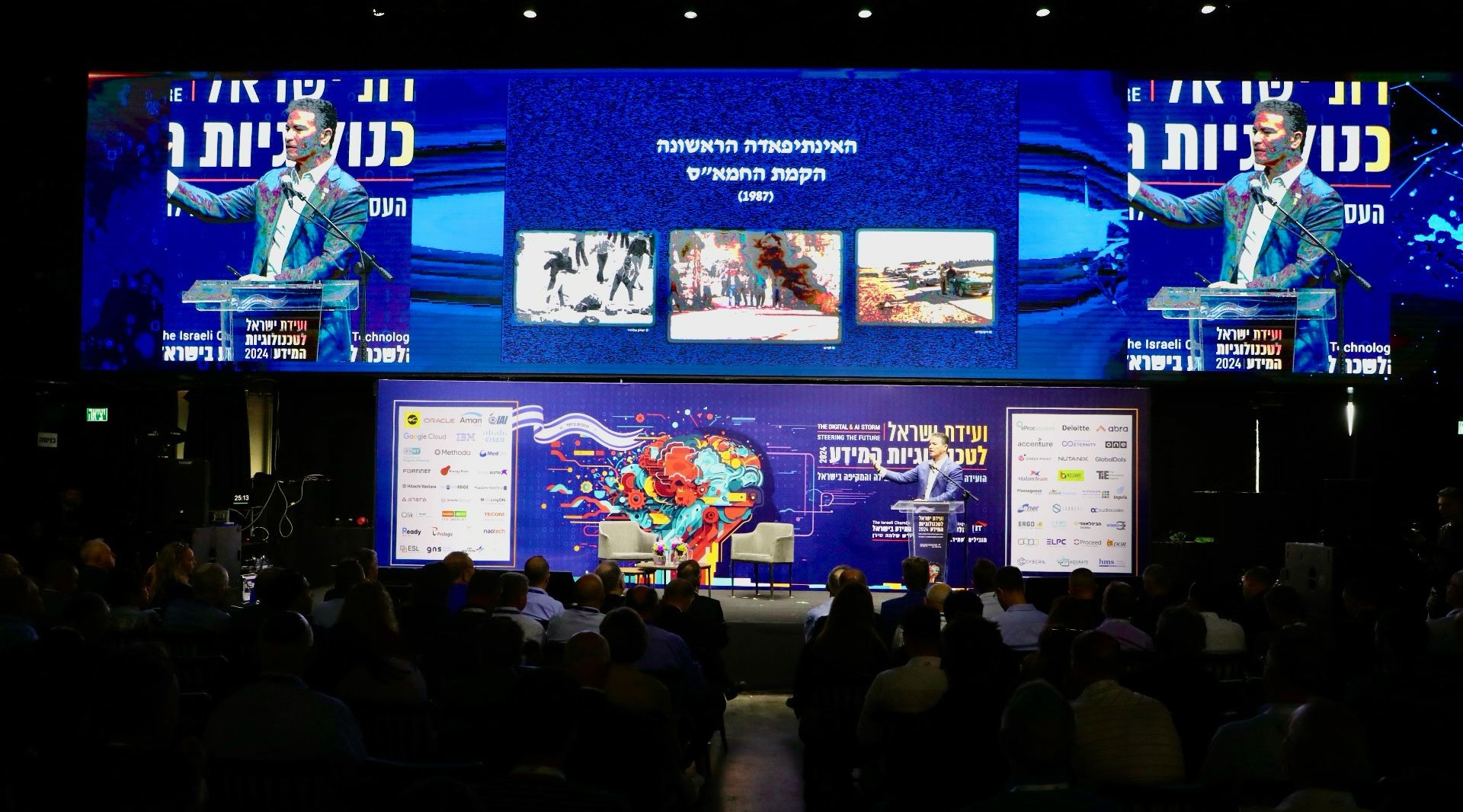
Yossi Cohen, ex-head of Mossad at Israel IT Summit; Credit: Niv Kantor
Exactly six months after October 7th, the Israeli Chamber of Information Technology held its annual IT Summit, attracting around 3,000 participants from across the board in tech.
Walking the halls and pathways at the packed event, held at a sprawling venue in a Tel Aviv suburb, I encountered executives of the largest tech firms, representatives of pretty much any government agency, and, in one case, a couple of freshmen looking for a job at IBM.
Aptly for an IT chamber event, perhaps, it went smoothly and content sessions were displayed not only in a packed speaker hall but on screens and loudspeakers throughout the venue.
The prevailing sentiment, both on and off stage, was ‘mixed feelings’, between a mild dosage of cautious optimism and deep concerns regarding the War in Gaza and its potential consequences.
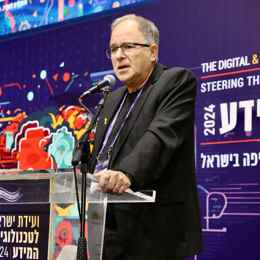
Eli Frank, Chairman of Israel IT Chamber; Credit: Niv Kantor
Eli Frank, the Chairman of Israel IT Chamber, was squarely positive. “The negative sentiment is political, but when it comes to business, I recognize that the world appreciates Israel’s tech capabilities,” he told Finance Magnates. “That’s why you see investments returning.”
Supporting this spirit, to some extent, were figures presented in two panel discussions, pointing to startup funding recovery (17% uptick in deal worth in Q1 compared to Q4 2024, according to Deloitte; 10% in funding volumes QoQ, per Blumberg Capital’s MD, Yodfat Harel Buchris).
However, these numbers assume a darker tone compared to pre-war and pre-judicial reform environments. Words like 'complex' and 'challenging' kept coming up in conversations, as other panelists highlighted the uncertainties and challenges ahead.
“Business owners committed to meeting schedules would hesitate to invest in a development centre in Kyiv, for example, and today this sentiment is extending to Israel too,” said Ben Pasternak, the CEO and Owner of Aman Group. Somewhat ominously, he went on to urge listeners to consider developing capabilities that international players currently provide.
"The Israeli hi-tech is alive and kicking," concluded Blumberg’s Harel-Buchris, "But, it is bruised."
Non-AI Innovation
The Summit’s theme was “Digital & AI Storm – Steering The Future.” Frank told me, between a radio interview and shaking hands with peers, that the Summit represents the peak of various meetups held by the Chamber throughout the year.
Indeed, after the sessions in the main hall had concluded, no less than eight separate content streams went on in parallel. I attended the fintech one and found the moments when it was not AI that created innovation or value propositions most interesting.
Talking about pensions and retirement plans for high-tech executives, Yair Ben David of Kedma Wealth Management showed mainly what AI can’t do. Bespoke and agile decision-making, he meticulously demonstrated, is still very much needed to generate the best returns. At least one fellow speaker took a business card.
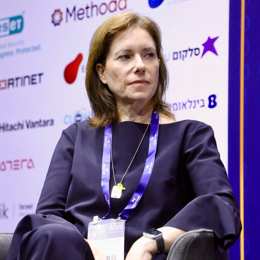
Hedva Ber, eToro’s deputy CEO; Credit: Niv Kantor
Later on, in a passionate speech peppered with good-humored jabs at competitors, Sarit Beck Barkai showed how innovation can start with listening. Spotting unpredictable user behaviour has led PayBox to launch “Boxes,” a banking-like service allowing users to manage funds outside the bank. “Israelis don’t want to feel that they are suckers.”
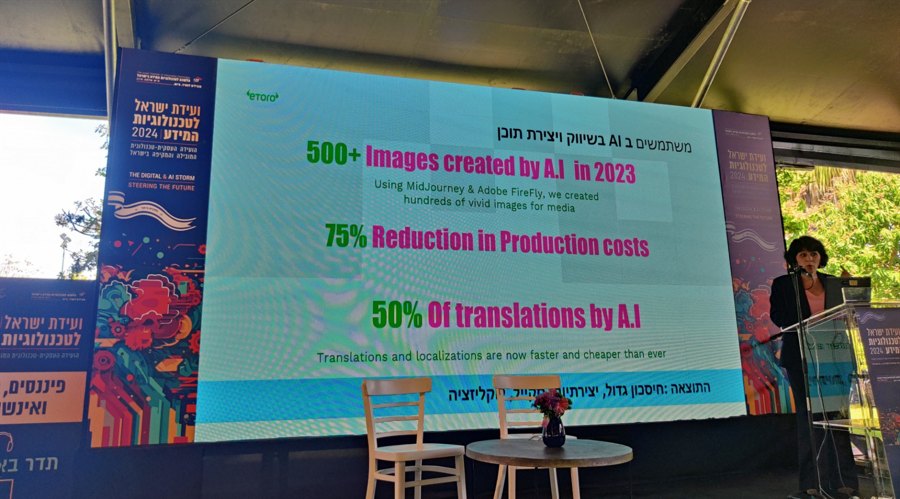
If banks don’t innovate “fast enough” compared to fintech firms, as stated by eToro’s deputy CEO, Hedva Ber, this can be a good place to start.
In her speech, the veteran ex-banking regulator emphasized elements of eToro’s offering that are well-known to readers of Finance Magnates, such as copy trading or fractional shares, as drivers of change and financial inclusion.
A presentation by eToro's Deputy CEO Hedva Ber at Israel IT Summit
For others, innovation is to be found on a larger scale. Airwallex’s Head of Israel and Middle East, Or Liban, walked attendees through the brief history and bright future of Embedded Finance, which is expected to facilitate a whopping $700 billion in 2032.
He defined Embedded Finance as “non-financial firms offering financial products,” which may sound obvious but remains a boon of revenue streams and retention for SMEs, which otherwise suffer “financial discrimination.”
Or Liban, Airwallex’s Head of Israel and Middle East; Credit: Niv Kantor
Airwallex is the only tech firm I know of whose founders first launched a coffee shop to experience retailers’ pain points firsthand, and this approach seems to trickle through with the group’s expansion.
Exactly six months after October 7th, the Israeli Chamber of Information Technology held its annual IT Summit, attracting around 3,000 participants from across the board in tech.
Walking the halls and pathways at the packed event, held at a sprawling venue in a Tel Aviv suburb, I encountered executives of the largest tech firms, representatives of pretty much any government agency, and, in one case, a couple of freshmen looking for a job at IBM.
Aptly for an IT chamber event, perhaps, it went smoothly and content sessions were displayed not only in a packed speaker hall but on screens and loudspeakers throughout the venue.
The prevailing sentiment, both on and off stage, was ‘mixed feelings’, between a mild dosage of cautious optimism and deep concerns regarding the War in Gaza and its potential consequences.
Eli Frank, Chairman of Israel IT Chamber; Credit: Niv Kantor
Eli Frank, the Chairman of Israel IT Chamber, was squarely positive. “The negative sentiment is political, but when it comes to business, I recognize that the world appreciates Israel’s tech capabilities,” he told Finance Magnates. “That’s why you see investments returning.”
Supporting this spirit, to some extent, were figures presented in two panel discussions, pointing to startup funding recovery (17% uptick in deal worth in Q1 compared to Q4 2024, according to Deloitte; 10% in funding volumes QoQ, per Blumberg Capital’s MD, Yodfat Harel Buchris).
However, these numbers assume a darker tone compared to pre-war and pre-judicial reform environments. Words like 'complex' and 'challenging' kept coming up in conversations, as other panelists highlighted the uncertainties and challenges ahead.
“Business owners committed to meeting schedules would hesitate to invest in a development centre in Kyiv, for example, and today this sentiment is extending to Israel too,” said Ben Pasternak, the CEO and Owner of Aman Group. Somewhat ominously, he went on to urge listeners to consider developing capabilities that international players currently provide.
"The Israeli hi-tech is alive and kicking," concluded Blumberg’s Harel-Buchris, "But, it is bruised."
Non-AI Innovation
The Summit’s theme was “Digital & AI Storm – Steering The Future.” Frank told me, between a radio interview and shaking hands with peers, that the Summit represents the peak of various meetups held by the Chamber throughout the year.
Indeed, after the sessions in the main hall had concluded, no less than eight separate content streams went on in parallel. I attended the fintech one and found the moments when it was not AI that created innovation or value propositions most interesting.
Talking about pensions and retirement plans for high-tech executives, Yair Ben David of Kedma Wealth Management showed mainly what AI can’t do. Bespoke and agile decision-making, he meticulously demonstrated, is still very much needed to generate the best returns. At least one fellow speaker took a business card.
Hedva Ber, eToro’s deputy CEO; Credit: Niv Kantor
Later on, in a passionate speech peppered with good-humored jabs at competitors, Sarit Beck Barkai showed how innovation can start with listening. Spotting unpredictable user behaviour has led PayBox to launch “Boxes,” a banking-like service allowing users to manage funds outside the bank. “Israelis don’t want to feel that they are suckers.”
If banks don’t innovate “fast enough” compared to fintech firms, as stated by eToro’s deputy CEO, Hedva Ber, this can be a good place to start.
In her speech, the veteran ex-banking regulator emphasized elements of eToro’s offering that are well-known to readers of Finance Magnates, such as copy trading or fractional shares, as drivers of change and financial inclusion.
A presentation by eToro's Deputy CEO Hedva Ber at Israel IT Summit
For others, innovation is to be found on a larger scale. Airwallex’s Head of Israel and Middle East, Or Liban, walked attendees through the brief history and bright future of Embedded Finance, which is expected to facilitate a whopping $700 billion in 2032.
He defined Embedded Finance as “non-financial firms offering financial products,” which may sound obvious but remains a boon of revenue streams and retention for SMEs, which otherwise suffer “financial discrimination.”
Or Liban, Airwallex’s Head of Israel and Middle East; Credit: Niv Kantor
Airwallex is the only tech firm I know of whose founders first launched a coffee shop to experience retailers’ pain points firsthand, and this approach seems to trickle through with the group’s expansion.
Why Is Bitcoin Surging? BTC Tests $74,500 but Price Prediction Warns of $36K Risk
CMC Markets’ Artur Delijergijevs on Metals Demand, Volatility, & Stable Execution
CMC Markets’ Artur Delijergijevs on Metals Demand, Volatility, & Stable Execution
In this exclusive Executive Interview, Finance Magnates speaks with Artur Delijergijevs, Head of Systematic Market Making at CMC Markets, about the current state of metals demand and market volatility.
Delijergijevs offers a desk-level view on:
- Metals Demand: Why metals are seeing the strongest demand from both retail and institutional clients right now.
- The Safe-Haven Debate: Questioning whether gold still fits the classic safe-haven definition given large daily price movements.
- Volatile Market Prep: How a market-making desk prepares its systems and pricing for stressed market conditions and high-impact economic events.
- Hybrid Execution: Why the best execution model combines electronic speed with human relationship support, especially during volatility.
- AI in Workflow: Where CMC Markets is integrating machine learning for risk management and pricing, and the limitations of AI during stressed markets.
- Dubai's Role: The strategic importance of Dubai’s location for covering global trading sessions across Asia, Europe, and the US.
Watch to understand how CMC Markets maintains stable pricing and reliable execution quality in high-volatility environments.
#CMCmarkets #forex #metals #gold #trading #volatility #MarketMaking #iFXDubai #FinanceMagnates #Finance #Fintech #Execution #AlgorithmicTrading #RiskManagement
In this exclusive Executive Interview, Finance Magnates speaks with Artur Delijergijevs, Head of Systematic Market Making at CMC Markets, about the current state of metals demand and market volatility.
Delijergijevs offers a desk-level view on:
- Metals Demand: Why metals are seeing the strongest demand from both retail and institutional clients right now.
- The Safe-Haven Debate: Questioning whether gold still fits the classic safe-haven definition given large daily price movements.
- Volatile Market Prep: How a market-making desk prepares its systems and pricing for stressed market conditions and high-impact economic events.
- Hybrid Execution: Why the best execution model combines electronic speed with human relationship support, especially during volatility.
- AI in Workflow: Where CMC Markets is integrating machine learning for risk management and pricing, and the limitations of AI during stressed markets.
- Dubai's Role: The strategic importance of Dubai’s location for covering global trading sessions across Asia, Europe, and the US.
Watch to understand how CMC Markets maintains stable pricing and reliable execution quality in high-volatility environments.
#CMCmarkets #forex #metals #gold #trading #volatility #MarketMaking #iFXDubai #FinanceMagnates #Finance #Fintech #Execution #AlgorithmicTrading #RiskManagement
Finance Magnates Awards 2026 – Nominations Now Open
Finance Magnates Awards 2026 – Nominations Now Open
The Finance Magnates Awards 2026 nominations are now open. 🏆
From fintech innovators to leading brokers, this is where the finance industry celebrates its biggest achievements.
Winners will be announced at the Cyprus Gala Dinner on November 6, 2026.
Nominate your brand now.
https://awards.financemagnates.com/?utm_source=linkedin&utm_medium=video&utm_campaign=nominations-open
#FMAwards #FinanceMagnates #FintechAwards #Fintech #FinanceIndustry
The Finance Magnates Awards 2026 nominations are now open. 🏆
From fintech innovators to leading brokers, this is where the finance industry celebrates its biggest achievements.
Winners will be announced at the Cyprus Gala Dinner on November 6, 2026.
Nominate your brand now.
https://awards.financemagnates.com/?utm_source=linkedin&utm_medium=video&utm_campaign=nominations-open
#FMAwards #FinanceMagnates #FintechAwards #Fintech #FinanceIndustry
Finance Magnates Awards 2026 | Nominations Now Open 🏆#Fintech #FMAwards #TradingIndustry
Finance Magnates Awards 2026 | Nominations Now Open 🏆#Fintech #FMAwards #TradingIndustry
Lights on. Cameras ready. 🎬
Finance Magnates Awards 2026 nominations are now open. 🏆
#FMAwards #FinanceMagnates #FintechAwards #Fintech
Lights on. Cameras ready. 🎬
Finance Magnates Awards 2026 nominations are now open. 🏆
#FMAwards #FinanceMagnates #FintechAwards #Fintech
Exness sees trust as the key theme for growth in MENA Trading Growth for 2026
Exness sees trust as the key theme for growth in MENA Trading Growth for 2026
Mohammad Amer, Regional Commercial Director at Exness, sits down to discuss the booming MENA financial trading market. Find out why Dubai is key to the company's growth strategy, how a mobile-first generation is changing expectations, and why trust will be the defining theme for traders in 2026.
In this interview, you'll learn:
* Why Dubai and the MENA region are critical growth markets for fintech and online trading.
* How Exness is addressing the demands of mobile-first, younger traders through engineering, platform stability, and transparent conditions.
* The essential role local talent plays in providing a culturally relevant and compliant user experience.
* Mohammad Amer's outlook on the future of the online trading industry and why stronger controls and systems are necessary.
* Why "trust" isn't just a brand value, but has commercial value—and why he predicts 2026 will be the "Year of Trust."
Key Takeaways:
➡️ The MENA region is rapidly shaping global financial markets.
➡️ New traders expect stability, precise execution, and transparency.
➡️ Local expertise is key to regulatory compliance and user experience.
➡️ Future success belongs to firms capable of meeting rising standards across regulation and platform consistency.
Read the full article at: https://www.financemagnates.com/thought-leadership/exness-sees-trust-as-the-key-theme-for-growth-in-mena-trading-growth-for-2026/
#Exness #MENA #Trading #FinTech #Dubai #OnlineTrading #FinanceMagnates #MohammadAmer #Trust #MobileTrading
Mohammad Amer, Regional Commercial Director at Exness, sits down to discuss the booming MENA financial trading market. Find out why Dubai is key to the company's growth strategy, how a mobile-first generation is changing expectations, and why trust will be the defining theme for traders in 2026.
In this interview, you'll learn:
* Why Dubai and the MENA region are critical growth markets for fintech and online trading.
* How Exness is addressing the demands of mobile-first, younger traders through engineering, platform stability, and transparent conditions.
* The essential role local talent plays in providing a culturally relevant and compliant user experience.
* Mohammad Amer's outlook on the future of the online trading industry and why stronger controls and systems are necessary.
* Why "trust" isn't just a brand value, but has commercial value—and why he predicts 2026 will be the "Year of Trust."
Key Takeaways:
➡️ The MENA region is rapidly shaping global financial markets.
➡️ New traders expect stability, precise execution, and transparency.
➡️ Local expertise is key to regulatory compliance and user experience.
➡️ Future success belongs to firms capable of meeting rising standards across regulation and platform consistency.
Read the full article at: https://www.financemagnates.com/thought-leadership/exness-sees-trust-as-the-key-theme-for-growth-in-mena-trading-growth-for-2026/
#Exness #MENA #Trading #FinTech #Dubai #OnlineTrading #FinanceMagnates #MohammadAmer #Trust #MobileTrading
Paytiko CEO Razi Salih on Why Payment Orchestration is a MUST-HAVE for Brokers in 2026
Paytiko CEO Razi Salih on Why Payment Orchestration is a MUST-HAVE for Brokers in 2026
At iFX Expo Dubai, Finance Magnates spoke with Razi Salih, CEO at Paytiko, about the evolution of the payments ecosystem and why payment orchestration has shifted from an option to a necessity for brokers, prop firms, and exchanges.
Mr. Salih explains how global expansion, the need for deep localisation, and the sheer number of new payment methods, from instant banking to stablecoins, are driving this critical infrastructure shift.
#PaymentOrchestration #Fintech #Brokerage #TradingPayments #RaziSalih #Paytiko #iFXExpoDubai #Stablecoins #AIinFintech
At iFX Expo Dubai, Finance Magnates spoke with Razi Salih, CEO at Paytiko, about the evolution of the payments ecosystem and why payment orchestration has shifted from an option to a necessity for brokers, prop firms, and exchanges.
Mr. Salih explains how global expansion, the need for deep localisation, and the sheer number of new payment methods, from instant banking to stablecoins, are driving this critical infrastructure shift.
#PaymentOrchestration #Fintech #Brokerage #TradingPayments #RaziSalih #Paytiko #iFXExpoDubai #Stablecoins #AIinFintech