Financial and Business News

A Tech Layoff 'Fear Gauge': Niche Prediction Market Becomes a Leading Economic Indicator

Thursday, 09/04/2026 | 14:24 GMT by Tanya Chepkova
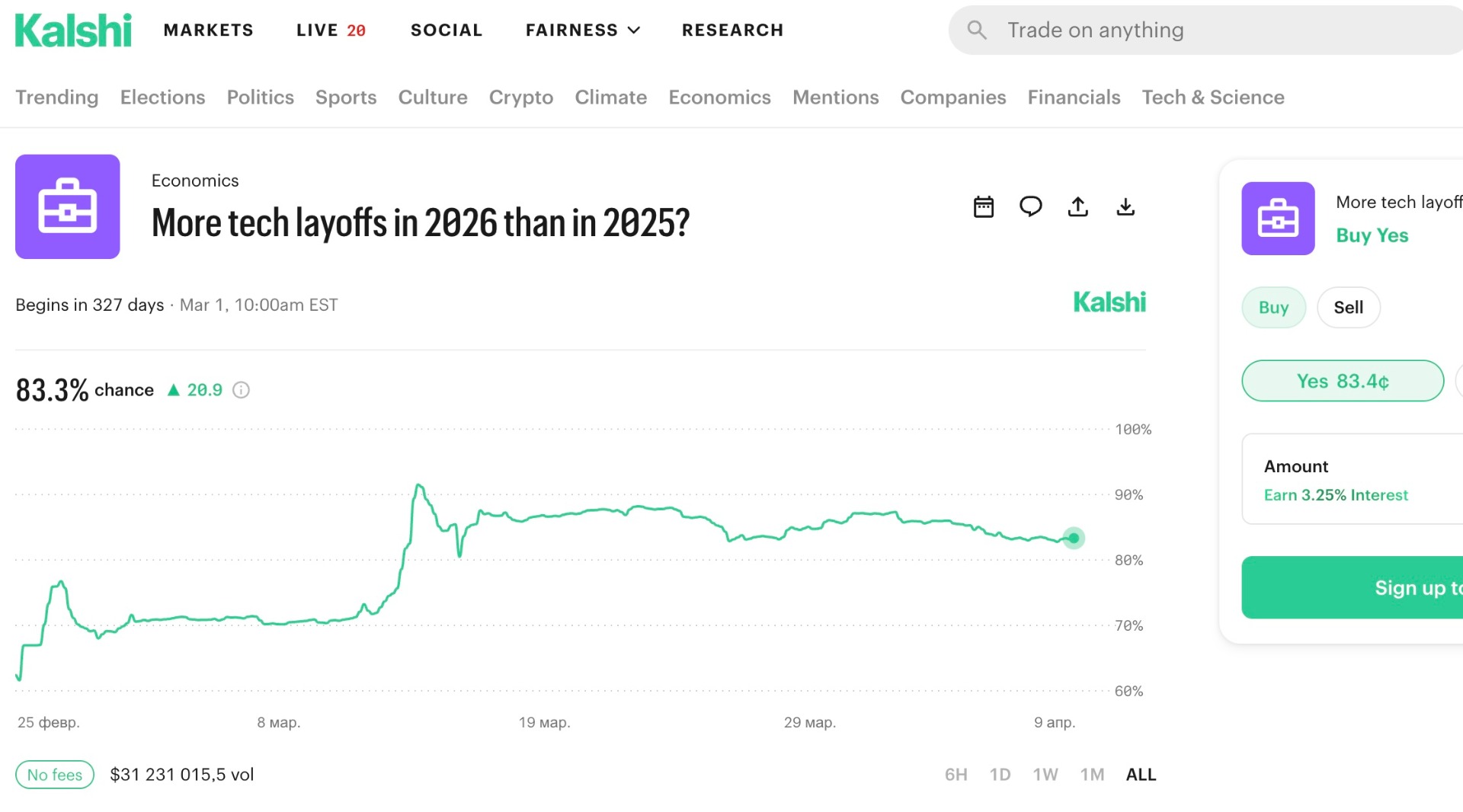
  • The contract assigns an 83% probability to higher tech layoffs, drawing over $30M in trading volume.
  • Traders are using the market as a real-time signal on AI-driven workforce changes and corporate cost cuts.
More tech layoffs in 20​26 than in 2025: Kalshi bets

One of the fastest-growing and most liquid contracts on Kalshi has nothing to do with sports or elections. Traders have put more than $30 million into a market asking a single question: will there be more tech layoffs in 2026 than in 2025?

That volume already exceeds Kalshi's popular Oscars contract. The market is pricing in an 83% probability that layoffs in the information sector will surpass the 2025 total of 447,000 — and it is starting to function as a real-time sentiment gauge for investors and professionals tracking the labor market impact of AI adoption and corporate restructuring.

"I think it's an important market, because people should know and position accordingly," Kalshi CEO Tarek Mansour said on a recent podcast, citing its relevance for both career planning and economic forecasting.

Why the Probability is So High

The signal reflects conditions on the ground. Industry trackers have recorded roughly 80,000–100,000 tech sector job cuts in Q1 2026, with the pace significantly ahead of early 2025 in many reports.

Two trends are driving the wave. First, large companies including Meta, Amazon, and Oracle are framing layoffs as AI-related restructuring, realigning headcount with new product architectures.

Second, a growing share of roles is being converted from full-time positions to contract or outsourced work, reducing fixed costs while capital flows toward AI infrastructure. Around 20% of confirmed 2026 tech layoffs have been explicitly attributed by companies to AI adoption.

What this Means for Market Participants

For the B2B finance audience, the market's emergence matters beyond its headline number. It is generating a form of alternative data with real analytical value. For macro traders, it offers a probability-weighted, real-time read on tech labor market health — something official datasets like FRED reports cannot provide, given their lag.

For equity analysts, sustained high layoff probabilities correlate with near-term margin improvement at large tech companies, but also carry longer-term reputational and regulatory risk.

For traders focused on data arbitrage, the contract itself has become a venue for trading discrepancies between different sector definitions and data sources. "It's just so interesting to see," said Kalshi COO Luana Lopes Lara, noting the market was growing at "20% week-over-week."

The tech layoff contract is an early example of prediction markets moving past event-based wagers into territory previously occupied by proprietary macro indicators — providing a faster, more granular signal than the official data that professionals have relied on for decades. Whether the 83% probability holds or fades as the year progresses is, of course, an open question.


One of the fastest-growing and most liquid contracts on Kalshi has nothing to do with sports or elections. Traders have put more than $30 million into a market asking a single question: will there be more tech layoffs in 2026 than in 2025?

That volume already exceeds Kalshi's popular Oscars contract. The market is pricing in an 83% probability that layoffs in the information sector will surpass the 2025 total of 447,000 — and it is starting to function as a real-time sentiment gauge for investors and professionals tracking the labor market impact of AI adoption and corporate restructuring.

"I think it's an important market, because people should know and position accordingly," Kalshi CEO Tarek Mansour said on a recent podcast, citing its relevance for both career planning and economic forecasting.

Why the Probability is So High

The signal reflects conditions on the ground. Industry trackers have recorded roughly 80,000–100,000 tech sector job cuts in Q1 2026, with the pace significantly ahead of early 2025 in many reports.

Two trends are driving the wave. First, large companies including Meta, Amazon, and Oracle are framing layoffs as AI-related restructuring, realigning headcount with new product architectures.

Second, a growing share of roles is being converted from full-time positions to contract or outsourced work, reducing fixed costs while capital flows toward AI infrastructure. Around 20% of confirmed 2026 tech layoffs have been explicitly attributed by companies to AI adoption.

What this Means for Market Participants

For the B2B finance audience, the market's emergence matters beyond its headline number. It is generating a form of alternative data with real analytical value. For macro traders, it offers a probability-weighted, real-time read on tech labor market health — something official datasets like FRED reports cannot provide, given their lag.

For equity analysts, sustained high layoff probabilities correlate with near-term margin improvement at large tech companies, but also carry longer-term reputational and regulatory risk.

For traders focused on data arbitrage, the contract itself has become a venue for trading discrepancies between different sector definitions and data sources. "It's just so interesting to see," said Kalshi COO Luana Lopes Lara, noting the market was growing at "20% week-over-week."

The tech layoff contract is an early example of prediction markets moving past event-based wagers into territory previously occupied by proprietary macro indicators — providing a faster, more granular signal than the official data that professionals have relied on for decades. Whether the 83% probability holds or fades as the year progresses is, of course, an open question.

About the Author: Tanya Chepkova
Tanya Chepkova
  • 158 Articles
Tanya Chepkova is a News Editor at Finance Magnates with more than 16 years of experience in financial journalism, covering forex, crypto, and digital asset markets. Her work spans daily industry reporting and data-driven, long-form explainers focused on market structure, trading models, and regulatory shifts. Before joining Finance Magnates, she led the editorial team of a cryptocurrency-focused media outlet for six years. Her reporting combines analytical depth with clear storytelling, with particular attention to how structural changes in trading, stablecoin infrastructure, and emerging products such as prediction markets reshape the broader financial ecosystem. She covers global developments and provides additional insight into CIS markets. Areas of Coverage: Crypto and digital asset markets Prediction markets Stablecoins and cross-border payments Industry analysis and long-form explainers

More from the Author

Trending