This is the second publication in a series of articles on natural gas market. It explains the demand side of the US market.
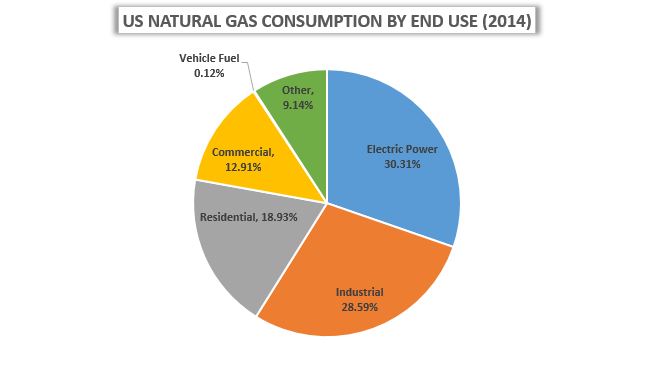
As an energy source, natural gas can be used in a variety of ways. It can heat homes and businesses, generate electricity, cook food, drive vehicles or serve as an industrial fuel. It is possible to divide consumers into several categories:
• Population (residential consumption) – private dwellings, apartments.
• Businesses and non-manufacturing activities (commercial consumption) – hotels, restaurants, wholesale and retail stores, etc.
• Industry and manufacturing (industrial consumption) – chemical plants, mining and mineral extraction, etc.
• Power plants (electric power sector) – gas-fired power plants and utility companies in general, whose primary business is to sell electricity and/or heat to the public.
• Transportation (vehicle fuel consumption) – trucks, cars, container ships and other vehicles that run on natural gas.
• Other consumption (technical consumption) – include gas used in drilling operations, as a fuel in natural gas processing plants and gas used in the operation of pipelines.
Source: EIA
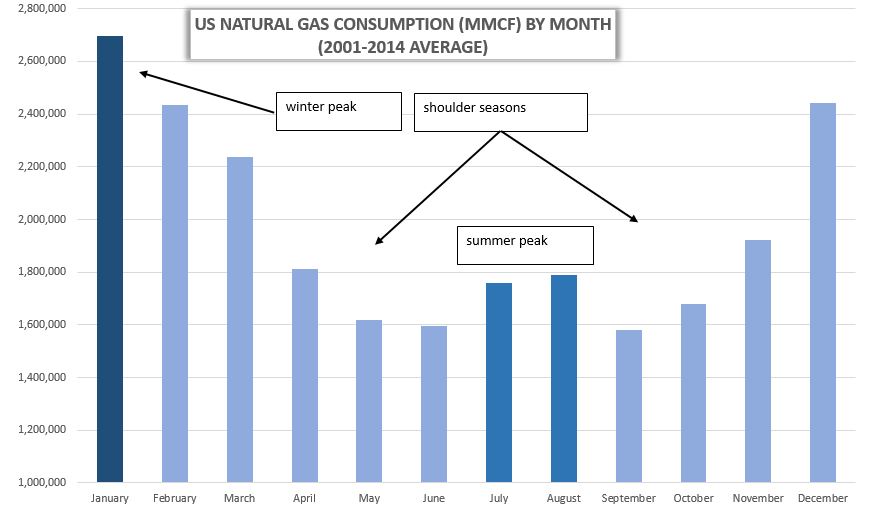
A very important characteristic of natural gas consumption is its seasonality. Demand peaks in January because of heavy usage for residential and commercial heating. It then weakens during spring and rises again in the summer months of July and August on electrical generation demand driven by air conditioning use. Demand then cools down again in autumn and starts rising again in winter. Spring and autumn are called “shoulder seasons”. In all three cases the demand for natural gas is driven by weather, which is probably a single most important factor determining natural gas consumption.
Source: EIA
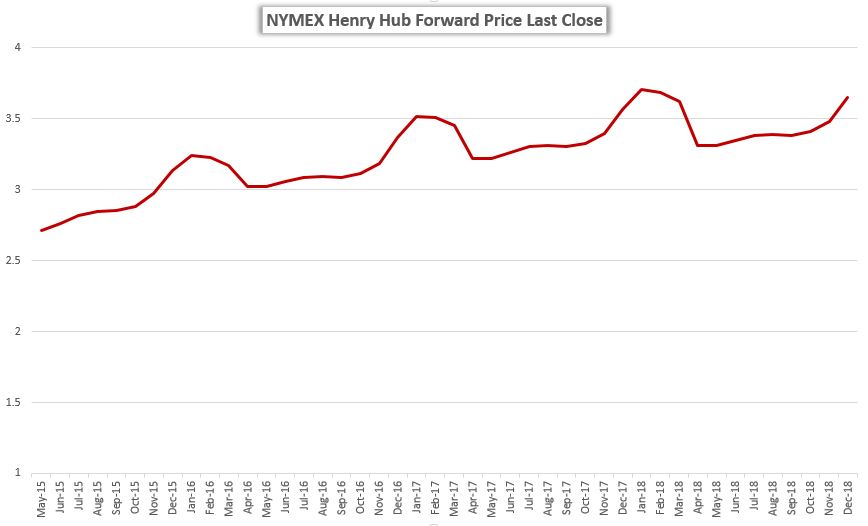
The seasonality of natural gas consumption is exhibited in the futures curve, where the highest-priced months of January and February are also the two months with the highest demand.
Source: Thomson Reuters
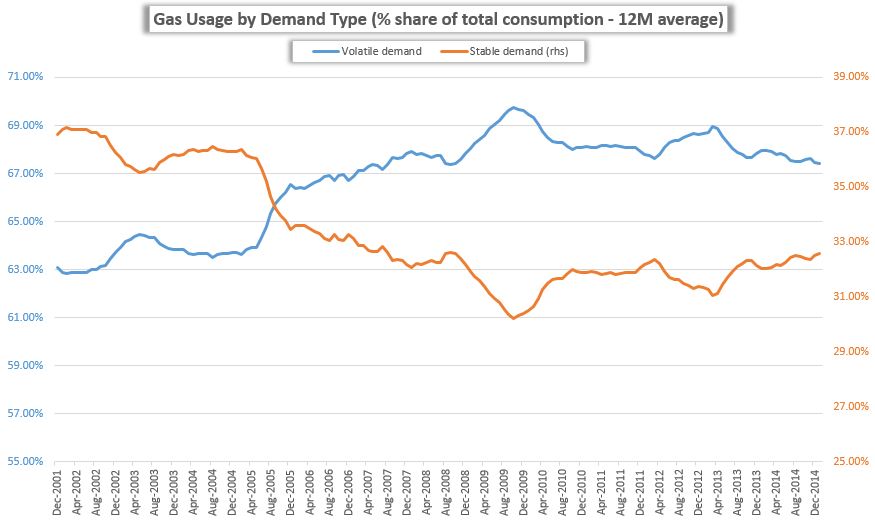
It is important to note, however, that weather does not drive all of the demand for natural gas (although, it does drive most of it). In fact, roughly a third of consumption has no seasonal pattern. Therefore, one can also divide demand into two broad categories:
1. Volatile, seasonal demand – weather-related demand (residential & commercial consumers and electric power sector) – 62% of total consumption in 2014.
2. Stable, non-seasonal demand – not directly driven by weather (industrial consumers, vehicle fuel, lease, plant fuel, pipeline & distribution use) – 38% of total consumption in 2014. However, one should note that some of the industrial consumption does have a degree of cyclicality, while the amount of gas used for distribution purposes is closely tied to the aggregate consumption and is therefore partly seasonal as well.
Source: EIA
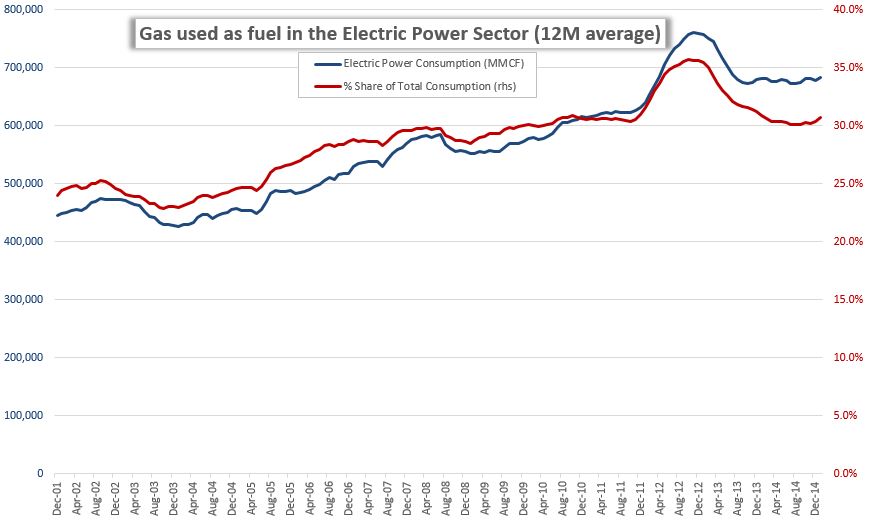
Over the past five years, the share of stable demand has been gradually rising – specifically, due to increased gas consumption in the industrial sector. Natural gas use in electric generation has also grown as the fuel is considered environmentally friendly and has a high heat content.
Source: EIA
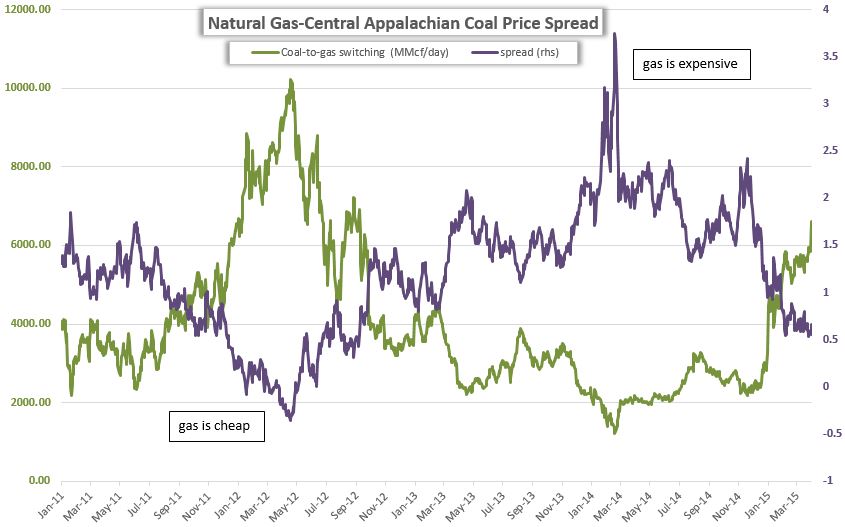
Natural gas is not the only hydrocarbon in the world and is not the only fuel that can be used to generate electricity. There are other substitutes out there and they may have an impact on consumption patterns in different sectors under different market conditions. One sector in which fuel switching occurs most profoundly is electrical generation. There are power plants that can burn both natural gas and coal and utilities may switch between one fuel to another depending on which is more profitable to burn. The spread between two substitute fuels play a key role in driving consumption dynamics. The most obvious substitute of gas in the electric power sector is coal. The graph below shows the spread between natural gas futures and Central Appalachian coal futures. As can be seen from that graph, there is a strong negative correlation between coal-to-gas switching and the spread. Natural gas consumption in the electric power sector rises as gas gets cheaper relative to coal and falls when the opposite occurs.
Source: Thomson Reuters
However, the cost of fuel is not the only factor determining the economics of fuel switching. Other important factors include: the cost of switching itself (technical cost), taxes, the cost of extra emissions produced by burning a dirtier fuel. In addition, utilities will not switch fuels if it is beneficial for just one day. They will look at the cost of either fuel over a medium to longer time frame to determine which fuel is more beneficial on a BTU basis.
In the next part of our natural gas series, we will take a closer look on the supply side of the market.
As an energy source, natural gas can be used in a variety of ways. It can heat homes and businesses, generate electricity, cook food, drive vehicles or serve as an industrial fuel. It is possible to divide consumers into several categories:
• Population (residential consumption) – private dwellings, apartments.
• Businesses and non-manufacturing activities (commercial consumption) – hotels, restaurants, wholesale and retail stores, etc.
• Industry and manufacturing (industrial consumption) – chemical plants, mining and mineral extraction, etc.
• Power plants (electric power sector) – gas-fired power plants and utility companies in general, whose primary business is to sell electricity and/or heat to the public.
• Transportation (vehicle fuel consumption) – trucks, cars, container ships and other vehicles that run on natural gas.
• Other consumption (technical consumption) – include gas used in drilling operations, as a fuel in natural gas processing plants and gas used in the operation of pipelines.
Source: EIA
A very important characteristic of natural gas consumption is its seasonality. Demand peaks in January because of heavy usage for residential and commercial heating. It then weakens during spring and rises again in the summer months of July and August on electrical generation demand driven by air conditioning use. Demand then cools down again in autumn and starts rising again in winter. Spring and autumn are called “shoulder seasons”. In all three cases the demand for natural gas is driven by weather, which is probably a single most important factor determining natural gas consumption.
Source: EIA
The seasonality of natural gas consumption is exhibited in the futures curve, where the highest-priced months of January and February are also the two months with the highest demand.
Source: Thomson Reuters
It is important to note, however, that weather does not drive all of the demand for natural gas (although, it does drive most of it). In fact, roughly a third of consumption has no seasonal pattern. Therefore, one can also divide demand into two broad categories:
1. Volatile, seasonal demand – weather-related demand (residential & commercial consumers and electric power sector) – 62% of total consumption in 2014.
2. Stable, non-seasonal demand – not directly driven by weather (industrial consumers, vehicle fuel, lease, plant fuel, pipeline & distribution use) – 38% of total consumption in 2014. However, one should note that some of the industrial consumption does have a degree of cyclicality, while the amount of gas used for distribution purposes is closely tied to the aggregate consumption and is therefore partly seasonal as well.
Source: EIA
Over the past five years, the share of stable demand has been gradually rising – specifically, due to increased gas consumption in the industrial sector. Natural gas use in electric generation has also grown as the fuel is considered environmentally friendly and has a high heat content.
Source: EIA
Natural gas is not the only hydrocarbon in the world and is not the only fuel that can be used to generate electricity. There are other substitutes out there and they may have an impact on consumption patterns in different sectors under different market conditions. One sector in which fuel switching occurs most profoundly is electrical generation. There are power plants that can burn both natural gas and coal and utilities may switch between one fuel to another depending on which is more profitable to burn. The spread between two substitute fuels play a key role in driving consumption dynamics. The most obvious substitute of gas in the electric power sector is coal. The graph below shows the spread between natural gas futures and Central Appalachian coal futures. As can be seen from that graph, there is a strong negative correlation between coal-to-gas switching and the spread. Natural gas consumption in the electric power sector rises as gas gets cheaper relative to coal and falls when the opposite occurs.
Source: Thomson Reuters
However, the cost of fuel is not the only factor determining the economics of fuel switching. Other important factors include: the cost of switching itself (technical cost), taxes, the cost of extra emissions produced by burning a dirtier fuel. In addition, utilities will not switch fuels if it is beneficial for just one day. They will look at the cost of either fuel over a medium to longer time frame to determine which fuel is more beneficial on a BTU basis.
In the next part of our natural gas series, we will take a closer look on the supply side of the market.
Vladimir Bezruchenko is an independent trader and financial writer based in The Hague, Netherlands.
He has been actively trading from home since 2013, specializing in US natural gas futures (NYMEX Henry Hub) and high-yielding commodity currencies. Vladimir is an active contributor to Seeking Alpha, where he writes detailed articles covering financial markets. His expertise also includes investing in non-public companies over the OTC market, focusing on pre-IPO deals.
Prior to his career in financial markets, Vladimir gained professional experience at Thomson Reuters. Before that, he pursued a career in real estate, working for well-known international brands such as CBRE and Colliers International.
Clearstream to Settle LCH-Cleared Equity Contracts
Featured Videos
OnePrime’s Jerry Khargi on Infrastructure, Liquidity & Trust | Executive Interview
Recorded live at FMLS:25 London, this exclusive executive interview features Jerry Khargi, Executive Director at OnePrime, in conversation with Andrea Badiola Mateos from Finance Magnates.
In this in-depth discussion, Jerry shares:
- OnePrime’s journey from a retail-focused business to a global institutional liquidity provider
- What truly sets award-winning trading infrastructure apart
- Key trends shaping institutional trading, including technology and AI
- The importance of transparency, ethics, and reputation in long-term success
- OnePrime’s vision for growth over the next 12–24 months
Fresh from winning Finance Magnates’ Best Trading Infrastructure Broker, Jerry explains how experience, mentorship, and real-world problem solving form the “special sauce” behind OnePrime’s institutional offering.
🏆 Award Highlight: Best Trading Infrastructure Broker
👉 Subscribe to Finance Magnates for more executive interviews, market insights, and exclusive coverage from the world’s leading financial events.
#FMLS25 #FinanceMagnates #OnePrime #InstitutionalTrading #Liquidity #TradingInfrastructure #ExecutiveInterview
Recorded live at FMLS:25 London, this exclusive executive interview features Jerry Khargi, Executive Director at OnePrime, in conversation with Andrea Badiola Mateos from Finance Magnates.
In this in-depth discussion, Jerry shares:
- OnePrime’s journey from a retail-focused business to a global institutional liquidity provider
- What truly sets award-winning trading infrastructure apart
- Key trends shaping institutional trading, including technology and AI
- The importance of transparency, ethics, and reputation in long-term success
- OnePrime’s vision for growth over the next 12–24 months
Fresh from winning Finance Magnates’ Best Trading Infrastructure Broker, Jerry explains how experience, mentorship, and real-world problem solving form the “special sauce” behind OnePrime’s institutional offering.
🏆 Award Highlight: Best Trading Infrastructure Broker
👉 Subscribe to Finance Magnates for more executive interviews, market insights, and exclusive coverage from the world’s leading financial events.
#FMLS25 #FinanceMagnates #OnePrime #InstitutionalTrading #Liquidity #TradingInfrastructure #ExecutiveInterview
Recorded live at FMLS:25 London, this exclusive executive interview features Jerry Khargi, Executive Director at OnePrime, in conversation with Andrea Badiola Mateos from Finance Magnates.
In this in-depth discussion, Jerry shares:
- OnePrime’s journey from a retail-focused business to a global institutional liquidity provider
- What truly sets award-winning trading infrastructure apart
- Key trends shaping institutional trading, including technology and AI
- The importance of transparency, ethics, and reputation in long-term success
- OnePrime’s vision for growth over the next 12–24 months
Fresh from winning Finance Magnates’ Best Trading Infrastructure Broker, Jerry explains how experience, mentorship, and real-world problem solving form the “special sauce” behind OnePrime’s institutional offering.
🏆 Award Highlight: Best Trading Infrastructure Broker
👉 Subscribe to Finance Magnates for more executive interviews, market insights, and exclusive coverage from the world’s leading financial events.
#FMLS25 #FinanceMagnates #OnePrime #InstitutionalTrading #Liquidity #TradingInfrastructure #ExecutiveInterview
Recorded live at FMLS:25 London, this exclusive executive interview features Jerry Khargi, Executive Director at OnePrime, in conversation with Andrea Badiola Mateos from Finance Magnates.
In this in-depth discussion, Jerry shares:
- OnePrime’s journey from a retail-focused business to a global institutional liquidity provider
- What truly sets award-winning trading infrastructure apart
- Key trends shaping institutional trading, including technology and AI
- The importance of transparency, ethics, and reputation in long-term success
- OnePrime’s vision for growth over the next 12–24 months
Fresh from winning Finance Magnates’ Best Trading Infrastructure Broker, Jerry explains how experience, mentorship, and real-world problem solving form the “special sauce” behind OnePrime’s institutional offering.
🏆 Award Highlight: Best Trading Infrastructure Broker
👉 Subscribe to Finance Magnates for more executive interviews, market insights, and exclusive coverage from the world’s leading financial events.
#FMLS25 #FinanceMagnates #OnePrime #InstitutionalTrading #Liquidity #TradingInfrastructure #ExecutiveInterview
How does the Finance Magnates newsroom decide which updates are worth covering? #financenews
What makes an update worth covering in financial media?
According to Yam Yehoshua, Editor-in-Chief at Finance Magnates, editorial focus starts with relevance: stories that serve the industry, support brokers and technology providers, and help decision-makers navigate their businesses.
A reminder that strong financial journalism is built on value, not volume.
What makes an update worth covering in financial media?
According to Yam Yehoshua, Editor-in-Chief at Finance Magnates, editorial focus starts with relevance: stories that serve the industry, support brokers and technology providers, and help decision-makers navigate their businesses.
A reminder that strong financial journalism is built on value, not volume.
What makes an update worth covering in financial media?
According to Yam Yehoshua, Editor-in-Chief at Finance Magnates, editorial focus starts with relevance: stories that serve the industry, support brokers and technology providers, and help decision-makers navigate their businesses.
A reminder that strong financial journalism is built on value, not volume.
What makes an update worth covering in financial media?
According to Yam Yehoshua, Editor-in-Chief at Finance Magnates, editorial focus starts with relevance: stories that serve the industry, support brokers and technology providers, and help decision-makers navigate their businesses.
A reminder that strong financial journalism is built on value, not volume.
What makes an update worth covering in financial media?
According to Yam Yehoshua, Editor-in-Chief at Finance Magnates, editorial focus starts with relevance: stories that serve the industry, support brokers and technology providers, and help decision-makers navigate their businesses.
A reminder that strong financial journalism is built on value, not volume.
What makes an update worth covering in financial media?
According to Yam Yehoshua, Editor-in-Chief at Finance Magnates, editorial focus starts with relevance: stories that serve the industry, support brokers and technology providers, and help decision-makers navigate their businesses.
A reminder that strong financial journalism is built on value, not volume.
Liquidity as a Business: How Brokers Can Earn More
This webinar will focuses on how brokers can create new revenue streams by launching or enhancing their liquidity business.
John Murillo, Chief Dealing Officer of the B2BROKER group, covers how:
- Retail brokers can launch their own B2B arm to distribute liquidity and boost profitability.
- Institutional brokers can upgrade their liquidity offering and strengthen their market position.
- New entrants can start from scratch and become liquidity providers through a ready-made turnkey solution.
Hosted by B2BROKER, a global fintech provider of liquidity and technology solutions, the session will reveal how to monetize liquidity, accelerate business growth, and increase profitability using the Liquidity Provider Turnkey solution.
📣 Stay updated with the latest in finance and trading! Follow Finance Magnates across our social media platforms for news, insights, and event updates.
Connect with us today:
🔗 LinkedIn: / https://www.linkedin.com/company/financemagnates/
👍 Facebook: / https://www.facebook.com/financemagnates/
📸 Instagram: / https://www.instagram.com/financemagnates_official/?hl=en
🐦 X: https://x.com/financemagnates?
🎥 TikTok: https://www.tiktok.com/tag/financemag...
▶️ YouTube: / @financemagnates_official
This webinar will focuses on how brokers can create new revenue streams by launching or enhancing their liquidity business.
John Murillo, Chief Dealing Officer of the B2BROKER group, covers how:
- Retail brokers can launch their own B2B arm to distribute liquidity and boost profitability.
- Institutional brokers can upgrade their liquidity offering and strengthen their market position.
- New entrants can start from scratch and become liquidity providers through a ready-made turnkey solution.
Hosted by B2BROKER, a global fintech provider of liquidity and technology solutions, the session will reveal how to monetize liquidity, accelerate business growth, and increase profitability using the Liquidity Provider Turnkey solution.
📣 Stay updated with the latest in finance and trading! Follow Finance Magnates across our social media platforms for news, insights, and event updates.
Connect with us today:
🔗 LinkedIn: / https://www.linkedin.com/company/financemagnates/
👍 Facebook: / https://www.facebook.com/financemagnates/
📸 Instagram: / https://www.instagram.com/financemagnates_official/?hl=en
🐦 X: https://x.com/financemagnates?
🎥 TikTok: https://www.tiktok.com/tag/financemag...
▶️ YouTube: / @financemagnates_official
This webinar will focuses on how brokers can create new revenue streams by launching or enhancing their liquidity business.
John Murillo, Chief Dealing Officer of the B2BROKER group, covers how:
- Retail brokers can launch their own B2B arm to distribute liquidity and boost profitability.
- Institutional brokers can upgrade their liquidity offering and strengthen their market position.
- New entrants can start from scratch and become liquidity providers through a ready-made turnkey solution.
Hosted by B2BROKER, a global fintech provider of liquidity and technology solutions, the session will reveal how to monetize liquidity, accelerate business growth, and increase profitability using the Liquidity Provider Turnkey solution.
📣 Stay updated with the latest in finance and trading! Follow Finance Magnates across our social media platforms for news, insights, and event updates.
Connect with us today:
🔗 LinkedIn: / https://www.linkedin.com/company/financemagnates/
👍 Facebook: / https://www.facebook.com/financemagnates/
📸 Instagram: / https://www.instagram.com/financemagnates_official/?hl=en
🐦 X: https://x.com/financemagnates?
🎥 TikTok: https://www.tiktok.com/tag/financemag...
▶️ YouTube: / @financemagnates_official
This webinar will focuses on how brokers can create new revenue streams by launching or enhancing their liquidity business.
John Murillo, Chief Dealing Officer of the B2BROKER group, covers how:
- Retail brokers can launch their own B2B arm to distribute liquidity and boost profitability.
- Institutional brokers can upgrade their liquidity offering and strengthen their market position.
- New entrants can start from scratch and become liquidity providers through a ready-made turnkey solution.
Hosted by B2BROKER, a global fintech provider of liquidity and technology solutions, the session will reveal how to monetize liquidity, accelerate business growth, and increase profitability using the Liquidity Provider Turnkey solution.
📣 Stay updated with the latest in finance and trading! Follow Finance Magnates across our social media platforms for news, insights, and event updates.
Connect with us today:
🔗 LinkedIn: / https://www.linkedin.com/company/financemagnates/
👍 Facebook: / https://www.facebook.com/financemagnates/
📸 Instagram: / https://www.instagram.com/financemagnates_official/?hl=en
🐦 X: https://x.com/financemagnates?
🎥 TikTok: https://www.tiktok.com/tag/financemag...
▶️ YouTube: / @financemagnates_official
This webinar will focuses on how brokers can create new revenue streams by launching or enhancing their liquidity business.
John Murillo, Chief Dealing Officer of the B2BROKER group, covers how:
- Retail brokers can launch their own B2B arm to distribute liquidity and boost profitability.
- Institutional brokers can upgrade their liquidity offering and strengthen their market position.
- New entrants can start from scratch and become liquidity providers through a ready-made turnkey solution.
Hosted by B2BROKER, a global fintech provider of liquidity and technology solutions, the session will reveal how to monetize liquidity, accelerate business growth, and increase profitability using the Liquidity Provider Turnkey solution.
📣 Stay updated with the latest in finance and trading! Follow Finance Magnates across our social media platforms for news, insights, and event updates.
Connect with us today:
🔗 LinkedIn: / https://www.linkedin.com/company/financemagnates/
👍 Facebook: / https://www.facebook.com/financemagnates/
📸 Instagram: / https://www.instagram.com/financemagnates_official/?hl=en
🐦 X: https://x.com/financemagnates?
🎥 TikTok: https://www.tiktok.com/tag/financemag...
▶️ YouTube: / @financemagnates_official
This webinar will focuses on how brokers can create new revenue streams by launching or enhancing their liquidity business.
John Murillo, Chief Dealing Officer of the B2BROKER group, covers how:
- Retail brokers can launch their own B2B arm to distribute liquidity and boost profitability.
- Institutional brokers can upgrade their liquidity offering and strengthen their market position.
- New entrants can start from scratch and become liquidity providers through a ready-made turnkey solution.
Hosted by B2BROKER, a global fintech provider of liquidity and technology solutions, the session will reveal how to monetize liquidity, accelerate business growth, and increase profitability using the Liquidity Provider Turnkey solution.
📣 Stay updated with the latest in finance and trading! Follow Finance Magnates across our social media platforms for news, insights, and event updates.
Connect with us today:
🔗 LinkedIn: / https://www.linkedin.com/company/financemagnates/
👍 Facebook: / https://www.facebook.com/financemagnates/
📸 Instagram: / https://www.instagram.com/financemagnates_official/?hl=en
🐦 X: https://x.com/financemagnates?
🎥 TikTok: https://www.tiktok.com/tag/financemag...
▶️ YouTube: / @financemagnates_official
How FYNXT is Transforming Brokerages with Modular Tech | Executive Interview with Stephen Miles
Join us for an exclusive interview with Stephen Miles, Chief Revenue Officer at FYNXT, recorded live at FMLS:25. In this conversation, Stephen breaks down how modular brokerage technology is driving growth, retention, and efficiency across the brokerage industry.
Learn how FYNXT's unified yet modular platform is giving brokers a competitive edge—powering faster onboarding, increased trading volumes, and dramatically improved IB performance.
🔑 What You'll Learn in This Video:
- The biggest challenges brokerages face going into 2026
- Why FYNXT’s modular platform is outperforming in-house builds
- How automation is transforming IB channels
- The real ROI: 11x LTV increases and reduced acquisition costs
👉 Don’t forget to like, comment, and subscribe.
#FYNXT #StephenMiles #FMLS2025 #BrokerageTechnology #ModularTech #FintechInterview #DigitalTransformation #FinancialMarkets #CROInterview #FintechInnovation #TradingTechnology #IndependentBrokers #FinanceLeaders
Join us for an exclusive interview with Stephen Miles, Chief Revenue Officer at FYNXT, recorded live at FMLS:25. In this conversation, Stephen breaks down how modular brokerage technology is driving growth, retention, and efficiency across the brokerage industry.
Learn how FYNXT's unified yet modular platform is giving brokers a competitive edge—powering faster onboarding, increased trading volumes, and dramatically improved IB performance.
🔑 What You'll Learn in This Video:
- The biggest challenges brokerages face going into 2026
- Why FYNXT’s modular platform is outperforming in-house builds
- How automation is transforming IB channels
- The real ROI: 11x LTV increases and reduced acquisition costs
👉 Don’t forget to like, comment, and subscribe.
#FYNXT #StephenMiles #FMLS2025 #BrokerageTechnology #ModularTech #FintechInterview #DigitalTransformation #FinancialMarkets #CROInterview #FintechInnovation #TradingTechnology #IndependentBrokers #FinanceLeaders
Join us for an exclusive interview with Stephen Miles, Chief Revenue Officer at FYNXT, recorded live at FMLS:25. In this conversation, Stephen breaks down how modular brokerage technology is driving growth, retention, and efficiency across the brokerage industry.
Learn how FYNXT's unified yet modular platform is giving brokers a competitive edge—powering faster onboarding, increased trading volumes, and dramatically improved IB performance.
🔑 What You'll Learn in This Video:
- The biggest challenges brokerages face going into 2026
- Why FYNXT’s modular platform is outperforming in-house builds
- How automation is transforming IB channels
- The real ROI: 11x LTV increases and reduced acquisition costs
👉 Don’t forget to like, comment, and subscribe.
#FYNXT #StephenMiles #FMLS2025 #BrokerageTechnology #ModularTech #FintechInterview #DigitalTransformation #FinancialMarkets #CROInterview #FintechInnovation #TradingTechnology #IndependentBrokers #FinanceLeaders
Join us for an exclusive interview with Stephen Miles, Chief Revenue Officer at FYNXT, recorded live at FMLS:25. In this conversation, Stephen breaks down how modular brokerage technology is driving growth, retention, and efficiency across the brokerage industry.
Learn how FYNXT's unified yet modular platform is giving brokers a competitive edge—powering faster onboarding, increased trading volumes, and dramatically improved IB performance.
🔑 What You'll Learn in This Video:
- The biggest challenges brokerages face going into 2026
- Why FYNXT’s modular platform is outperforming in-house builds
- How automation is transforming IB channels
- The real ROI: 11x LTV increases and reduced acquisition costs
👉 Don’t forget to like, comment, and subscribe.
#FYNXT #StephenMiles #FMLS2025 #BrokerageTechnology #ModularTech #FintechInterview #DigitalTransformation #FinancialMarkets #CROInterview #FintechInnovation #TradingTechnology #IndependentBrokers #FinanceLeaders
Join us for an exclusive interview with Stephen Miles, Chief Revenue Officer at FYNXT, recorded live at FMLS:25. In this conversation, Stephen breaks down how modular brokerage technology is driving growth, retention, and efficiency across the brokerage industry.
Learn how FYNXT's unified yet modular platform is giving brokers a competitive edge—powering faster onboarding, increased trading volumes, and dramatically improved IB performance.
🔑 What You'll Learn in This Video:
- The biggest challenges brokerages face going into 2026
- Why FYNXT’s modular platform is outperforming in-house builds
- How automation is transforming IB channels
- The real ROI: 11x LTV increases and reduced acquisition costs
👉 Don’t forget to like, comment, and subscribe.
#FYNXT #StephenMiles #FMLS2025 #BrokerageTechnology #ModularTech #FintechInterview #DigitalTransformation #FinancialMarkets #CROInterview #FintechInnovation #TradingTechnology #IndependentBrokers #FinanceLeaders
Join us for an exclusive interview with Stephen Miles, Chief Revenue Officer at FYNXT, recorded live at FMLS:25. In this conversation, Stephen breaks down how modular brokerage technology is driving growth, retention, and efficiency across the brokerage industry.
Learn how FYNXT's unified yet modular platform is giving brokers a competitive edge—powering faster onboarding, increased trading volumes, and dramatically improved IB performance.
🔑 What You'll Learn in This Video:
- The biggest challenges brokerages face going into 2026
- Why FYNXT’s modular platform is outperforming in-house builds
- How automation is transforming IB channels
- The real ROI: 11x LTV increases and reduced acquisition costs
👉 Don’t forget to like, comment, and subscribe.
#FYNXT #StephenMiles #FMLS2025 #BrokerageTechnology #ModularTech #FintechInterview #DigitalTransformation #FinancialMarkets #CROInterview #FintechInnovation #TradingTechnology #IndependentBrokers #FinanceLeaders
Executive Interview | Charlotte Bullock | Chief Product Officer, Bank of London | FMLS:25
In this interview, we sat down with Charlotte Bullock, Head of Product at The Bank of London, previously at SAP and now shaping product at one of the sector’s most ambitious new banking players.
Charlotte reflects on the Summit so far and talks about the culture inside fintech banks today. We look at the pressures that come with scaling, and how firms can hold onto the nimble approach that made them stand out early on.
We also cover the state of payments ahead of her appearance on the payments roundtable: the blockages financial firms face, the areas that still need fixing, and what a realistic solution looks like in 2026.
In this interview, we sat down with Charlotte Bullock, Head of Product at The Bank of London, previously at SAP and now shaping product at one of the sector’s most ambitious new banking players.
Charlotte reflects on the Summit so far and talks about the culture inside fintech banks today. We look at the pressures that come with scaling, and how firms can hold onto the nimble approach that made them stand out early on.
We also cover the state of payments ahead of her appearance on the payments roundtable: the blockages financial firms face, the areas that still need fixing, and what a realistic solution looks like in 2026.
In this interview, we sat down with Charlotte Bullock, Head of Product at The Bank of London, previously at SAP and now shaping product at one of the sector’s most ambitious new banking players.
Charlotte reflects on the Summit so far and talks about the culture inside fintech banks today. We look at the pressures that come with scaling, and how firms can hold onto the nimble approach that made them stand out early on.
We also cover the state of payments ahead of her appearance on the payments roundtable: the blockages financial firms face, the areas that still need fixing, and what a realistic solution looks like in 2026.
In this interview, we sat down with Charlotte Bullock, Head of Product at The Bank of London, previously at SAP and now shaping product at one of the sector’s most ambitious new banking players.
Charlotte reflects on the Summit so far and talks about the culture inside fintech banks today. We look at the pressures that come with scaling, and how firms can hold onto the nimble approach that made them stand out early on.
We also cover the state of payments ahead of her appearance on the payments roundtable: the blockages financial firms face, the areas that still need fixing, and what a realistic solution looks like in 2026.
In this interview, we sat down with Charlotte Bullock, Head of Product at The Bank of London, previously at SAP and now shaping product at one of the sector’s most ambitious new banking players.
Charlotte reflects on the Summit so far and talks about the culture inside fintech banks today. We look at the pressures that come with scaling, and how firms can hold onto the nimble approach that made them stand out early on.
We also cover the state of payments ahead of her appearance on the payments roundtable: the blockages financial firms face, the areas that still need fixing, and what a realistic solution looks like in 2026.
In this interview, we sat down with Charlotte Bullock, Head of Product at The Bank of London, previously at SAP and now shaping product at one of the sector’s most ambitious new banking players.
Charlotte reflects on the Summit so far and talks about the culture inside fintech banks today. We look at the pressures that come with scaling, and how firms can hold onto the nimble approach that made them stand out early on.
We also cover the state of payments ahead of her appearance on the payments roundtable: the blockages financial firms face, the areas that still need fixing, and what a realistic solution looks like in 2026.