

By Arthur Fedoruk, CEO, Calleague
Walk the floor of almost any brokerage operation today and look at what's actually on a conversion agent's screen. Not the org chart version. The real one.
There isn't one dialer - there are several, plus a handful of softphones from different providers, each in its own window. The CRM is somewhere in the mix. WhatsApp Web is open in another tab, Telegram in another, because that's where leads actually reply. A spreadsheet somewhere tracking which SIP trunk is "working today." A manager's chat where someone is asking, again, why the answer rate dropped this morning. The agent - the person whose entire job is to talk to a prospect and turn them into a deposit - is spending half their attention being a switchboard operator for their own tools.
I started in this industry about thirteen years ago as a call center agent. Back then the setup was honest about what it was: a physical phone on the desk and a printed list of leads next to it. You dialed, you crossed out a name, you moved on. It was primitive, but it was unified - everything the agent needed was in one place, and the agent's job was to talk.
Here's the uncomfortable truth about the last thirteen years: we added an enormous amount of technology and somehow made the agent's desk more fragmented, not less. We replaced the paper list with six browser tabs. That's the problem worth talking about.
What "today's setup" actually costs
The fragmentation isn't just a cosmetic complaint. It shows up in the numbers, and it shows up in three specific places.
The first is business-logic depth - or rather, the lack of it. Brokerage operations don't run on generic call-center logic. They run on multi-brand routing, a hard split between conversion and retention desks, lead-group rules, language and time-zone matching, and compliance recording that has to hold up across every channel a lead might use. Generic platforms support generic operations: dial, route, log, record. The moment your actual operational logic gets more specific than that - and in a brokerage it always does - your team starts bolting on workarounds outside the software. A spreadsheet here, a manual reassignment there, a side chat to coordinate. Every one of those workarounds is friction, and friction is where conversion goes to die.
The second is the obsession with features over results. The communications vendor market loves to talk about how competitive it is and how rich everyone's feature list has become. Brokers do not care. A broker cares about exactly one thing: did the answer rate go up, did conversion go up, did deposits go up. A feature that doesn't move one of those numbers is overhead dressed up as progress. Most current setups are drowning in features and starving for results.
The third - and this is the one I'd put on a billboard - is action count. Ask any vendor a simple question: how many manual actions does an agent, a manager, or an admin have to take inside your platform to reach the maximum possible result? In most setups today, that number is enormous. Manually switching SIP trunks when a line degrades. Manually reassigning leads. Manually managing lists. Manually pulling reports to figure out what went wrong. Every single action is a tax on the operation, and it's a tax paid in the one currency that matters - the agent's attention, which should be on the prospect and nothing else.
Here's the question almost no one in this business stops to ask: why does a shift last nine hours when the average agent spends about two hours a day actually talking to clients? Where do the other seven go? They go to the switchboard work - the tabs, the switching, the reassigning, the chasing, the reporting. Seven hours of an agent's day consumed by managing tools instead of talking to prospects. That gap is the real cost of action count, and most operations have simply learned to live with it.
That's today's caller setup. Powerful tools, fragmented surface, and a human being acting as the integration layer that the software should have provided.
What the desk looks like when you fix it
Calleague is a 360° external conversion platform for brokerage operations. I'll unpack what that means, but start with the picture of the desk, because that's where the difference is felt.
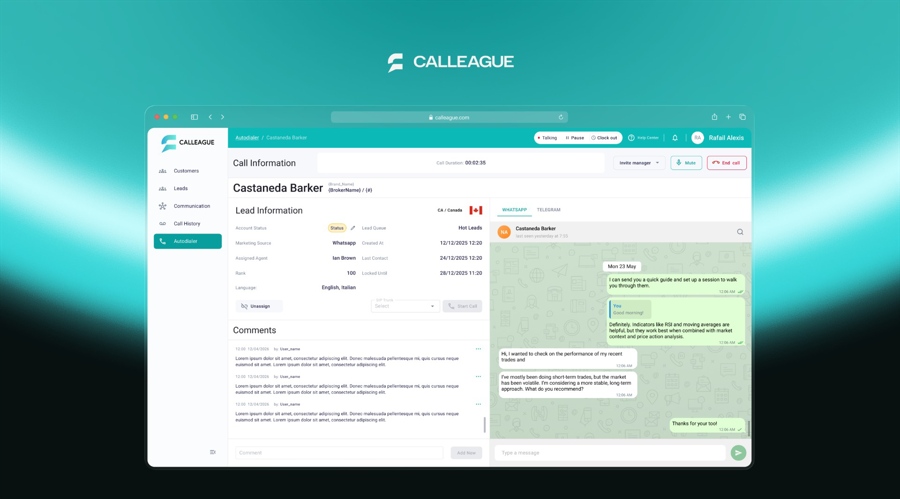
A conversion agent on Calleague never leaves Calleague. One softphone for everything - right inside the browser. The dialer, the messaging channels, the lead they're working - it's a single workspace, fully automated underneath. A retention agent gets click-to-call from any CRM record, so the call starts where the customer context already lives. The principle is the same one the paper-list desk got right by accident and the modern stack lost: unified, not fragmented. The agent's job is to talk to the client, not to manage the software.
Underneath that single surface there are two products, working as one.
The first is Messengers - WhatsApp and Telegram, the same channels your team already uses, but better, brought into the workspace.
The second is the Dialer, built to cover the full range of brokerage operations needs. Every VoIP or SIP trunk you already run plugs in with just a username and a URL. Not a six-week "integration project" - a connection. The Dialer is organized around the architecture brokerage operations actually have: brands, lead groups, and a rule engine. That's what lets the platform express your real operational logic natively instead of forcing it into workarounds outside the software.
The part that actually moves the number
If I get to keep one idea in front of a broker, it's this one: automated, seamless SIP-trunk monitoring and switching.
Calleague continuously monitors every connected trunk and routes traffic through the best-performing line in real time. When a trunk starts to degrade, the platform switches - without an agent noticing, without a manager being pinged, without anyone opening a spreadsheet. The agent keeps talking. The line just keeps working.
This changes the relationship a broker has with their own answer rate. Today, most operations observe answer rate. They watch it on a dashboard, they react when it falls, they escalate, they manually intervene. With real-time monitoring and auto-switching, you stop observing answer rate and start managing it. And because answer rate is the front of the funnel, managing it flows straight downstream: a guaranteed answer-rate lift is, in this business, a guaranteed deposit lift. Every conversation that connects is a conversation that can convert.
That's the whole thesis, and it ties back to the three problems with today's setup. It's business logic expressed natively - multi-brand, multi-trunk routing that knows your operation. It's results, not features - the auto-switching exists because it moves answer rate, not because it looks good on a comparison sheet. And it collapses the action count to as close to zero as the work allows - the manual trunk-switching, the reassignments, the list management, the reporting scramble all move from the human to the platform.
The desk, put back together
This isn't a concept or a roadmap. The Messengers run, the Dialer runs, the routing engine runs, and brokers are working on it today. Everything described above exists and works - one workspace, both products unified, automation doing the switchboard work underneath. The direction we keep pushing in is consistent: take more actions off the human and put them under the platform, so the agent's day is spent the way it was always supposed to be.
Thirteen years ago the agent's desk was a phone and a piece of paper. The job was to talk. Somewhere along the way we surrounded that job with so much tooling that talking became the smallest part of the agent's day. The point of fixing the setup isn't to add another window. It's to give the agent back the one they started with - a single surface, everything in reach, and full automation doing the switchboard work underneath.
The agent talks to the client. The platform handles the rest. That's what the caller's desk is supposed to look like.


