>
What Does Meaningful Broker Transparency Look Like? Insights from ePlanet Brokers’ H1 2026 Report
Disclaimer
What Does Meaningful Broker Transparency Look Like? Insights from ePlanet Brokers’ H1 2026 Report
Thursday,17/09/2026|17:31GMTby
ePlanet
Disclaimer
This article explores what meaningful transparency should look like in online brokerage, using ePlanet Brokers’ H1 2026 operational data as a practical case study.
Transparency is one of the most common promises in financial services, but publishing internal operational metrics is a different matter. Brokers may be comfortable discussing products, technology and trading conditions, yet figures covering failed verification attempts, payment issues, withdrawal delays, execution performance or complaints are more difficult to disclose. There is always a risk that such data may be taken out of context, attract criticism or make little sense without clear definitions.
Yet operational performance is a major part of the client experience. Meaningful transparency should therefore explain not only where a broker performs well, but also where friction occurs, why it happens and what is being done to improve it. ePlanet Brokers’ H1 2026 Transparency Report represents an attempt to apply this approach across KYC, deposits, withdrawals, trading infrastructure, customer support and complaints.
The complete report, including methodology and metric definitions, is available here:
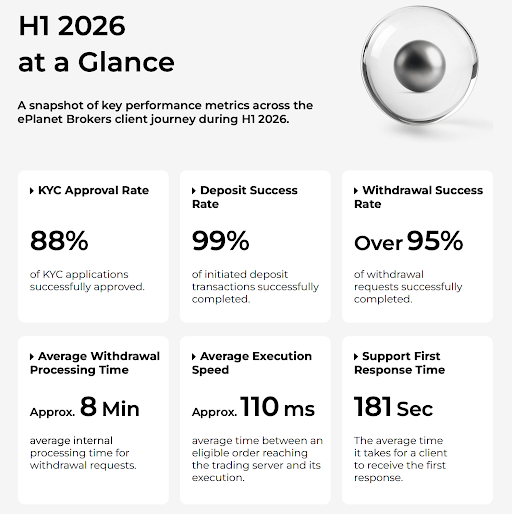
H1 2026 at a Glance: A snapshot of key operational metrics published by ePlanet Brokers.
The Balance Between KYC Compliance and Client Onboarding
KYC is often one of the first operational experiences a client has with a broker. The challenge is to make onboarding efficient while maintaining appropriate identity verification, AML controls and financial-crime prevention. For transparency to be useful here, publishing an approval rate alone is not enough. Traders can also benefit from knowing why verification fails and what a broker is doing to reduce unnecessary friction.
ePlanet Brokers reported an 88% KYC approval rate in H1 2026, compared with 71% in H2 2025. Its automated identity verification process took less than 30 seconds on average. The report also identifies duplicate accounts, document image or authenticity issues, and incomplete, damaged or non-compliant identity documents as the main reasons verification could not be completed successfully on first submission.
Rather than excluding these unsuccessful cases from the discussion, the report identifies clearer verification requirements, Dedicated Account Manager support, specialist review for complex cases and continuous process improvement as areas for improving the onboarding experience.
Payment Transparency Can Explain Deposit Friction
Deposit performance can depend on several systems beyond the broker itself. Banks, payment providers and blockchain networks can all introduce operational dependencies, but when a transaction fails, clients may simply experience the outcome as a problem with their broker. Clearer disclosure can help explain where friction originates and what can be improved.
In H1 2026, ePlanet Brokers reported a 99% deposit success rate, compared with approximately 95% in H2 2025, with average processing time of approximately one minute. The report identifies incorrect wallet information and incorrect blockchain networks among causes of unsuccessful crypto deposits, while incorrect or mismatched information and banking-system returns can affect bank transactions.
The company’s stated priorities include improving payment-system reliability, reducing avoidable delays and providing clearer information around payment processes. Disclosure of both the success rate and the reasons behind unsuccessful transactions provides clients with more context than a headline performance number alone.
Why Withdrawal Transparency Matters to Traders
Withdrawal problems can be particularly damaging to client confidence. Banking processes, payment providers, compliance requirements, account reviews and blockchain confirmations can all affect the experience, yet brokers may be reluctant to disclose how frequently withdrawals succeed, how long internal processing takes or why individual requests encounter delays.
ePlanet Brokers reported withdrawal success above 95% in H1 2026, compared with approximately 90% in H2 2025. Average internal processing time declined from under 20 minutes to approximately eight minutes, while the proportion of automated withdrawals increased from approximately 10% or lower to more than 40%.
The report also acknowledges the sources of friction. Interbank settlement delays, bank-specific transaction restrictions and additional review requirements were identified as the main reasons for withdrawal delays. Cases requiring additional review represented less than 10% of total withdrawal requests and could involve account, payment, security or compliance considerations.
Importantly, the eight-minute figure measures internal processing by ePlanet Brokers, not the complete time required for funds to reach the client’s final destination. External banking, payment-provider and blockchain processes may add additional time.
For the end of 2026, ePlanet Brokers is targeting average internal withdrawal processing below five minutes, a 50% automated withdrawal rate, and approximately 40% of eligible withdrawals processed instantly.
More information about the withdrawal process and potential causes of delays is available here.
Execution Quality Sits at the Heart of Trading
Execution is central to the trading experience, yet it is another area where broad claims such as “fast execution” can be more common than measurable disclosure. Any persistent weakness in execution quality or infrastructure reliability can directly affect the client experience and ultimately reduce a broker’s competitive advantage.
ePlanet Brokers reported 99.9% order execution success in H1 2026, compared with approximately 98% in H2 2025. Average execution speed improved from approximately 150 milliseconds to 110 milliseconds, an improvement of around 26.7%.
The report defines execution speed as the time between an eligible order reaching the trading server and its execution. This distinction is important because an average infrastructure metric is not a guarantee for every individual order. Market volatility, liquidity, price movements, session conditions and technical factors can affect execution.
The company’s improvement priorities include faster execution, higher platform reliability, continuous performance monitoring and infrastructure optimization. Trading-platform uptime was also reported above 99.997% on a 2026 year-to-date basis, adding another measurable dimension to infrastructure reliability.
Support Performance Is Also Measurable
Customer support metrics can be uncomfortable to publish because they depend heavily on people, case complexity and internal coordination. But support becomes particularly important when another part of the client journey does not work as expected.
ePlanet Brokers reported an average first-response time of 181 seconds in H1 2026, compared with 248 seconds in H2 2025, an improvement of approximately 27%. Average resolution time also declined from 80 minutes to 67 minutes. The company provides 24/7 customer support alongside Dedicated Account Managers who can provide an additional point of contact and coordinate with specialist teams.
These are averages rather than guarantees for every case. More complex payment, technical, account or compliance matters can require additional investigation. Their value is that service performance becomes measurable and can be compared with future reporting periods.
Complaints May Be the Hardest Metric to Disclose
Few companies actively want to publish how many complaints they receive or explain what clients complain about. Yet this may be one of the more meaningful forms of transparency. Understanding complaint rates and their causes can help prospective clients approach a broker with better information and more realistic expectations.
Formal complaints at ePlanet Brokers represented 0.2% of active clients in H1 2026, compared with 0.3% in H2 2025. The company also reported a formal complaint resolution rate above 99%.
The report identifies two principal areas behind complaints. One involved account restrictions following trading or account reviews, including a limited number of cases involving suspected or confirmed activity potentially breaching applicable Terms and Conditions. Another involved market volatility and trading outcomes, where rapid price movements, wider spreads, slippage and changing market conditions contributed to client concerns.
Publishing these reasons provides context that the percentages alone cannot. A resolution rate above 99%, for example, means formal complaints were processed through the company’s framework, not necessarily that every client received the outcome they initially requested.
Regulatory and compliance information remains a separate part of broker assessment. ePlanet Brokers operates through entities in Vanuatu and the Comoros Union, with its Vanuatu entity operating under the regulatory framework of the Vanuatu Financial Services Commission (VFSC). Operational transparency does not replace regulatory due diligence, but the two can provide different perspectives when assessing a broker.
Transparency Is More Credible When It Includes Imperfections
Meaningful transparency cannot consist only of publishing strong numbers. If reporting highlights successes while excluding failed transactions, delays, complaints and operational limitations, it risks becoming another marketing exercise.
The more difficult approach is to disclose strengths alongside weaknesses, explain why friction occurs and establish measurable priorities for improvement. ePlanet Brokers’ H1 2026 report attempts to do this across KYC, deposits, withdrawals, execution, support and complaints, while providing definitions that help put the figures into context.
For clients, this can create a more informed basis for assessing a broker. For brokers, it creates accountability because today’s disclosed performance becomes a benchmark for tomorrow.
Ultimately, acknowledging imperfections alongside achievements can build greater confidence than presenting an image of flawless operations. A broker that openly explains what works, what still creates friction and what it intends to improve demonstrates that transparency is not simply a promotional claim, but part of building a more honest and sustainable relationship with its clients.
Transparency is one of the most common promises in financial services, but publishing internal operational metrics is a different matter. Brokers may be comfortable discussing products, technology and trading conditions, yet figures covering failed verification attempts, payment issues, withdrawal delays, execution performance or complaints are more difficult to disclose. There is always a risk that such data may be taken out of context, attract criticism or make little sense without clear definitions.
Yet operational performance is a major part of the client experience. Meaningful transparency should therefore explain not only where a broker performs well, but also where friction occurs, why it happens and what is being done to improve it. ePlanet Brokers’ H1 2026 Transparency Report represents an attempt to apply this approach across KYC, deposits, withdrawals, trading infrastructure, customer support and complaints.
The complete report, including methodology and metric definitions, is available here:
H1 2026 at a Glance: A snapshot of key operational metrics published by ePlanet Brokers.
The Balance Between KYC Compliance and Client Onboarding
KYC is often one of the first operational experiences a client has with a broker. The challenge is to make onboarding efficient while maintaining appropriate identity verification, AML controls and financial-crime prevention. For transparency to be useful here, publishing an approval rate alone is not enough. Traders can also benefit from knowing why verification fails and what a broker is doing to reduce unnecessary friction.
ePlanet Brokers reported an 88% KYC approval rate in H1 2026, compared with 71% in H2 2025. Its automated identity verification process took less than 30 seconds on average. The report also identifies duplicate accounts, document image or authenticity issues, and incomplete, damaged or non-compliant identity documents as the main reasons verification could not be completed successfully on first submission.
Rather than excluding these unsuccessful cases from the discussion, the report identifies clearer verification requirements, Dedicated Account Manager support, specialist review for complex cases and continuous process improvement as areas for improving the onboarding experience.
Payment Transparency Can Explain Deposit Friction
Deposit performance can depend on several systems beyond the broker itself. Banks, payment providers and blockchain networks can all introduce operational dependencies, but when a transaction fails, clients may simply experience the outcome as a problem with their broker. Clearer disclosure can help explain where friction originates and what can be improved.
In H1 2026, ePlanet Brokers reported a 99% deposit success rate, compared with approximately 95% in H2 2025, with average processing time of approximately one minute. The report identifies incorrect wallet information and incorrect blockchain networks among causes of unsuccessful crypto deposits, while incorrect or mismatched information and banking-system returns can affect bank transactions.
The company’s stated priorities include improving payment-system reliability, reducing avoidable delays and providing clearer information around payment processes. Disclosure of both the success rate and the reasons behind unsuccessful transactions provides clients with more context than a headline performance number alone.
Why Withdrawal Transparency Matters to Traders
Withdrawal problems can be particularly damaging to client confidence. Banking processes, payment providers, compliance requirements, account reviews and blockchain confirmations can all affect the experience, yet brokers may be reluctant to disclose how frequently withdrawals succeed, how long internal processing takes or why individual requests encounter delays.
ePlanet Brokers reported withdrawal success above 95% in H1 2026, compared with approximately 90% in H2 2025. Average internal processing time declined from under 20 minutes to approximately eight minutes, while the proportion of automated withdrawals increased from approximately 10% or lower to more than 40%.
The report also acknowledges the sources of friction. Interbank settlement delays, bank-specific transaction restrictions and additional review requirements were identified as the main reasons for withdrawal delays. Cases requiring additional review represented less than 10% of total withdrawal requests and could involve account, payment, security or compliance considerations.
Importantly, the eight-minute figure measures internal processing by ePlanet Brokers, not the complete time required for funds to reach the client’s final destination. External banking, payment-provider and blockchain processes may add additional time.
For the end of 2026, ePlanet Brokers is targeting average internal withdrawal processing below five minutes, a 50% automated withdrawal rate, and approximately 40% of eligible withdrawals processed instantly.
More information about the withdrawal process and potential causes of delays is available here.
Execution Quality Sits at the Heart of Trading
Execution is central to the trading experience, yet it is another area where broad claims such as “fast execution” can be more common than measurable disclosure. Any persistent weakness in execution quality or infrastructure reliability can directly affect the client experience and ultimately reduce a broker’s competitive advantage.
ePlanet Brokers reported 99.9% order execution success in H1 2026, compared with approximately 98% in H2 2025. Average execution speed improved from approximately 150 milliseconds to 110 milliseconds, an improvement of around 26.7%.
The report defines execution speed as the time between an eligible order reaching the trading server and its execution. This distinction is important because an average infrastructure metric is not a guarantee for every individual order. Market volatility, liquidity, price movements, session conditions and technical factors can affect execution.
The company’s improvement priorities include faster execution, higher platform reliability, continuous performance monitoring and infrastructure optimization. Trading-platform uptime was also reported above 99.997% on a 2026 year-to-date basis, adding another measurable dimension to infrastructure reliability.
Support Performance Is Also Measurable
Customer support metrics can be uncomfortable to publish because they depend heavily on people, case complexity and internal coordination. But support becomes particularly important when another part of the client journey does not work as expected.
ePlanet Brokers reported an average first-response time of 181 seconds in H1 2026, compared with 248 seconds in H2 2025, an improvement of approximately 27%. Average resolution time also declined from 80 minutes to 67 minutes. The company provides 24/7 customer support alongside Dedicated Account Managers who can provide an additional point of contact and coordinate with specialist teams.
These are averages rather than guarantees for every case. More complex payment, technical, account or compliance matters can require additional investigation. Their value is that service performance becomes measurable and can be compared with future reporting periods.
Complaints May Be the Hardest Metric to Disclose
Few companies actively want to publish how many complaints they receive or explain what clients complain about. Yet this may be one of the more meaningful forms of transparency. Understanding complaint rates and their causes can help prospective clients approach a broker with better information and more realistic expectations.
Formal complaints at ePlanet Brokers represented 0.2% of active clients in H1 2026, compared with 0.3% in H2 2025. The company also reported a formal complaint resolution rate above 99%.
The report identifies two principal areas behind complaints. One involved account restrictions following trading or account reviews, including a limited number of cases involving suspected or confirmed activity potentially breaching applicable Terms and Conditions. Another involved market volatility and trading outcomes, where rapid price movements, wider spreads, slippage and changing market conditions contributed to client concerns.
Publishing these reasons provides context that the percentages alone cannot. A resolution rate above 99%, for example, means formal complaints were processed through the company’s framework, not necessarily that every client received the outcome they initially requested.
Regulatory and compliance information remains a separate part of broker assessment. ePlanet Brokers operates through entities in Vanuatu and the Comoros Union, with its Vanuatu entity operating under the regulatory framework of the Vanuatu Financial Services Commission (VFSC). Operational transparency does not replace regulatory due diligence, but the two can provide different perspectives when assessing a broker.
Transparency Is More Credible When It Includes Imperfections
Meaningful transparency cannot consist only of publishing strong numbers. If reporting highlights successes while excluding failed transactions, delays, complaints and operational limitations, it risks becoming another marketing exercise.
The more difficult approach is to disclose strengths alongside weaknesses, explain why friction occurs and establish measurable priorities for improvement. ePlanet Brokers’ H1 2026 report attempts to do this across KYC, deposits, withdrawals, execution, support and complaints, while providing definitions that help put the figures into context.
For clients, this can create a more informed basis for assessing a broker. For brokers, it creates accountability because today’s disclosed performance becomes a benchmark for tomorrow.
Ultimately, acknowledging imperfections alongside achievements can build greater confidence than presenting an image of flawless operations. A broker that openly explains what works, what still creates friction and what it intends to improve demonstrates that transparency is not simply a promotional claim, but part of building a more honest and sustainable relationship with its clients.
The technology underpinning crypto could fundamentally change the future of how money moves,” says OpenPayd CCO Lux Thiagarajah
Featured Videos
iFOREX Revises Earnings Forecast; AvaTrade to Close Polish Office
iFOREX Revises Earnings Forecast; AvaTrade to Close Polish Office
iFOREX Revises Earnings Forecast; AvaTrade to Close Polish Office
iFOREX Revises Earnings Forecast; AvaTrade to Close Polish Office
Today’s financial news recap covers iFOREX cuts its first-half earnings estimate, AvaTrade closes its Poland branch, Devexperts targets South Korean brokers, and TradingView adds MCP for AI tools.
Finance Magnates Daily Recap brings you the latest news from forex and CFD brokers, fintech, payments, cryptocurrency, digital assets, trading platforms, financial regulation and global markets.
Get the key company news, executive moves, deals, regulatory updates and market developments of the day, in just a few minutes. New episodes published every weekday.
Read more: https://www.financemagnates.com
#FinanceMagnates #ForexNews #FintechNews
Today’s financial news recap covers iFOREX cuts its first-half earnings estimate, AvaTrade closes its Poland branch, Devexperts targets South Korean brokers, and TradingView adds MCP for AI tools.
Finance Magnates Daily Recap brings you the latest news from forex and CFD brokers, fintech, payments, cryptocurrency, digital assets, trading platforms, financial regulation and global markets.
Get the key company news, executive moves, deals, regulatory updates and market developments of the day, in just a few minutes. New episodes published every weekday.
Read more: https://www.financemagnates.com
#FinanceMagnates #ForexNews #FintechNews
Today’s financial news recap covers iFOREX cuts its first-half earnings estimate, AvaTrade closes its Poland branch, Devexperts targets South Korean brokers, and TradingView adds MCP for AI tools.
Finance Magnates Daily Recap brings you the latest news from forex and CFD brokers, fintech, payments, cryptocurrency, digital assets, trading platforms, financial regulation and global markets.
Get the key company news, executive moves, deals, regulatory updates and market developments of the day, in just a few minutes. New episodes published every weekday.
Read more: https://www.financemagnates.com
#FinanceMagnates #ForexNews #FintechNews
Today’s financial news recap covers iFOREX cuts its first-half earnings estimate, AvaTrade closes its Poland branch, Devexperts targets South Korean brokers, and TradingView adds MCP for AI tools.
Finance Magnates Daily Recap brings you the latest news from forex and CFD brokers, fintech, payments, cryptocurrency, digital assets, trading platforms, financial regulation and global markets.
Get the key company news, executive moves, deals, regulatory updates and market developments of the day, in just a few minutes. New episodes published every weekday.
Read more: https://www.financemagnates.com
#FinanceMagnates #ForexNews #FintechNews
Can you memorise the textbook? That’s not necessarily the point.
Can you memorise the textbook? That’s not necessarily the point.
Can you memorise the textbook? That’s not necessarily the point.
Can you memorise the textbook? That’s not necessarily the point.
Can you memorise the textbook? That’s not necessarily the point.
Can you memorise the textbook? That’s not necessarily the point.
What matters is whether you can retain the information, understand it and actually apply it.
Take brokerage models. Knowing what a brokerage model is only gets you so far. What companies really need is an understanding of how to build one and how it can be applied.
That kind of practical understanding goes beyond simply reading a textbook.
#FinanceMagnates #FMAcademy #Fintech #FinanceCareers #ProfessionalDevelopment
What matters is whether you can retain the information, understand it and actually apply it.
Take brokerage models. Knowing what a brokerage model is only gets you so far. What companies really need is an understanding of how to build one and how it can be applied.
That kind of practical understanding goes beyond simply reading a textbook.
#FinanceMagnates #FMAcademy #Fintech #FinanceCareers #ProfessionalDevelopment
What matters is whether you can retain the information, understand it and actually apply it.
Take brokerage models. Knowing what a brokerage model is only gets you so far. What companies really need is an understanding of how to build one and how it can be applied.
That kind of practical understanding goes beyond simply reading a textbook.
#FinanceMagnates #FMAcademy #Fintech #FinanceCareers #ProfessionalDevelopment
What matters is whether you can retain the information, understand it and actually apply it.
Take brokerage models. Knowing what a brokerage model is only gets you so far. What companies really need is an understanding of how to build one and how it can be applied.
That kind of practical understanding goes beyond simply reading a textbook.
#FinanceMagnates #FMAcademy #Fintech #FinanceCareers #ProfessionalDevelopment
What matters is whether you can retain the information, understand it and actually apply it.
Take brokerage models. Knowing what a brokerage model is only gets you so far. What companies really need is an understanding of how to build one and how it can be applied.
That kind of practical understanding goes beyond simply reading a textbook.
#FinanceMagnates #FMAcademy #Fintech #FinanceCareers #ProfessionalDevelopment
What matters is whether you can retain the information, understand it and actually apply it.
Take brokerage models. Knowing what a brokerage model is only gets you so far. What companies really need is an understanding of how to build one and how it can be applied.
That kind of practical understanding goes beyond simply reading a textbook.
#FinanceMagnates #FMAcademy #Fintech #FinanceCareers #ProfessionalDevelopment
US Senate Blocks CLARITY Act; IBKR Links X to Trading
US Senate Blocks CLARITY Act; IBKR Links X to Trading
US Senate Blocks CLARITY Act; IBKR Links X to Trading
US Senate Blocks CLARITY Act; IBKR Links X to Trading
US Senate Blocks CLARITY Act; IBKR Links X to Trading
US Senate Blocks CLARITY Act; IBKR Links X to Trading
Today’s financial news recap covers the US Senate blocks the CLARITY Act, Interactive Brokers links X Cashtags to trading, and Match-Trade offers seven-day prop firm launch with Match-Prop.
Finance Magnates Daily Recap brings you the latest news from forex and CFD brokers, fintech, payments, cryptocurrency, digital assets, trading platforms, financial regulation and global markets.
Get the key company news, executive moves, deals, regulatory updates and market developments of the day, in just a few minutes. New episodes published every weekday.
Read more: https://www.financemagnates.com
#FinanceMagnates #ForexNews #FintechNews
Today’s financial news recap covers the US Senate blocks the CLARITY Act, Interactive Brokers links X Cashtags to trading, and Match-Trade offers seven-day prop firm launch with Match-Prop.
Finance Magnates Daily Recap brings you the latest news from forex and CFD brokers, fintech, payments, cryptocurrency, digital assets, trading platforms, financial regulation and global markets.
Get the key company news, executive moves, deals, regulatory updates and market developments of the day, in just a few minutes. New episodes published every weekday.
Read more: https://www.financemagnates.com
#FinanceMagnates #ForexNews #FintechNews
Today’s financial news recap covers the US Senate blocks the CLARITY Act, Interactive Brokers links X Cashtags to trading, and Match-Trade offers seven-day prop firm launch with Match-Prop.
Finance Magnates Daily Recap brings you the latest news from forex and CFD brokers, fintech, payments, cryptocurrency, digital assets, trading platforms, financial regulation and global markets.
Get the key company news, executive moves, deals, regulatory updates and market developments of the day, in just a few minutes. New episodes published every weekday.
Read more: https://www.financemagnates.com
#FinanceMagnates #ForexNews #FintechNews
Today’s financial news recap covers the US Senate blocks the CLARITY Act, Interactive Brokers links X Cashtags to trading, and Match-Trade offers seven-day prop firm launch with Match-Prop.
Finance Magnates Daily Recap brings you the latest news from forex and CFD brokers, fintech, payments, cryptocurrency, digital assets, trading platforms, financial regulation and global markets.
Get the key company news, executive moves, deals, regulatory updates and market developments of the day, in just a few minutes. New episodes published every weekday.
Read more: https://www.financemagnates.com
#FinanceMagnates #ForexNews #FintechNews
Today’s financial news recap covers the US Senate blocks the CLARITY Act, Interactive Brokers links X Cashtags to trading, and Match-Trade offers seven-day prop firm launch with Match-Prop.
Finance Magnates Daily Recap brings you the latest news from forex and CFD brokers, fintech, payments, cryptocurrency, digital assets, trading platforms, financial regulation and global markets.
Get the key company news, executive moves, deals, regulatory updates and market developments of the day, in just a few minutes. New episodes published every weekday.
Read more: https://www.financemagnates.com
#FinanceMagnates #ForexNews #FintechNews
Today’s financial news recap covers the US Senate blocks the CLARITY Act, Interactive Brokers links X Cashtags to trading, and Match-Trade offers seven-day prop firm launch with Match-Prop.
Finance Magnates Daily Recap brings you the latest news from forex and CFD brokers, fintech, payments, cryptocurrency, digital assets, trading platforms, financial regulation and global markets.
Get the key company news, executive moves, deals, regulatory updates and market developments of the day, in just a few minutes. New episodes published every weekday.
Read more: https://www.financemagnates.com
#FinanceMagnates #ForexNews #FintechNews
Revolut KYC Incident; CoinEx Shuts Down
Revolut KYC Incident; CoinEx Shuts Down
Revolut KYC Incident; CoinEx Shuts Down
Revolut KYC Incident; CoinEx Shuts Down
Revolut KYC Incident; CoinEx Shuts Down
Revolut KYC Incident; CoinEx Shuts Down
Today’s financial news recap covers the Revolut KYC data incident, CoinEx’s shutdown, and Anthropic’s push into financial services.
Finance Magnates Daily Recap brings you the latest news from forex and CFD brokers, fintech, payments, cryptocurrency, digital assets, trading platforms, financial regulation and global markets.
Get the key company news, executive moves, deals, regulatory updates and market developments of the day, in just a few minutes. New episodes published every weekday.
Read more: https://www.financemagnates.com
#FinanceMagnates #ForexNews #FintechNews
Today’s financial news recap covers the Revolut KYC data incident, CoinEx’s shutdown, and Anthropic’s push into financial services.
Finance Magnates Daily Recap brings you the latest news from forex and CFD brokers, fintech, payments, cryptocurrency, digital assets, trading platforms, financial regulation and global markets.
Get the key company news, executive moves, deals, regulatory updates and market developments of the day, in just a few minutes. New episodes published every weekday.
Read more: https://www.financemagnates.com
#FinanceMagnates #ForexNews #FintechNews
Today’s financial news recap covers the Revolut KYC data incident, CoinEx’s shutdown, and Anthropic’s push into financial services.
Finance Magnates Daily Recap brings you the latest news from forex and CFD brokers, fintech, payments, cryptocurrency, digital assets, trading platforms, financial regulation and global markets.
Get the key company news, executive moves, deals, regulatory updates and market developments of the day, in just a few minutes. New episodes published every weekday.
Read more: https://www.financemagnates.com
#FinanceMagnates #ForexNews #FintechNews
Today’s financial news recap covers the Revolut KYC data incident, CoinEx’s shutdown, and Anthropic’s push into financial services.
Finance Magnates Daily Recap brings you the latest news from forex and CFD brokers, fintech, payments, cryptocurrency, digital assets, trading platforms, financial regulation and global markets.
Get the key company news, executive moves, deals, regulatory updates and market developments of the day, in just a few minutes. New episodes published every weekday.
Read more: https://www.financemagnates.com
#FinanceMagnates #ForexNews #FintechNews
Today’s financial news recap covers the Revolut KYC data incident, CoinEx’s shutdown, and Anthropic’s push into financial services.
Finance Magnates Daily Recap brings you the latest news from forex and CFD brokers, fintech, payments, cryptocurrency, digital assets, trading platforms, financial regulation and global markets.
Get the key company news, executive moves, deals, regulatory updates and market developments of the day, in just a few minutes. New episodes published every weekday.
Read more: https://www.financemagnates.com
#FinanceMagnates #ForexNews #FintechNews
Today’s financial news recap covers the Revolut KYC data incident, CoinEx’s shutdown, and Anthropic’s push into financial services.
Finance Magnates Daily Recap brings you the latest news from forex and CFD brokers, fintech, payments, cryptocurrency, digital assets, trading platforms, financial regulation and global markets.
Get the key company news, executive moves, deals, regulatory updates and market developments of the day, in just a few minutes. New episodes published every weekday.
Read more: https://www.financemagnates.com
#FinanceMagnates #ForexNews #FintechNews
Is FM Academy just for individuals looking to upskill?
Is FM Academy just for individuals looking to upskill?
Is FM Academy just for individuals looking to upskill?
Is FM Academy just for individuals looking to upskill?
Is FM Academy just for individuals looking to upskill?
Is FM Academy just for individuals looking to upskill?
Not at all.
Individual professionals can use FM Academy to build their knowledge and skills, while companies can use corporate bundles to train entire teams and bring new hires up to speed.
For individuals, that means flexible learning. For companies, it means a more structured way to train multiple employees without coordinating separate training for everyone.
#FinanceMagnates #FMAcademy #Fintech #ProfessionalDevelopment #CorporateTraining
Not at all.
Individual professionals can use FM Academy to build their knowledge and skills, while companies can use corporate bundles to train entire teams and bring new hires up to speed.
For individuals, that means flexible learning. For companies, it means a more structured way to train multiple employees without coordinating separate training for everyone.
#FinanceMagnates #FMAcademy #Fintech #ProfessionalDevelopment #CorporateTraining
Not at all.
Individual professionals can use FM Academy to build their knowledge and skills, while companies can use corporate bundles to train entire teams and bring new hires up to speed.
For individuals, that means flexible learning. For companies, it means a more structured way to train multiple employees without coordinating separate training for everyone.
#FinanceMagnates #FMAcademy #Fintech #ProfessionalDevelopment #CorporateTraining
Not at all.
Individual professionals can use FM Academy to build their knowledge and skills, while companies can use corporate bundles to train entire teams and bring new hires up to speed.
For individuals, that means flexible learning. For companies, it means a more structured way to train multiple employees without coordinating separate training for everyone.
#FinanceMagnates #FMAcademy #Fintech #ProfessionalDevelopment #CorporateTraining
Not at all.
Individual professionals can use FM Academy to build their knowledge and skills, while companies can use corporate bundles to train entire teams and bring new hires up to speed.
For individuals, that means flexible learning. For companies, it means a more structured way to train multiple employees without coordinating separate training for everyone.
#FinanceMagnates #FMAcademy #Fintech #ProfessionalDevelopment #CorporateTraining
Not at all.
Individual professionals can use FM Academy to build their knowledge and skills, while companies can use corporate bundles to train entire teams and bring new hires up to speed.
For individuals, that means flexible learning. For companies, it means a more structured way to train multiple employees without coordinating separate training for everyone.
#FinanceMagnates #FMAcademy #Fintech #ProfessionalDevelopment #CorporateTraining