Biden's “genocide” declaration and unorthodox monetary policies by President Erdogan have sent the lira falling.
Turkish Lira
The high-yielding Turkish Lira has been experiencing heavy selling pressure across the board over growing concerns of Turkey-USA relations, coupled with the unorthodox monetary policies by President Erdogan, fear for pre-mature interest rate cuts, and the potential for a new financial crisis in the country.
Biden’s “Armenian genocide” recognition:
The currency has lost more than 4% over the last trading sessions after US President Joe Biden recognized the 1915 massacres of approx. 1.5 million Armenians in the Ottoman Empire as a genocide.
Turkey, which is the second-largest army in the NATO alliance and a chronically closed ally with the United States, has rejected Biden’s decision, denying the killings were systematically orchestrated and constitute a genocide.
The declaration came at bad timing, since the relation between the two allies has been damaged recently over geopolitical issues such as the purchase of the Russian S-400 air defence system by Turkey, political differences in the Syrian civil war, and recent US sanctions.
Market Reaction:
Concerning for another financial crisis in Turkey and the deteriorated inflation outlook, investors have moved away from lira-denominated assets towards harder currencies such as Euro and US dollar, pressuring the Turkish Lira towards record lows against major currencies.
Lira, which is one of the worst emerging-market performers in 2021, depreciates further above the psychological level of 10 against the Euro for the first time, without showing any signs of a slowdown.
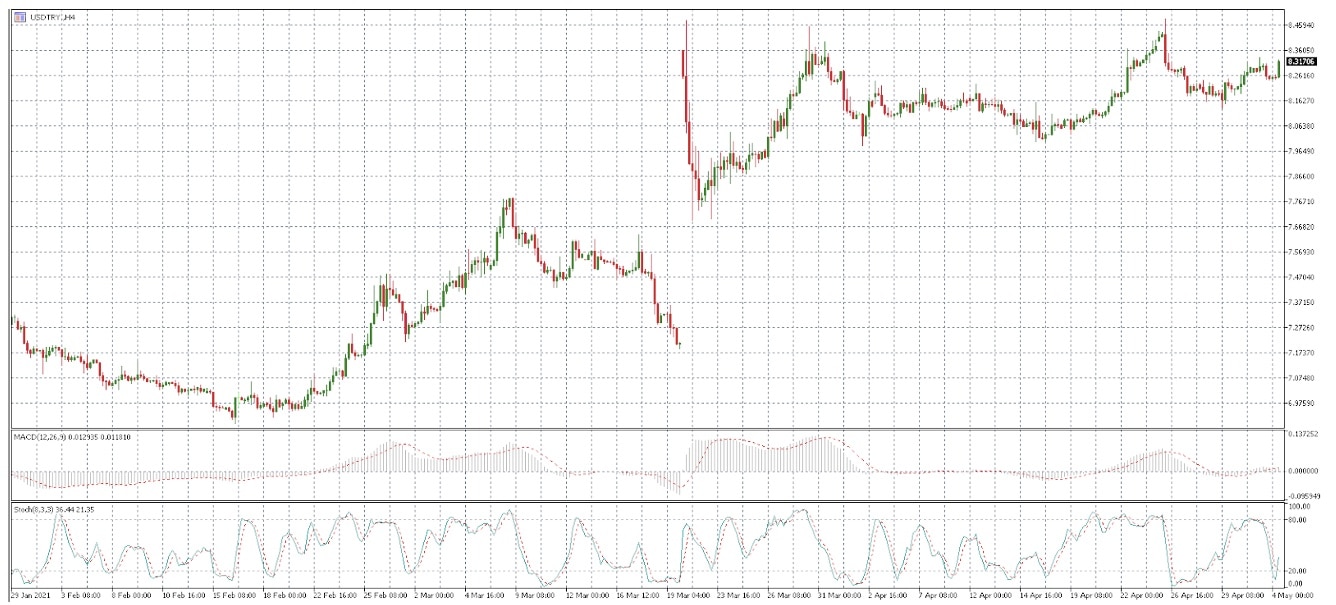
USD/TRY pair, 4-hour chart
Hence, the currency loses further ground against the US dollar, trading near a record high of $8.60 reached on 06 November 2020, despite greenback weakness across the board over the dovish Federal Reserve.
Free-falling economy and skyrocketed inflation rate:
Investors have started losing confidence in Turkey as the economy is free-falling, debts have been elevating to record highs, while the inflation rate skyrocketed beyond 15% in Q1, 2021, and is expected to rise to 18% soon.
The rising commodities prices have given a boost in food inflation, causing many problems in the already-poor society ahead of the presidential elections in 2023. The crude oil prices have quadrupled in the last few months in the country, while the prices of industrial commodities such as copper, iron ore, and LNG climbed to multi-year highs.
President Erdogan’s unorthodox view of monetary economics harms Turkey’s assets:
President Tayyip Erdogan-who is a fan of low-interest rates and a critic of tight monetary policy, has described the interest rates as the “mother and father of all evil”.
Erdogan has an unorthodox view of monetary economics, thinking that the higher interest rates cannot solve economic problems, causing only inflation pressure on the economy.
He has publicly criticised the hawkish monetary policies taken by his former central governors who have lifted the key interest rates to 19% in a small period of just 2 years, a move necessary to contain Turkey’s chronically high inflation rate and to support the falling Lira.
Shocking the global markets, President Erdogan fired his hawkish Central bank governor Mr. Naci Agbal on Saturday, March 20, 2021, replacing him with a former ruling AK Party (AKP) lawmaker and critic of tight monetary policy Mr. Sahap Kavcioglu.
That was the third replacement of central bankers since 2019, who all resisted the president's growth-at-all-costs policy and low-interest rates.
The former governor-who was appointed less than five months ago-had made the mistake to aggressively raise the policy rate by 875 basis points to 19% two days before his replacement, the highest of any developed or EM economy.
Erdogan’s surprising decision increased the currency and country risk for Turkey, triggering a domino of heavy sales in any TRY-denominated asset or companies exposed to the Turkish economy from the institutional investors.
As a result, markets responded immediately to the unexpected removal, sending the Turkish Lira to as low as 19% against major currencies on Monday, March 22, 2021, posting its worst plunge since the preview’s monetary crisis in 2018.
Hence, the Istanbul stock exchange lost 10%, its steepest drop since 2013, while the 10-year Turkey’s bond yields added almost 500 basis points to 19%, the most on record.
Foreign investors have lost their trust in the Lira since Turkey's central bank is no longer functioning independently under Erdogan’s rule, and the rate hikes required to curb inflation are no longer possible with the new “dovish” Central banker.
President’s Erdogan political party AKP has started losing supporters, forcing the administration to give additional pandemic-relief fiscal packages to the economy.
The high-yielding Turkish Lira has been experiencing heavy selling pressure across the board over growing concerns of Turkey-USA relations, coupled with the unorthodox monetary policies by President Erdogan, fear for pre-mature interest rate cuts, and the potential for a new financial crisis in the country.
Biden’s “Armenian genocide” recognition:
The currency has lost more than 4% over the last trading sessions after US President Joe Biden recognized the 1915 massacres of approx. 1.5 million Armenians in the Ottoman Empire as a genocide.
Turkey, which is the second-largest army in the NATO alliance and a chronically closed ally with the United States, has rejected Biden’s decision, denying the killings were systematically orchestrated and constitute a genocide.
The declaration came at bad timing, since the relation between the two allies has been damaged recently over geopolitical issues such as the purchase of the Russian S-400 air defence system by Turkey, political differences in the Syrian civil war, and recent US sanctions.
Market Reaction:
Concerning for another financial crisis in Turkey and the deteriorated inflation outlook, investors have moved away from lira-denominated assets towards harder currencies such as Euro and US dollar, pressuring the Turkish Lira towards record lows against major currencies.
Lira, which is one of the worst emerging-market performers in 2021, depreciates further above the psychological level of 10 against the Euro for the first time, without showing any signs of a slowdown.
USD/TRY pair, 4-hour chart
Hence, the currency loses further ground against the US dollar, trading near a record high of $8.60 reached on 06 November 2020, despite greenback weakness across the board over the dovish Federal Reserve.
Free-falling economy and skyrocketed inflation rate:
Investors have started losing confidence in Turkey as the economy is free-falling, debts have been elevating to record highs, while the inflation rate skyrocketed beyond 15% in Q1, 2021, and is expected to rise to 18% soon.
The rising commodities prices have given a boost in food inflation, causing many problems in the already-poor society ahead of the presidential elections in 2023. The crude oil prices have quadrupled in the last few months in the country, while the prices of industrial commodities such as copper, iron ore, and LNG climbed to multi-year highs.
President Erdogan’s unorthodox view of monetary economics harms Turkey’s assets:
President Tayyip Erdogan-who is a fan of low-interest rates and a critic of tight monetary policy, has described the interest rates as the “mother and father of all evil”.
Erdogan has an unorthodox view of monetary economics, thinking that the higher interest rates cannot solve economic problems, causing only inflation pressure on the economy.
He has publicly criticised the hawkish monetary policies taken by his former central governors who have lifted the key interest rates to 19% in a small period of just 2 years, a move necessary to contain Turkey’s chronically high inflation rate and to support the falling Lira.
Shocking the global markets, President Erdogan fired his hawkish Central bank governor Mr. Naci Agbal on Saturday, March 20, 2021, replacing him with a former ruling AK Party (AKP) lawmaker and critic of tight monetary policy Mr. Sahap Kavcioglu.
That was the third replacement of central bankers since 2019, who all resisted the president's growth-at-all-costs policy and low-interest rates.
The former governor-who was appointed less than five months ago-had made the mistake to aggressively raise the policy rate by 875 basis points to 19% two days before his replacement, the highest of any developed or EM economy.
Erdogan’s surprising decision increased the currency and country risk for Turkey, triggering a domino of heavy sales in any TRY-denominated asset or companies exposed to the Turkish economy from the institutional investors.
As a result, markets responded immediately to the unexpected removal, sending the Turkish Lira to as low as 19% against major currencies on Monday, March 22, 2021, posting its worst plunge since the preview’s monetary crisis in 2018.
Hence, the Istanbul stock exchange lost 10%, its steepest drop since 2013, while the 10-year Turkey’s bond yields added almost 500 basis points to 19%, the most on record.
Foreign investors have lost their trust in the Lira since Turkey's central bank is no longer functioning independently under Erdogan’s rule, and the rate hikes required to curb inflation are no longer possible with the new “dovish” Central banker.
President’s Erdogan political party AKP has started losing supporters, forcing the administration to give additional pandemic-relief fiscal packages to the economy.
Beyond FX: What Match-Trader Is Bringing to Brokers at iFX EXPO International
Featured Videos
FM Daily Brief – 11 June 2026
Today’s Thursday, the 11th of June 2026, and these are our main stories: Spain moves to classify certain futures products as CFDs for retail investors, IUX reports more than $1.5 trillion in monthly trading volume, and a closer look at why crypto still struggles to reach the mainstream.
In this video, we review @AxiOfficialChannel , a multi-asset broker offering access to forex and CFD markets through MetaTrader 4, MetaTrader 5, the Axi Trading App, and copy trading solutions.
We examine the broker’s regulatory framework, platform offering, market coverage, and customer support structure. We also explore key features such as available trading instruments, swap-free account options, funding considerations, and multilingual support.
Watch the full video for a clear, fact-based overview of Axi’s products, trading tools, and overall broker offering.
#Axi #ForexBroker #CFDTrading #FinanceMagnates #Trading #BrokerReview #OnlineTrading
In this video, we review @AxiOfficialChannel , a multi-asset broker offering access to forex and CFD markets through MetaTrader 4, MetaTrader 5, the Axi Trading App, and copy trading solutions.
We examine the broker’s regulatory framework, platform offering, market coverage, and customer support structure. We also explore key features such as available trading instruments, swap-free account options, funding considerations, and multilingual support.
Watch the full video for a clear, fact-based overview of Axi’s products, trading tools, and overall broker offering.
#Axi #ForexBroker #CFDTrading #FinanceMagnates #Trading #BrokerReview #OnlineTrading
In this video, we review @AxiOfficialChannel , a multi-asset broker offering access to forex and CFD markets through MetaTrader 4, MetaTrader 5, the Axi Trading App, and copy trading solutions.
We examine the broker’s regulatory framework, platform offering, market coverage, and customer support structure. We also explore key features such as available trading instruments, swap-free account options, funding considerations, and multilingual support.
Watch the full video for a clear, fact-based overview of Axi’s products, trading tools, and overall broker offering.
#Axi #ForexBroker #CFDTrading #FinanceMagnates #Trading #BrokerReview #OnlineTrading
In this video, we review @AxiOfficialChannel , a multi-asset broker offering access to forex and CFD markets through MetaTrader 4, MetaTrader 5, the Axi Trading App, and copy trading solutions.
We examine the broker’s regulatory framework, platform offering, market coverage, and customer support structure. We also explore key features such as available trading instruments, swap-free account options, funding considerations, and multilingual support.
Watch the full video for a clear, fact-based overview of Axi’s products, trading tools, and overall broker offering.
#Axi #ForexBroker #CFDTrading #FinanceMagnates #Trading #BrokerReview #OnlineTrading
In this video, we review @AxiOfficialChannel , a multi-asset broker offering access to forex and CFD markets through MetaTrader 4, MetaTrader 5, the Axi Trading App, and copy trading solutions.
We examine the broker’s regulatory framework, platform offering, market coverage, and customer support structure. We also explore key features such as available trading instruments, swap-free account options, funding considerations, and multilingual support.
Watch the full video for a clear, fact-based overview of Axi’s products, trading tools, and overall broker offering.
#Axi #ForexBroker #CFDTrading #FinanceMagnates #Trading #BrokerReview #OnlineTrading
In this video, we review @AxiOfficialChannel , a multi-asset broker offering access to forex and CFD markets through MetaTrader 4, MetaTrader 5, the Axi Trading App, and copy trading solutions.
We examine the broker’s regulatory framework, platform offering, market coverage, and customer support structure. We also explore key features such as available trading instruments, swap-free account options, funding considerations, and multilingual support.
Watch the full video for a clear, fact-based overview of Axi’s products, trading tools, and overall broker offering.
#Axi #ForexBroker #CFDTrading #FinanceMagnates #Trading #BrokerReview #OnlineTrading
Multi-Asset or Die: The New Brokerage Playbook
This panel will explore how firms are moving beyond CFDs into crypto, perpetuals, equities, and multi‑asset offerings, and the challenges they face across regulation, technology, liquidity, and risk management. It examines what is driving the shift, what it takes to execute it successfully, and how brokers can position themselves for the next phase of growth.
Beyond Reach? Retail Investor Acquisition Across APAC
APAC accounts for two-thirds of global retail trading traffic, but with differences of language, regulation, and trader profile, the region's growth is ag great as complexity.
This session gathers CMOs, heads of acquisition, and IB relationship managers to examine what actually works, channel by channel, market by market.
Attendees will walk away with:
A clear view of which channels deliver funded, retained traders across Singapore, Japan, and Southeast Asia
Understanding of how to structure IB partnerships for LTV, not first deposit
Insight into what localization actually costs beyond the translation budget
Perspective on how ad restrictions, crypto promotion limits, and bundling rules differ across APAC jurisdictions
A read on whether the super-app model changes acquisition economics for retail investing platforms
APAC accounts for two-thirds of global retail trading traffic, but with differences of language, regulation, and trader profile, the region's growth is ag great as complexity.
This session gathers CMOs, heads of acquisition, and IB relationship managers to examine what actually works, channel by channel, market by market.
Attendees will walk away with:
A clear view of which channels deliver funded, retained traders across Singapore, Japan, and Southeast Asia
Understanding of how to structure IB partnerships for LTV, not first deposit
Insight into what localization actually costs beyond the translation budget
Perspective on how ad restrictions, crypto promotion limits, and bundling rules differ across APAC jurisdictions
A read on whether the super-app model changes acquisition economics for retail investing platforms
APAC accounts for two-thirds of global retail trading traffic, but with differences of language, regulation, and trader profile, the region's growth is ag great as complexity.
This session gathers CMOs, heads of acquisition, and IB relationship managers to examine what actually works, channel by channel, market by market.
Attendees will walk away with:
A clear view of which channels deliver funded, retained traders across Singapore, Japan, and Southeast Asia
Understanding of how to structure IB partnerships for LTV, not first deposit
Insight into what localization actually costs beyond the translation budget
Perspective on how ad restrictions, crypto promotion limits, and bundling rules differ across APAC jurisdictions
A read on whether the super-app model changes acquisition economics for retail investing platforms
APAC accounts for two-thirds of global retail trading traffic, but with differences of language, regulation, and trader profile, the region's growth is ag great as complexity.
This session gathers CMOs, heads of acquisition, and IB relationship managers to examine what actually works, channel by channel, market by market.
Attendees will walk away with:
A clear view of which channels deliver funded, retained traders across Singapore, Japan, and Southeast Asia
Understanding of how to structure IB partnerships for LTV, not first deposit
Insight into what localization actually costs beyond the translation budget
Perspective on how ad restrictions, crypto promotion limits, and bundling rules differ across APAC jurisdictions
A read on whether the super-app model changes acquisition economics for retail investing platforms
APAC accounts for two-thirds of global retail trading traffic, but with differences of language, regulation, and trader profile, the region's growth is ag great as complexity.
This session gathers CMOs, heads of acquisition, and IB relationship managers to examine what actually works, channel by channel, market by market.
Attendees will walk away with:
A clear view of which channels deliver funded, retained traders across Singapore, Japan, and Southeast Asia
Understanding of how to structure IB partnerships for LTV, not first deposit
Insight into what localization actually costs beyond the translation budget
Perspective on how ad restrictions, crypto promotion limits, and bundling rules differ across APAC jurisdictions
A read on whether the super-app model changes acquisition economics for retail investing platforms
APAC accounts for two-thirds of global retail trading traffic, but with differences of language, regulation, and trader profile, the region's growth is ag great as complexity.
This session gathers CMOs, heads of acquisition, and IB relationship managers to examine what actually works, channel by channel, market by market.
Attendees will walk away with:
A clear view of which channels deliver funded, retained traders across Singapore, Japan, and Southeast Asia
Understanding of how to structure IB partnerships for LTV, not first deposit
Insight into what localization actually costs beyond the translation budget
Perspective on how ad restrictions, crypto promotion limits, and bundling rules differ across APAC jurisdictions
A read on whether the super-app model changes acquisition economics for retail investing platforms