
Follow the Collateral: How Tokenized Treasuries Are Entering Institutional Crypto

Thursday, 20/08/2026 | 07:20 GMT by FM
Disclaimer
  • Tokenized U.S. Treasuries are driving institutional adoption by serving as crypto collateral.
bitcoin

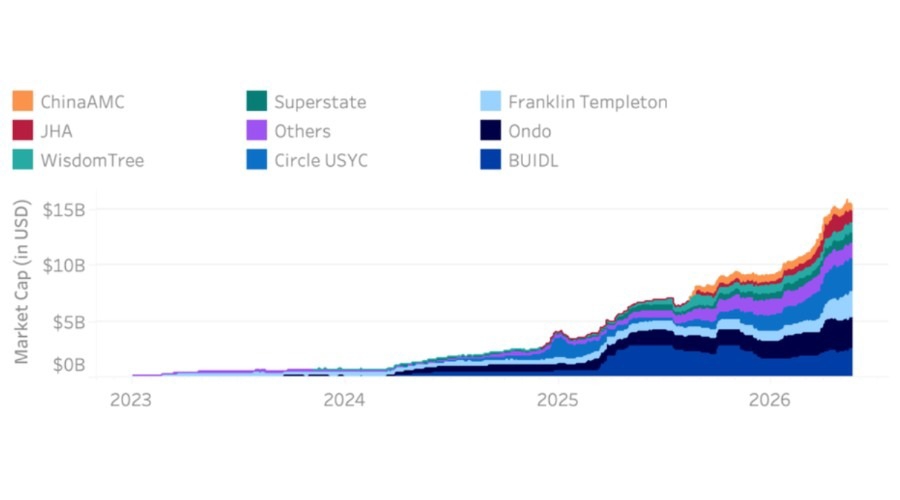
Retail adoption is measured in signups. Institutional adoption is measured in what a risk committee accepts as margin, and by that standard the tokenized US Treasury market has gone from roughly $1.7 billion in early 2024 to $15.2 billion across 76 products by early May 2026, on Kaiko's count. Posting an asset as collateral is a judgment about issuer, custody and legal claim that no adoption survey captures.
Follow the Collateral: How Tokenized Treasuries Are Entering Institutional Crypto

Collateral Is the Slowest Layer to Move

Of everything being rebuilt on continuous settlement, collateral moves last, for a reason that has nothing to do with technology. A payment that fails can be resent. A yield product that underperforms can be exited. A collateral that turns out to be unenforceable takes the position with it, so the bar is set by the worst plausible outcome rather than the expected one.

That makes the order in which assets become acceptable margin a better adoption signal than any volume figure. An asset qualifies only when the venue accepting it can value it continuously, liquidate it predictably and establish who owns it.

Books that never close change what a margin desk can hold, because a standing objection to volatile collateral has always been that it cannot be sold at three in the morning on a Sunday.

"A venue processing $34.3 trillion across 449 assets isn't a trading platform anymore; it's a settlement layer," says Binance Interim Chief Marketing Officer, Eowyn Chen. "Volume at that scale changes what you can build on top of it — deeper liquidity means tighter spreads, tighter spreads make payments and collateral viable, and suddenly the core functions of a bank are running on rails that never close."

Andrew Gibb's five-stage framework for institutional entry into a new asset class places digital assets at pioneer allocation, and the evidence he cites is operational rather than price-based: Standard Chartered took full ownership of Zodia Custody in May 2026, folding regulated custody into its core securities services business.

Sovereign Debt Moved First

Government debt made the transition first, and the composition explains why. Kaiko's early-May 2026 reading puts the tokenized US Treasury market at $15.2 billion across 76 products at a category APY of 3.4%, led by Circle's USYC at $2.9 billion, BlackRock's BUIDL at $2.6 billion, Ondo's USDY and Franklin Templeton's BENJI at $2.1 billion each, and Centrifuge's JTRSY at $1.2 billion.

Other trackers land nearby by different routes. Allium recorded $16.3 billion on July 15, 2026. RWA.xyz put distributed value at $16.17 billion on 7 August, up78.22% year to date across87 assets held by 62,976 holders.

Those are three different measurements, and the spread between them indicates how young the reporting layer still is.

The reason sovereign debt led is unglamorous. A yield-bearing, dollar-denominated instrument backed by short-dated government paper is already the collateral institutions hold, so the diligence question narrows to the wrapper and the custody arrangement rather than the underlying asset.

The Wrapper Market Is Voting

Whoever issues the wrapper controls its distribution and the rail it settles on, so the issuer mix is a direct read on which venues capture on-chain collateral flow. Kaiko's May 2026 snapshot shows a sharp realignment. Wrapped Bitcoin held 67.8% of the tracked market in August 2024 and now holds 41.6%, or $8.83 billion. Coinbase's cbBTC has taken 29.8% and Binance's BTCB 24.7%, while Lombard's LBTC has fallen from8.2% in the first quarter of 2025 to 3.75%.

The distribution underneath those shares matters more than the ranking itself. cbBTC concentrates in decentralized lending, with $3.05 billion on Morpho backing Coinbase's own on-chain loan book and $1.42 billion on Aave.

BTCB runs almost entirely on BNB Chain, trading on PancakeSwap and underpinning yield products on Venus, Kinza and Solv. It is accepted as collateral inside the Binance Web3 Wallet through a Venus integration, and it is not eligible collateral on Binance's own centralized loans, cross margin or futures. That distinction separates an asset circulating on-chain from one a centralized risk desk has cleared.

Most of What Has Been Tokenized Does Nothing

Set against that, the wider market is thinner than the growth rates imply. BeInCrypto Research tracked roughly $60 billion across more than 7,000 tokenized products and 12 asset classes, and found US Treasuries to be the only category at production-grade maturity: roughly $15 billion across 100 assets, with 99% of it able to move on public rails rather than sitting in closed internal ledgers.

The rest is more constrained than it appears. Asset-backed credit is nominally the largest category at $23.7 billion, but only 10% is distributed, and Figure's private home-equity channel alone accounts for $18.3 billion of it. Real estate, long the sector's showcase use case, sits at about$457 million and has declined year to date.

The practical bottleneck is custody. As Global Banking and Finance Review sets out, institutional custody is a governance question about legal ownership, asset segregation and provider failure, not one about where keys are stored. The Financial Stability Board's 2025 thematic review found continuing gaps in how jurisdictions answer it.

A market where one asset class functions and eleven do not is not yet a tokenized market. It is a tokenized Treasury market with experiments attached.

Where the Diligence Actually Happens

Collateral is the layer where adoption becomes hard to reverse, because an asset accepted as margin is one a risk committee has already signed off in writing. The infrastructure is largely built. What the next two quarters test is whether a second asset class arrives to use it.

Retail adoption is measured in signups. Institutional adoption is measured in what a risk committee accepts as margin, and by that standard the tokenized US Treasury market has gone from roughly $1.7 billion in early 2024 to $15.2 billion across 76 products by early May 2026, on Kaiko's count. Posting an asset as collateral is a judgment about issuer, custody and legal claim that no adoption survey captures.

Follow the Collateral: How Tokenized Treasuries Are Entering Institutional Crypto

Collateral Is the Slowest Layer to Move

Of everything being rebuilt on continuous settlement, collateral moves last, for a reason that has nothing to do with technology. A payment that fails can be resent. A yield product that underperforms can be exited. A collateral that turns out to be unenforceable takes the position with it, so the bar is set by the worst plausible outcome rather than the expected one.

That makes the order in which assets become acceptable margin a better adoption signal than any volume figure. An asset qualifies only when the venue accepting it can value it continuously, liquidate it predictably and establish who owns it.

Books that never close change what a margin desk can hold, because a standing objection to volatile collateral has always been that it cannot be sold at three in the morning on a Sunday.

"A venue processing $34.3 trillion across 449 assets isn't a trading platform anymore; it's a settlement layer," says Binance Interim Chief Marketing Officer, Eowyn Chen. "Volume at that scale changes what you can build on top of it — deeper liquidity means tighter spreads, tighter spreads make payments and collateral viable, and suddenly the core functions of a bank are running on rails that never close."

Andrew Gibb's five-stage framework for institutional entry into a new asset class places digital assets at pioneer allocation, and the evidence he cites is operational rather than price-based: Standard Chartered took full ownership of Zodia Custody in May 2026, folding regulated custody into its core securities services business.

Sovereign Debt Moved First

Government debt made the transition first, and the composition explains why. Kaiko's early-May 2026 reading puts the tokenized US Treasury market at $15.2 billion across 76 products at a category APY of 3.4%, led by Circle's USYC at $2.9 billion, BlackRock's BUIDL at $2.6 billion, Ondo's USDY and Franklin Templeton's BENJI at $2.1 billion each, and Centrifuge's JTRSY at $1.2 billion.

Other trackers land nearby by different routes. Allium recorded $16.3 billion on July 15, 2026. RWA.xyz put distributed value at $16.17 billion on 7 August, up78.22% year to date across87 assets held by 62,976 holders.

Those are three different measurements, and the spread between them indicates how young the reporting layer still is.

The reason sovereign debt led is unglamorous. A yield-bearing, dollar-denominated instrument backed by short-dated government paper is already the collateral institutions hold, so the diligence question narrows to the wrapper and the custody arrangement rather than the underlying asset.

The Wrapper Market Is Voting

Whoever issues the wrapper controls its distribution and the rail it settles on, so the issuer mix is a direct read on which venues capture on-chain collateral flow. Kaiko's May 2026 snapshot shows a sharp realignment. Wrapped Bitcoin held 67.8% of the tracked market in August 2024 and now holds 41.6%, or $8.83 billion. Coinbase's cbBTC has taken 29.8% and Binance's BTCB 24.7%, while Lombard's LBTC has fallen from8.2% in the first quarter of 2025 to 3.75%.

The distribution underneath those shares matters more than the ranking itself. cbBTC concentrates in decentralized lending, with $3.05 billion on Morpho backing Coinbase's own on-chain loan book and $1.42 billion on Aave.

BTCB runs almost entirely on BNB Chain, trading on PancakeSwap and underpinning yield products on Venus, Kinza and Solv. It is accepted as collateral inside the Binance Web3 Wallet through a Venus integration, and it is not eligible collateral on Binance's own centralized loans, cross margin or futures. That distinction separates an asset circulating on-chain from one a centralized risk desk has cleared.

Most of What Has Been Tokenized Does Nothing

Set against that, the wider market is thinner than the growth rates imply. BeInCrypto Research tracked roughly $60 billion across more than 7,000 tokenized products and 12 asset classes, and found US Treasuries to be the only category at production-grade maturity: roughly $15 billion across 100 assets, with 99% of it able to move on public rails rather than sitting in closed internal ledgers.

The rest is more constrained than it appears. Asset-backed credit is nominally the largest category at $23.7 billion, but only 10% is distributed, and Figure's private home-equity channel alone accounts for $18.3 billion of it. Real estate, long the sector's showcase use case, sits at about$457 million and has declined year to date.

The practical bottleneck is custody. As Global Banking and Finance Review sets out, institutional custody is a governance question about legal ownership, asset segregation and provider failure, not one about where keys are stored. The Financial Stability Board's 2025 thematic review found continuing gaps in how jurisdictions answer it.

A market where one asset class functions and eleven do not is not yet a tokenized market. It is a tokenized Treasury market with experiments attached.

Where the Diligence Actually Happens

Collateral is the layer where adoption becomes hard to reverse, because an asset accepted as margin is one a risk committee has already signed off in writing. The infrastructure is largely built. What the next two quarters test is whether a second asset class arrives to use it.

Disclaimer

Thought Leadership

!"#$%&'()*+,-./0123456789:;<=>?@ABCDEFGHIJKLMNOPQRSTUVWXYZ[\]^_`abcdefghijklmnopqrstuvwxyz{|} !"#$%&'()*+,-./0123456789:;<=>?@ABCDEFGHIJKLMNOPQRSTUVWXYZ[\]^_`abcdefghijklmnopqrstuvwxyz{|}