
Well, with investors on the lookout for their next crypt score, it’s easy to get swept up in a wave of ICO excitement. Sure, ICOs provide a great source of capital for start-up companies looking to pursue a new digital adventure – but if you jump in the deep end without armbands, you’re likely to drown. With this in mind, here’s why your ICO will fail in 2018:
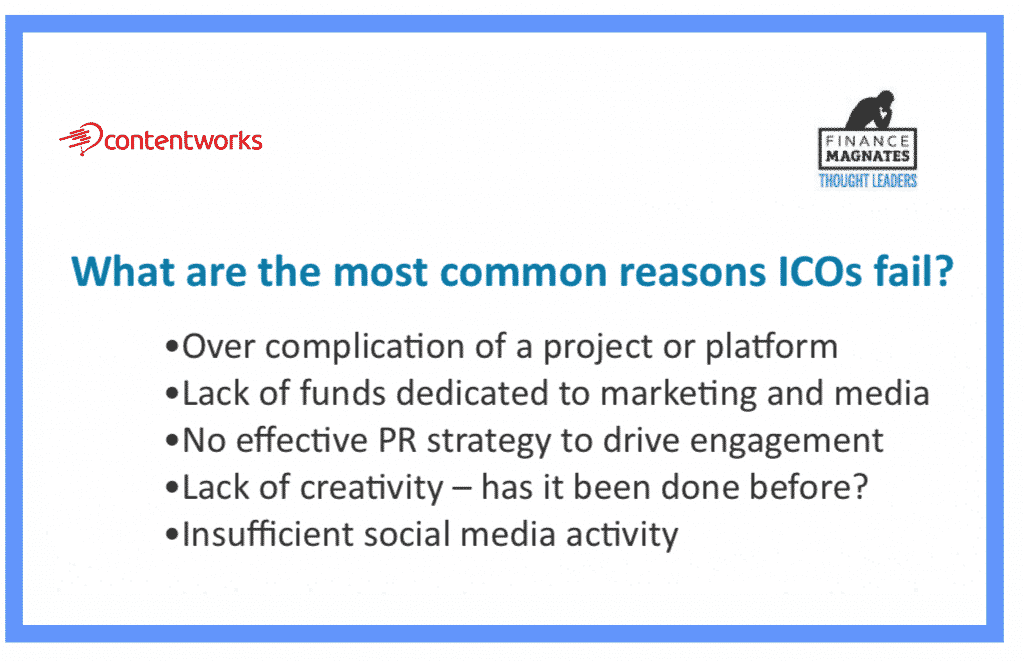
If you want investors to favour your ICO – make sure they understand your coin offering. Be concise yet interesting, creative yet not too ‘techy’ and try to explain concepts from scratch. Of course, the detail you go into is likely to depend on your target audience.
While industry experts won’t expect you to breakdown every ‘tricky’ word, novices to crypto will. Maybe you’ll have to speak to both audiences and this requires carefully scripted content.
Takeaway: Use intelligent and well-crafted content to explain your ICO in a way that’s easy to understand, yet not overly dumbed down or patronising. Use graphics, tables, charts and other visual material if necessary.
Not spending enough time/money on media buying

Reuters
With ICOs popping up left, right and centre, it’s essential to devise a media buying strategy that’ll help you stand out from the crowd. If you don’t, you run the risk of being lost in a fast-growing and ever-evolving world that bows to the feet of thought leaders and innovative marketing. You simply can’t afford to sit quietly in a corner.
Important questions to ask during the media buying process include:
How much do you want to raise?
Who are you trying to reach? What is your target market?
What is your budget and how can you use it to meet your objectives?
Where will you buy media? Are there any standout outlets that attract you?
How much will you spend on each media outlet? Why?
Is there room for negotiation? Can you make your budget stretch further?
Takeaway – media buying is a process that will allow you to talk to your target audience with optimum clarity, so remember to put enough time and money into your media plan.
No effective PR strategy
PR is an important part of business, which needs an effective strategy. Whether you’re launching a new ICO, discussing ICO changes, or blogging about industry news, do so with confidence and authority in order to establish yourself as a market leader. As easy as it sounds, managing public relations and improving your online reputation is no simple task – so here are several points to bear in mind.
Is your PR and content management strategy compliant? Jumping through regulatory hoops is all part of the game, so be sure to know the industry latest to avoid getting a slap on the wrist or more!
Are you communicating with the right people? Be sure to tailor all content to your target market and consider which advertising outlets are likely to be most effective when putting together your media buying strategy.
Do you have a crisis management plan in place? Bad PR can destroy your ICO launch, so be sure you know exactly what to do if things go wrong.
Takeaway – streamline all your content and ensure all PR activity is monitored.
No unique USPs and a lack of creativity
If you’re looking to the future with hope, optimism and an interest in setting up your own ICO, then great! This article is designed to warn you about the potential pitfalls (and how you can avoid them) rather than popping your enthusiasm-filled bubble. The reality is, ICOs are not straightforward and with new ideas and concepts arising daily, you need to get noticed – and that means coming up with some unique USPs.
So, before you even attempt to launch an ICO or enter the crypto world – ask yourself: What will make investors choose this particular ICO over a competitor’s ICO?
Ideas to consider include:
Make your ICO as secure as possible and promote this throughout your PR and content marketing material.
Offer incentives and awards. The ‘utility model’ is particularly effective wherein investors can use tokens to buy innovative services and products from the creator. For example, tokens can be traded for exclusive weapons and skins in a video game project as this gives tokens inherent value that’ll last long after an initial ICO product launch.
Think outside the box. An ICO is an ICO at the end of the day, but with a creative content marketing strategy you can bring it to life. Consider infographics, images, video content with an engaging script – and why not make yourself the go-to gurus for industry news by setting up your own blog?
Takeaway: Creativity is of paramount importance with top-notch content being an integral part of any ICO marketing campaign.
Insufficient social media activity

Bloomberg
Social media activity should be at the forefront of your mind when launching or promoting an ICO. Sites like Facebook, Twitter and Instagram are not just for millennials who spend their time sharing selfies and catching up for friends. Platforms of this kind are also ideal for business allowing you to cast your net wider in terms of advertising.
A leading platform within the finance world is Telegram – a new application being used by companies looking to spread the word about their tokens. With several groups tailored specifically to cryptocurrencies, ICOs and brokers should certainly care about this platform, which looks set to be a key player throughout 2018.
Takeaway: Using social media is an effective way to generate ICO buzz, particularly before a token launch. That said; pay close attention to compliance and remember to maintain a professional tone of voice when addressing online communities.
As mentioned above, you should also have a bad PR strategy in place to limit the backlash should something go wrong. The above tips are designed to give you a head start for 2018 – after all, to be forewarned is to be forearmed. If you need any assistance with your ICO campaign, please contact the Contentworks team today.
Well, with investors on the lookout for their next crypt score, it’s easy to get swept up in a wave of ICO excitement. Sure, ICOs provide a great source of capital for start-up companies looking to pursue a new digital adventure – but if you jump in the deep end without armbands, you’re likely to drown. With this in mind, here’s why your ICO will fail in 2018:
If you want investors to favour your ICO – make sure they understand your coin offering. Be concise yet interesting, creative yet not too ‘techy’ and try to explain concepts from scratch. Of course, the detail you go into is likely to depend on your target audience.
While industry experts won’t expect you to breakdown every ‘tricky’ word, novices to crypto will. Maybe you’ll have to speak to both audiences and this requires carefully scripted content.
Takeaway: Use intelligent and well-crafted content to explain your ICO in a way that’s easy to understand, yet not overly dumbed down or patronising. Use graphics, tables, charts and other visual material if necessary.
Not spending enough time/money on media buying
Reuters
With ICOs popping up left, right and centre, it’s essential to devise a media buying strategy that’ll help you stand out from the crowd. If you don’t, you run the risk of being lost in a fast-growing and ever-evolving world that bows to the feet of thought leaders and innovative marketing. You simply can’t afford to sit quietly in a corner.
Important questions to ask during the media buying process include:
How much do you want to raise?
Who are you trying to reach? What is your target market?
What is your budget and how can you use it to meet your objectives?
Where will you buy media? Are there any standout outlets that attract you?
How much will you spend on each media outlet? Why?
Is there room for negotiation? Can you make your budget stretch further?
Takeaway – media buying is a process that will allow you to talk to your target audience with optimum clarity, so remember to put enough time and money into your media plan.
No effective PR strategy
PR is an important part of business, which needs an effective strategy. Whether you’re launching a new ICO, discussing ICO changes, or blogging about industry news, do so with confidence and authority in order to establish yourself as a market leader. As easy as it sounds, managing public relations and improving your online reputation is no simple task – so here are several points to bear in mind.
Is your PR and content management strategy compliant? Jumping through regulatory hoops is all part of the game, so be sure to know the industry latest to avoid getting a slap on the wrist or more!
Are you communicating with the right people? Be sure to tailor all content to your target market and consider which advertising outlets are likely to be most effective when putting together your media buying strategy.
Do you have a crisis management plan in place? Bad PR can destroy your ICO launch, so be sure you know exactly what to do if things go wrong.
Takeaway – streamline all your content and ensure all PR activity is monitored.
No unique USPs and a lack of creativity
If you’re looking to the future with hope, optimism and an interest in setting up your own ICO, then great! This article is designed to warn you about the potential pitfalls (and how you can avoid them) rather than popping your enthusiasm-filled bubble. The reality is, ICOs are not straightforward and with new ideas and concepts arising daily, you need to get noticed – and that means coming up with some unique USPs.
So, before you even attempt to launch an ICO or enter the crypto world – ask yourself: What will make investors choose this particular ICO over a competitor’s ICO?
Ideas to consider include:
Make your ICO as secure as possible and promote this throughout your PR and content marketing material.
Offer incentives and awards. The ‘utility model’ is particularly effective wherein investors can use tokens to buy innovative services and products from the creator. For example, tokens can be traded for exclusive weapons and skins in a video game project as this gives tokens inherent value that’ll last long after an initial ICO product launch.
Think outside the box. An ICO is an ICO at the end of the day, but with a creative content marketing strategy you can bring it to life. Consider infographics, images, video content with an engaging script – and why not make yourself the go-to gurus for industry news by setting up your own blog?
Takeaway: Creativity is of paramount importance with top-notch content being an integral part of any ICO marketing campaign.
Insufficient social media activity
Bloomberg
Social media activity should be at the forefront of your mind when launching or promoting an ICO. Sites like Facebook, Twitter and Instagram are not just for millennials who spend their time sharing selfies and catching up for friends. Platforms of this kind are also ideal for business allowing you to cast your net wider in terms of advertising.
A leading platform within the finance world is Telegram – a new application being used by companies looking to spread the word about their tokens. With several groups tailored specifically to cryptocurrencies, ICOs and brokers should certainly care about this platform, which looks set to be a key player throughout 2018.
Takeaway: Using social media is an effective way to generate ICO buzz, particularly before a token launch. That said; pay close attention to compliance and remember to maintain a professional tone of voice when addressing online communities.
As mentioned above, you should also have a bad PR strategy in place to limit the backlash should something go wrong. The above tips are designed to give you a head start for 2018 – after all, to be forewarned is to be forearmed. If you need any assistance with your ICO campaign, please contact the Contentworks team today.
SMX's 1900% Surge Since November Is Not a Momentum Trade; It's Based on Transformative and Deliverable Techology
Featured Videos
Executive Interview | Charlotte Bullock | Chief Product Officer, Bank of London | FMLS:25
In this interview, we sat down with Charlotte Bullock, Head of Product at The Bank of London, previously at SAP and now shaping product at one of the sector’s most ambitious new banking players.
Charlotte reflects on the Summit so far and talks about the culture inside fintech banks today. We look at the pressures that come with scaling, and how firms can hold onto the nimble approach that made them stand out early on.
We also cover the state of payments ahead of her appearance on the payments roundtable: the blockages financial firms face, the areas that still need fixing, and what a realistic solution looks like in 2026.
In this interview, we sat down with Charlotte Bullock, Head of Product at The Bank of London, previously at SAP and now shaping product at one of the sector’s most ambitious new banking players.
Charlotte reflects on the Summit so far and talks about the culture inside fintech banks today. We look at the pressures that come with scaling, and how firms can hold onto the nimble approach that made them stand out early on.
We also cover the state of payments ahead of her appearance on the payments roundtable: the blockages financial firms face, the areas that still need fixing, and what a realistic solution looks like in 2026.
In this interview, we sat down with Charlotte Bullock, Head of Product at The Bank of London, previously at SAP and now shaping product at one of the sector’s most ambitious new banking players.
Charlotte reflects on the Summit so far and talks about the culture inside fintech banks today. We look at the pressures that come with scaling, and how firms can hold onto the nimble approach that made them stand out early on.
We also cover the state of payments ahead of her appearance on the payments roundtable: the blockages financial firms face, the areas that still need fixing, and what a realistic solution looks like in 2026.
In this interview, we sat down with Charlotte Bullock, Head of Product at The Bank of London, previously at SAP and now shaping product at one of the sector’s most ambitious new banking players.
Charlotte reflects on the Summit so far and talks about the culture inside fintech banks today. We look at the pressures that come with scaling, and how firms can hold onto the nimble approach that made them stand out early on.
We also cover the state of payments ahead of her appearance on the payments roundtable: the blockages financial firms face, the areas that still need fixing, and what a realistic solution looks like in 2026.
In this conversation, we sit down with Drew Niv, CSO at ATFX Connect and one of the most influential figures in modern FX.
We speak about market structure, the institutional view on liquidity, and the sharp rise of prop trading, a sector Drew has been commenting on in recent months. Drew explains why he once dismissed prop trading, why his view changed, and what he now thinks the model means for brokers, clients and risk managers.
We explore subscription-fee dependency, the high reneging rate, and the long-term challenge: how brokers can build a more stable and honest version of the model. Drew also talks about the traffic advantage standalone prop firms have built and why brokers may still win in the long run if they take the right approach.
In this conversation, we sit down with Drew Niv, CSO at ATFX Connect and one of the most influential figures in modern FX.
We speak about market structure, the institutional view on liquidity, and the sharp rise of prop trading, a sector Drew has been commenting on in recent months. Drew explains why he once dismissed prop trading, why his view changed, and what he now thinks the model means for brokers, clients and risk managers.
We explore subscription-fee dependency, the high reneging rate, and the long-term challenge: how brokers can build a more stable and honest version of the model. Drew also talks about the traffic advantage standalone prop firms have built and why brokers may still win in the long run if they take the right approach.
In this conversation, we sit down with Drew Niv, CSO at ATFX Connect and one of the most influential figures in modern FX.
We speak about market structure, the institutional view on liquidity, and the sharp rise of prop trading, a sector Drew has been commenting on in recent months. Drew explains why he once dismissed prop trading, why his view changed, and what he now thinks the model means for brokers, clients and risk managers.
We explore subscription-fee dependency, the high reneging rate, and the long-term challenge: how brokers can build a more stable and honest version of the model. Drew also talks about the traffic advantage standalone prop firms have built and why brokers may still win in the long run if they take the right approach.
In this conversation, we sit down with Drew Niv, CSO at ATFX Connect and one of the most influential figures in modern FX.
We speak about market structure, the institutional view on liquidity, and the sharp rise of prop trading, a sector Drew has been commenting on in recent months. Drew explains why he once dismissed prop trading, why his view changed, and what he now thinks the model means for brokers, clients and risk managers.
We explore subscription-fee dependency, the high reneging rate, and the long-term challenge: how brokers can build a more stable and honest version of the model. Drew also talks about the traffic advantage standalone prop firms have built and why brokers may still win in the long run if they take the right approach.
In this conversation, we sit down with Drew Niv, CSO at ATFX Connect and one of the most influential figures in modern FX.
We speak about market structure, the institutional view on liquidity, and the sharp rise of prop trading, a sector Drew has been commenting on in recent months. Drew explains why he once dismissed prop trading, why his view changed, and what he now thinks the model means for brokers, clients and risk managers.
We explore subscription-fee dependency, the high reneging rate, and the long-term challenge: how brokers can build a more stable and honest version of the model. Drew also talks about the traffic advantage standalone prop firms have built and why brokers may still win in the long run if they take the right approach.
In this conversation, we sit down with Drew Niv, CSO at ATFX Connect and one of the most influential figures in modern FX.
We speak about market structure, the institutional view on liquidity, and the sharp rise of prop trading, a sector Drew has been commenting on in recent months. Drew explains why he once dismissed prop trading, why his view changed, and what he now thinks the model means for brokers, clients and risk managers.
We explore subscription-fee dependency, the high reneging rate, and the long-term challenge: how brokers can build a more stable and honest version of the model. Drew also talks about the traffic advantage standalone prop firms have built and why brokers may still win in the long run if they take the right approach.
Executive Interview | Remonda Z. Kirketerp Møller| CEO & Founder Muinmos | FMLS:25
In this interview, Remonda Z. Kirketerp Møller, founder of Muinmos, breaks down the state of AI in regtech and what responsible adoption really looks like for brokers. We talk about rising fragmentation, the pressures around compliance accuracy, and why most firms are still in the early stages of AI maturity.
Ramanda also shares insights on regulator sandboxes, shifting expectations around accountability, and the current reality of MiCA licensing and passporting in Europe.
A concise look at where compliance, onboarding, and AI-driven processes are heading next.
In this interview, Remonda Z. Kirketerp Møller, founder of Muinmos, breaks down the state of AI in regtech and what responsible adoption really looks like for brokers. We talk about rising fragmentation, the pressures around compliance accuracy, and why most firms are still in the early stages of AI maturity.
Ramanda also shares insights on regulator sandboxes, shifting expectations around accountability, and the current reality of MiCA licensing and passporting in Europe.
A concise look at where compliance, onboarding, and AI-driven processes are heading next.
In this interview, Remonda Z. Kirketerp Møller, founder of Muinmos, breaks down the state of AI in regtech and what responsible adoption really looks like for brokers. We talk about rising fragmentation, the pressures around compliance accuracy, and why most firms are still in the early stages of AI maturity.
Ramanda also shares insights on regulator sandboxes, shifting expectations around accountability, and the current reality of MiCA licensing and passporting in Europe.
A concise look at where compliance, onboarding, and AI-driven processes are heading next.
In this interview, Remonda Z. Kirketerp Møller, founder of Muinmos, breaks down the state of AI in regtech and what responsible adoption really looks like for brokers. We talk about rising fragmentation, the pressures around compliance accuracy, and why most firms are still in the early stages of AI maturity.
Ramanda also shares insights on regulator sandboxes, shifting expectations around accountability, and the current reality of MiCA licensing and passporting in Europe.
A concise look at where compliance, onboarding, and AI-driven processes are heading next.
In this interview, Remonda Z. Kirketerp Møller, founder of Muinmos, breaks down the state of AI in regtech and what responsible adoption really looks like for brokers. We talk about rising fragmentation, the pressures around compliance accuracy, and why most firms are still in the early stages of AI maturity.
Ramanda also shares insights on regulator sandboxes, shifting expectations around accountability, and the current reality of MiCA licensing and passporting in Europe.
A concise look at where compliance, onboarding, and AI-driven processes are heading next.
In this interview, Remonda Z. Kirketerp Møller, founder of Muinmos, breaks down the state of AI in regtech and what responsible adoption really looks like for brokers. We talk about rising fragmentation, the pressures around compliance accuracy, and why most firms are still in the early stages of AI maturity.
Ramanda also shares insights on regulator sandboxes, shifting expectations around accountability, and the current reality of MiCA licensing and passporting in Europe.
A concise look at where compliance, onboarding, and AI-driven processes are heading next.
In this conversation, we speak with Aydin Bonabi, CEO and co-founder of Surveill, a firm focused on fraud detection and AI-driven compliance tools for financial institutions.
We start with Aydin’s view of the Summit and the challenges brokers face as fraud tactics grow more complex. He explains how firms can stay ahead through real-time signals, data patterns, and early-stage detection.
We also talk about AI training and why compliance teams often struggle to keep models accurate, fair, and aligned with regulatory expectations. Aydin breaks down what “good” AI training looks like inside a financial environment, including the importance of clean data, domain expertise, and human oversight.
He closes with a clear message: fraud is scaling, and so must the tools that stop it.
In this conversation, we speak with Aydin Bonabi, CEO and co-founder of Surveill, a firm focused on fraud detection and AI-driven compliance tools for financial institutions.
We start with Aydin’s view of the Summit and the challenges brokers face as fraud tactics grow more complex. He explains how firms can stay ahead through real-time signals, data patterns, and early-stage detection.
We also talk about AI training and why compliance teams often struggle to keep models accurate, fair, and aligned with regulatory expectations. Aydin breaks down what “good” AI training looks like inside a financial environment, including the importance of clean data, domain expertise, and human oversight.
He closes with a clear message: fraud is scaling, and so must the tools that stop it.
In this conversation, we speak with Aydin Bonabi, CEO and co-founder of Surveill, a firm focused on fraud detection and AI-driven compliance tools for financial institutions.
We start with Aydin’s view of the Summit and the challenges brokers face as fraud tactics grow more complex. He explains how firms can stay ahead through real-time signals, data patterns, and early-stage detection.
We also talk about AI training and why compliance teams often struggle to keep models accurate, fair, and aligned with regulatory expectations. Aydin breaks down what “good” AI training looks like inside a financial environment, including the importance of clean data, domain expertise, and human oversight.
He closes with a clear message: fraud is scaling, and so must the tools that stop it.
In this conversation, we speak with Aydin Bonabi, CEO and co-founder of Surveill, a firm focused on fraud detection and AI-driven compliance tools for financial institutions.
We start with Aydin’s view of the Summit and the challenges brokers face as fraud tactics grow more complex. He explains how firms can stay ahead through real-time signals, data patterns, and early-stage detection.
We also talk about AI training and why compliance teams often struggle to keep models accurate, fair, and aligned with regulatory expectations. Aydin breaks down what “good” AI training looks like inside a financial environment, including the importance of clean data, domain expertise, and human oversight.
He closes with a clear message: fraud is scaling, and so must the tools that stop it.
In this conversation, we speak with Aydin Bonabi, CEO and co-founder of Surveill, a firm focused on fraud detection and AI-driven compliance tools for financial institutions.
We start with Aydin’s view of the Summit and the challenges brokers face as fraud tactics grow more complex. He explains how firms can stay ahead through real-time signals, data patterns, and early-stage detection.
We also talk about AI training and why compliance teams often struggle to keep models accurate, fair, and aligned with regulatory expectations. Aydin breaks down what “good” AI training looks like inside a financial environment, including the importance of clean data, domain expertise, and human oversight.
He closes with a clear message: fraud is scaling, and so must the tools that stop it.
In this conversation, we speak with Aydin Bonabi, CEO and co-founder of Surveill, a firm focused on fraud detection and AI-driven compliance tools for financial institutions.
We start with Aydin’s view of the Summit and the challenges brokers face as fraud tactics grow more complex. He explains how firms can stay ahead through real-time signals, data patterns, and early-stage detection.
We also talk about AI training and why compliance teams often struggle to keep models accurate, fair, and aligned with regulatory expectations. Aydin breaks down what “good” AI training looks like inside a financial environment, including the importance of clean data, domain expertise, and human oversight.
He closes with a clear message: fraud is scaling, and so must the tools that stop it.
Exness expands its presence in Africa: Inside our interview with Paul Margarites in Cape Town
Finance Magnates met with Paul Margarites, Exness regional commercial director for Sub-Saharan Africa, during a visit to the firm’s office opening in Cape Town. In this talk, led by Andrea Badiola Mateos, Co-CEO at Finance Magnates, Paul shares views on the South African trading space, local user behavior, mobile trends, regulation, team growth, and how Exness plans to grow in more markets across the region. @Exness
Read the article at: https://www.financemagnates.com/thought-leadership/exness-expands-its-presence-in-africa-inside-our-interview-with-paul-margarites/
#exness #financemagnates #exnesstrading #CFDtrading #tradeonline #africanews #capetown
Finance Magnates met with Paul Margarites, Exness regional commercial director for Sub-Saharan Africa, during a visit to the firm’s office opening in Cape Town. In this talk, led by Andrea Badiola Mateos, Co-CEO at Finance Magnates, Paul shares views on the South African trading space, local user behavior, mobile trends, regulation, team growth, and how Exness plans to grow in more markets across the region. @Exness
Read the article at: https://www.financemagnates.com/thought-leadership/exness-expands-its-presence-in-africa-inside-our-interview-with-paul-margarites/
#exness #financemagnates #exnesstrading #CFDtrading #tradeonline #africanews #capetown
Finance Magnates met with Paul Margarites, Exness regional commercial director for Sub-Saharan Africa, during a visit to the firm’s office opening in Cape Town. In this talk, led by Andrea Badiola Mateos, Co-CEO at Finance Magnates, Paul shares views on the South African trading space, local user behavior, mobile trends, regulation, team growth, and how Exness plans to grow in more markets across the region. @Exness
Read the article at: https://www.financemagnates.com/thought-leadership/exness-expands-its-presence-in-africa-inside-our-interview-with-paul-margarites/
#exness #financemagnates #exnesstrading #CFDtrading #tradeonline #africanews #capetown
Finance Magnates met with Paul Margarites, Exness regional commercial director for Sub-Saharan Africa, during a visit to the firm’s office opening in Cape Town. In this talk, led by Andrea Badiola Mateos, Co-CEO at Finance Magnates, Paul shares views on the South African trading space, local user behavior, mobile trends, regulation, team growth, and how Exness plans to grow in more markets across the region. @Exness
Read the article at: https://www.financemagnates.com/thought-leadership/exness-expands-its-presence-in-africa-inside-our-interview-with-paul-margarites/
#exness #financemagnates #exnesstrading #CFDtrading #tradeonline #africanews #capetown
Finance Magnates met with Paul Margarites, Exness regional commercial director for Sub-Saharan Africa, during a visit to the firm’s office opening in Cape Town. In this talk, led by Andrea Badiola Mateos, Co-CEO at Finance Magnates, Paul shares views on the South African trading space, local user behavior, mobile trends, regulation, team growth, and how Exness plans to grow in more markets across the region. @Exness
Read the article at: https://www.financemagnates.com/thought-leadership/exness-expands-its-presence-in-africa-inside-our-interview-with-paul-margarites/
#exness #financemagnates #exnesstrading #CFDtrading #tradeonline #africanews #capetown
Finance Magnates met with Paul Margarites, Exness regional commercial director for Sub-Saharan Africa, during a visit to the firm’s office opening in Cape Town. In this talk, led by Andrea Badiola Mateos, Co-CEO at Finance Magnates, Paul shares views on the South African trading space, local user behavior, mobile trends, regulation, team growth, and how Exness plans to grow in more markets across the region. @Exness
Read the article at: https://www.financemagnates.com/thought-leadership/exness-expands-its-presence-in-africa-inside-our-interview-with-paul-margarites/
#exness #financemagnates #exnesstrading #CFDtrading #tradeonline #africanews #capetown