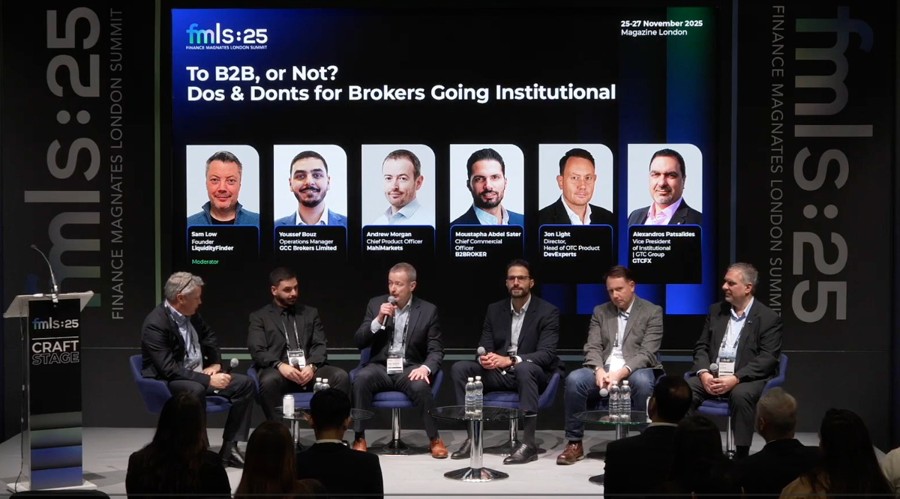
Panelists of "To B2B or Not? Dos and Don'ts for Brokers Going Institutional" at FMLS:25 warned that B2B demands real infrastructure and risk expertise, not marketing ambition.
Opportunities remain, but only brokers with niche strengths and deep client service can compete.
Watch the full video interview from Finance Magnates London Summit 2025
At a Finance Magnates London Summit 2025 panel tilled "To B2B or Not? Dos and Donts for Brokers Going Institutional", industry leaders cautioned retail brokers: B2B liquidity is a compelling but challenging space, not just a simple add-on.
Moderator Sam Low, founder of LiquidityFinder, noted that when his platform launched in 2019, it listed “five to ten” major B2B brokers. Today, he said, there are around 40 on his site alone.
“So is there still an opportunity to go from being a retail broker to being a B2B broker — or is it just too crowded?” he asked.
‘Wrong people in the space’
“There’s still plenty of opportunity, but there is a lot of wrong out there,” said Youssef Bouz of GCC Brokers. “A lot of brokers just think, ‘Oh, this guy can give liquidity, so let me try to do it too,’ but they don’t have the right setup or strategy to actually be a B2B broker.
Sam Low, Youssef Bouz, Andrew Morgan, Moustapha Abdel Sater, Jon Light, Alexandros Patsalides
GCC Group’s vice president of institutional, Alexandros Patsalides, said the market is “crowded” with “copycat liquidity providers which just provide a meta service”. Success, he argued, requires “a niche, proper capital, and the right people, processes and systems”, especially for retail brokers trying to “go institutional” with only B2C experience.
From a technology perspective, Jon Light of Devexperts described many entrants as offering similar, relabeled liquidity solutions under the “prime of prime” banner.
The panel outlined clear ways for retail brokers to distinguish themselves in the B2B space, focusing on unique approaches beyond relying on standard pricing.
Low suggested one route: using a broker’s own retail flow as an additional pricing source, to create “a distinct price” based on a different risk pool.
That, he argued, requires “sophisticated kit”, not just re-marking bank pricing.
For Bouz, key differentiators include transparency and client education over unrealistic promises.
As a full STP broker partnered with top-tier LPs, GCC faces clients who have been promised zero spreads and no slippage elsewhere; many realize the difference only after issues arise, highlighting the value of honest service. Patsalides framed GTC Prime’s strategy around its origin story: helping smaller brokers overcome the same hurdles its own retail arm once faced.
“When you’re new to the market, nobody’s going to help you. They will try to make as much as they can from you,” he said. GTC Prime was “not set up for gain as such… but to help.” Patsalides pointed to swap-free products as a concrete differentiator: GTC absorbs the cost to offer these and, while it results in losses at times, it also builds client loyalty—a strategic trade-off.
Moustapha Abdel Sater from B2Broker summarized: “Our north star is customer experience, combining price, 24/7 support, consultative guidance, and helping B2B clients grow.”
New Frontiers: Prop Firms, Crypto and ‘Toxic’ Flow
Despite the crowded market, the panel identified several niches where B2B providers can still carve out space.
One is the funded trader / prop firm segment. Light explained that challenge accounts are almost entirely simulated and that only a small minority of traders reach funded status — and even then, many “funded” accounts remain sims.
For those prop firms that do send live flow, however, securing top-quality liquidity is difficult because providers know they will only receive “a tiny amount of that flow” and may hesitate to offer their best terms.
A second frontier is the expansion of multi-asset offerings and extended trading hours, particularly in crypto. Low observed that traditional brokers are moving into digital assets, while crypto firms are eyeing traditional brokerage, creating a convergence around multi-asset offerings.
For those that cannot credibly do everything, he suggested, the alternative is to “choose one particular field and be excellent at that” — for example, a standout gold product or niche crosses.
Morgan described 24/7 market-making as another differentiator. Continuous operations—supported by automation, weekend staffing, and advanced risk frameworks—require significant investment but set providers apart.
Regulation, Relationships, and the Rising Cost of Talent
The panel also identified proactive regulatory support and quality personnel as structural differentiators enabling firms to sustainably separate from competitors.
Light and Low noted that selective broker onboarding based on jurisdiction is another differentiator. Firms ready to support clients with compliance, banking, and structure help fill an industry need and can build a defensible position.
The panel emphasized that institutional sales teams, trusted relationships, and networks are vital, building enduring client trust beyond features alone.
Low added that the value of institutional sales teams is “going up and up”, with firms competing over the same individuals and teams. “You can pay peanuts and get monkeys, or you pay premium prices and get premium business,” he said.
‘Why am I Doing This?’ – the Final Warning to Retail Brokers
Asked for closing advice, panelists urged retail brokers to treat a B2B expansion as a strategic commitment, not an experiment.
“Make sure you have the capital, the right facility, the right technology, the right team… and only then proceed,” said Bouz.
Morgan stressed that ambition must match capability: a small, local B2B setup is “very different” from a multi-regional offering with exchange co-locations and extended hours.
Moustapha warned against entering “to be the new cool kid on the street”, noting that infrastructure, compliance and clear separation of books are essential. “If you lose trust, you lose both games — retail and B2B.”
Light added that technology alone is not enough: differentiation often requires taking calculated risks in new markets and hiring well-connected institutional sales talent.
Patsalides was the most direct: before launching, founders must ask, “Why am I doing this, and am I ready for it?” Moving from retail to institutional, he said, demands full commitment: “If you fail, there are no second chances.”
At a Finance Magnates London Summit 2025 panel tilled "To B2B or Not? Dos and Donts for Brokers Going Institutional", industry leaders cautioned retail brokers: B2B liquidity is a compelling but challenging space, not just a simple add-on.
Moderator Sam Low, founder of LiquidityFinder, noted that when his platform launched in 2019, it listed “five to ten” major B2B brokers. Today, he said, there are around 40 on his site alone.
“So is there still an opportunity to go from being a retail broker to being a B2B broker — or is it just too crowded?” he asked.
‘Wrong people in the space’
“There’s still plenty of opportunity, but there is a lot of wrong out there,” said Youssef Bouz of GCC Brokers. “A lot of brokers just think, ‘Oh, this guy can give liquidity, so let me try to do it too,’ but they don’t have the right setup or strategy to actually be a B2B broker.
Sam Low, Youssef Bouz, Andrew Morgan, Moustapha Abdel Sater, Jon Light, Alexandros Patsalides
GCC Group’s vice president of institutional, Alexandros Patsalides, said the market is “crowded” with “copycat liquidity providers which just provide a meta service”. Success, he argued, requires “a niche, proper capital, and the right people, processes and systems”, especially for retail brokers trying to “go institutional” with only B2C experience.
From a technology perspective, Jon Light of Devexperts described many entrants as offering similar, relabeled liquidity solutions under the “prime of prime” banner.
The panel outlined clear ways for retail brokers to distinguish themselves in the B2B space, focusing on unique approaches beyond relying on standard pricing.
Low suggested one route: using a broker’s own retail flow as an additional pricing source, to create “a distinct price” based on a different risk pool.
That, he argued, requires “sophisticated kit”, not just re-marking bank pricing.
For Bouz, key differentiators include transparency and client education over unrealistic promises.
As a full STP broker partnered with top-tier LPs, GCC faces clients who have been promised zero spreads and no slippage elsewhere; many realize the difference only after issues arise, highlighting the value of honest service. Patsalides framed GTC Prime’s strategy around its origin story: helping smaller brokers overcome the same hurdles its own retail arm once faced.
“When you’re new to the market, nobody’s going to help you. They will try to make as much as they can from you,” he said. GTC Prime was “not set up for gain as such… but to help.” Patsalides pointed to swap-free products as a concrete differentiator: GTC absorbs the cost to offer these and, while it results in losses at times, it also builds client loyalty—a strategic trade-off.
Moustapha Abdel Sater from B2Broker summarized: “Our north star is customer experience, combining price, 24/7 support, consultative guidance, and helping B2B clients grow.”
New Frontiers: Prop Firms, Crypto and ‘Toxic’ Flow
Despite the crowded market, the panel identified several niches where B2B providers can still carve out space.
One is the funded trader / prop firm segment. Light explained that challenge accounts are almost entirely simulated and that only a small minority of traders reach funded status — and even then, many “funded” accounts remain sims.
For those prop firms that do send live flow, however, securing top-quality liquidity is difficult because providers know they will only receive “a tiny amount of that flow” and may hesitate to offer their best terms.
A second frontier is the expansion of multi-asset offerings and extended trading hours, particularly in crypto. Low observed that traditional brokers are moving into digital assets, while crypto firms are eyeing traditional brokerage, creating a convergence around multi-asset offerings.
For those that cannot credibly do everything, he suggested, the alternative is to “choose one particular field and be excellent at that” — for example, a standout gold product or niche crosses.
Morgan described 24/7 market-making as another differentiator. Continuous operations—supported by automation, weekend staffing, and advanced risk frameworks—require significant investment but set providers apart.
Regulation, Relationships, and the Rising Cost of Talent
The panel also identified proactive regulatory support and quality personnel as structural differentiators enabling firms to sustainably separate from competitors.
Light and Low noted that selective broker onboarding based on jurisdiction is another differentiator. Firms ready to support clients with compliance, banking, and structure help fill an industry need and can build a defensible position.
The panel emphasized that institutional sales teams, trusted relationships, and networks are vital, building enduring client trust beyond features alone.
Low added that the value of institutional sales teams is “going up and up”, with firms competing over the same individuals and teams. “You can pay peanuts and get monkeys, or you pay premium prices and get premium business,” he said.
‘Why am I Doing This?’ – the Final Warning to Retail Brokers
Asked for closing advice, panelists urged retail brokers to treat a B2B expansion as a strategic commitment, not an experiment.
“Make sure you have the capital, the right facility, the right technology, the right team… and only then proceed,” said Bouz.
Morgan stressed that ambition must match capability: a small, local B2B setup is “very different” from a multi-regional offering with exchange co-locations and extended hours.
Moustapha warned against entering “to be the new cool kid on the street”, noting that infrastructure, compliance and clear separation of books are essential. “If you lose trust, you lose both games — retail and B2B.”
Light added that technology alone is not enough: differentiation often requires taking calculated risks in new markets and hiring well-connected institutional sales talent.
Patsalides was the most direct: before launching, founders must ask, “Why am I doing this, and am I ready for it?” Moving from retail to institutional, he said, demands full commitment: “If you fail, there are no second chances.”
Tanya Chepkova is a News Editor at Finance Magnates with more than 16 years of experience in financial journalism, covering forex, crypto, and digital asset markets. Her work spans daily industry reporting and data-driven, long-form explainers focused on market structure, trading models, and regulatory shifts.
Before joining Finance Magnates, she led the editorial team of a cryptocurrency-focused media outlet for six years. Her reporting combines analytical depth with clear storytelling, with particular attention to how structural changes in trading, stablecoin infrastructure, and emerging products such as prediction markets reshape the broader financial ecosystem. She covers global developments and provides additional insight into CIS markets.
Areas of Coverage:
Crypto and digital asset markets
Prediction markets
Stablecoins and cross-border payments
Industry analysis and long-form explainers
MetaTrader 5 Brokers Gain Direct Access to Vantage Liquidity via MetaQuotes’ Ultency
Featured Videos
FP Markets Winner Spotlight 🏆 | Global Broker of the Year 2025 #Trading #Broker #Innovation #Shorts
FP Markets Winner Spotlight 🏆 | Global Broker of the Year 2025 #Trading #Broker #Innovation #Shorts
FP Markets Winner Spotlight 🏆 | Global Broker of the Year 2025 #Trading #Broker #Innovation #Shorts
FP Markets Winner Spotlight 🏆 | Global Broker of the Year 2025 #Trading #Broker #Innovation #Shorts
FP Markets takes the spotlight as Global Broker of the Year 2025 at the Finance Magnates Awards.
Martin Stoilov, Head of Client Experience, shares that trust, innovation, and people played a key role in the company’s success, supported by a strong foundation of integrity and client-centricity.
Following this milestone, FP Markets continues to focus on growth, technology investment, and its core values of transparency and excellence.
👉 Be part of FM Awards 2026: https://awards.financemagnates.com/#nominate
FP Markets takes the spotlight as Global Broker of the Year 2025 at the Finance Magnates Awards.
Martin Stoilov, Head of Client Experience, shares that trust, innovation, and people played a key role in the company’s success, supported by a strong foundation of integrity and client-centricity.
Following this milestone, FP Markets continues to focus on growth, technology investment, and its core values of transparency and excellence.
👉 Be part of FM Awards 2026: https://awards.financemagnates.com/#nominate
FP Markets takes the spotlight as Global Broker of the Year 2025 at the Finance Magnates Awards.
Martin Stoilov, Head of Client Experience, shares that trust, innovation, and people played a key role in the company’s success, supported by a strong foundation of integrity and client-centricity.
Following this milestone, FP Markets continues to focus on growth, technology investment, and its core values of transparency and excellence.
👉 Be part of FM Awards 2026: https://awards.financemagnates.com/#nominate
FP Markets takes the spotlight as Global Broker of the Year 2025 at the Finance Magnates Awards.
Martin Stoilov, Head of Client Experience, shares that trust, innovation, and people played a key role in the company’s success, supported by a strong foundation of integrity and client-centricity.
Following this milestone, FP Markets continues to focus on growth, technology investment, and its core values of transparency and excellence.
👉 Be part of FM Awards 2026: https://awards.financemagnates.com/#nominate
In this video, we review @HolaPrimeMarketsOfficial, a multi-asset forex and CFDs broker offering different account types, trading platforms, and flexible trading conditions.
We cover the broker’s overall offering, including account options, trading environment, platforms like MT4 and MT5, and additional services such as managed accounts and fast withdrawals.
Watch the full video to see if Hola Prime Markets fits your trading needs.
📣 Stay up to date with the latest in finance and trading. Follow Finance Magnates for industry news, insights, and global event coverage.
Connect with us:
🔗 LinkedIn: /financemagnates
👍 Facebook: /financemagnates
📸 Instagram: https://www.instagram.com/financemagnates
🐦 X: https://x.com/financemagnates
🎥 TikTok: https://www.tiktok.com/tag/financemagnates
▶️ YouTube: /@financemagnates_official
#HolaPrime #ForexBroker #CFDTrading #FinanceMagnates #Trading #Forex #BrokerReview
In this video, we review @HolaPrimeMarketsOfficial, a multi-asset forex and CFDs broker offering different account types, trading platforms, and flexible trading conditions.
We cover the broker’s overall offering, including account options, trading environment, platforms like MT4 and MT5, and additional services such as managed accounts and fast withdrawals.
Watch the full video to see if Hola Prime Markets fits your trading needs.
📣 Stay up to date with the latest in finance and trading. Follow Finance Magnates for industry news, insights, and global event coverage.
Connect with us:
🔗 LinkedIn: /financemagnates
👍 Facebook: /financemagnates
📸 Instagram: https://www.instagram.com/financemagnates
🐦 X: https://x.com/financemagnates
🎥 TikTok: https://www.tiktok.com/tag/financemagnates
▶️ YouTube: /@financemagnates_official
#HolaPrime #ForexBroker #CFDTrading #FinanceMagnates #Trading #Forex #BrokerReview
In this video, we review @HolaPrimeMarketsOfficial, a multi-asset forex and CFDs broker offering different account types, trading platforms, and flexible trading conditions.
We cover the broker’s overall offering, including account options, trading environment, platforms like MT4 and MT5, and additional services such as managed accounts and fast withdrawals.
Watch the full video to see if Hola Prime Markets fits your trading needs.
📣 Stay up to date with the latest in finance and trading. Follow Finance Magnates for industry news, insights, and global event coverage.
Connect with us:
🔗 LinkedIn: /financemagnates
👍 Facebook: /financemagnates
📸 Instagram: https://www.instagram.com/financemagnates
🐦 X: https://x.com/financemagnates
🎥 TikTok: https://www.tiktok.com/tag/financemagnates
▶️ YouTube: /@financemagnates_official
#HolaPrime #ForexBroker #CFDTrading #FinanceMagnates #Trading #Forex #BrokerReview
In this video, we review @HolaPrimeMarketsOfficial, a multi-asset forex and CFDs broker offering different account types, trading platforms, and flexible trading conditions.
We cover the broker’s overall offering, including account options, trading environment, platforms like MT4 and MT5, and additional services such as managed accounts and fast withdrawals.
Watch the full video to see if Hola Prime Markets fits your trading needs.
📣 Stay up to date with the latest in finance and trading. Follow Finance Magnates for industry news, insights, and global event coverage.
Connect with us:
🔗 LinkedIn: /financemagnates
👍 Facebook: /financemagnates
📸 Instagram: https://www.instagram.com/financemagnates
🐦 X: https://x.com/financemagnates
🎥 TikTok: https://www.tiktok.com/tag/financemagnates
▶️ YouTube: /@financemagnates_official
#HolaPrime #ForexBroker #CFDTrading #FinanceMagnates #Trading #Forex #BrokerReview
In this video, we review @HolaPrimeMarketsOfficial, a multi-asset forex and CFDs broker offering different account types, trading platforms, and flexible trading conditions.
We cover the broker’s overall offering, including account options, trading environment, platforms like MT4 and MT5, and additional services such as managed accounts and fast withdrawals.
Watch the full video to see if Hola Prime Markets fits your trading needs.
📣 Stay up to date with the latest in finance and trading. Follow Finance Magnates for industry news, insights, and global event coverage.
Connect with us:
🔗 LinkedIn: /financemagnates
👍 Facebook: /financemagnates
📸 Instagram: https://www.instagram.com/financemagnates
🐦 X: https://x.com/financemagnates
🎥 TikTok: https://www.tiktok.com/tag/financemagnates
▶️ YouTube: /@financemagnates_official
#HolaPrime #ForexBroker #CFDTrading #FinanceMagnates #Trading #Forex #BrokerReview
In this video, we review @HolaPrimeMarketsOfficial, a multi-asset forex and CFDs broker offering different account types, trading platforms, and flexible trading conditions.
We cover the broker’s overall offering, including account options, trading environment, platforms like MT4 and MT5, and additional services such as managed accounts and fast withdrawals.
Watch the full video to see if Hola Prime Markets fits your trading needs.
📣 Stay up to date with the latest in finance and trading. Follow Finance Magnates for industry news, insights, and global event coverage.
Connect with us:
🔗 LinkedIn: /financemagnates
👍 Facebook: /financemagnates
📸 Instagram: https://www.instagram.com/financemagnates
🐦 X: https://x.com/financemagnates
🎥 TikTok: https://www.tiktok.com/tag/financemagnates
▶️ YouTube: /@financemagnates_official
#HolaPrime #ForexBroker #CFDTrading #FinanceMagnates #Trading #Forex #BrokerReview
Hola Prime Review: What You Need to Know | Full Breakdown by Finance Magnates
Hola Prime Review: What You Need to Know | Full Breakdown by Finance Magnates
Hola Prime Review: What You Need to Know | Full Breakdown by Finance Magnates
Hola Prime Review: What You Need to Know | Full Breakdown by Finance Magnates
Hola Prime Review: What You Need to Know | Full Breakdown by Finance Magnates
Hola Prime Review: What You Need to Know | Full Breakdown by Finance Magnates
In this video, we review @HolaPrime_Global, a proprietary trading firm offering evaluation programs and performance-based payouts in simulated market environments.
We cover how the challenge model works, including account types, profit splits (up to 95%), trading rules, and what it takes to reach a funded account. You’ll also learn about available platforms like MT4, MT5, cTrader, and more, along with insights into payouts, support, and trading conditions.
Watch the full video to see if Hola Prime fits your trading style.
📣 Stay up to date with the latest in finance and trading. Follow Finance Magnates for industry news, insights, and global event coverage.
Connect with us:
🔗 LinkedIn: /financemagnates
👍 Facebook: /financemagnates
📸 Instagram: https://www.instagram.com/financemagnates
🐦 X: https://x.com/financemagnates
🎥 TikTok: https://www.tiktok.com/tag/financemagnates
▶️ YouTube: /@financemagnates_official
#HolaPrime #PropFirm #Trading #FinanceMagnates #Forex #FuturesTrading #TradingReview #PropFirmReview
In this video, we review @HolaPrime_Global, a proprietary trading firm offering evaluation programs and performance-based payouts in simulated market environments.
We cover how the challenge model works, including account types, profit splits (up to 95%), trading rules, and what it takes to reach a funded account. You’ll also learn about available platforms like MT4, MT5, cTrader, and more, along with insights into payouts, support, and trading conditions.
Watch the full video to see if Hola Prime fits your trading style.
📣 Stay up to date with the latest in finance and trading. Follow Finance Magnates for industry news, insights, and global event coverage.
Connect with us:
🔗 LinkedIn: /financemagnates
👍 Facebook: /financemagnates
📸 Instagram: https://www.instagram.com/financemagnates
🐦 X: https://x.com/financemagnates
🎥 TikTok: https://www.tiktok.com/tag/financemagnates
▶️ YouTube: /@financemagnates_official
#HolaPrime #PropFirm #Trading #FinanceMagnates #Forex #FuturesTrading #TradingReview #PropFirmReview
In this video, we review @HolaPrime_Global, a proprietary trading firm offering evaluation programs and performance-based payouts in simulated market environments.
We cover how the challenge model works, including account types, profit splits (up to 95%), trading rules, and what it takes to reach a funded account. You’ll also learn about available platforms like MT4, MT5, cTrader, and more, along with insights into payouts, support, and trading conditions.
Watch the full video to see if Hola Prime fits your trading style.
📣 Stay up to date with the latest in finance and trading. Follow Finance Magnates for industry news, insights, and global event coverage.
Connect with us:
🔗 LinkedIn: /financemagnates
👍 Facebook: /financemagnates
📸 Instagram: https://www.instagram.com/financemagnates
🐦 X: https://x.com/financemagnates
🎥 TikTok: https://www.tiktok.com/tag/financemagnates
▶️ YouTube: /@financemagnates_official
#HolaPrime #PropFirm #Trading #FinanceMagnates #Forex #FuturesTrading #TradingReview #PropFirmReview
In this video, we review @HolaPrime_Global, a proprietary trading firm offering evaluation programs and performance-based payouts in simulated market environments.
We cover how the challenge model works, including account types, profit splits (up to 95%), trading rules, and what it takes to reach a funded account. You’ll also learn about available platforms like MT4, MT5, cTrader, and more, along with insights into payouts, support, and trading conditions.
Watch the full video to see if Hola Prime fits your trading style.
📣 Stay up to date with the latest in finance and trading. Follow Finance Magnates for industry news, insights, and global event coverage.
Connect with us:
🔗 LinkedIn: /financemagnates
👍 Facebook: /financemagnates
📸 Instagram: https://www.instagram.com/financemagnates
🐦 X: https://x.com/financemagnates
🎥 TikTok: https://www.tiktok.com/tag/financemagnates
▶️ YouTube: /@financemagnates_official
#HolaPrime #PropFirm #Trading #FinanceMagnates #Forex #FuturesTrading #TradingReview #PropFirmReview
In this video, we review @HolaPrime_Global, a proprietary trading firm offering evaluation programs and performance-based payouts in simulated market environments.
We cover how the challenge model works, including account types, profit splits (up to 95%), trading rules, and what it takes to reach a funded account. You’ll also learn about available platforms like MT4, MT5, cTrader, and more, along with insights into payouts, support, and trading conditions.
Watch the full video to see if Hola Prime fits your trading style.
📣 Stay up to date with the latest in finance and trading. Follow Finance Magnates for industry news, insights, and global event coverage.
Connect with us:
🔗 LinkedIn: /financemagnates
👍 Facebook: /financemagnates
📸 Instagram: https://www.instagram.com/financemagnates
🐦 X: https://x.com/financemagnates
🎥 TikTok: https://www.tiktok.com/tag/financemagnates
▶️ YouTube: /@financemagnates_official
#HolaPrime #PropFirm #Trading #FinanceMagnates #Forex #FuturesTrading #TradingReview #PropFirmReview
In this video, we review @HolaPrime_Global, a proprietary trading firm offering evaluation programs and performance-based payouts in simulated market environments.
We cover how the challenge model works, including account types, profit splits (up to 95%), trading rules, and what it takes to reach a funded account. You’ll also learn about available platforms like MT4, MT5, cTrader, and more, along with insights into payouts, support, and trading conditions.
Watch the full video to see if Hola Prime fits your trading style.
📣 Stay up to date with the latest in finance and trading. Follow Finance Magnates for industry news, insights, and global event coverage.
Connect with us:
🔗 LinkedIn: /financemagnates
👍 Facebook: /financemagnates
📸 Instagram: https://www.instagram.com/financemagnates
🐦 X: https://x.com/financemagnates
🎥 TikTok: https://www.tiktok.com/tag/financemagnates
▶️ YouTube: /@financemagnates_official
#HolaPrime #PropFirm #Trading #FinanceMagnates #Forex #FuturesTrading #TradingReview #PropFirmReview
Axi Winner Spotlight 🏆 | Global Most Innovative Broker 2025 #Innovation #Trading #Fintech #Broker
Axi Winner Spotlight 🏆 | Global Most Innovative Broker 2025 #Innovation #Trading #Fintech #Broker
Axi Winner Spotlight 🏆 | Global Most Innovative Broker 2025 #Innovation #Trading #Fintech #Broker
Axi Winner Spotlight 🏆 | Global Most Innovative Broker 2025 #Innovation #Trading #Fintech #Broker
Axi Winner Spotlight 🏆 | Global Most Innovative Broker 2025 #Innovation #Trading #Fintech #Broker
Axi Winner Spotlight 🏆 | Global Most Innovative Broker 2025 #Innovation #Trading #Fintech #Broker
Axi takes the spotlight at the Finance Magnates Awards, winning Global Most Innovative Broker 2025.
Olivia Xenofontos and Ivanna Openko share how the team will feel: proud, motivated, and ready to keep delivering.
They also describe the night as well-organized, focused, and enjoyable for all.
👉 Be part of FM Awards 2026.
Axi takes the spotlight at the Finance Magnates Awards, winning Global Most Innovative Broker 2025.
Olivia Xenofontos and Ivanna Openko share how the team will feel: proud, motivated, and ready to keep delivering.
They also describe the night as well-organized, focused, and enjoyable for all.
👉 Be part of FM Awards 2026.
Axi takes the spotlight at the Finance Magnates Awards, winning Global Most Innovative Broker 2025.
Olivia Xenofontos and Ivanna Openko share how the team will feel: proud, motivated, and ready to keep delivering.
They also describe the night as well-organized, focused, and enjoyable for all.
👉 Be part of FM Awards 2026.
Axi takes the spotlight at the Finance Magnates Awards, winning Global Most Innovative Broker 2025.
Olivia Xenofontos and Ivanna Openko share how the team will feel: proud, motivated, and ready to keep delivering.
They also describe the night as well-organized, focused, and enjoyable for all.
👉 Be part of FM Awards 2026.
Axi takes the spotlight at the Finance Magnates Awards, winning Global Most Innovative Broker 2025.
Olivia Xenofontos and Ivanna Openko share how the team will feel: proud, motivated, and ready to keep delivering.
They also describe the night as well-organized, focused, and enjoyable for all.
👉 Be part of FM Awards 2026.
Axi takes the spotlight at the Finance Magnates Awards, winning Global Most Innovative Broker 2025.
Olivia Xenofontos and Ivanna Openko share how the team will feel: proud, motivated, and ready to keep delivering.
They also describe the night as well-organized, focused, and enjoyable for all.
👉 Be part of FM Awards 2026.
Recognition that matters.
Built on transparency.
Driven by the industry.
The Finance Magnates Awards 2026.
Nominations are now open.
🔗 https://awards.financemagnates.com/?utm_source=SM&utm_medium=social&utm_campaign=recognition-matters
Recognition that matters.
Built on transparency.
Driven by the industry.
The Finance Magnates Awards 2026.
Nominations are now open.
🔗 https://awards.financemagnates.com/?utm_source=SM&utm_medium=social&utm_campaign=recognition-matters
Recognition that matters.
Built on transparency.
Driven by the industry.
The Finance Magnates Awards 2026.
Nominations are now open.
🔗 https://awards.financemagnates.com/?utm_source=SM&utm_medium=social&utm_campaign=recognition-matters
Recognition that matters.
Built on transparency.
Driven by the industry.
The Finance Magnates Awards 2026.
Nominations are now open.
🔗 https://awards.financemagnates.com/?utm_source=SM&utm_medium=social&utm_campaign=recognition-matters
Recognition that matters.
Built on transparency.
Driven by the industry.
The Finance Magnates Awards 2026.
Nominations are now open.
🔗 https://awards.financemagnates.com/?utm_source=SM&utm_medium=social&utm_campaign=recognition-matters
Recognition that matters.
Built on transparency.
Driven by the industry.
The Finance Magnates Awards 2026.
Nominations are now open.
🔗 https://awards.financemagnates.com/?utm_source=SM&utm_medium=social&utm_campaign=recognition-matters