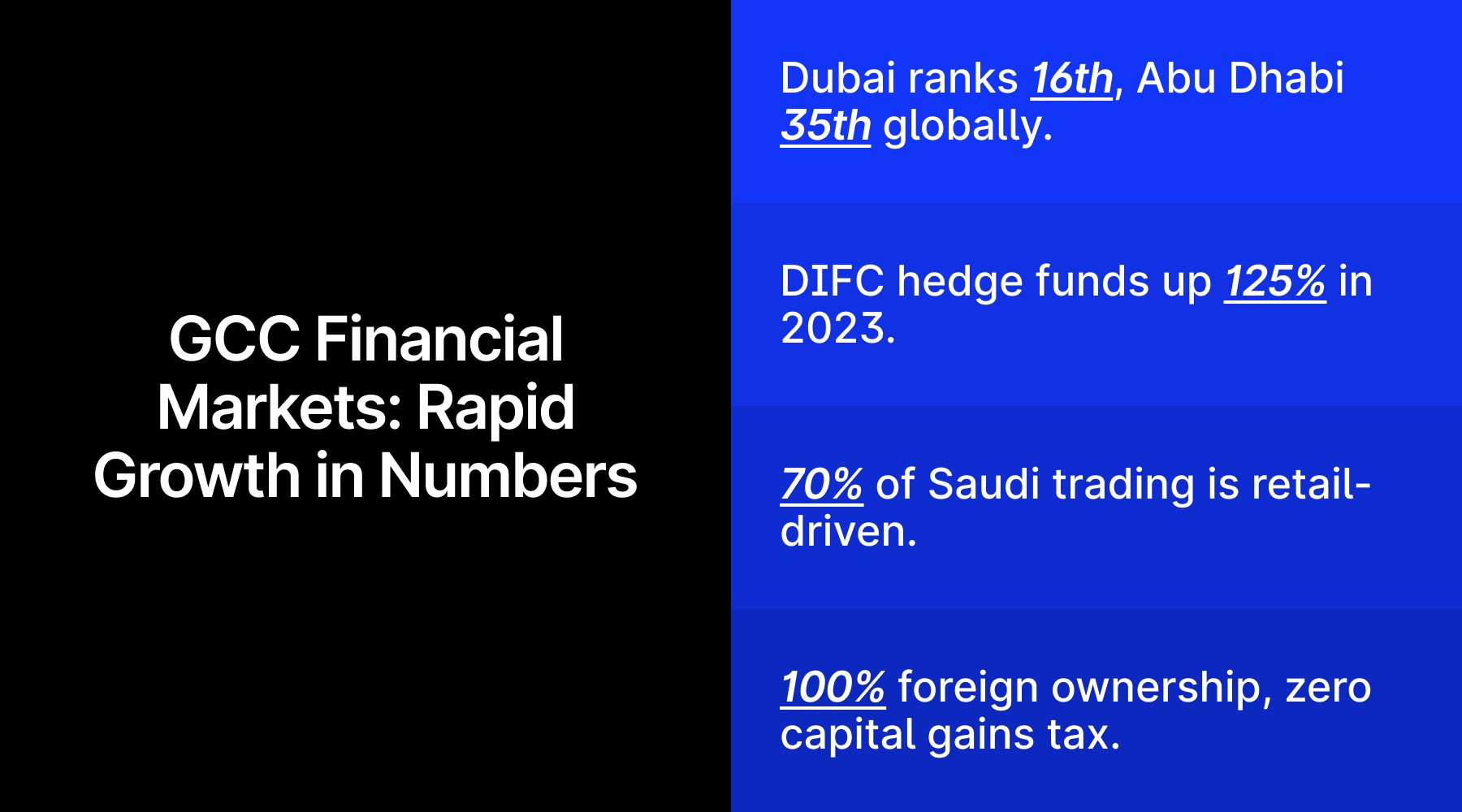
With 100% foreign ownership and zero capital gains tax, the Gulf Cooperation Council region is becoming a prime destination for hedge funds, leading to a 125% surge in fund registrations year over year.
“Hedge funds are setting up here not necessarily to trade just the GCC but to trade markets globally,” says Damian Bunce, CEO of GTN Middle East.
The most recent Global Financial Centres Index illustrates the growing influence of the GCC’s (Gulf Cooperation Council) two main financial centres, with Dubai moving up four places to 16th and Abu Dhabi advancing from 37th to 35th. Riyadh, Doha and Kuwait City also made big moves, albeit from a much lower base.
The increasing appeal of the region for hedge funds is a significant factor in this growth. A report published by Dubai International Financial Centre (DIFC) in September 2024 notes that the number of hedge funds establishing operations in the centre rose by 125% in 2023.
An Attractive Alternative to Traditional Hedge Fund Centres
Big-hitters such as Brevan Howard, AQR Capital Management, Wellington Management, BlackRock Advisors, GoldenTree Asset Management, Marshall Wace, Winton, Balyasny Asset Management, TCI Fund Management and Hudson Bay Capital Management have set up shop in the region.
“The surge in hedge fund interest is also driven by growing institutional demand,” explains Ritu Singh, regional director of StoneX. “Sovereign wealth funds are allocating more capital to hedge funds, particularly in quant-driven and macro strategies.”
Tadawul and Nasdaq Dubai have expanded their offerings, introducing more derivatives and structured products, and Dubai and Abu Dhabi have also witnessed a rise in fixed income and structured product issuance.
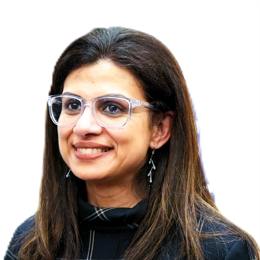
Institutional traders want better market access but that is not something that has been delivered upon particularly well in the GCC, suggests Richard Elston, head of institutional at CMC Markets.
Richard Elston, Group Head of Institutional at CMC Connect; Source: LinkedIn
“Access to cash equities and exchange traded derivatives as well as any other synthetic stuff or longer term fixed income is what the market is calling out for at the moment and that is our raison d'etre to be here, to fill that mid-market gap and provide both a technological and wider market asset class solution,” he says.
While many European, Asian, and US-based firms are looking to grow their business in the GCC, fintech broker GTN, with its long successful heritage across GCC, has expanded internationally with regulated offices in Dubai, the US, the UK, and Singapore.
Damian Bunce, CEO GTN Middle East, observes that the GCC markets are developing rapidly, citing the Saudi stock exchange’s aspirations to break into the top five largest exchanges globally.
To increase accessibility, the exchange has launched numerous initiatives including cross-listing Sharia compliant exchange traded funds such as the CSOP MSCI Hong Kong China Equity ETF and global collaborations such as the Saudi Public Investment Fund investing in State Street Global Advisors Europe-listed SPDR JP Morgan Saudi Arabia Aggregate Bond UCITS ETF.
The Regulator Is Stepping In
At regulatory level, the Capital Markets Authority has approved amendments allowing institutions to open omnibus accounts for their clients, which aims to promote investment and boost the market’s attractiveness and efficiency.
Damian Bunce, CEO at GTN Middle East
“We are increasingly seeing hedge funds setting up here in Dubai and Abu Dhabi, not necessarily to trade just the GCC markets but to trade markets globally,” explains Bunce. “Whilst the Saudi market is heavily retail-driven (about 70% of the volume on the Saudi exchange comes from retail) this is changing rapidly and the exchange is promoting co-location services to attract the most sophisticated traders.”
Bunce describes the trading environment as sophisticated, highlighting that a large amount of options trading occurs across the region. The typical Qatari, Kuwaiti, Saudi or Emirati trader is usually focused on two markets—their own domestic market and the US market.
“They are trading the stock, options and bonds of the big names such as Google and Tesla but they are also very interested in small cap/penny stock markets because of the volatility they offer,” he says. “CFDs are available for retail trading in most GCC markets except for Saudi Arabia.”
Elston refers to strong growth in yields and volumes from familiar names within the industry who operate trading desks and sales centres in the region.
“There is maybe a slightly different ethos between Dubai and Abu Dhabi,” he says. “The traditional wealth tends to sit in the latter, whereas Dubai is where the retail aggregators tend to operate, although it is catching up in the hedge fund and family office space. I would suggest that the market is a little bit ‘over-brokered’ in that area, not so much by the big names but through the appeal of Dubai as a growing market.”
Bunce is confident that the number of trading desks in the region will grow rapidly given the desire of regulators in Abu Dhabi and Dubai to encourage more types of business.
“Then you have factors such as zero income tax, a favourable time zone and the accessibility of the region from Europe and elsewhere,” he adds. “It is also appealing from a geopolitical perspective and relatively easy to obtain a 10 year visa to work here.”
“An Asset Gathering Exercise”
While the GCC is an increasingly attractive location for hedge funds, Elston points out that the majority are representative offices of rather than legally constituted funds.
“However, they are here on an asset gathering exercise and that is unlikely to change any time soon,” he says. “This trend is exacerbated by the regulatory landscape in Abu Dhabi and Dubai, where institutions gravitate towards Abu Dhabi Global Market (ADGM) or to the Dubai Financial Services Authority (DFSA) and DIFC and the regulators are clearly keen to attract more of these types of businesses into the region.”
Elston is quick to dismiss any suggestion of regulatory arbitrage, though. “Most of the people that work in the DFSA, for example, have come from tier one regulators and have made a choice to come to this part of the world,” he says. “So it is a very mature regulator with some nuance that is appropriate for this particular market.”
He accepts that most trading is still conducted outside the GCC while noting that a number of institutions have trading desks in the region. “From an infrastructure perspective there are plenty of data centres here to support low latency trading,” adds Elston.
Christophe Moser, managing director Dubai at TP ICAP says DIFC offers a fast-track approval process—a standalone authorisation team was created in 2023—while the DFSA tailors its supervisory activities based on the risk profile of each regulated entity.
“This means that higher-risk entities receive more intensive oversight, while lower-risk entities are subject to less stringent supervision,” he adds. “The regulator is continuously monitoring the risk environment and dynamically adjusts its regulatory approach as needed.”
The relaxation of qualified foreign investor rules has made it easier for global funds to trade in Saudi equity and derivatives markets. However, Singh cautions that there are still challenges for institutional traders.
“Liquidity constraints in some GCC markets can make it difficult to execute large institutional trades,” she concludes. “Additionally, the derivatives and futures markets are still in their early stages, requiring further development to attract more hedge funds and institutional capital. Greater regulatory harmonisation across the GCC could also simplify market access for global funds.”
The most recent Global Financial Centres Index illustrates the growing influence of the GCC’s (Gulf Cooperation Council) two main financial centres, with Dubai moving up four places to 16th and Abu Dhabi advancing from 37th to 35th. Riyadh, Doha and Kuwait City also made big moves, albeit from a much lower base.
The increasing appeal of the region for hedge funds is a significant factor in this growth. A report published by Dubai International Financial Centre (DIFC) in September 2024 notes that the number of hedge funds establishing operations in the centre rose by 125% in 2023.
An Attractive Alternative to Traditional Hedge Fund Centres
Big-hitters such as Brevan Howard, AQR Capital Management, Wellington Management, BlackRock Advisors, GoldenTree Asset Management, Marshall Wace, Winton, Balyasny Asset Management, TCI Fund Management and Hudson Bay Capital Management have set up shop in the region.
“The surge in hedge fund interest is also driven by growing institutional demand,” explains Ritu Singh, regional director of StoneX. “Sovereign wealth funds are allocating more capital to hedge funds, particularly in quant-driven and macro strategies.”
Tadawul and Nasdaq Dubai have expanded their offerings, introducing more derivatives and structured products, and Dubai and Abu Dhabi have also witnessed a rise in fixed income and structured product issuance.
Institutional traders want better market access but that is not something that has been delivered upon particularly well in the GCC, suggests Richard Elston, head of institutional at CMC Markets.
Richard Elston, Group Head of Institutional at CMC Connect; Source: LinkedIn
“Access to cash equities and exchange traded derivatives as well as any other synthetic stuff or longer term fixed income is what the market is calling out for at the moment and that is our raison d'etre to be here, to fill that mid-market gap and provide both a technological and wider market asset class solution,” he says.
While many European, Asian, and US-based firms are looking to grow their business in the GCC, fintech broker GTN, with its long successful heritage across GCC, has expanded internationally with regulated offices in Dubai, the US, the UK, and Singapore.
Damian Bunce, CEO GTN Middle East, observes that the GCC markets are developing rapidly, citing the Saudi stock exchange’s aspirations to break into the top five largest exchanges globally.
To increase accessibility, the exchange has launched numerous initiatives including cross-listing Sharia compliant exchange traded funds such as the CSOP MSCI Hong Kong China Equity ETF and global collaborations such as the Saudi Public Investment Fund investing in State Street Global Advisors Europe-listed SPDR JP Morgan Saudi Arabia Aggregate Bond UCITS ETF.
The Regulator Is Stepping In
At regulatory level, the Capital Markets Authority has approved amendments allowing institutions to open omnibus accounts for their clients, which aims to promote investment and boost the market’s attractiveness and efficiency.
Damian Bunce, CEO at GTN Middle East
“We are increasingly seeing hedge funds setting up here in Dubai and Abu Dhabi, not necessarily to trade just the GCC markets but to trade markets globally,” explains Bunce. “Whilst the Saudi market is heavily retail-driven (about 70% of the volume on the Saudi exchange comes from retail) this is changing rapidly and the exchange is promoting co-location services to attract the most sophisticated traders.”
Bunce describes the trading environment as sophisticated, highlighting that a large amount of options trading occurs across the region. The typical Qatari, Kuwaiti, Saudi or Emirati trader is usually focused on two markets—their own domestic market and the US market.
“They are trading the stock, options and bonds of the big names such as Google and Tesla but they are also very interested in small cap/penny stock markets because of the volatility they offer,” he says. “CFDs are available for retail trading in most GCC markets except for Saudi Arabia.”
Elston refers to strong growth in yields and volumes from familiar names within the industry who operate trading desks and sales centres in the region.
“There is maybe a slightly different ethos between Dubai and Abu Dhabi,” he says. “The traditional wealth tends to sit in the latter, whereas Dubai is where the retail aggregators tend to operate, although it is catching up in the hedge fund and family office space. I would suggest that the market is a little bit ‘over-brokered’ in that area, not so much by the big names but through the appeal of Dubai as a growing market.”
Bunce is confident that the number of trading desks in the region will grow rapidly given the desire of regulators in Abu Dhabi and Dubai to encourage more types of business.
“Then you have factors such as zero income tax, a favourable time zone and the accessibility of the region from Europe and elsewhere,” he adds. “It is also appealing from a geopolitical perspective and relatively easy to obtain a 10 year visa to work here.”
“An Asset Gathering Exercise”
While the GCC is an increasingly attractive location for hedge funds, Elston points out that the majority are representative offices of rather than legally constituted funds.
“However, they are here on an asset gathering exercise and that is unlikely to change any time soon,” he says. “This trend is exacerbated by the regulatory landscape in Abu Dhabi and Dubai, where institutions gravitate towards Abu Dhabi Global Market (ADGM) or to the Dubai Financial Services Authority (DFSA) and DIFC and the regulators are clearly keen to attract more of these types of businesses into the region.”
Elston is quick to dismiss any suggestion of regulatory arbitrage, though. “Most of the people that work in the DFSA, for example, have come from tier one regulators and have made a choice to come to this part of the world,” he says. “So it is a very mature regulator with some nuance that is appropriate for this particular market.”
He accepts that most trading is still conducted outside the GCC while noting that a number of institutions have trading desks in the region. “From an infrastructure perspective there are plenty of data centres here to support low latency trading,” adds Elston.
Christophe Moser, managing director Dubai at TP ICAP says DIFC offers a fast-track approval process—a standalone authorisation team was created in 2023—while the DFSA tailors its supervisory activities based on the risk profile of each regulated entity.
“This means that higher-risk entities receive more intensive oversight, while lower-risk entities are subject to less stringent supervision,” he adds. “The regulator is continuously monitoring the risk environment and dynamically adjusts its regulatory approach as needed.”
The relaxation of qualified foreign investor rules has made it easier for global funds to trade in Saudi equity and derivatives markets. However, Singh cautions that there are still challenges for institutional traders.
“Liquidity constraints in some GCC markets can make it difficult to execute large institutional trades,” she concludes. “Additionally, the derivatives and futures markets are still in their early stages, requiring further development to attract more hedge funds and institutional capital. Greater regulatory harmonisation across the GCC could also simplify market access for global funds.”
Paul Golden is an experienced freelance financial journalist with a strong institutional background. Over the past two decades, he has written for globally recognised financial publications, covering topics such as market structure, regulation, trading behaviour, and economic policy.
"Ensuring Seamless Execution": Nick Twidale on ATFX Connect’s Strategy for 2026
FP Markets Winner Spotlight 🏆 | Global Broker of the Year 2025 #Trading #Broker #Innovation #Shorts
FP Markets Winner Spotlight 🏆 | Global Broker of the Year 2025 #Trading #Broker #Innovation #Shorts
FP Markets takes the spotlight as Global Broker of the Year 2025 at the Finance Magnates Awards.
Martin Stoilov, Head of Client Experience, shares that trust, innovation, and people played a key role in the company’s success, supported by a strong foundation of integrity and client-centricity.
Following this milestone, FP Markets continues to focus on growth, technology investment, and its core values of transparency and excellence.
👉 Be part of FM Awards 2026: https://awards.financemagnates.com/#nominate
FP Markets takes the spotlight as Global Broker of the Year 2025 at the Finance Magnates Awards.
Martin Stoilov, Head of Client Experience, shares that trust, innovation, and people played a key role in the company’s success, supported by a strong foundation of integrity and client-centricity.
Following this milestone, FP Markets continues to focus on growth, technology investment, and its core values of transparency and excellence.
👉 Be part of FM Awards 2026: https://awards.financemagnates.com/#nominate
In this video, we review @HolaPrimeMarketsOfficial, a multi-asset forex and CFDs broker offering different account types, trading platforms, and flexible trading conditions.
We cover the broker’s overall offering, including account options, trading environment, platforms like MT4 and MT5, and additional services such as managed accounts and fast withdrawals.
Watch the full video to see if Hola Prime Markets fits your trading needs.
📣 Stay up to date with the latest in finance and trading. Follow Finance Magnates for industry news, insights, and global event coverage.
Connect with us:
🔗 LinkedIn: /financemagnates
👍 Facebook: /financemagnates
📸 Instagram: https://www.instagram.com/financemagnates
🐦 X: https://x.com/financemagnates
🎥 TikTok: https://www.tiktok.com/tag/financemagnates
▶️ YouTube: /@financemagnates_official
#HolaPrime #ForexBroker #CFDTrading #FinanceMagnates #Trading #Forex #BrokerReview
In this video, we review @HolaPrimeMarketsOfficial, a multi-asset forex and CFDs broker offering different account types, trading platforms, and flexible trading conditions.
We cover the broker’s overall offering, including account options, trading environment, platforms like MT4 and MT5, and additional services such as managed accounts and fast withdrawals.
Watch the full video to see if Hola Prime Markets fits your trading needs.
📣 Stay up to date with the latest in finance and trading. Follow Finance Magnates for industry news, insights, and global event coverage.
Connect with us:
🔗 LinkedIn: /financemagnates
👍 Facebook: /financemagnates
📸 Instagram: https://www.instagram.com/financemagnates
🐦 X: https://x.com/financemagnates
🎥 TikTok: https://www.tiktok.com/tag/financemagnates
▶️ YouTube: /@financemagnates_official
#HolaPrime #ForexBroker #CFDTrading #FinanceMagnates #Trading #Forex #BrokerReview
Hola Prime Review: What You Need to Know | Full Breakdown by Finance Magnates
Hola Prime Review: What You Need to Know | Full Breakdown by Finance Magnates
In this video, we review @HolaPrime_Global, a proprietary trading firm offering evaluation programs and performance-based payouts in simulated market environments.
We cover how the challenge model works, including account types, profit splits (up to 95%), trading rules, and what it takes to reach a funded account. You’ll also learn about available platforms like MT4, MT5, cTrader, and more, along with insights into payouts, support, and trading conditions.
Watch the full video to see if Hola Prime fits your trading style.
📣 Stay up to date with the latest in finance and trading. Follow Finance Magnates for industry news, insights, and global event coverage.
Connect with us:
🔗 LinkedIn: /financemagnates
👍 Facebook: /financemagnates
📸 Instagram: https://www.instagram.com/financemagnates
🐦 X: https://x.com/financemagnates
🎥 TikTok: https://www.tiktok.com/tag/financemagnates
▶️ YouTube: /@financemagnates_official
#HolaPrime #PropFirm #Trading #FinanceMagnates #Forex #FuturesTrading #TradingReview #PropFirmReview
In this video, we review @HolaPrime_Global, a proprietary trading firm offering evaluation programs and performance-based payouts in simulated market environments.
We cover how the challenge model works, including account types, profit splits (up to 95%), trading rules, and what it takes to reach a funded account. You’ll also learn about available platforms like MT4, MT5, cTrader, and more, along with insights into payouts, support, and trading conditions.
Watch the full video to see if Hola Prime fits your trading style.
📣 Stay up to date with the latest in finance and trading. Follow Finance Magnates for industry news, insights, and global event coverage.
Connect with us:
🔗 LinkedIn: /financemagnates
👍 Facebook: /financemagnates
📸 Instagram: https://www.instagram.com/financemagnates
🐦 X: https://x.com/financemagnates
🎥 TikTok: https://www.tiktok.com/tag/financemagnates
▶️ YouTube: /@financemagnates_official
#HolaPrime #PropFirm #Trading #FinanceMagnates #Forex #FuturesTrading #TradingReview #PropFirmReview
Axi Winner Spotlight 🏆 | Global Most Innovative Broker 2025 #Innovation #Trading #Fintech #Broker
Axi Winner Spotlight 🏆 | Global Most Innovative Broker 2025 #Innovation #Trading #Fintech #Broker
Axi takes the spotlight at the Finance Magnates Awards, winning Global Most Innovative Broker 2025.
Olivia Xenofontos and Ivanna Openko share how the team will feel: proud, motivated, and ready to keep delivering.
They also describe the night as well-organized, focused, and enjoyable for all.
👉 Be part of FM Awards 2026.
Axi takes the spotlight at the Finance Magnates Awards, winning Global Most Innovative Broker 2025.
Olivia Xenofontos and Ivanna Openko share how the team will feel: proud, motivated, and ready to keep delivering.
They also describe the night as well-organized, focused, and enjoyable for all.
👉 Be part of FM Awards 2026.
Recognition that matters.
Built on transparency.
Driven by the industry.
The Finance Magnates Awards 2026.
Nominations are now open.
🔗 https://awards.financemagnates.com/?utm_source=SM&utm_medium=social&utm_campaign=recognition-matters
Recognition that matters.
Built on transparency.
Driven by the industry.
The Finance Magnates Awards 2026.
Nominations are now open.
🔗 https://awards.financemagnates.com/?utm_source=SM&utm_medium=social&utm_campaign=recognition-matters