One of the revelations of the BIS's latest FX survey was that non-dealer institutions aren't only the largest segment of FX's $5.3 trillion market, but compose of the majority of it. We take a look at this important trend.
Sifting through the Bank of International Settlements (BIS) Triennial FX Survey, arguably the most important trend taking place is the growth of non-dealer bank participation. Within the report, the survey polls participant dealers in regards to trading details such as volumes by currency, counterparty type and region.
Topping the list of counterparties was the ‘other financial institution’ segment. Responsible for $2.8 trillion, or 53% of the survey’s $5.3 trillion a day total for global FX volumes, the segment includes smaller banks that do not act as dealers in the FX market, proprietary traders within investment banks, and institutional investors such as pension, hedge and mutual funds. Volumes in this group rose 48% from $1.9 trillion in 2010, to the most recent $2.8 trillion. During the 2010 survey the other financial institutions overtook reporting dealers, with market share continuing to climb over the last three years.
There are several factors that have led to the rising volumes of the non-dealer. Perhaps the main cause has been advances of electronic trading which has provided easier opportunities for Tier 2/3 banks to offer eFX solutions to their clients. Also, a factor is the dwindling profit margins posted on FX volumes, leading major banks to focus their marketing efforts to reach less competitive countries that provide the opportunity to achieve higher revenues per million dollars traded. As a result, banks in countries such as Poland, Turkey, as well as South-East Asian nations have become recent entrants to the eFX world.
On a more macro-level, globalization as a whole can’t be underestimated. As long as cross-boundary trade increases, so does demand among firms for foreign exchange services. This demand represents itself through the increased needs of businesses for FX solutions from regional banks. In addition, larger regional banks are able to leverage their expertise to price their local currency more aggressively to foreigners.
Explaining how technology has evolved the industry, Peter A. Bondesen, Sales Manager EMEA at FlexTrade stated to Forex Magnates that, “Improvements in technology that is available to firms is an important factor. For smaller banks, technology was a stumbling block to enter the FX market.” As a result, Bondesen added that new entrants aren’t only aggregating liquidity to resell it to their customers, but are using their “regional expertise in the local currency” to provide pricing to the rest of the world. Specifically, Bondesen noted that through implementation of eFX solutions, Scandinavian regional banks have succeeded to become the main markets in their respective currencies by connecting their liquidity to major financial centers and trading venues.
Due to the economic efficiencies available in technology, smaller firms are also able to source customized solutions to better fit both their buy and sell-side needs. Explaining this, Harpal Sandhu, CEO, Integral Development Corp added to Forex Magnates that, “Our experience is in line with what the BIS report states, which is that “smaller banks” and “institutional investors” are growth areas.” He added that, “We have seen a dramatic customer growth in these areas because these market participants require an OTC platform that offers the flexibility so they can do whatever they want with it, for their own benefits or those of their customers.”
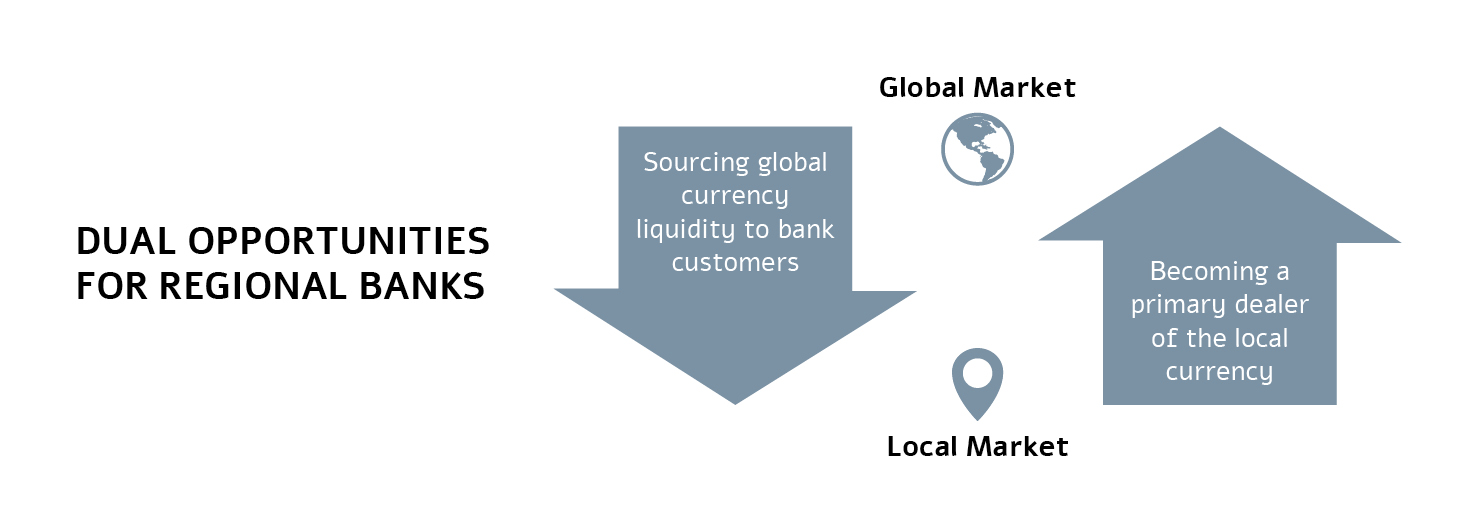
As a result, it is becoming a ‘two-way street’ where banks are able to grow their FX businesses by sourcing global pricing for their local customers, as well as becoming liquidity providers of their local currency to the rest of the world. Meeting this dual demand, Illit Geller, CEO of Tradair explained that there are “Two solutions categories; the ECN - where liquidity of the ECN can be rebranded by the regional bank for its customers, and liquidity optimization management (LOM) which provide a tier1 bank type solution for regional banks pricing and distribution."
Illit Geller, CEO of TradAir
In terms of technology, this had led to the creation of different types of products to fit the primary needs of banks. Geller explained that in regards to regional banks that are using their expertise to provide pricing of their local currency to the rest of the world, firms require greater customization and risk controls as she stated, “It is not enough to provide similar technology solutions to those of the 1st tier banks, regional banks require tight trader controls, different algorithms and workflow management suited for their unique currency needs.”
Similarly, firms seeking cost-efficient solutions to offer eFX services to clients are also witnessing an ever expanding product line to choose from, as providers like Integral have been offering solutions that require little to no upfront costs to launch. Having established client bases, these solutions allow regional banks to both resell prime dealer liquidity to their clients as well as price their own market-making initiatives. Although much of the initial business that regional banks are receiving is based on upselling services to existing clients, firms are also using the FX services to gain new customers. Over the long run, Bondesen believes that banks with the “Most efficient setups will be able to show this to customers to win clients. More than just reselling, they will be able to win new clients with great services.”
Fragmented but still centralized
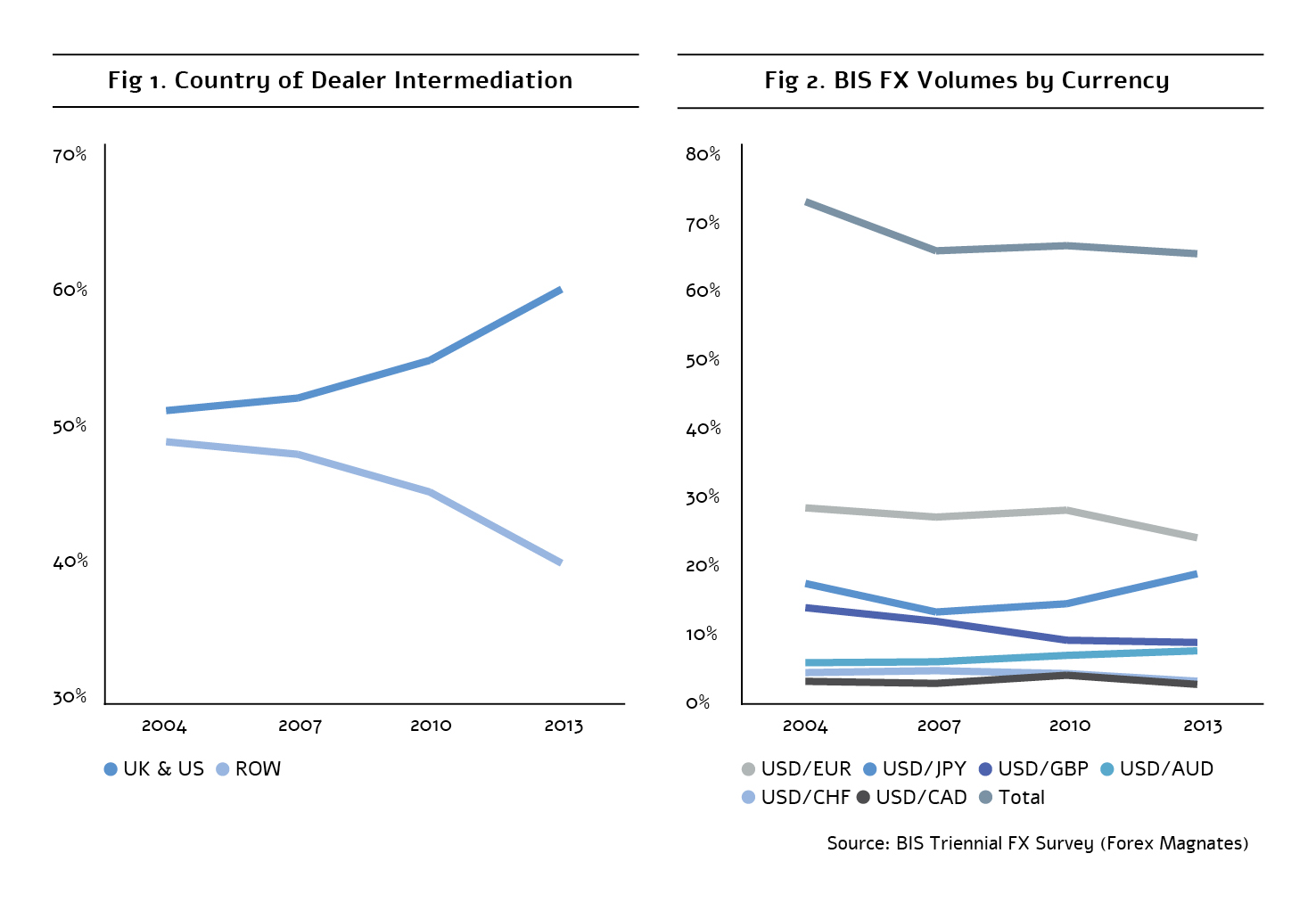
Interestingly though, as the FX market has become increasingly fragmented, as witnessed by the increased importance of non-dealers, the UK and US’s hold on the market has increased. Between 2010 to 2013, combined UK and US volumes rose from 54.7% to 59.8% (Figure 1–data is based on jurisdiction that was used to intermediate a dealer's trade). This occurred even as market share of major currencies has been trending lower (Figure 2). The numbers demonstrate that despite the increase of global FX demand, international firms are favoring to work with established centers when deciding where to source or send their liquidity.
Factoring into this trend has been the ease of access to connect with the major FX centers, as well as tight pricing. As a result, it has become easier and cheaper than ever for institutional investors and regional banks to source liquidity of major currencies for the proprietary trading and customer needs.
Benefiting from the demand of global firms to partner with UK and US dealers as their counterparties, telecom networking firms have been quickly rolling out cross-boundary low latency services. Among solutions, one of the main services is the installment of private point to point networks between financial centers. In this setup, telecom firms create local access points where foreign traders can connect to high-speed networks. For example, through a private network between Stockholm and London, Swedish traders can reduce latency by connecting directly to local access points, instead of relying on public networks to send their data to and from the United Kingdom.
Asian Opportunities
Harpal Sandhu, CEO, Integral Development Corp
While these networks do provide an opportunity to access the liquid UK and US markets, they are still a substitute to localized pricing. As such, foreign firms do suffer from increased slippage costs and higher latency than local traders. In this regard, Bondesen believes there is an opportunity for the creation of localized hubs of primary liquidity. Specifically, he mentioned that the build-up of local Asian FX liquidity centers is an important trend taking place in the industry.
As a result, dealers and ECNs that are able to create trading venues where pricing is independent of UK and US financial centers, will be well situated to leverage their regional location when marketing their liquidity. In this regard, Singapore has currently taken the lead among Asian countries as a regional center of sourcing liquidity. In the latest BIS report, Singapore led Asian countries in terms of FX intermediation with $383 billion in daily volumes. This compared to $374 billion in Japan and $275 billion of daily FX trading in Hong Kong.
An Aggregators' World
Rising along with the overall FX industry volumes and specifically the activity among non-dealers are aggregators. These are the firms that provide the technology to combine multiple liquidity sources into one tradable feed. In addition, providers are creating risk management solutions that allow users to create their pricing to clients, and become forex market makers to their customers. Services include products to dynamically adjust spreads, as well as decide which customer order flow to hedge externally or warehouse internally. Due to the increase use of these services, smaller financial institutions are effectively able to become dealers and provide eFX services. In addition, rather than needing to tap into public trading venues, using aggregator technology, buy-side traders are creating their own ECNs as they combine multiple pricing relationships into one tradable feed.
Speaking about this trend in the FX industry earlier this year, EBS CEO, Gil Mandelzis, referred to the future as the ‘Decade of the Aggregator’ and believed it was one of the main growth areas in the industry. Not surprisingly, this potential has spawned the creation of many new firms entering the aggregation market. As a result, this has led to the question of whether the market has become too saturated with third party aggregators.
James Sinclair, CEO, MarketFactory
Providing an opinion, Sinclair explained that the diversity of the market and multitude of needs are allowing many firms to operate in the space as he stated, “Far from becoming a crowded space, this is becoming a space where different firms serve different segments and offer different value propositions. Aggregator is too broad a term. Some aggregators are allied, paid by or even owned by banks; others are more akin to an ECN.”
A $6 trillion-a-day market?
As mentioned above, one of the corollaries of the increase of smaller firms implementing eFX solutions is the ability for them to become dealers to their clients. The result is that much of the ‘other financial institution’ segment volume flow isn’t reaching primary dealers and being reported within the BIS’s statistics. Analyzing the retail market in October, Forex Magnates estimated that the volumes were at least double the $78 billion- a-day reported by the BIS, based on brokers handling flow internally. Similarly, of the $2.8 trillion from non-dealers reported by the BIS, it doesn’t include non-hedged trades that never get factored within primary dealer books. However, unlike retail firms where warehoused liquidity comprises over 50% of order flow, market-making among regional banks is estimated to be between 20-40%.
To calculate the entire market though requires an understanding of just how much of the reported $2.8 trillion is sell side driven. Based on the BIS figures, of the $2.8 trillion, $1.183 trillion of the volumes were composed of FX Spot trading. Using the spot figure as the foundation for deriving sell-side market making volumes and attributing that 30% of originates from non-banks, we can estimate that an additional 14%-28% from the $1.183 trillion is being traded. Applying the mid-point 21% ratio calculates to around $250 billion in non-reported volumes. When adding an approximate (low estimate) of $80 billion a day in non-reported retail volumes, the combined FX market sums up to $5.63 trillion in daily volume taking place in April 2013.
Admittedly, these calculations are rough estimates. Additionally, they are based on April 2013 trading results, with the market since subsiding somewhat. Nonetheless, taking into account the growth of non-dealer participants, both in the retail market as well as regional banks, does point to a rising portion of unreported volumes. Therefore, while we may not be at the point where $6 trillion a day in volume is consistently taking place, thanks to the diversity of growth engines in the FX industry, we aren’t too far away from eclipsing another trillion dollar barrier.
Sifting through the Bank of International Settlements (BIS) Triennial FX Survey, arguably the most important trend taking place is the growth of non-dealer bank participation. Within the report, the survey polls participant dealers in regards to trading details such as volumes by currency, counterparty type and region.
Topping the list of counterparties was the ‘other financial institution’ segment. Responsible for $2.8 trillion, or 53% of the survey’s $5.3 trillion a day total for global FX volumes, the segment includes smaller banks that do not act as dealers in the FX market, proprietary traders within investment banks, and institutional investors such as pension, hedge and mutual funds. Volumes in this group rose 48% from $1.9 trillion in 2010, to the most recent $2.8 trillion. During the 2010 survey the other financial institutions overtook reporting dealers, with market share continuing to climb over the last three years.
There are several factors that have led to the rising volumes of the non-dealer. Perhaps the main cause has been advances of electronic trading which has provided easier opportunities for Tier 2/3 banks to offer eFX solutions to their clients. Also, a factor is the dwindling profit margins posted on FX volumes, leading major banks to focus their marketing efforts to reach less competitive countries that provide the opportunity to achieve higher revenues per million dollars traded. As a result, banks in countries such as Poland, Turkey, as well as South-East Asian nations have become recent entrants to the eFX world.
On a more macro-level, globalization as a whole can’t be underestimated. As long as cross-boundary trade increases, so does demand among firms for foreign exchange services. This demand represents itself through the increased needs of businesses for FX solutions from regional banks. In addition, larger regional banks are able to leverage their expertise to price their local currency more aggressively to foreigners.
Explaining how technology has evolved the industry, Peter A. Bondesen, Sales Manager EMEA at FlexTrade stated to Forex Magnates that, “Improvements in technology that is available to firms is an important factor. For smaller banks, technology was a stumbling block to enter the FX market.” As a result, Bondesen added that new entrants aren’t only aggregating liquidity to resell it to their customers, but are using their “regional expertise in the local currency” to provide pricing to the rest of the world. Specifically, Bondesen noted that through implementation of eFX solutions, Scandinavian regional banks have succeeded to become the main markets in their respective currencies by connecting their liquidity to major financial centers and trading venues.
Due to the economic efficiencies available in technology, smaller firms are also able to source customized solutions to better fit both their buy and sell-side needs. Explaining this, Harpal Sandhu, CEO, Integral Development Corp added to Forex Magnates that, “Our experience is in line with what the BIS report states, which is that “smaller banks” and “institutional investors” are growth areas.” He added that, “We have seen a dramatic customer growth in these areas because these market participants require an OTC platform that offers the flexibility so they can do whatever they want with it, for their own benefits or those of their customers.”
As a result, it is becoming a ‘two-way street’ where banks are able to grow their FX businesses by sourcing global pricing for their local customers, as well as becoming liquidity providers of their local currency to the rest of the world. Meeting this dual demand, Illit Geller, CEO of Tradair explained that there are “Two solutions categories; the ECN - where liquidity of the ECN can be rebranded by the regional bank for its customers, and liquidity optimization management (LOM) which provide a tier1 bank type solution for regional banks pricing and distribution."
Illit Geller, CEO of TradAir
In terms of technology, this had led to the creation of different types of products to fit the primary needs of banks. Geller explained that in regards to regional banks that are using their expertise to provide pricing of their local currency to the rest of the world, firms require greater customization and risk controls as she stated, “It is not enough to provide similar technology solutions to those of the 1st tier banks, regional banks require tight trader controls, different algorithms and workflow management suited for their unique currency needs.”
Similarly, firms seeking cost-efficient solutions to offer eFX services to clients are also witnessing an ever expanding product line to choose from, as providers like Integral have been offering solutions that require little to no upfront costs to launch. Having established client bases, these solutions allow regional banks to both resell prime dealer liquidity to their clients as well as price their own market-making initiatives. Although much of the initial business that regional banks are receiving is based on upselling services to existing clients, firms are also using the FX services to gain new customers. Over the long run, Bondesen believes that banks with the “Most efficient setups will be able to show this to customers to win clients. More than just reselling, they will be able to win new clients with great services.”
Fragmented but still centralized
Interestingly though, as the FX market has become increasingly fragmented, as witnessed by the increased importance of non-dealers, the UK and US’s hold on the market has increased. Between 2010 to 2013, combined UK and US volumes rose from 54.7% to 59.8% (Figure 1–data is based on jurisdiction that was used to intermediate a dealer's trade). This occurred even as market share of major currencies has been trending lower (Figure 2). The numbers demonstrate that despite the increase of global FX demand, international firms are favoring to work with established centers when deciding where to source or send their liquidity.
Factoring into this trend has been the ease of access to connect with the major FX centers, as well as tight pricing. As a result, it has become easier and cheaper than ever for institutional investors and regional banks to source liquidity of major currencies for the proprietary trading and customer needs.
Benefiting from the demand of global firms to partner with UK and US dealers as their counterparties, telecom networking firms have been quickly rolling out cross-boundary low latency services. Among solutions, one of the main services is the installment of private point to point networks between financial centers. In this setup, telecom firms create local access points where foreign traders can connect to high-speed networks. For example, through a private network between Stockholm and London, Swedish traders can reduce latency by connecting directly to local access points, instead of relying on public networks to send their data to and from the United Kingdom.
Asian Opportunities
Harpal Sandhu, CEO, Integral Development Corp
While these networks do provide an opportunity to access the liquid UK and US markets, they are still a substitute to localized pricing. As such, foreign firms do suffer from increased slippage costs and higher latency than local traders. In this regard, Bondesen believes there is an opportunity for the creation of localized hubs of primary liquidity. Specifically, he mentioned that the build-up of local Asian FX liquidity centers is an important trend taking place in the industry.
As a result, dealers and ECNs that are able to create trading venues where pricing is independent of UK and US financial centers, will be well situated to leverage their regional location when marketing their liquidity. In this regard, Singapore has currently taken the lead among Asian countries as a regional center of sourcing liquidity. In the latest BIS report, Singapore led Asian countries in terms of FX intermediation with $383 billion in daily volumes. This compared to $374 billion in Japan and $275 billion of daily FX trading in Hong Kong.
An Aggregators' World
Rising along with the overall FX industry volumes and specifically the activity among non-dealers are aggregators. These are the firms that provide the technology to combine multiple liquidity sources into one tradable feed. In addition, providers are creating risk management solutions that allow users to create their pricing to clients, and become forex market makers to their customers. Services include products to dynamically adjust spreads, as well as decide which customer order flow to hedge externally or warehouse internally. Due to the increase use of these services, smaller financial institutions are effectively able to become dealers and provide eFX services. In addition, rather than needing to tap into public trading venues, using aggregator technology, buy-side traders are creating their own ECNs as they combine multiple pricing relationships into one tradable feed.
Speaking about this trend in the FX industry earlier this year, EBS CEO, Gil Mandelzis, referred to the future as the ‘Decade of the Aggregator’ and believed it was one of the main growth areas in the industry. Not surprisingly, this potential has spawned the creation of many new firms entering the aggregation market. As a result, this has led to the question of whether the market has become too saturated with third party aggregators.
James Sinclair, CEO, MarketFactory
Providing an opinion, Sinclair explained that the diversity of the market and multitude of needs are allowing many firms to operate in the space as he stated, “Far from becoming a crowded space, this is becoming a space where different firms serve different segments and offer different value propositions. Aggregator is too broad a term. Some aggregators are allied, paid by or even owned by banks; others are more akin to an ECN.”
A $6 trillion-a-day market?
As mentioned above, one of the corollaries of the increase of smaller firms implementing eFX solutions is the ability for them to become dealers to their clients. The result is that much of the ‘other financial institution’ segment volume flow isn’t reaching primary dealers and being reported within the BIS’s statistics. Analyzing the retail market in October, Forex Magnates estimated that the volumes were at least double the $78 billion- a-day reported by the BIS, based on brokers handling flow internally. Similarly, of the $2.8 trillion from non-dealers reported by the BIS, it doesn’t include non-hedged trades that never get factored within primary dealer books. However, unlike retail firms where warehoused liquidity comprises over 50% of order flow, market-making among regional banks is estimated to be between 20-40%.
To calculate the entire market though requires an understanding of just how much of the reported $2.8 trillion is sell side driven. Based on the BIS figures, of the $2.8 trillion, $1.183 trillion of the volumes were composed of FX Spot trading. Using the spot figure as the foundation for deriving sell-side market making volumes and attributing that 30% of originates from non-banks, we can estimate that an additional 14%-28% from the $1.183 trillion is being traded. Applying the mid-point 21% ratio calculates to around $250 billion in non-reported volumes. When adding an approximate (low estimate) of $80 billion a day in non-reported retail volumes, the combined FX market sums up to $5.63 trillion in daily volume taking place in April 2013.
Admittedly, these calculations are rough estimates. Additionally, they are based on April 2013 trading results, with the market since subsiding somewhat. Nonetheless, taking into account the growth of non-dealer participants, both in the retail market as well as regional banks, does point to a rising portion of unreported volumes. Therefore, while we may not be at the point where $6 trillion a day in volume is consistently taking place, thanks to the diversity of growth engines in the FX industry, we aren’t too far away from eclipsing another trillion dollar barrier.
CFTC Lets US Firms Keep Trading Swaps on Two More UK Platforms After Brexit
Featured Videos
CMC Markets’ Artur Delijergijevs on Metals Demand, Volatility, & Stable Execution
CMC Markets’ Artur Delijergijevs on Metals Demand, Volatility, & Stable Execution
CMC Markets’ Artur Delijergijevs on Metals Demand, Volatility, & Stable Execution
CMC Markets’ Artur Delijergijevs on Metals Demand, Volatility, & Stable Execution
In this exclusive Executive Interview, Finance Magnates speaks with Artur Delijergijevs, Head of Systematic Market Making at CMC Markets, about the current state of metals demand and market volatility.
Delijergijevs offers a desk-level view on:
- Metals Demand: Why metals are seeing the strongest demand from both retail and institutional clients right now.
- The Safe-Haven Debate: Questioning whether gold still fits the classic safe-haven definition given large daily price movements.
- Volatile Market Prep: How a market-making desk prepares its systems and pricing for stressed market conditions and high-impact economic events.
- Hybrid Execution: Why the best execution model combines electronic speed with human relationship support, especially during volatility.
- AI in Workflow: Where CMC Markets is integrating machine learning for risk management and pricing, and the limitations of AI during stressed markets.
- Dubai's Role: The strategic importance of Dubai’s location for covering global trading sessions across Asia, Europe, and the US.
Watch to understand how CMC Markets maintains stable pricing and reliable execution quality in high-volatility environments.
#CMCmarkets #forex #metals #gold #trading #volatility #MarketMaking #iFXDubai #FinanceMagnates #Finance #Fintech #Execution #AlgorithmicTrading #RiskManagement
In this exclusive Executive Interview, Finance Magnates speaks with Artur Delijergijevs, Head of Systematic Market Making at CMC Markets, about the current state of metals demand and market volatility.
Delijergijevs offers a desk-level view on:
- Metals Demand: Why metals are seeing the strongest demand from both retail and institutional clients right now.
- The Safe-Haven Debate: Questioning whether gold still fits the classic safe-haven definition given large daily price movements.
- Volatile Market Prep: How a market-making desk prepares its systems and pricing for stressed market conditions and high-impact economic events.
- Hybrid Execution: Why the best execution model combines electronic speed with human relationship support, especially during volatility.
- AI in Workflow: Where CMC Markets is integrating machine learning for risk management and pricing, and the limitations of AI during stressed markets.
- Dubai's Role: The strategic importance of Dubai’s location for covering global trading sessions across Asia, Europe, and the US.
Watch to understand how CMC Markets maintains stable pricing and reliable execution quality in high-volatility environments.
#CMCmarkets #forex #metals #gold #trading #volatility #MarketMaking #iFXDubai #FinanceMagnates #Finance #Fintech #Execution #AlgorithmicTrading #RiskManagement
In this exclusive Executive Interview, Finance Magnates speaks with Artur Delijergijevs, Head of Systematic Market Making at CMC Markets, about the current state of metals demand and market volatility.
Delijergijevs offers a desk-level view on:
- Metals Demand: Why metals are seeing the strongest demand from both retail and institutional clients right now.
- The Safe-Haven Debate: Questioning whether gold still fits the classic safe-haven definition given large daily price movements.
- Volatile Market Prep: How a market-making desk prepares its systems and pricing for stressed market conditions and high-impact economic events.
- Hybrid Execution: Why the best execution model combines electronic speed with human relationship support, especially during volatility.
- AI in Workflow: Where CMC Markets is integrating machine learning for risk management and pricing, and the limitations of AI during stressed markets.
- Dubai's Role: The strategic importance of Dubai’s location for covering global trading sessions across Asia, Europe, and the US.
Watch to understand how CMC Markets maintains stable pricing and reliable execution quality in high-volatility environments.
#CMCmarkets #forex #metals #gold #trading #volatility #MarketMaking #iFXDubai #FinanceMagnates #Finance #Fintech #Execution #AlgorithmicTrading #RiskManagement
In this exclusive Executive Interview, Finance Magnates speaks with Artur Delijergijevs, Head of Systematic Market Making at CMC Markets, about the current state of metals demand and market volatility.
Delijergijevs offers a desk-level view on:
- Metals Demand: Why metals are seeing the strongest demand from both retail and institutional clients right now.
- The Safe-Haven Debate: Questioning whether gold still fits the classic safe-haven definition given large daily price movements.
- Volatile Market Prep: How a market-making desk prepares its systems and pricing for stressed market conditions and high-impact economic events.
- Hybrid Execution: Why the best execution model combines electronic speed with human relationship support, especially during volatility.
- AI in Workflow: Where CMC Markets is integrating machine learning for risk management and pricing, and the limitations of AI during stressed markets.
- Dubai's Role: The strategic importance of Dubai’s location for covering global trading sessions across Asia, Europe, and the US.
Watch to understand how CMC Markets maintains stable pricing and reliable execution quality in high-volatility environments.
#CMCmarkets #forex #metals #gold #trading #volatility #MarketMaking #iFXDubai #FinanceMagnates #Finance #Fintech #Execution #AlgorithmicTrading #RiskManagement
Finance Magnates Awards 2026 – Nominations Now Open
Finance Magnates Awards 2026 – Nominations Now Open
Finance Magnates Awards 2026 – Nominations Now Open
Finance Magnates Awards 2026 – Nominations Now Open
Finance Magnates Awards 2026 – Nominations Now Open
Finance Magnates Awards 2026 – Nominations Now Open
The Finance Magnates Awards 2026 nominations are now open. 🏆
From fintech innovators to leading brokers, this is where the finance industry celebrates its biggest achievements.
Winners will be announced at the Cyprus Gala Dinner on November 6, 2026.
Nominate your brand now.
https://awards.financemagnates.com/?utm_source=linkedin&utm_medium=video&utm_campaign=nominations-open
#FMAwards #FinanceMagnates #FintechAwards #Fintech #FinanceIndustry
The Finance Magnates Awards 2026 nominations are now open. 🏆
From fintech innovators to leading brokers, this is where the finance industry celebrates its biggest achievements.
Winners will be announced at the Cyprus Gala Dinner on November 6, 2026.
Nominate your brand now.
https://awards.financemagnates.com/?utm_source=linkedin&utm_medium=video&utm_campaign=nominations-open
#FMAwards #FinanceMagnates #FintechAwards #Fintech #FinanceIndustry
The Finance Magnates Awards 2026 nominations are now open. 🏆
From fintech innovators to leading brokers, this is where the finance industry celebrates its biggest achievements.
Winners will be announced at the Cyprus Gala Dinner on November 6, 2026.
Nominate your brand now.
https://awards.financemagnates.com/?utm_source=linkedin&utm_medium=video&utm_campaign=nominations-open
#FMAwards #FinanceMagnates #FintechAwards #Fintech #FinanceIndustry
The Finance Magnates Awards 2026 nominations are now open. 🏆
From fintech innovators to leading brokers, this is where the finance industry celebrates its biggest achievements.
Winners will be announced at the Cyprus Gala Dinner on November 6, 2026.
Nominate your brand now.
https://awards.financemagnates.com/?utm_source=linkedin&utm_medium=video&utm_campaign=nominations-open
#FMAwards #FinanceMagnates #FintechAwards #Fintech #FinanceIndustry
The Finance Magnates Awards 2026 nominations are now open. 🏆
From fintech innovators to leading brokers, this is where the finance industry celebrates its biggest achievements.
Winners will be announced at the Cyprus Gala Dinner on November 6, 2026.
Nominate your brand now.
https://awards.financemagnates.com/?utm_source=linkedin&utm_medium=video&utm_campaign=nominations-open
#FMAwards #FinanceMagnates #FintechAwards #Fintech #FinanceIndustry
The Finance Magnates Awards 2026 nominations are now open. 🏆
From fintech innovators to leading brokers, this is where the finance industry celebrates its biggest achievements.
Winners will be announced at the Cyprus Gala Dinner on November 6, 2026.
Nominate your brand now.
https://awards.financemagnates.com/?utm_source=linkedin&utm_medium=video&utm_campaign=nominations-open
#FMAwards #FinanceMagnates #FintechAwards #Fintech #FinanceIndustry
Finance Magnates Awards 2026 | Nominations Now Open 🏆#Fintech #FMAwards #TradingIndustry
Finance Magnates Awards 2026 | Nominations Now Open 🏆#Fintech #FMAwards #TradingIndustry
Finance Magnates Awards 2026 | Nominations Now Open 🏆#Fintech #FMAwards #TradingIndustry
Finance Magnates Awards 2026 | Nominations Now Open 🏆#Fintech #FMAwards #TradingIndustry
Finance Magnates Awards 2026 | Nominations Now Open 🏆#Fintech #FMAwards #TradingIndustry
Finance Magnates Awards 2026 | Nominations Now Open 🏆#Fintech #FMAwards #TradingIndustry
Lights on. Cameras ready. 🎬
Finance Magnates Awards 2026 nominations are now open. 🏆
#FMAwards #FinanceMagnates #FintechAwards #Fintech
Lights on. Cameras ready. 🎬
Finance Magnates Awards 2026 nominations are now open. 🏆
#FMAwards #FinanceMagnates #FintechAwards #Fintech
Lights on. Cameras ready. 🎬
Finance Magnates Awards 2026 nominations are now open. 🏆
#FMAwards #FinanceMagnates #FintechAwards #Fintech
Lights on. Cameras ready. 🎬
Finance Magnates Awards 2026 nominations are now open. 🏆
#FMAwards #FinanceMagnates #FintechAwards #Fintech
Lights on. Cameras ready. 🎬
Finance Magnates Awards 2026 nominations are now open. 🏆
#FMAwards #FinanceMagnates #FintechAwards #Fintech
Lights on. Cameras ready. 🎬
Finance Magnates Awards 2026 nominations are now open. 🏆
#FMAwards #FinanceMagnates #FintechAwards #Fintech
Exness sees trust as the key theme for growth in MENA Trading Growth for 2026
Exness sees trust as the key theme for growth in MENA Trading Growth for 2026
Exness sees trust as the key theme for growth in MENA Trading Growth for 2026
Exness sees trust as the key theme for growth in MENA Trading Growth for 2026
Exness sees trust as the key theme for growth in MENA Trading Growth for 2026
Exness sees trust as the key theme for growth in MENA Trading Growth for 2026
Mohammad Amer, Regional Commercial Director at Exness, sits down to discuss the booming MENA financial trading market. Find out why Dubai is key to the company's growth strategy, how a mobile-first generation is changing expectations, and why trust will be the defining theme for traders in 2026.
In this interview, you'll learn:
* Why Dubai and the MENA region are critical growth markets for fintech and online trading.
* How Exness is addressing the demands of mobile-first, younger traders through engineering, platform stability, and transparent conditions.
* The essential role local talent plays in providing a culturally relevant and compliant user experience.
* Mohammad Amer's outlook on the future of the online trading industry and why stronger controls and systems are necessary.
* Why "trust" isn't just a brand value, but has commercial value—and why he predicts 2026 will be the "Year of Trust."
Key Takeaways:
➡️ The MENA region is rapidly shaping global financial markets.
➡️ New traders expect stability, precise execution, and transparency.
➡️ Local expertise is key to regulatory compliance and user experience.
➡️ Future success belongs to firms capable of meeting rising standards across regulation and platform consistency.
Read the full article at: https://www.financemagnates.com/thought-leadership/exness-sees-trust-as-the-key-theme-for-growth-in-mena-trading-growth-for-2026/
#Exness #MENA #Trading #FinTech #Dubai #OnlineTrading #FinanceMagnates #MohammadAmer #Trust #MobileTrading
Mohammad Amer, Regional Commercial Director at Exness, sits down to discuss the booming MENA financial trading market. Find out why Dubai is key to the company's growth strategy, how a mobile-first generation is changing expectations, and why trust will be the defining theme for traders in 2026.
In this interview, you'll learn:
* Why Dubai and the MENA region are critical growth markets for fintech and online trading.
* How Exness is addressing the demands of mobile-first, younger traders through engineering, platform stability, and transparent conditions.
* The essential role local talent plays in providing a culturally relevant and compliant user experience.
* Mohammad Amer's outlook on the future of the online trading industry and why stronger controls and systems are necessary.
* Why "trust" isn't just a brand value, but has commercial value—and why he predicts 2026 will be the "Year of Trust."
Key Takeaways:
➡️ The MENA region is rapidly shaping global financial markets.
➡️ New traders expect stability, precise execution, and transparency.
➡️ Local expertise is key to regulatory compliance and user experience.
➡️ Future success belongs to firms capable of meeting rising standards across regulation and platform consistency.
Read the full article at: https://www.financemagnates.com/thought-leadership/exness-sees-trust-as-the-key-theme-for-growth-in-mena-trading-growth-for-2026/
#Exness #MENA #Trading #FinTech #Dubai #OnlineTrading #FinanceMagnates #MohammadAmer #Trust #MobileTrading
Mohammad Amer, Regional Commercial Director at Exness, sits down to discuss the booming MENA financial trading market. Find out why Dubai is key to the company's growth strategy, how a mobile-first generation is changing expectations, and why trust will be the defining theme for traders in 2026.
In this interview, you'll learn:
* Why Dubai and the MENA region are critical growth markets for fintech and online trading.
* How Exness is addressing the demands of mobile-first, younger traders through engineering, platform stability, and transparent conditions.
* The essential role local talent plays in providing a culturally relevant and compliant user experience.
* Mohammad Amer's outlook on the future of the online trading industry and why stronger controls and systems are necessary.
* Why "trust" isn't just a brand value, but has commercial value—and why he predicts 2026 will be the "Year of Trust."
Key Takeaways:
➡️ The MENA region is rapidly shaping global financial markets.
➡️ New traders expect stability, precise execution, and transparency.
➡️ Local expertise is key to regulatory compliance and user experience.
➡️ Future success belongs to firms capable of meeting rising standards across regulation and platform consistency.
Read the full article at: https://www.financemagnates.com/thought-leadership/exness-sees-trust-as-the-key-theme-for-growth-in-mena-trading-growth-for-2026/
#Exness #MENA #Trading #FinTech #Dubai #OnlineTrading #FinanceMagnates #MohammadAmer #Trust #MobileTrading
Mohammad Amer, Regional Commercial Director at Exness, sits down to discuss the booming MENA financial trading market. Find out why Dubai is key to the company's growth strategy, how a mobile-first generation is changing expectations, and why trust will be the defining theme for traders in 2026.
In this interview, you'll learn:
* Why Dubai and the MENA region are critical growth markets for fintech and online trading.
* How Exness is addressing the demands of mobile-first, younger traders through engineering, platform stability, and transparent conditions.
* The essential role local talent plays in providing a culturally relevant and compliant user experience.
* Mohammad Amer's outlook on the future of the online trading industry and why stronger controls and systems are necessary.
* Why "trust" isn't just a brand value, but has commercial value—and why he predicts 2026 will be the "Year of Trust."
Key Takeaways:
➡️ The MENA region is rapidly shaping global financial markets.
➡️ New traders expect stability, precise execution, and transparency.
➡️ Local expertise is key to regulatory compliance and user experience.
➡️ Future success belongs to firms capable of meeting rising standards across regulation and platform consistency.
Read the full article at: https://www.financemagnates.com/thought-leadership/exness-sees-trust-as-the-key-theme-for-growth-in-mena-trading-growth-for-2026/
#Exness #MENA #Trading #FinTech #Dubai #OnlineTrading #FinanceMagnates #MohammadAmer #Trust #MobileTrading
Mohammad Amer, Regional Commercial Director at Exness, sits down to discuss the booming MENA financial trading market. Find out why Dubai is key to the company's growth strategy, how a mobile-first generation is changing expectations, and why trust will be the defining theme for traders in 2026.
In this interview, you'll learn:
* Why Dubai and the MENA region are critical growth markets for fintech and online trading.
* How Exness is addressing the demands of mobile-first, younger traders through engineering, platform stability, and transparent conditions.
* The essential role local talent plays in providing a culturally relevant and compliant user experience.
* Mohammad Amer's outlook on the future of the online trading industry and why stronger controls and systems are necessary.
* Why "trust" isn't just a brand value, but has commercial value—and why he predicts 2026 will be the "Year of Trust."
Key Takeaways:
➡️ The MENA region is rapidly shaping global financial markets.
➡️ New traders expect stability, precise execution, and transparency.
➡️ Local expertise is key to regulatory compliance and user experience.
➡️ Future success belongs to firms capable of meeting rising standards across regulation and platform consistency.
Read the full article at: https://www.financemagnates.com/thought-leadership/exness-sees-trust-as-the-key-theme-for-growth-in-mena-trading-growth-for-2026/
#Exness #MENA #Trading #FinTech #Dubai #OnlineTrading #FinanceMagnates #MohammadAmer #Trust #MobileTrading
Mohammad Amer, Regional Commercial Director at Exness, sits down to discuss the booming MENA financial trading market. Find out why Dubai is key to the company's growth strategy, how a mobile-first generation is changing expectations, and why trust will be the defining theme for traders in 2026.
In this interview, you'll learn:
* Why Dubai and the MENA region are critical growth markets for fintech and online trading.
* How Exness is addressing the demands of mobile-first, younger traders through engineering, platform stability, and transparent conditions.
* The essential role local talent plays in providing a culturally relevant and compliant user experience.
* Mohammad Amer's outlook on the future of the online trading industry and why stronger controls and systems are necessary.
* Why "trust" isn't just a brand value, but has commercial value—and why he predicts 2026 will be the "Year of Trust."
Key Takeaways:
➡️ The MENA region is rapidly shaping global financial markets.
➡️ New traders expect stability, precise execution, and transparency.
➡️ Local expertise is key to regulatory compliance and user experience.
➡️ Future success belongs to firms capable of meeting rising standards across regulation and platform consistency.
Read the full article at: https://www.financemagnates.com/thought-leadership/exness-sees-trust-as-the-key-theme-for-growth-in-mena-trading-growth-for-2026/
#Exness #MENA #Trading #FinTech #Dubai #OnlineTrading #FinanceMagnates #MohammadAmer #Trust #MobileTrading
Paytiko CEO Razi Salih on Why Payment Orchestration is a MUST-HAVE for Brokers in 2026
Paytiko CEO Razi Salih on Why Payment Orchestration is a MUST-HAVE for Brokers in 2026
Paytiko CEO Razi Salih on Why Payment Orchestration is a MUST-HAVE for Brokers in 2026
Paytiko CEO Razi Salih on Why Payment Orchestration is a MUST-HAVE for Brokers in 2026
Paytiko CEO Razi Salih on Why Payment Orchestration is a MUST-HAVE for Brokers in 2026
Paytiko CEO Razi Salih on Why Payment Orchestration is a MUST-HAVE for Brokers in 2026
At iFX Expo Dubai, Finance Magnates spoke with Razi Salih, CEO at Paytiko, about the evolution of the payments ecosystem and why payment orchestration has shifted from an option to a necessity for brokers, prop firms, and exchanges.
Mr. Salih explains how global expansion, the need for deep localisation, and the sheer number of new payment methods, from instant banking to stablecoins, are driving this critical infrastructure shift.
#PaymentOrchestration #Fintech #Brokerage #TradingPayments #RaziSalih #Paytiko #iFXExpoDubai #Stablecoins #AIinFintech
At iFX Expo Dubai, Finance Magnates spoke with Razi Salih, CEO at Paytiko, about the evolution of the payments ecosystem and why payment orchestration has shifted from an option to a necessity for brokers, prop firms, and exchanges.
Mr. Salih explains how global expansion, the need for deep localisation, and the sheer number of new payment methods, from instant banking to stablecoins, are driving this critical infrastructure shift.
#PaymentOrchestration #Fintech #Brokerage #TradingPayments #RaziSalih #Paytiko #iFXExpoDubai #Stablecoins #AIinFintech
At iFX Expo Dubai, Finance Magnates spoke with Razi Salih, CEO at Paytiko, about the evolution of the payments ecosystem and why payment orchestration has shifted from an option to a necessity for brokers, prop firms, and exchanges.
Mr. Salih explains how global expansion, the need for deep localisation, and the sheer number of new payment methods, from instant banking to stablecoins, are driving this critical infrastructure shift.
#PaymentOrchestration #Fintech #Brokerage #TradingPayments #RaziSalih #Paytiko #iFXExpoDubai #Stablecoins #AIinFintech
At iFX Expo Dubai, Finance Magnates spoke with Razi Salih, CEO at Paytiko, about the evolution of the payments ecosystem and why payment orchestration has shifted from an option to a necessity for brokers, prop firms, and exchanges.
Mr. Salih explains how global expansion, the need for deep localisation, and the sheer number of new payment methods, from instant banking to stablecoins, are driving this critical infrastructure shift.
#PaymentOrchestration #Fintech #Brokerage #TradingPayments #RaziSalih #Paytiko #iFXExpoDubai #Stablecoins #AIinFintech
At iFX Expo Dubai, Finance Magnates spoke with Razi Salih, CEO at Paytiko, about the evolution of the payments ecosystem and why payment orchestration has shifted from an option to a necessity for brokers, prop firms, and exchanges.
Mr. Salih explains how global expansion, the need for deep localisation, and the sheer number of new payment methods, from instant banking to stablecoins, are driving this critical infrastructure shift.
#PaymentOrchestration #Fintech #Brokerage #TradingPayments #RaziSalih #Paytiko #iFXExpoDubai #Stablecoins #AIinFintech
At iFX Expo Dubai, Finance Magnates spoke with Razi Salih, CEO at Paytiko, about the evolution of the payments ecosystem and why payment orchestration has shifted from an option to a necessity for brokers, prop firms, and exchanges.
Mr. Salih explains how global expansion, the need for deep localisation, and the sheer number of new payment methods, from instant banking to stablecoins, are driving this critical infrastructure shift.
#PaymentOrchestration #Fintech #Brokerage #TradingPayments #RaziSalih #Paytiko #iFXExpoDubai #Stablecoins #AIinFintech