Financial and Business News

Regulatory Shifts Reshape Trade Reporting: Liquidity Provider Agreements Require Changes

Thursday, 06/03/2025 | 09:13 GMT by Quinn Perrott
  • New rules under EMIR Refit, ASIC, and MAS Rewrite require firms to align data, automate UTI sharing, and renew LEIs.
  • Firms must update agreements with liquidity providers to meet stricter trade reporting rules.
ASIC and MAS

Recent updates under the EU EMIR Refit, UK EMIR Refit, and the ASIC and MAS Rewrite frameworks have introduced stricter trade reporting obligations. Market participants must adjust their agreements with liquidity providers to comply with the new requirements.

Automated UTI Assignment Systems Help Mitigate Discrepancies

A primary focus is the Unique Transaction Identifier (UTI). The regulatory regimes mandate that both parties to a trade submit identical UTIs in their transaction reports. The responsibility for UTI generation should be clarified in trading agreements or separate bilateral documents.

Jurisdictions like MAS expect counterparties to establish internal policies governing the UTI creation process. Automated systems for UTI assignment can help mitigate discrepancies, particularly for high-volume trading relationships.

Consistent Reporting of Key Fields Under Scrutiny

Pairing and matching processes are also under scrutiny. Counterparties must ensure consistent reporting of key fields such as UTI, ISIN, transaction direction, and execution venue. Clear protocols should be in place to resolve mismatches, with designated contact points on both sides.

Although ASIC does not enforce report matching, its adherence to the IOSCO UTI waterfall increases the likelihood of alignment efforts by Australian Derivative Trade Repositories (ADTRs).

Document UPI Sharing Mechanisms for Regulatory Clarity

Delegated reporting arrangements require additional provisions. Reporting delegates, such as TRAction, should be authorized to contact both parties to rectify discrepancies before submission. Pre-submission checks can identify potential mismatches, helping counterparties avoid regulatory breaches.

Legal Entity Identifier (LEI) renewals are another critical requirement. Regulators reject trades involving lapsed LEIs in EMIR and MiFIR reports, necessitating resubmission after renewal. Timely LEI updates are essential to maintain uninterrupted reporting. However, the obligation does not apply to counterparty 2 under ASIC and MAS rules.

Unique Product Identifier (UPI) sharing mechanisms should be documented, with one party designated to obtain UPIs from the ANNA DSB library. Written agreements can provide operational clarity and demonstrate compliance during regulatory reviews.

New ASIC Rules Require Regular Checks for SSR

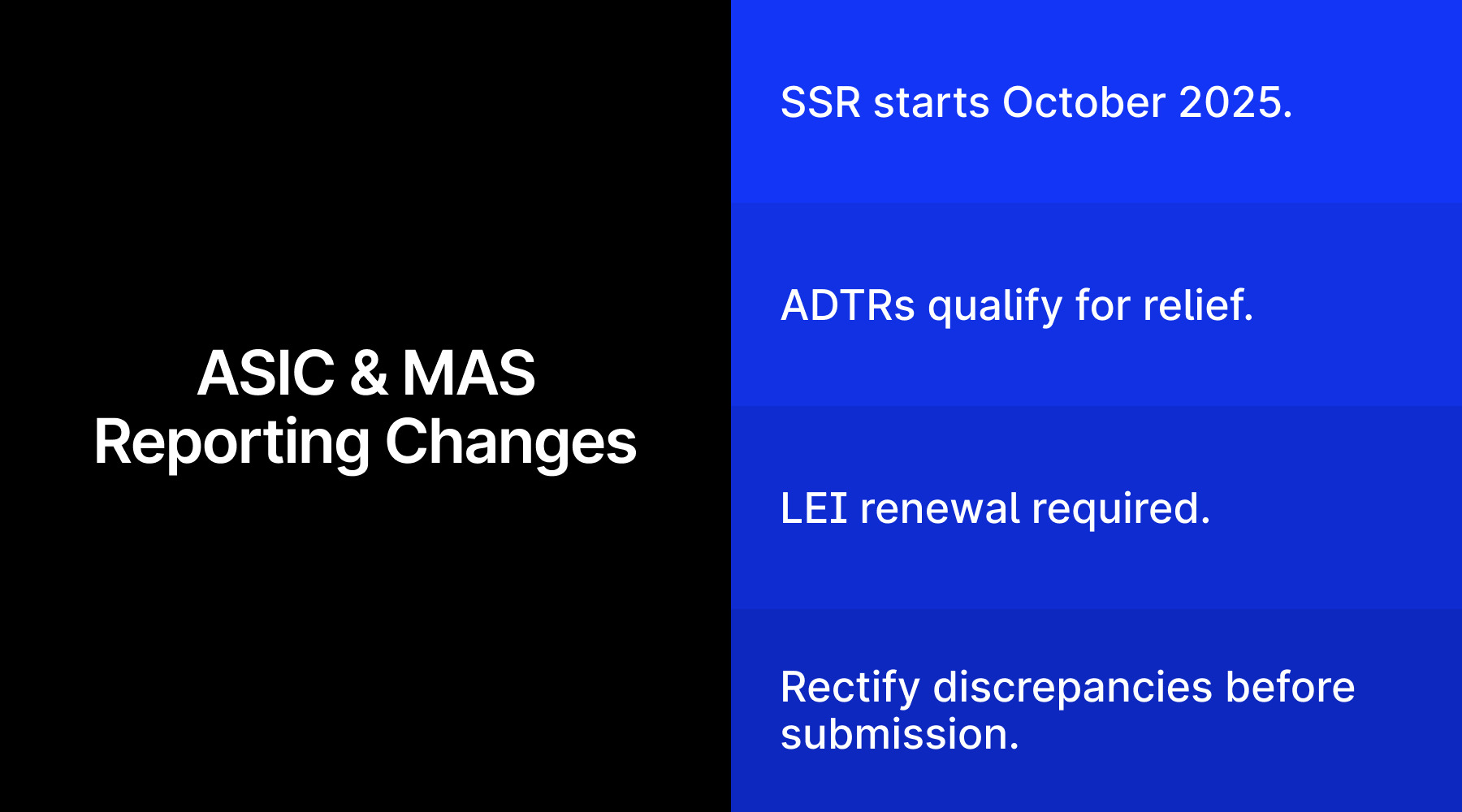
The ASIC Rewrite introduces changes to single-sided reporting (SSR) from October 2025. Alternative reporting arrangements will no longer apply, and only ADTRs will qualify for SSR relief. Counterparties must conduct regular checks on trades reported on their behalf to meet eligibility requirements.

Market participants should review their delegated reporting agreements and internal systems to align with the updated regulations. Collateral reporting obligations under the ASIC Rewrite, including the reporting of collateral received, also require consideration.

Recent updates under the EU EMIR Refit, UK EMIR Refit, and the ASIC and MAS Rewrite frameworks have introduced stricter trade reporting obligations. Market participants must adjust their agreements with liquidity providers to comply with the new requirements.

Automated UTI Assignment Systems Help Mitigate Discrepancies

A primary focus is the Unique Transaction Identifier (UTI). The regulatory regimes mandate that both parties to a trade submit identical UTIs in their transaction reports. The responsibility for UTI generation should be clarified in trading agreements or separate bilateral documents.

Jurisdictions like MAS expect counterparties to establish internal policies governing the UTI creation process. Automated systems for UTI assignment can help mitigate discrepancies, particularly for high-volume trading relationships.

Consistent Reporting of Key Fields Under Scrutiny

Pairing and matching processes are also under scrutiny. Counterparties must ensure consistent reporting of key fields such as UTI, ISIN, transaction direction, and execution venue. Clear protocols should be in place to resolve mismatches, with designated contact points on both sides.

Although ASIC does not enforce report matching, its adherence to the IOSCO UTI waterfall increases the likelihood of alignment efforts by Australian Derivative Trade Repositories (ADTRs).

Document UPI Sharing Mechanisms for Regulatory Clarity

Delegated reporting arrangements require additional provisions. Reporting delegates, such as TRAction, should be authorized to contact both parties to rectify discrepancies before submission. Pre-submission checks can identify potential mismatches, helping counterparties avoid regulatory breaches.

Legal Entity Identifier (LEI) renewals are another critical requirement. Regulators reject trades involving lapsed LEIs in EMIR and MiFIR reports, necessitating resubmission after renewal. Timely LEI updates are essential to maintain uninterrupted reporting. However, the obligation does not apply to counterparty 2 under ASIC and MAS rules.

Unique Product Identifier (UPI) sharing mechanisms should be documented, with one party designated to obtain UPIs from the ANNA DSB library. Written agreements can provide operational clarity and demonstrate compliance during regulatory reviews.

New ASIC Rules Require Regular Checks for SSR

The ASIC Rewrite introduces changes to single-sided reporting (SSR) from October 2025. Alternative reporting arrangements will no longer apply, and only ADTRs will qualify for SSR relief. Counterparties must conduct regular checks on trades reported on their behalf to meet eligibility requirements.

Market participants should review their delegated reporting agreements and internal systems to align with the updated regulations. Collateral reporting obligations under the ASIC Rewrite, including the reporting of collateral received, also require consideration.

About the Author: Quinn Perrott
Quinn Perrott
  • 12 Articles
  • 13 Followers
Quinn is Co-CEO and founder of TRAction and focuses on assisting clients in Europe, Asia and Australia to meet their regulatory requirements with trade and transaction reporting solutions as well as development of the best execution platform. With a background in IT, Quinn started in the financial markets as IT Manager for City Index. He then co-founded and worked as a General Manager at one of Australia’s largest margin FX and CFD providers. Quinn has provided educational sessions to Australia’s regulatory bodies in relation to operational aspects of derivatives and trading platforms.

More from the Author

Institutional FX