A new report reveals hedge funds' growing concerns over FX prime brokerage consolidation.
Firms face risks like reduced liquidity and lack of backup plans if their primary broker exits.
The Dow took a nosedive on Wednesday, shedding 1,123 points in its worst session of the month.
Consolidation
in the forex prime brokerage (FX PB) sector is becoming increasingly apparent,
especially to hedge funds. A new report by Acuiti, commissioned by Standard
Chartered, underscores the growing concerns among fund managers about the
adverse changes occurring in the sector. The study, based on interviews with 57
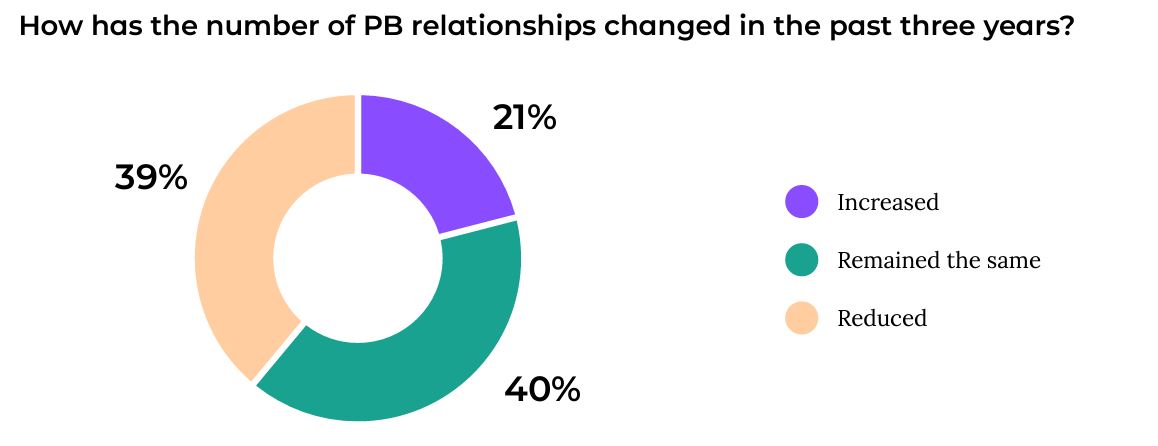
hedge fund operations executives, shows that nearly 40% have reduced their FX
PB partnerships in the past three years, often because providers are exiting
the market.
Declining Number of FX
Prime Brokerage Relationships
The report
revealed that hedge funds are increasingly worried about the thinning landscape
of FX PB providers. The most common reason for reducing these relationships was
an internal consolidation decision. However, one-third of the firms that
reduced their FX PB providers did so because their existing broker withdrew
from the market, while 24% were forcibly offboarded.
Source: Acuiti
Firms that
were either offboarded or whose provider left the market reported multiple
challenges. These included reduced access to liquidity, the costs associated
with onboarding a new broker, and heightened operational and settlement risks.
Notably, more than a third of these firms lacked a contingency plan, further
intensifying their concerns.
“Hedge
funds are highly reliant on their FX PB providers and it is no surprise that
levels of concern are high across the market,” Ross Lancaster, the Head of
Research at Acuiti, commented.
Also, the
industry's risk profile has undergone scrutiny following several high-profile
losses, including the Archegos Capital Management collapse. These incidents
have led to increased minimum monthly commissions and the offboarding of
smaller firms that offer lower transaction volumes, creating a two-tier market.
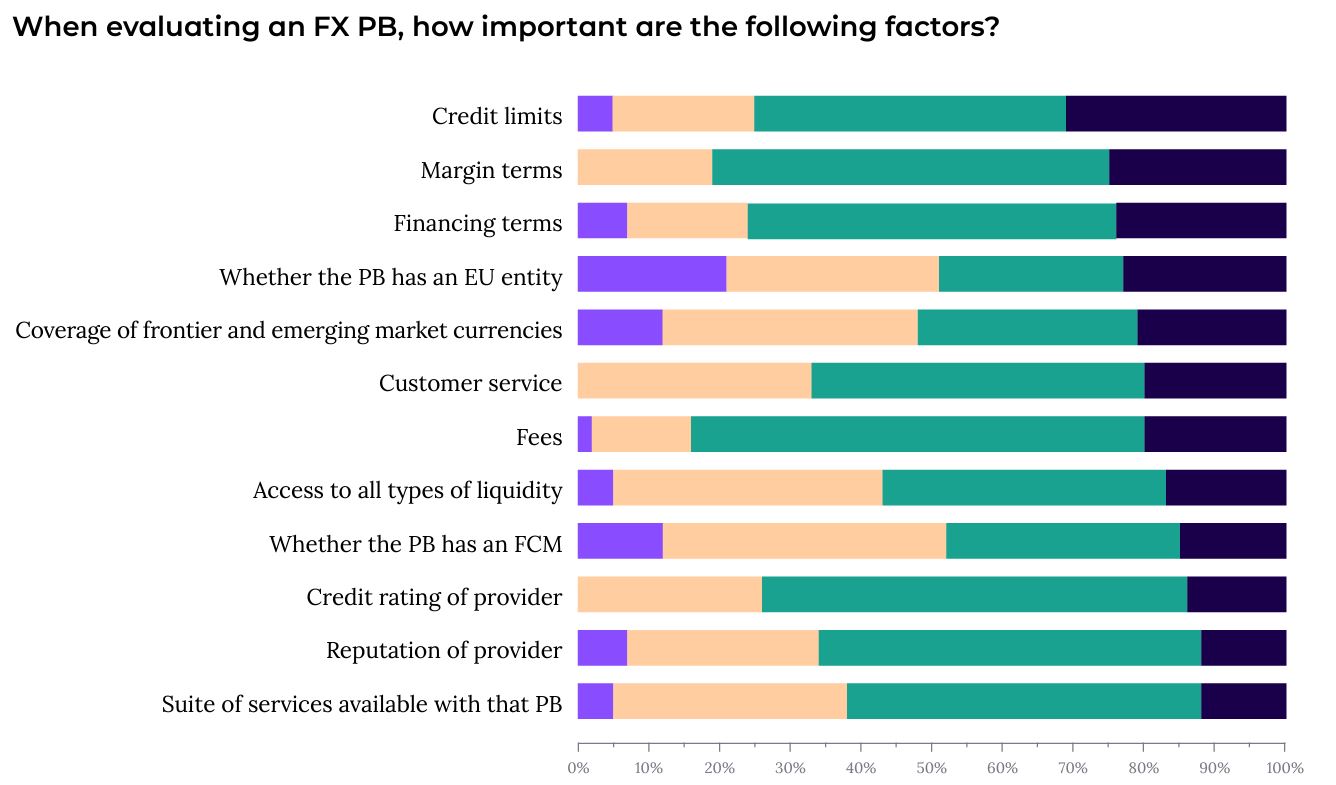
Source: Acuiti
“There is
an opportunity for expansion among the sell-side to meet the demand from hedge
funds both to access unique trading opportunities in emerging and frontier
markets but also to reduce operational risk associated with the dependence on
specific providers,” Lancaster added.
Satisfaction Levels Vary
by Firm Size
In addition,
the study found that smaller hedge funds, particularly those with Assets Under
Management (AUM) of less than $1 billion, risk facing limited provider options.
Hedge
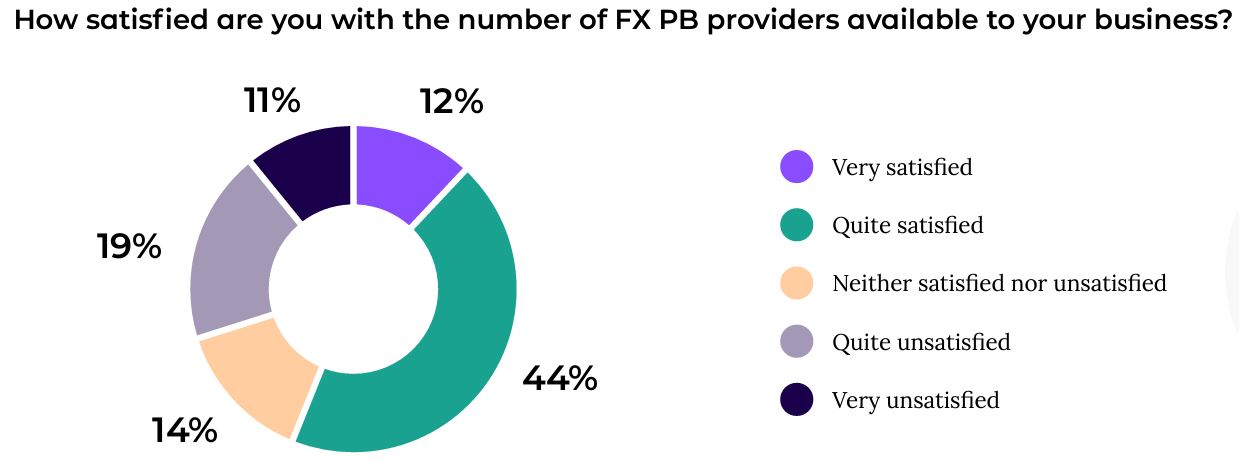
funds' contentment with the number of available FX PB providers differed
substantially based on the size of their AUM. Around 43% of firms with an AUM of
less than $1 billion expressed dissatisfaction, compared to only 12% and 8%
among firms with an AUM of over $5 billion. Consequently, smaller hedge funds
are increasingly dissatisfied with their limited options.
Source: Acuiti
In 2023, there has indeed been little talk about new FX PBs entering the market. Instead, the focus has been on existing firms being acquired. For example, in September, Marex announced the acquisition of Cowen's prime brokerage business. However, the cryptocurrency market offers an opportunity for industry growth, where investors are continually seeking greater trust.
Impact and Future Outlook
Over half
of the surveyed firms were quite concerned about the possibility of their FX PB
providers exiting the market, while 16% were very concerned. Andy Ross, the Global
Head of Prime & Financing at Standard Chartered, noted that hedge funds are
facing increasing challenges in finding a reliable FX PB provider, particularly
as they seek to expand their currency trading strategies.
Therefore,
as the market continues to evolve, hedge funds must be increasingly strategic
in choosing their FX PB providers, especially in a consolidating market that
poses both operational and liquidity risks.
“At the
same time, with ongoing growth in the global market place, hedge funds from
across the world are looking for a partner that can provide access to a broad
spectrum of currencies to optimise their trading strategies,” Ross concluded.
This
research report draws upon a survey involving 57 hedge funds, with participants
hailing from various regions, including North America (19%), the European Union
(24%), the UK (29%), Asia (22%), and other parts of the world (6%). The AUM for
these funds ranged from $0-100 million (11%), $101-500 million (16%), $501
million-1 billion (14%), $1-5 billion (23%), to over $5 billion (37%).
Consolidation
in the forex prime brokerage (FX PB) sector is becoming increasingly apparent,
especially to hedge funds. A new report by Acuiti, commissioned by Standard
Chartered, underscores the growing concerns among fund managers about the
adverse changes occurring in the sector. The study, based on interviews with 57
hedge fund operations executives, shows that nearly 40% have reduced their FX
PB partnerships in the past three years, often because providers are exiting
the market.
Declining Number of FX
Prime Brokerage Relationships
The report
revealed that hedge funds are increasingly worried about the thinning landscape
of FX PB providers. The most common reason for reducing these relationships was
an internal consolidation decision. However, one-third of the firms that
reduced their FX PB providers did so because their existing broker withdrew
from the market, while 24% were forcibly offboarded.
Source: Acuiti
Firms that
were either offboarded or whose provider left the market reported multiple
challenges. These included reduced access to liquidity, the costs associated
with onboarding a new broker, and heightened operational and settlement risks.
Notably, more than a third of these firms lacked a contingency plan, further
intensifying their concerns.
“Hedge
funds are highly reliant on their FX PB providers and it is no surprise that
levels of concern are high across the market,” Ross Lancaster, the Head of
Research at Acuiti, commented.
Also, the
industry's risk profile has undergone scrutiny following several high-profile
losses, including the Archegos Capital Management collapse. These incidents
have led to increased minimum monthly commissions and the offboarding of
smaller firms that offer lower transaction volumes, creating a two-tier market.
Source: Acuiti
“There is
an opportunity for expansion among the sell-side to meet the demand from hedge
funds both to access unique trading opportunities in emerging and frontier
markets but also to reduce operational risk associated with the dependence on
specific providers,” Lancaster added.
Satisfaction Levels Vary
by Firm Size
In addition,
the study found that smaller hedge funds, particularly those with Assets Under
Management (AUM) of less than $1 billion, risk facing limited provider options.
Hedge
funds' contentment with the number of available FX PB providers differed
substantially based on the size of their AUM. Around 43% of firms with an AUM of
less than $1 billion expressed dissatisfaction, compared to only 12% and 8%
among firms with an AUM of over $5 billion. Consequently, smaller hedge funds
are increasingly dissatisfied with their limited options.
Source: Acuiti
In 2023, there has indeed been little talk about new FX PBs entering the market. Instead, the focus has been on existing firms being acquired. For example, in September, Marex announced the acquisition of Cowen's prime brokerage business. However, the cryptocurrency market offers an opportunity for industry growth, where investors are continually seeking greater trust.
Impact and Future Outlook
Over half
of the surveyed firms were quite concerned about the possibility of their FX PB
providers exiting the market, while 16% were very concerned. Andy Ross, the Global
Head of Prime & Financing at Standard Chartered, noted that hedge funds are
facing increasing challenges in finding a reliable FX PB provider, particularly
as they seek to expand their currency trading strategies.
Therefore,
as the market continues to evolve, hedge funds must be increasingly strategic
in choosing their FX PB providers, especially in a consolidating market that
poses both operational and liquidity risks.
“At the
same time, with ongoing growth in the global market place, hedge funds from
across the world are looking for a partner that can provide access to a broad
spectrum of currencies to optimise their trading strategies,” Ross concluded.
This
research report draws upon a survey involving 57 hedge funds, with participants
hailing from various regions, including North America (19%), the European Union
(24%), the UK (29%), Asia (22%), and other parts of the world (6%). The AUM for
these funds ranged from $0-100 million (11%), $101-500 million (16%), $501
million-1 billion (14%), $1-5 billion (23%), to over $5 billion (37%).
Damian Chmiel is a Senior Analyst & Editor at Finance Magnates with more than 15 years of experience in the CFD and online trading industry. Active as both a trader and journalist since 2010, he focuses on broker coverage, fintech innovation, and regulatory developments across Europe, the Middle East, and Asia.
His work includes interviews with C-level leaders at major brokerages and fintech platforms, as well as co-authoring Finance Magnates’ quarterly industry benchmarking reports. Damian’s reporting is data-driven, market-aware, and grounded in direct industry engagement. His analysis and commentary have also been cited by external media outlets, including Investing.com, Binance, The Asset, Stockhead, and Dispatch.
Education:
MA in Finance and Accounting, Cracow University of Economics
MetaTrader 5 Brokers Gain Direct Access to Vantage Liquidity via MetaQuotes’ Ultency
FP Markets Winner Spotlight 🏆 | Global Broker of the Year 2025 #Trading #Broker #Innovation #Shorts
FP Markets Winner Spotlight 🏆 | Global Broker of the Year 2025 #Trading #Broker #Innovation #Shorts
FP Markets takes the spotlight as Global Broker of the Year 2025 at the Finance Magnates Awards.
Martin Stoilov, Head of Client Experience, shares that trust, innovation, and people played a key role in the company’s success, supported by a strong foundation of integrity and client-centricity.
Following this milestone, FP Markets continues to focus on growth, technology investment, and its core values of transparency and excellence.
👉 Be part of FM Awards 2026: https://awards.financemagnates.com/#nominate
FP Markets takes the spotlight as Global Broker of the Year 2025 at the Finance Magnates Awards.
Martin Stoilov, Head of Client Experience, shares that trust, innovation, and people played a key role in the company’s success, supported by a strong foundation of integrity and client-centricity.
Following this milestone, FP Markets continues to focus on growth, technology investment, and its core values of transparency and excellence.
👉 Be part of FM Awards 2026: https://awards.financemagnates.com/#nominate
In this video, we review @HolaPrimeMarketsOfficial, a multi-asset forex and CFDs broker offering different account types, trading platforms, and flexible trading conditions.
We cover the broker’s overall offering, including account options, trading environment, platforms like MT4 and MT5, and additional services such as managed accounts and fast withdrawals.
Watch the full video to see if Hola Prime Markets fits your trading needs.
📣 Stay up to date with the latest in finance and trading. Follow Finance Magnates for industry news, insights, and global event coverage.
Connect with us:
🔗 LinkedIn: /financemagnates
👍 Facebook: /financemagnates
📸 Instagram: https://www.instagram.com/financemagnates
🐦 X: https://x.com/financemagnates
🎥 TikTok: https://www.tiktok.com/tag/financemagnates
▶️ YouTube: /@financemagnates_official
#HolaPrime #ForexBroker #CFDTrading #FinanceMagnates #Trading #Forex #BrokerReview
In this video, we review @HolaPrimeMarketsOfficial, a multi-asset forex and CFDs broker offering different account types, trading platforms, and flexible trading conditions.
We cover the broker’s overall offering, including account options, trading environment, platforms like MT4 and MT5, and additional services such as managed accounts and fast withdrawals.
Watch the full video to see if Hola Prime Markets fits your trading needs.
📣 Stay up to date with the latest in finance and trading. Follow Finance Magnates for industry news, insights, and global event coverage.
Connect with us:
🔗 LinkedIn: /financemagnates
👍 Facebook: /financemagnates
📸 Instagram: https://www.instagram.com/financemagnates
🐦 X: https://x.com/financemagnates
🎥 TikTok: https://www.tiktok.com/tag/financemagnates
▶️ YouTube: /@financemagnates_official
#HolaPrime #ForexBroker #CFDTrading #FinanceMagnates #Trading #Forex #BrokerReview
Hola Prime Review: What You Need to Know | Full Breakdown by Finance Magnates
Hola Prime Review: What You Need to Know | Full Breakdown by Finance Magnates
In this video, we review @HolaPrime_Global, a proprietary trading firm offering evaluation programs and performance-based payouts in simulated market environments.
We cover how the challenge model works, including account types, profit splits (up to 95%), trading rules, and what it takes to reach a funded account. You’ll also learn about available platforms like MT4, MT5, cTrader, and more, along with insights into payouts, support, and trading conditions.
Watch the full video to see if Hola Prime fits your trading style.
📣 Stay up to date with the latest in finance and trading. Follow Finance Magnates for industry news, insights, and global event coverage.
Connect with us:
🔗 LinkedIn: /financemagnates
👍 Facebook: /financemagnates
📸 Instagram: https://www.instagram.com/financemagnates
🐦 X: https://x.com/financemagnates
🎥 TikTok: https://www.tiktok.com/tag/financemagnates
▶️ YouTube: /@financemagnates_official
#HolaPrime #PropFirm #Trading #FinanceMagnates #Forex #FuturesTrading #TradingReview #PropFirmReview
In this video, we review @HolaPrime_Global, a proprietary trading firm offering evaluation programs and performance-based payouts in simulated market environments.
We cover how the challenge model works, including account types, profit splits (up to 95%), trading rules, and what it takes to reach a funded account. You’ll also learn about available platforms like MT4, MT5, cTrader, and more, along with insights into payouts, support, and trading conditions.
Watch the full video to see if Hola Prime fits your trading style.
📣 Stay up to date with the latest in finance and trading. Follow Finance Magnates for industry news, insights, and global event coverage.
Connect with us:
🔗 LinkedIn: /financemagnates
👍 Facebook: /financemagnates
📸 Instagram: https://www.instagram.com/financemagnates
🐦 X: https://x.com/financemagnates
🎥 TikTok: https://www.tiktok.com/tag/financemagnates
▶️ YouTube: /@financemagnates_official
#HolaPrime #PropFirm #Trading #FinanceMagnates #Forex #FuturesTrading #TradingReview #PropFirmReview
Axi Winner Spotlight 🏆 | Global Most Innovative Broker 2025 #Innovation #Trading #Fintech #Broker
Axi Winner Spotlight 🏆 | Global Most Innovative Broker 2025 #Innovation #Trading #Fintech #Broker
Axi takes the spotlight at the Finance Magnates Awards, winning Global Most Innovative Broker 2025.
Olivia Xenofontos and Ivanna Openko share how the team will feel: proud, motivated, and ready to keep delivering.
They also describe the night as well-organized, focused, and enjoyable for all.
👉 Be part of FM Awards 2026.
Axi takes the spotlight at the Finance Magnates Awards, winning Global Most Innovative Broker 2025.
Olivia Xenofontos and Ivanna Openko share how the team will feel: proud, motivated, and ready to keep delivering.
They also describe the night as well-organized, focused, and enjoyable for all.
👉 Be part of FM Awards 2026.
Recognition that matters.
Built on transparency.
Driven by the industry.
The Finance Magnates Awards 2026.
Nominations are now open.
🔗 https://awards.financemagnates.com/?utm_source=SM&utm_medium=social&utm_campaign=recognition-matters
Recognition that matters.
Built on transparency.
Driven by the industry.
The Finance Magnates Awards 2026.
Nominations are now open.
🔗 https://awards.financemagnates.com/?utm_source=SM&utm_medium=social&utm_campaign=recognition-matters