Most of the foreign exchange institutional platforms experienced declines following April's record highs.
Despite the dollar's worst performance in 5 decades, market volatility has surprisingly decreased rather than spiked.
Why the USD price is going down?
After a
record-breaking April and a particularly weak May, June 2025 brought relative
stabilization in terms of volumes across institutional foreign exchange (FX)
markets.
However,
geopolitical tensions, ongoing trade wars, and decisions made by Donald Trump,
combined with the dollar experiencing its worst performance in 50 years,
suggest that market calm remains elusive.
Let’s check
how trading volumes changed month-over-month and year-over-year across major
platforms, including Cboe FX, FXSpotStream, TFX, Euronext FX, and Fastmatch's
360T.
Subdued Volumes in the
United States
Cboe FX
volumes declined slightly in June, dropping from May's reported $1.06 trillion
to $1.01 trillion. However, due to fewer trading days in the past month,
average daily volumes (ADV) actually increased to $48.3 billion compared to
$47.9 billion the month prior.
When
compared to the same period last year, both metrics showed growth. Total
volumes in May 2024 stood at just under $971 billion, with ADV at $47.5
billion.
We observed
another month of significant volume weakening following the record-breaking
values achieved in April, when Trump-induced volatilitydrove
institutional-level trading activity in the currency markets to unprecedented
heights.
FXSpotStream
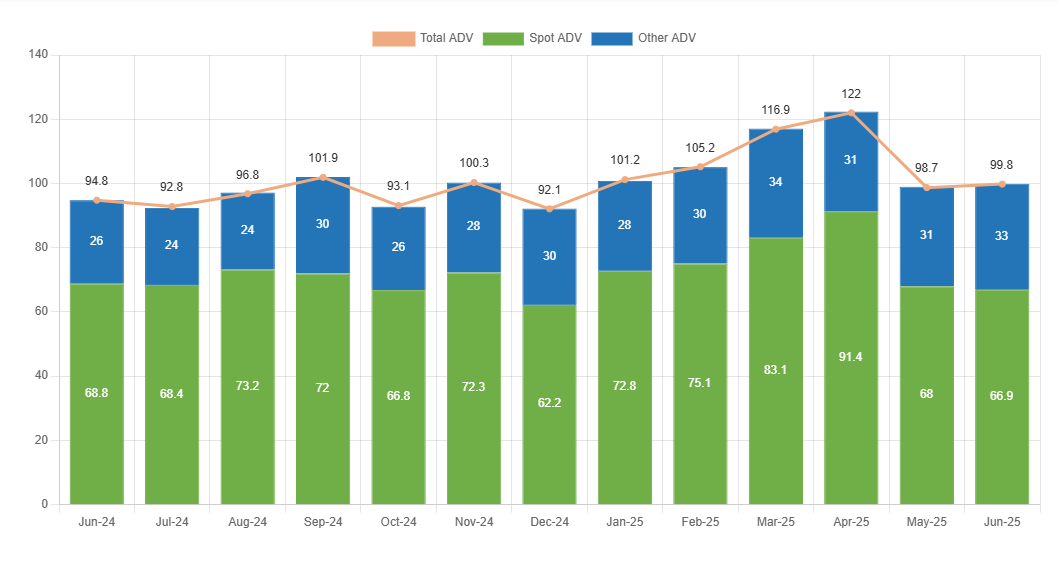
reported similar trends. After a sharp decline in May, June volumes remained at
year-to-date lows, recovering modestly from last month's $98.7 billion ADV to
$99.8 billion.
Source: FXSpotStream
Even Steeper Declines in
Japan
The
situation in the Japanese market tells a more dramatic story. Depreciation was
decidedly stronger, as evidenced by volume data from the Click 365 platform
operated by the Tokyo Stock Exchange. Total transaction volume reached 1.18
contracts, falling 18% compared to May and nearly 50% compared to the same
period last year. The average daily number of traded contracts stood at 56,225.
USD/JPY
remained the most popular trading pair, though it experienced a 31%
month-over-month decline in turnover and an 18% year-over-year drop.
Weak and Mixed Volumes
Across the Old Continent
European
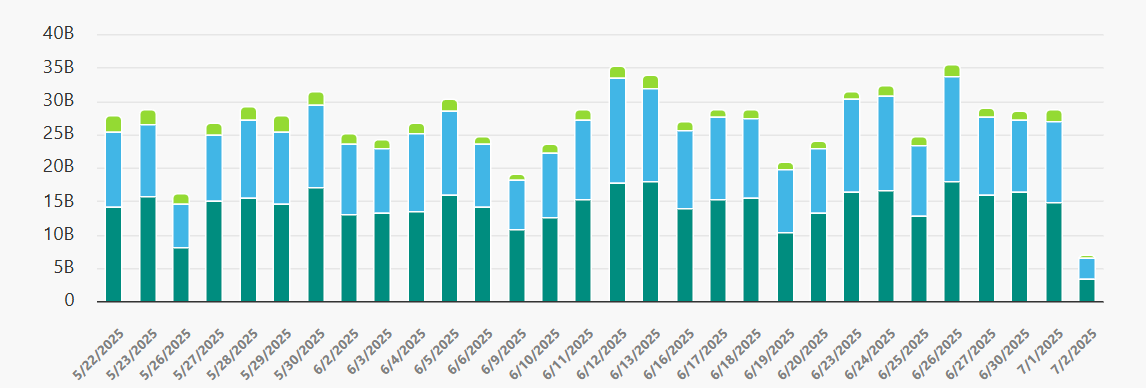
exchanges presented a mixed picture. Euronext FX total volume positioned itself
at nearly $609.5 billion in June, with average daily volume at $27.7 billion,
again declining sharply compared to values reported in recent months. May
recorded $719.87 billion, while the record-breaking April reached $893.1
billion.
Source: Euronext FX
Fastmatch's
360T platform, conversely, noted a rebound from May's steep decline when total
volumes dropped to $605.1 billion from $871 billion reported the month earlier.
This time, the figure reached $711.7 billion. ADV grew from $27.5 billion to
$33.9 billion in June.
Currently,
with the dollar posting its worst year-start in over 50 years and its index
testing the lowest levels since 2022, we would typically expect renewed
volatility spikes rather than market quieting.
After a
record-breaking April and a particularly weak May, June 2025 brought relative
stabilization in terms of volumes across institutional foreign exchange (FX)
markets.
However,
geopolitical tensions, ongoing trade wars, and decisions made by Donald Trump,
combined with the dollar experiencing its worst performance in 50 years,
suggest that market calm remains elusive.
Let’s check
how trading volumes changed month-over-month and year-over-year across major
platforms, including Cboe FX, FXSpotStream, TFX, Euronext FX, and Fastmatch's
360T.
Subdued Volumes in the
United States
Cboe FX
volumes declined slightly in June, dropping from May's reported $1.06 trillion
to $1.01 trillion. However, due to fewer trading days in the past month,
average daily volumes (ADV) actually increased to $48.3 billion compared to
$47.9 billion the month prior.
When
compared to the same period last year, both metrics showed growth. Total
volumes in May 2024 stood at just under $971 billion, with ADV at $47.5
billion.
We observed
another month of significant volume weakening following the record-breaking
values achieved in April, when Trump-induced volatilitydrove
institutional-level trading activity in the currency markets to unprecedented
heights.
FXSpotStream
reported similar trends. After a sharp decline in May, June volumes remained at
year-to-date lows, recovering modestly from last month's $98.7 billion ADV to
$99.8 billion.
Source: FXSpotStream
Even Steeper Declines in
Japan
The
situation in the Japanese market tells a more dramatic story. Depreciation was
decidedly stronger, as evidenced by volume data from the Click 365 platform
operated by the Tokyo Stock Exchange. Total transaction volume reached 1.18
contracts, falling 18% compared to May and nearly 50% compared to the same
period last year. The average daily number of traded contracts stood at 56,225.
USD/JPY
remained the most popular trading pair, though it experienced a 31%
month-over-month decline in turnover and an 18% year-over-year drop.
Weak and Mixed Volumes
Across the Old Continent
European
exchanges presented a mixed picture. Euronext FX total volume positioned itself
at nearly $609.5 billion in June, with average daily volume at $27.7 billion,
again declining sharply compared to values reported in recent months. May
recorded $719.87 billion, while the record-breaking April reached $893.1
billion.
Source: Euronext FX
Fastmatch's
360T platform, conversely, noted a rebound from May's steep decline when total
volumes dropped to $605.1 billion from $871 billion reported the month earlier.
This time, the figure reached $711.7 billion. ADV grew from $27.5 billion to
$33.9 billion in June.
Currently,
with the dollar posting its worst year-start in over 50 years and its index
testing the lowest levels since 2022, we would typically expect renewed
volatility spikes rather than market quieting.
Damian Chmiel is a Senior Analyst & Editor at Finance Magnates with more than 15 years of experience in the CFD and online trading industry. Active as both a trader and journalist since 2010, he focuses on broker coverage, fintech innovation, and regulatory developments across Europe, the Middle East, and Asia.
His work includes interviews with C-level leaders at major brokerages and fintech platforms, as well as co-authoring Finance Magnates’ quarterly industry benchmarking reports. Damian’s reporting is data-driven, market-aware, and grounded in direct industry engagement. His analysis and commentary have also been cited by external media outlets, including Investing.com, Binance, The Asset, Stockhead, and Dispatch.
Education:
MA in Finance and Accounting, Cracow University of Economics
MetaTrader 5 Brokers Gain Direct Access to Vantage Liquidity via MetaQuotes’ Ultency
FP Markets Winner Spotlight 🏆 | Global Broker of the Year 2025 #Trading #Broker #Innovation #Shorts
FP Markets Winner Spotlight 🏆 | Global Broker of the Year 2025 #Trading #Broker #Innovation #Shorts
FP Markets takes the spotlight as Global Broker of the Year 2025 at the Finance Magnates Awards.
Martin Stoilov, Head of Client Experience, shares that trust, innovation, and people played a key role in the company’s success, supported by a strong foundation of integrity and client-centricity.
Following this milestone, FP Markets continues to focus on growth, technology investment, and its core values of transparency and excellence.
👉 Be part of FM Awards 2026: https://awards.financemagnates.com/#nominate
FP Markets takes the spotlight as Global Broker of the Year 2025 at the Finance Magnates Awards.
Martin Stoilov, Head of Client Experience, shares that trust, innovation, and people played a key role in the company’s success, supported by a strong foundation of integrity and client-centricity.
Following this milestone, FP Markets continues to focus on growth, technology investment, and its core values of transparency and excellence.
👉 Be part of FM Awards 2026: https://awards.financemagnates.com/#nominate
In this video, we review @HolaPrimeMarketsOfficial, a multi-asset forex and CFDs broker offering different account types, trading platforms, and flexible trading conditions.
We cover the broker’s overall offering, including account options, trading environment, platforms like MT4 and MT5, and additional services such as managed accounts and fast withdrawals.
Watch the full video to see if Hola Prime Markets fits your trading needs.
📣 Stay up to date with the latest in finance and trading. Follow Finance Magnates for industry news, insights, and global event coverage.
Connect with us:
🔗 LinkedIn: /financemagnates
👍 Facebook: /financemagnates
📸 Instagram: https://www.instagram.com/financemagnates
🐦 X: https://x.com/financemagnates
🎥 TikTok: https://www.tiktok.com/tag/financemagnates
▶️ YouTube: /@financemagnates_official
#HolaPrime #ForexBroker #CFDTrading #FinanceMagnates #Trading #Forex #BrokerReview
In this video, we review @HolaPrimeMarketsOfficial, a multi-asset forex and CFDs broker offering different account types, trading platforms, and flexible trading conditions.
We cover the broker’s overall offering, including account options, trading environment, platforms like MT4 and MT5, and additional services such as managed accounts and fast withdrawals.
Watch the full video to see if Hola Prime Markets fits your trading needs.
📣 Stay up to date with the latest in finance and trading. Follow Finance Magnates for industry news, insights, and global event coverage.
Connect with us:
🔗 LinkedIn: /financemagnates
👍 Facebook: /financemagnates
📸 Instagram: https://www.instagram.com/financemagnates
🐦 X: https://x.com/financemagnates
🎥 TikTok: https://www.tiktok.com/tag/financemagnates
▶️ YouTube: /@financemagnates_official
#HolaPrime #ForexBroker #CFDTrading #FinanceMagnates #Trading #Forex #BrokerReview
Hola Prime Review: What You Need to Know | Full Breakdown by Finance Magnates
Hola Prime Review: What You Need to Know | Full Breakdown by Finance Magnates
In this video, we review @HolaPrime_Global, a proprietary trading firm offering evaluation programs and performance-based payouts in simulated market environments.
We cover how the challenge model works, including account types, profit splits (up to 95%), trading rules, and what it takes to reach a funded account. You’ll also learn about available platforms like MT4, MT5, cTrader, and more, along with insights into payouts, support, and trading conditions.
Watch the full video to see if Hola Prime fits your trading style.
📣 Stay up to date with the latest in finance and trading. Follow Finance Magnates for industry news, insights, and global event coverage.
Connect with us:
🔗 LinkedIn: /financemagnates
👍 Facebook: /financemagnates
📸 Instagram: https://www.instagram.com/financemagnates
🐦 X: https://x.com/financemagnates
🎥 TikTok: https://www.tiktok.com/tag/financemagnates
▶️ YouTube: /@financemagnates_official
#HolaPrime #PropFirm #Trading #FinanceMagnates #Forex #FuturesTrading #TradingReview #PropFirmReview
In this video, we review @HolaPrime_Global, a proprietary trading firm offering evaluation programs and performance-based payouts in simulated market environments.
We cover how the challenge model works, including account types, profit splits (up to 95%), trading rules, and what it takes to reach a funded account. You’ll also learn about available platforms like MT4, MT5, cTrader, and more, along with insights into payouts, support, and trading conditions.
Watch the full video to see if Hola Prime fits your trading style.
📣 Stay up to date with the latest in finance and trading. Follow Finance Magnates for industry news, insights, and global event coverage.
Connect with us:
🔗 LinkedIn: /financemagnates
👍 Facebook: /financemagnates
📸 Instagram: https://www.instagram.com/financemagnates
🐦 X: https://x.com/financemagnates
🎥 TikTok: https://www.tiktok.com/tag/financemagnates
▶️ YouTube: /@financemagnates_official
#HolaPrime #PropFirm #Trading #FinanceMagnates #Forex #FuturesTrading #TradingReview #PropFirmReview
Axi Winner Spotlight 🏆 | Global Most Innovative Broker 2025 #Innovation #Trading #Fintech #Broker
Axi Winner Spotlight 🏆 | Global Most Innovative Broker 2025 #Innovation #Trading #Fintech #Broker
Axi takes the spotlight at the Finance Magnates Awards, winning Global Most Innovative Broker 2025.
Olivia Xenofontos and Ivanna Openko share how the team will feel: proud, motivated, and ready to keep delivering.
They also describe the night as well-organized, focused, and enjoyable for all.
👉 Be part of FM Awards 2026.
Axi takes the spotlight at the Finance Magnates Awards, winning Global Most Innovative Broker 2025.
Olivia Xenofontos and Ivanna Openko share how the team will feel: proud, motivated, and ready to keep delivering.
They also describe the night as well-organized, focused, and enjoyable for all.
👉 Be part of FM Awards 2026.
Recognition that matters.
Built on transparency.
Driven by the industry.
The Finance Magnates Awards 2026.
Nominations are now open.
🔗 https://awards.financemagnates.com/?utm_source=SM&utm_medium=social&utm_campaign=recognition-matters
Recognition that matters.
Built on transparency.
Driven by the industry.
The Finance Magnates Awards 2026.
Nominations are now open.
🔗 https://awards.financemagnates.com/?utm_source=SM&utm_medium=social&utm_campaign=recognition-matters