
FXSpotStream raced ahead of CBOE FX in the final quarter of 2018, as top players cede market share
FM
The composition of the group of market players offering electronic FX trading shifted somewhat over the past year. While traditional leaders kept things steady at the top in the face of Thomson Reuters and CME Group’s NEX acquisition, the company holding the third spot changed in the latter part of 2018 as FXSpotStream raced ahead of CBOE FX.
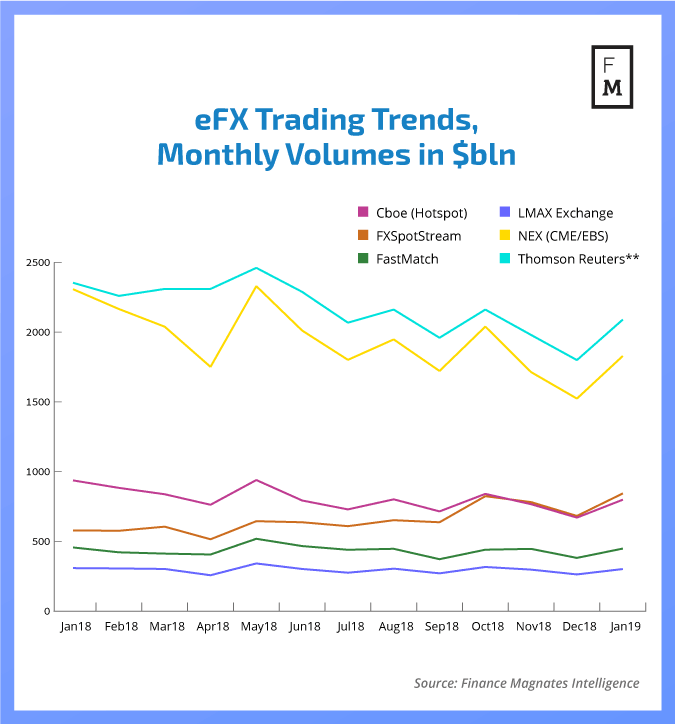
eFX Trading Volumes Trends throughout 2018, Source: FM Intelligence
Over the past year, the market share losers have been the biggest players in the eFX space. Both Thomson Reuters and CME Group’s NEX EBS division left more room for smaller companies.
Between 2017 and 2018, the dominance of the two biggest eFX trading volumes handlers that are reporting their numbers publicly declined by a touch over five percent. That said, Thomson Reuters and EBS are still holding close to two-thirds of eFX trading volumes as of 2018.
Over a year, which was marked by low volatility, competition among market players has naturally increased. The trading venues have undertaken a number of initiatives to promote their services with FXSpotStream adding State Street in February and highlighting its NDFs offering which it launched in 2017.
We touched upon the increasingly brisk volumes from the company in July last year, but towards the end of the year, that growth rate accelerated. FXSpotStream raced ahead of CBOE FX in the final quarter of 2018 and kept its lead intact in January 2019.
The annual growth rate for January 2019 reached over 46 percent, a figure that was also highlighted by a monthly increase of 18 percent when compared to December of 2018. The company shattered multiple records throughout last year and started 2019 with another one.
Asked about the reasons behind the growth of the company's service, CEO Alan Schwarz pointed to FXSpotStream’s unique business model, the vast expansion of the offering beyond spot, which also includes swaps, forwards, NDFs/NDS and precious metal spot and swaps, the high touch level of support provided, and the continued migration of volume from anonymous to disclosed channels.
Overall, last year the foreign exchange market has been relatively slow. The first quarter proved to be somewhat active, as the US dollar ceded ground across the board. Over the next nine months, however, the greenback slowly recovered its losses and finished the year close to unchanged.
Institutional traders have gradually lost appetite in the market as political uncertainty dominated the space in Europe. In the meantime, the lack of further escalation in trade wars prevented any material trends from emerging. That didn’t prevent the overall volume across eFX products from increasing by 17 percent across the publicly reporting venues that Finance Magnates tracked.
With all that said and done, 2019 started with a bang for the FX market. Unfortunately for most traders, however, the flash crash spike from the first big trading day of the year didn’t lead to a sustained rise in volatility.
Market Share Developments
When looking at market share developments across the eFX spectrum we took two different approaches. We first compared January 2018 to January 2019, a statistic that singled out FXSpotStream as the fastest growing eFX trading venue especially in the latter part of 2018 when it reported multiple records.
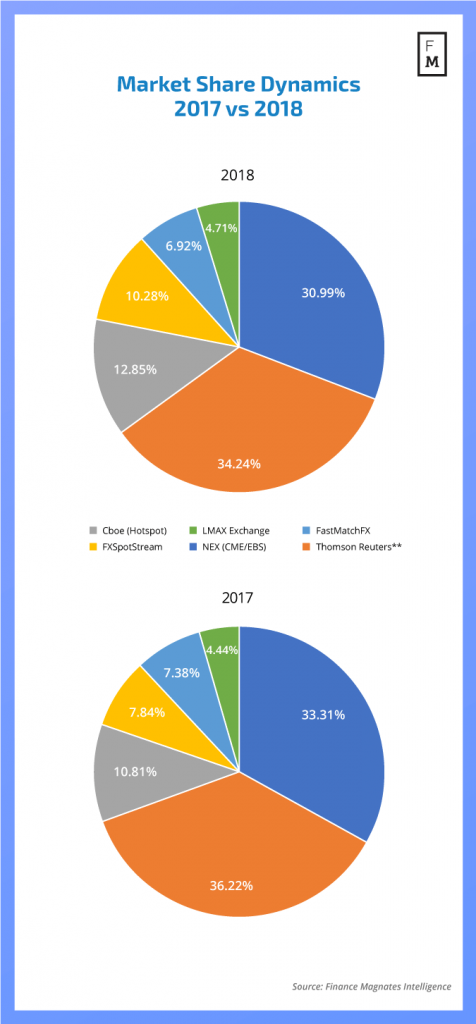
eFX Market Share Dynamics 2018 vs 2017, Source: FM Intelligence
Overall for 2018, the firm’s market share increased by almost 2.5 percentage points to just above 10 percent. In the meantime despite the losing third spot, CBOE FX also marked an increase by just below two percent at the cost of both Thomson Reuters and CME’s NEX EBS division, which lost two and 2.2 percent respectively.
Looking at January 2019, the market share developments year-on-year show Thomson Reuters dropping by less than one percentage point when compared to January 2018 to just above 33 percent of the total volumes. CME Group’s NEX EBS division marks a more pronounced drop from 33 percent to 29 percent. CBOE FX drops slightly by about one point to just below 13 percent.
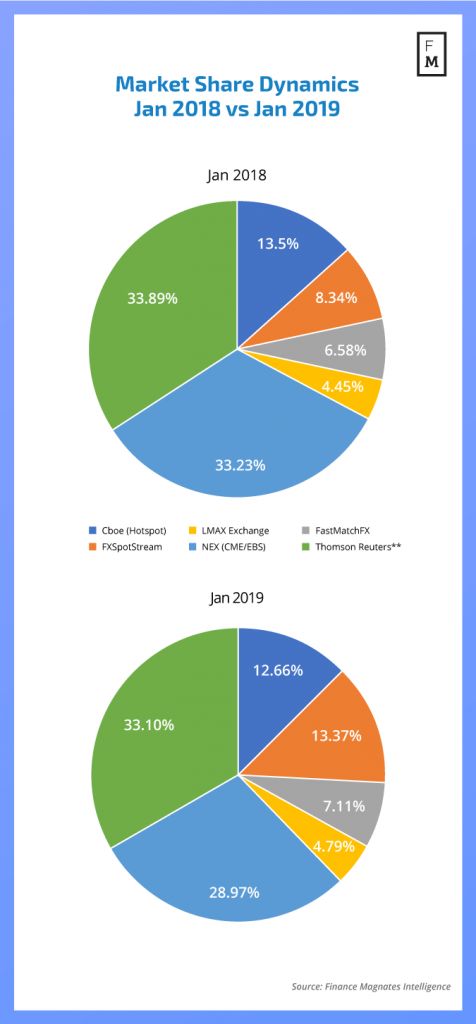
eFX Market Share Dynamics January 2019 vs January 2018, Source: FM Intelligence
The bulk of growth in market share falls on FXSpotStream which managed to raise its trading volumes to as much as 13.3 percent of the total among publicly reporting eFX trading volumes. It inched ahead of CBOE FX marginally, and this race is likely to heat up in the coming months especially if the FX volatility cycle turns.
LMAX is another company that gained market share with a small bump to just below five percent. Euronext’s investment in Fastmatch lost out to competitors over 2018, but is looking to an upbeat start in 2019 with roughly seven percent of the total trading volumes transacted via venues tracked by the Finance Magnates Intelligence department.
The composition of the group of market players offering electronic FX trading shifted somewhat over the past year. While traditional leaders kept things steady at the top in the face of Thomson Reuters and CME Group’s NEX acquisition, the company holding the third spot changed in the latter part of 2018 as FXSpotStream raced ahead of CBOE FX.
eFX Trading Volumes Trends throughout 2018, Source: FM Intelligence
Over the past year, the market share losers have been the biggest players in the eFX space. Both Thomson Reuters and CME Group’s NEX EBS division left more room for smaller companies.
Between 2017 and 2018, the dominance of the two biggest eFX trading volumes handlers that are reporting their numbers publicly declined by a touch over five percent. That said, Thomson Reuters and EBS are still holding close to two-thirds of eFX trading volumes as of 2018.
Over a year, which was marked by low volatility, competition among market players has naturally increased. The trading venues have undertaken a number of initiatives to promote their services with FXSpotStream adding State Street in February and highlighting its NDFs offering which it launched in 2017.
We touched upon the increasingly brisk volumes from the company in July last year, but towards the end of the year, that growth rate accelerated. FXSpotStream raced ahead of CBOE FX in the final quarter of 2018 and kept its lead intact in January 2019.
The annual growth rate for January 2019 reached over 46 percent, a figure that was also highlighted by a monthly increase of 18 percent when compared to December of 2018. The company shattered multiple records throughout last year and started 2019 with another one.
Asked about the reasons behind the growth of the company's service, CEO Alan Schwarz pointed to FXSpotStream’s unique business model, the vast expansion of the offering beyond spot, which also includes swaps, forwards, NDFs/NDS and precious metal spot and swaps, the high touch level of support provided, and the continued migration of volume from anonymous to disclosed channels.
Overall, last year the foreign exchange market has been relatively slow. The first quarter proved to be somewhat active, as the US dollar ceded ground across the board. Over the next nine months, however, the greenback slowly recovered its losses and finished the year close to unchanged.
Institutional traders have gradually lost appetite in the market as political uncertainty dominated the space in Europe. In the meantime, the lack of further escalation in trade wars prevented any material trends from emerging. That didn’t prevent the overall volume across eFX products from increasing by 17 percent across the publicly reporting venues that Finance Magnates tracked.
With all that said and done, 2019 started with a bang for the FX market. Unfortunately for most traders, however, the flash crash spike from the first big trading day of the year didn’t lead to a sustained rise in volatility.
Market Share Developments
When looking at market share developments across the eFX spectrum we took two different approaches. We first compared January 2018 to January 2019, a statistic that singled out FXSpotStream as the fastest growing eFX trading venue especially in the latter part of 2018 when it reported multiple records.
eFX Market Share Dynamics 2018 vs 2017, Source: FM Intelligence
Overall for 2018, the firm’s market share increased by almost 2.5 percentage points to just above 10 percent. In the meantime despite the losing third spot, CBOE FX also marked an increase by just below two percent at the cost of both Thomson Reuters and CME’s NEX EBS division, which lost two and 2.2 percent respectively.
Looking at January 2019, the market share developments year-on-year show Thomson Reuters dropping by less than one percentage point when compared to January 2018 to just above 33 percent of the total volumes. CME Group’s NEX EBS division marks a more pronounced drop from 33 percent to 29 percent. CBOE FX drops slightly by about one point to just below 13 percent.
eFX Market Share Dynamics January 2019 vs January 2018, Source: FM Intelligence
The bulk of growth in market share falls on FXSpotStream which managed to raise its trading volumes to as much as 13.3 percent of the total among publicly reporting eFX trading volumes. It inched ahead of CBOE FX marginally, and this race is likely to heat up in the coming months especially if the FX volatility cycle turns.
LMAX is another company that gained market share with a small bump to just below five percent. Euronext’s investment in Fastmatch lost out to competitors over 2018, but is looking to an upbeat start in 2019 with roughly seven percent of the total trading volumes transacted via venues tracked by the Finance Magnates Intelligence department.
GCEX Secures MiCA Licence in Denmark as EU Crypto Regulation Takes Shape
Featured Videos
Executive Interview | Charlotte Bullock | Chief Product Officer, Bank of London | FMLS:25
In this interview, we sat down with Charlotte Bullock, Head of Product at The Bank of London, previously at SAP and now shaping product at one of the sector’s most ambitious new banking players.
Charlotte reflects on the Summit so far and talks about the culture inside fintech banks today. We look at the pressures that come with scaling, and how firms can hold onto the nimble approach that made them stand out early on.
We also cover the state of payments ahead of her appearance on the payments roundtable: the blockages financial firms face, the areas that still need fixing, and what a realistic solution looks like in 2026.
In this interview, we sat down with Charlotte Bullock, Head of Product at The Bank of London, previously at SAP and now shaping product at one of the sector’s most ambitious new banking players.
Charlotte reflects on the Summit so far and talks about the culture inside fintech banks today. We look at the pressures that come with scaling, and how firms can hold onto the nimble approach that made them stand out early on.
We also cover the state of payments ahead of her appearance on the payments roundtable: the blockages financial firms face, the areas that still need fixing, and what a realistic solution looks like in 2026.
In this interview, we sat down with Charlotte Bullock, Head of Product at The Bank of London, previously at SAP and now shaping product at one of the sector’s most ambitious new banking players.
Charlotte reflects on the Summit so far and talks about the culture inside fintech banks today. We look at the pressures that come with scaling, and how firms can hold onto the nimble approach that made them stand out early on.
We also cover the state of payments ahead of her appearance on the payments roundtable: the blockages financial firms face, the areas that still need fixing, and what a realistic solution looks like in 2026.
In this interview, we sat down with Charlotte Bullock, Head of Product at The Bank of London, previously at SAP and now shaping product at one of the sector’s most ambitious new banking players.
Charlotte reflects on the Summit so far and talks about the culture inside fintech banks today. We look at the pressures that come with scaling, and how firms can hold onto the nimble approach that made them stand out early on.
We also cover the state of payments ahead of her appearance on the payments roundtable: the blockages financial firms face, the areas that still need fixing, and what a realistic solution looks like in 2026.
In this conversation, we sit down with Drew Niv, CSO at ATFX Connect and one of the most influential figures in modern FX.
We speak about market structure, the institutional view on liquidity, and the sharp rise of prop trading, a sector Drew has been commenting on in recent months. Drew explains why he once dismissed prop trading, why his view changed, and what he now thinks the model means for brokers, clients and risk managers.
We explore subscription-fee dependency, the high reneging rate, and the long-term challenge: how brokers can build a more stable and honest version of the model. Drew also talks about the traffic advantage standalone prop firms have built and why brokers may still win in the long run if they take the right approach.
In this conversation, we sit down with Drew Niv, CSO at ATFX Connect and one of the most influential figures in modern FX.
We speak about market structure, the institutional view on liquidity, and the sharp rise of prop trading, a sector Drew has been commenting on in recent months. Drew explains why he once dismissed prop trading, why his view changed, and what he now thinks the model means for brokers, clients and risk managers.
We explore subscription-fee dependency, the high reneging rate, and the long-term challenge: how brokers can build a more stable and honest version of the model. Drew also talks about the traffic advantage standalone prop firms have built and why brokers may still win in the long run if they take the right approach.
In this conversation, we sit down with Drew Niv, CSO at ATFX Connect and one of the most influential figures in modern FX.
We speak about market structure, the institutional view on liquidity, and the sharp rise of prop trading, a sector Drew has been commenting on in recent months. Drew explains why he once dismissed prop trading, why his view changed, and what he now thinks the model means for brokers, clients and risk managers.
We explore subscription-fee dependency, the high reneging rate, and the long-term challenge: how brokers can build a more stable and honest version of the model. Drew also talks about the traffic advantage standalone prop firms have built and why brokers may still win in the long run if they take the right approach.
In this conversation, we sit down with Drew Niv, CSO at ATFX Connect and one of the most influential figures in modern FX.
We speak about market structure, the institutional view on liquidity, and the sharp rise of prop trading, a sector Drew has been commenting on in recent months. Drew explains why he once dismissed prop trading, why his view changed, and what he now thinks the model means for brokers, clients and risk managers.
We explore subscription-fee dependency, the high reneging rate, and the long-term challenge: how brokers can build a more stable and honest version of the model. Drew also talks about the traffic advantage standalone prop firms have built and why brokers may still win in the long run if they take the right approach.
In this conversation, we sit down with Drew Niv, CSO at ATFX Connect and one of the most influential figures in modern FX.
We speak about market structure, the institutional view on liquidity, and the sharp rise of prop trading, a sector Drew has been commenting on in recent months. Drew explains why he once dismissed prop trading, why his view changed, and what he now thinks the model means for brokers, clients and risk managers.
We explore subscription-fee dependency, the high reneging rate, and the long-term challenge: how brokers can build a more stable and honest version of the model. Drew also talks about the traffic advantage standalone prop firms have built and why brokers may still win in the long run if they take the right approach.
In this conversation, we sit down with Drew Niv, CSO at ATFX Connect and one of the most influential figures in modern FX.
We speak about market structure, the institutional view on liquidity, and the sharp rise of prop trading, a sector Drew has been commenting on in recent months. Drew explains why he once dismissed prop trading, why his view changed, and what he now thinks the model means for brokers, clients and risk managers.
We explore subscription-fee dependency, the high reneging rate, and the long-term challenge: how brokers can build a more stable and honest version of the model. Drew also talks about the traffic advantage standalone prop firms have built and why brokers may still win in the long run if they take the right approach.
Executive Interview | Remonda Z. Kirketerp Møller| CEO & Founder Muinmos | FMLS:25
In this interview, Remonda Z. Kirketerp Møller, founder of Muinmos, breaks down the state of AI in regtech and what responsible adoption really looks like for brokers. We talk about rising fragmentation, the pressures around compliance accuracy, and why most firms are still in the early stages of AI maturity.
Ramanda also shares insights on regulator sandboxes, shifting expectations around accountability, and the current reality of MiCA licensing and passporting in Europe.
A concise look at where compliance, onboarding, and AI-driven processes are heading next.
In this interview, Remonda Z. Kirketerp Møller, founder of Muinmos, breaks down the state of AI in regtech and what responsible adoption really looks like for brokers. We talk about rising fragmentation, the pressures around compliance accuracy, and why most firms are still in the early stages of AI maturity.
Ramanda also shares insights on regulator sandboxes, shifting expectations around accountability, and the current reality of MiCA licensing and passporting in Europe.
A concise look at where compliance, onboarding, and AI-driven processes are heading next.
In this interview, Remonda Z. Kirketerp Møller, founder of Muinmos, breaks down the state of AI in regtech and what responsible adoption really looks like for brokers. We talk about rising fragmentation, the pressures around compliance accuracy, and why most firms are still in the early stages of AI maturity.
Ramanda also shares insights on regulator sandboxes, shifting expectations around accountability, and the current reality of MiCA licensing and passporting in Europe.
A concise look at where compliance, onboarding, and AI-driven processes are heading next.
In this interview, Remonda Z. Kirketerp Møller, founder of Muinmos, breaks down the state of AI in regtech and what responsible adoption really looks like for brokers. We talk about rising fragmentation, the pressures around compliance accuracy, and why most firms are still in the early stages of AI maturity.
Ramanda also shares insights on regulator sandboxes, shifting expectations around accountability, and the current reality of MiCA licensing and passporting in Europe.
A concise look at where compliance, onboarding, and AI-driven processes are heading next.
In this interview, Remonda Z. Kirketerp Møller, founder of Muinmos, breaks down the state of AI in regtech and what responsible adoption really looks like for brokers. We talk about rising fragmentation, the pressures around compliance accuracy, and why most firms are still in the early stages of AI maturity.
Ramanda also shares insights on regulator sandboxes, shifting expectations around accountability, and the current reality of MiCA licensing and passporting in Europe.
A concise look at where compliance, onboarding, and AI-driven processes are heading next.
In this interview, Remonda Z. Kirketerp Møller, founder of Muinmos, breaks down the state of AI in regtech and what responsible adoption really looks like for brokers. We talk about rising fragmentation, the pressures around compliance accuracy, and why most firms are still in the early stages of AI maturity.
Ramanda also shares insights on regulator sandboxes, shifting expectations around accountability, and the current reality of MiCA licensing and passporting in Europe.
A concise look at where compliance, onboarding, and AI-driven processes are heading next.
In this conversation, we speak with Aydin Bonabi, CEO and co-founder of Surveill, a firm focused on fraud detection and AI-driven compliance tools for financial institutions.
We start with Aydin’s view of the Summit and the challenges brokers face as fraud tactics grow more complex. He explains how firms can stay ahead through real-time signals, data patterns, and early-stage detection.
We also talk about AI training and why compliance teams often struggle to keep models accurate, fair, and aligned with regulatory expectations. Aydin breaks down what “good” AI training looks like inside a financial environment, including the importance of clean data, domain expertise, and human oversight.
He closes with a clear message: fraud is scaling, and so must the tools that stop it.
In this conversation, we speak with Aydin Bonabi, CEO and co-founder of Surveill, a firm focused on fraud detection and AI-driven compliance tools for financial institutions.
We start with Aydin’s view of the Summit and the challenges brokers face as fraud tactics grow more complex. He explains how firms can stay ahead through real-time signals, data patterns, and early-stage detection.
We also talk about AI training and why compliance teams often struggle to keep models accurate, fair, and aligned with regulatory expectations. Aydin breaks down what “good” AI training looks like inside a financial environment, including the importance of clean data, domain expertise, and human oversight.
He closes with a clear message: fraud is scaling, and so must the tools that stop it.
In this conversation, we speak with Aydin Bonabi, CEO and co-founder of Surveill, a firm focused on fraud detection and AI-driven compliance tools for financial institutions.
We start with Aydin’s view of the Summit and the challenges brokers face as fraud tactics grow more complex. He explains how firms can stay ahead through real-time signals, data patterns, and early-stage detection.
We also talk about AI training and why compliance teams often struggle to keep models accurate, fair, and aligned with regulatory expectations. Aydin breaks down what “good” AI training looks like inside a financial environment, including the importance of clean data, domain expertise, and human oversight.
He closes with a clear message: fraud is scaling, and so must the tools that stop it.
In this conversation, we speak with Aydin Bonabi, CEO and co-founder of Surveill, a firm focused on fraud detection and AI-driven compliance tools for financial institutions.
We start with Aydin’s view of the Summit and the challenges brokers face as fraud tactics grow more complex. He explains how firms can stay ahead through real-time signals, data patterns, and early-stage detection.
We also talk about AI training and why compliance teams often struggle to keep models accurate, fair, and aligned with regulatory expectations. Aydin breaks down what “good” AI training looks like inside a financial environment, including the importance of clean data, domain expertise, and human oversight.
He closes with a clear message: fraud is scaling, and so must the tools that stop it.
In this conversation, we speak with Aydin Bonabi, CEO and co-founder of Surveill, a firm focused on fraud detection and AI-driven compliance tools for financial institutions.
We start with Aydin’s view of the Summit and the challenges brokers face as fraud tactics grow more complex. He explains how firms can stay ahead through real-time signals, data patterns, and early-stage detection.
We also talk about AI training and why compliance teams often struggle to keep models accurate, fair, and aligned with regulatory expectations. Aydin breaks down what “good” AI training looks like inside a financial environment, including the importance of clean data, domain expertise, and human oversight.
He closes with a clear message: fraud is scaling, and so must the tools that stop it.
In this conversation, we speak with Aydin Bonabi, CEO and co-founder of Surveill, a firm focused on fraud detection and AI-driven compliance tools for financial institutions.
We start with Aydin’s view of the Summit and the challenges brokers face as fraud tactics grow more complex. He explains how firms can stay ahead through real-time signals, data patterns, and early-stage detection.
We also talk about AI training and why compliance teams often struggle to keep models accurate, fair, and aligned with regulatory expectations. Aydin breaks down what “good” AI training looks like inside a financial environment, including the importance of clean data, domain expertise, and human oversight.
He closes with a clear message: fraud is scaling, and so must the tools that stop it.
Exness expands its presence in Africa: Inside our interview with Paul Margarites in Cape Town
Finance Magnates met with Paul Margarites, Exness regional commercial director for Sub-Saharan Africa, during a visit to the firm’s office opening in Cape Town. In this talk, led by Andrea Badiola Mateos, Co-CEO at Finance Magnates, Paul shares views on the South African trading space, local user behavior, mobile trends, regulation, team growth, and how Exness plans to grow in more markets across the region. @Exness
Read the article at: https://www.financemagnates.com/thought-leadership/exness-expands-its-presence-in-africa-inside-our-interview-with-paul-margarites/
#exness #financemagnates #exnesstrading #CFDtrading #tradeonline #africanews #capetown
Finance Magnates met with Paul Margarites, Exness regional commercial director for Sub-Saharan Africa, during a visit to the firm’s office opening in Cape Town. In this talk, led by Andrea Badiola Mateos, Co-CEO at Finance Magnates, Paul shares views on the South African trading space, local user behavior, mobile trends, regulation, team growth, and how Exness plans to grow in more markets across the region. @Exness
Read the article at: https://www.financemagnates.com/thought-leadership/exness-expands-its-presence-in-africa-inside-our-interview-with-paul-margarites/
#exness #financemagnates #exnesstrading #CFDtrading #tradeonline #africanews #capetown
Finance Magnates met with Paul Margarites, Exness regional commercial director for Sub-Saharan Africa, during a visit to the firm’s office opening in Cape Town. In this talk, led by Andrea Badiola Mateos, Co-CEO at Finance Magnates, Paul shares views on the South African trading space, local user behavior, mobile trends, regulation, team growth, and how Exness plans to grow in more markets across the region. @Exness
Read the article at: https://www.financemagnates.com/thought-leadership/exness-expands-its-presence-in-africa-inside-our-interview-with-paul-margarites/
#exness #financemagnates #exnesstrading #CFDtrading #tradeonline #africanews #capetown
Finance Magnates met with Paul Margarites, Exness regional commercial director for Sub-Saharan Africa, during a visit to the firm’s office opening in Cape Town. In this talk, led by Andrea Badiola Mateos, Co-CEO at Finance Magnates, Paul shares views on the South African trading space, local user behavior, mobile trends, regulation, team growth, and how Exness plans to grow in more markets across the region. @Exness
Read the article at: https://www.financemagnates.com/thought-leadership/exness-expands-its-presence-in-africa-inside-our-interview-with-paul-margarites/
#exness #financemagnates #exnesstrading #CFDtrading #tradeonline #africanews #capetown
Finance Magnates met with Paul Margarites, Exness regional commercial director for Sub-Saharan Africa, during a visit to the firm’s office opening in Cape Town. In this talk, led by Andrea Badiola Mateos, Co-CEO at Finance Magnates, Paul shares views on the South African trading space, local user behavior, mobile trends, regulation, team growth, and how Exness plans to grow in more markets across the region. @Exness
Read the article at: https://www.financemagnates.com/thought-leadership/exness-expands-its-presence-in-africa-inside-our-interview-with-paul-margarites/
#exness #financemagnates #exnesstrading #CFDtrading #tradeonline #africanews #capetown
Finance Magnates met with Paul Margarites, Exness regional commercial director for Sub-Saharan Africa, during a visit to the firm’s office opening in Cape Town. In this talk, led by Andrea Badiola Mateos, Co-CEO at Finance Magnates, Paul shares views on the South African trading space, local user behavior, mobile trends, regulation, team growth, and how Exness plans to grow in more markets across the region. @Exness
Read the article at: https://www.financemagnates.com/thought-leadership/exness-expands-its-presence-in-africa-inside-our-interview-with-paul-margarites/
#exness #financemagnates #exnesstrading #CFDtrading #tradeonline #africanews #capetown