Starting my career as a trader on Wall Street, one of the big mysteries I had, was just how all these trades on the NYSE got executed and reported. Within the maze of specialist booths and flying paper, trades were being crossed and buyers and sellers were recognized. While the occasional errors occur, the wild system is highly efficient at reporting and settling trades.
In the world of OTC, settlement represents a larger factor, as participants are not bound by a central exchange system that insures against counterparty risk. As such, companies are on their own to ensure that trades are settled correctly with their counterparties, and an exchange of funds takes place.
Launched in 2002, CLS Bank was created as a private sector initiative, to deliver and operate services to mitigate settlement risk in the FX market. Owned and operated by member institutions and working alongside central banks, CLS offers members the ability to settle trades within a central location, thus, providing efficiencies to FX markets.
To understand what CLS does, it is first important to know how settlement works. Settlement is the process in which the payment and securities of a transaction are delivered. Within the securities world, this occurs in a three day window. For example, if a trader buys 100 shares of IBM stock at $100/share, the broker has three days to collect the $10,000 from the client, transfer it to the seller, and collect the shares back for the client.
Within FX, settlement does not involve securities, but instead different currencies. Therefore, in a EUR/USD trade, the seller sends dollars while receiving euros. For OTC participants, one of the greatest worries is settlement risk, which occurs when a counterparty is unable or unwilling to provide either the payment or transfer of securities.
While a deal between two parties can easily be voided, thus limiting impact of a problematic counterparty, the greater concern is the systemic risk. As traders are simultaneously trading with multiple parties, if one party fails to honor a transaction, it can affect counterparties and could prevent them from having the funds and/or securities to settle other trades.
Jake Smith, Head of Communications at CLS, explained that “FX settlement risk is also known as ‘Herstatt Risk’ ”. The name is derived from the failure of a privately owned German bank in 1974. At the time, Bankhaus Herstatt had received delivery of Deutsche marks from US counterparty banks, but had been put into receivership before the corresponding dollars were sent, due to the time zone difference.” Smith explained that, while this occurred nearly 40 years ago, “due to volumes growing substantially since that time, settlement risk has grown significantly.”
To mitigate this risk, CLS was created. Currently, there are over 60 members, who represent some of the largest financial institutions from around the world. CLS provides a central settlement network for FX transactions between its members and their customers. To facilitate settlement, all members are required to have a single multi-currency account with CLS, supporting the 17 currencies that are settled by its system.
Settlement
After conducting a trade, members send transactional details to CLS Bank, including trade details, counterparties, and settlement data. On the day of settlement, CLS Bank multilaterally nets all the instructions between the settlement members, calculating each institution’s pay-in obligations for the day, to ensure settlement of all their instructions on a payment-versus- payment basis. As settlement completes, pay-out of multi-laterally netted long balances will occur.
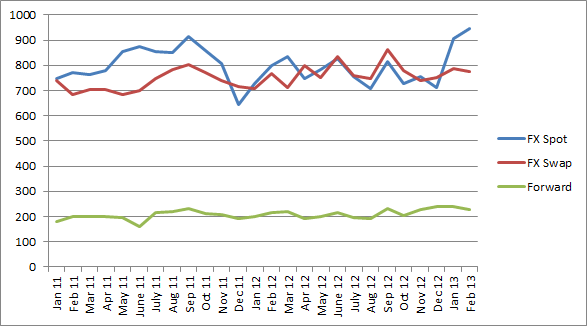
That means, that for every $1 trillion of In/Out swaps settled, members need to provide funding for less than $10 billion, and $40 million for spot FX. With CLS handling nearly $5 trillion worth of daily settlements, the netting rates are a key element in allowing firms to grow their transactional volumes, while substantially reducing the amount of funding required. According to Smith, “CLS believes this safer and efficient process is one of the factors that led to the increase in FX volumes over the last 10 years.”
CLS ADV Since January 2011 (According to BIS accounting)
Industry Benefits
Smith explained that CLS provides a number of benefits to the FX industry, including, settlement risk mitigation, multi-lateral netting, operational and IT efficiencies, business growth opportunities, and the ability to develop industry solutions best practices, common standards and rules that benefit the FX market.
Within settlement risk mitigation also comes credit recognition. By being CLS members, credit departments have a greater understanding of each other and the counterparty risk. This allows firms to allocate less risk between trades to other members. For example, while a bank may decide to trade up to $10 billion with another member, they are more likely to limit their trade exposure to non-members.
In terms of operational efficiencies, a key factor is with regard to CLS’s one rule and oversight committee. Having one set of guidelines for members and central banks, provides all participants with a clearer understanding of their counterparties. When adding a new currency, the corresponding central bank needs to follow the standardized guidelines. These rules provide protection for members who benefit from the increased transparency a participating central bank will need to follow.
Regulatory Recognition
In July 2012, the critical role that CLS plays in global financial markets was recognised by the US Department of the Treasury’s Financial Stability Oversight Council, when it designated CLS as a systemically important Financial Market Utility (FMU). CLS’s importance was highlighted further in November 2012, with the announcement of the US Treasury Department’s exemption of FX swaps and forwards from the clearing requirements required for many financial products under the Dodd-Frank legislation. The role that CLS plays in the mitigation of FX settlement risk was believed to be a contributing factor towards that decision.
Technology
CLS’s increased investment in technology, has enabled it to materially expand peak capacity as it updated core technologies, to meet the elevated standards required of a systemically important FMU. The result is that CLS can now accommodate trade matching volumes of up to five times the average daily volume, and process 20 per cent of a peak day’s volume in a one hour period.
Furthermore, CLS has put in place a flexible technology infrastructure, which enables “capacity on demand”, supporting future software upgrades to be delivered to increase capacity in a matter of days and weeks. This structure, allows CLS to pay for technology only when required, while fulfilling obligations to the market to settle all eligible FX settlement instructions.
The need to build capacity was demonstrated on January 22, 2013, when CLS settled more than 2.6 million instructions, 18 per cent more than the previous high, recorded on 19 September, 2012.
Future
Looking to the future, as emerging markets grow, CLS has received interest from settlement members to include additional currencies. As such, CLS has been evaluating the addition of the Brazilian real, Chilean peso, Chinese renminbi, Russian ruble and Thai baht, amongst others.
Another area where CLS is extending its services is in same day settlement. A significant percentage of USD/CAD trades are intra-day and are not currently included in CLS settlement, due to the time of day. CLS is developing a same day settlement service between US and Canadian dollars to address this settlement risk, which has a proposed launch date in late 2013.
The CAD was chosen as the US, Canadian, and Mexican central banks share similar hours, and would be able to manage a same day settlement process between them. Based on the results, the CLS Bank plans to launch similar regional same day settlement activities in Europe.
Finally, one of the main challenges CLS faces over the next year, is to define new categories of membership, including providing settlement services for cleared FX. To date, CLS has had constructive conversations with CCPs to identify ways in which it might be able to work together in the future, by providing direct Membership.
Starting my career as a trader on Wall Street, one of the big mysteries I had, was just how all these trades on the NYSE got executed and reported. Within the maze of specialist booths and flying paper, trades were being crossed and buyers and sellers were recognized. While the occasional errors occur, the wild system is highly efficient at reporting and settling trades.
In the world of OTC, settlement represents a larger factor, as participants are not bound by a central exchange system that insures against counterparty risk. As such, companies are on their own to ensure that trades are settled correctly with their counterparties, and an exchange of funds takes place.
Launched in 2002, CLS Bank was created as a private sector initiative, to deliver and operate services to mitigate settlement risk in the FX market. Owned and operated by member institutions and working alongside central banks, CLS offers members the ability to settle trades within a central location, thus, providing efficiencies to FX markets.
To understand what CLS does, it is first important to know how settlement works. Settlement is the process in which the payment and securities of a transaction are delivered. Within the securities world, this occurs in a three day window. For example, if a trader buys 100 shares of IBM stock at $100/share, the broker has three days to collect the $10,000 from the client, transfer it to the seller, and collect the shares back for the client.
Within FX, settlement does not involve securities, but instead different currencies. Therefore, in a EUR/USD trade, the seller sends dollars while receiving euros. For OTC participants, one of the greatest worries is settlement risk, which occurs when a counterparty is unable or unwilling to provide either the payment or transfer of securities.
While a deal between two parties can easily be voided, thus limiting impact of a problematic counterparty, the greater concern is the systemic risk. As traders are simultaneously trading with multiple parties, if one party fails to honor a transaction, it can affect counterparties and could prevent them from having the funds and/or securities to settle other trades.
Jake Smith, Head of Communications at CLS, explained that “FX settlement risk is also known as ‘Herstatt Risk’ ”. The name is derived from the failure of a privately owned German bank in 1974. At the time, Bankhaus Herstatt had received delivery of Deutsche marks from US counterparty banks, but had been put into receivership before the corresponding dollars were sent, due to the time zone difference.” Smith explained that, while this occurred nearly 40 years ago, “due to volumes growing substantially since that time, settlement risk has grown significantly.”
To mitigate this risk, CLS was created. Currently, there are over 60 members, who represent some of the largest financial institutions from around the world. CLS provides a central settlement network for FX transactions between its members and their customers. To facilitate settlement, all members are required to have a single multi-currency account with CLS, supporting the 17 currencies that are settled by its system.
Settlement
After conducting a trade, members send transactional details to CLS Bank, including trade details, counterparties, and settlement data. On the day of settlement, CLS Bank multilaterally nets all the instructions between the settlement members, calculating each institution’s pay-in obligations for the day, to ensure settlement of all their instructions on a payment-versus- payment basis. As settlement completes, pay-out of multi-laterally netted long balances will occur.
That means, that for every $1 trillion of In/Out swaps settled, members need to provide funding for less than $10 billion, and $40 million for spot FX. With CLS handling nearly $5 trillion worth of daily settlements, the netting rates are a key element in allowing firms to grow their transactional volumes, while substantially reducing the amount of funding required. According to Smith, “CLS believes this safer and efficient process is one of the factors that led to the increase in FX volumes over the last 10 years.”
CLS ADV Since January 2011 (According to BIS accounting)
Industry Benefits
Smith explained that CLS provides a number of benefits to the FX industry, including, settlement risk mitigation, multi-lateral netting, operational and IT efficiencies, business growth opportunities, and the ability to develop industry solutions best practices, common standards and rules that benefit the FX market.
Within settlement risk mitigation also comes credit recognition. By being CLS members, credit departments have a greater understanding of each other and the counterparty risk. This allows firms to allocate less risk between trades to other members. For example, while a bank may decide to trade up to $10 billion with another member, they are more likely to limit their trade exposure to non-members.
In terms of operational efficiencies, a key factor is with regard to CLS’s one rule and oversight committee. Having one set of guidelines for members and central banks, provides all participants with a clearer understanding of their counterparties. When adding a new currency, the corresponding central bank needs to follow the standardized guidelines. These rules provide protection for members who benefit from the increased transparency a participating central bank will need to follow.
Regulatory Recognition
In July 2012, the critical role that CLS plays in global financial markets was recognised by the US Department of the Treasury’s Financial Stability Oversight Council, when it designated CLS as a systemically important Financial Market Utility (FMU). CLS’s importance was highlighted further in November 2012, with the announcement of the US Treasury Department’s exemption of FX swaps and forwards from the clearing requirements required for many financial products under the Dodd-Frank legislation. The role that CLS plays in the mitigation of FX settlement risk was believed to be a contributing factor towards that decision.
Technology
CLS’s increased investment in technology, has enabled it to materially expand peak capacity as it updated core technologies, to meet the elevated standards required of a systemically important FMU. The result is that CLS can now accommodate trade matching volumes of up to five times the average daily volume, and process 20 per cent of a peak day’s volume in a one hour period.
Furthermore, CLS has put in place a flexible technology infrastructure, which enables “capacity on demand”, supporting future software upgrades to be delivered to increase capacity in a matter of days and weeks. This structure, allows CLS to pay for technology only when required, while fulfilling obligations to the market to settle all eligible FX settlement instructions.
The need to build capacity was demonstrated on January 22, 2013, when CLS settled more than 2.6 million instructions, 18 per cent more than the previous high, recorded on 19 September, 2012.
Future
Looking to the future, as emerging markets grow, CLS has received interest from settlement members to include additional currencies. As such, CLS has been evaluating the addition of the Brazilian real, Chilean peso, Chinese renminbi, Russian ruble and Thai baht, amongst others.
Another area where CLS is extending its services is in same day settlement. A significant percentage of USD/CAD trades are intra-day and are not currently included in CLS settlement, due to the time of day. CLS is developing a same day settlement service between US and Canadian dollars to address this settlement risk, which has a proposed launch date in late 2013.
The CAD was chosen as the US, Canadian, and Mexican central banks share similar hours, and would be able to manage a same day settlement process between them. Based on the results, the CLS Bank plans to launch similar regional same day settlement activities in Europe.
Finally, one of the main challenges CLS faces over the next year, is to define new categories of membership, including providing settlement services for cleared FX. To date, CLS has had constructive conversations with CCPs to identify ways in which it might be able to work together in the future, by providing direct Membership.
FIS Adds Clearing for Prediction Market Contracts, Building on OTC Trading
Featured Videos
CMC Markets’ Artur Delijergijevs on Metals Demand, Volatility, & Stable Execution
CMC Markets’ Artur Delijergijevs on Metals Demand, Volatility, & Stable Execution
CMC Markets’ Artur Delijergijevs on Metals Demand, Volatility, & Stable Execution
CMC Markets’ Artur Delijergijevs on Metals Demand, Volatility, & Stable Execution
In this exclusive Executive Interview, Finance Magnates speaks with Artur Delijergijevs, Head of Systematic Market Making at CMC Markets, about the current state of metals demand and market volatility.
Delijergijevs offers a desk-level view on:
- Metals Demand: Why metals are seeing the strongest demand from both retail and institutional clients right now.
- The Safe-Haven Debate: Questioning whether gold still fits the classic safe-haven definition given large daily price movements.
- Volatile Market Prep: How a market-making desk prepares its systems and pricing for stressed market conditions and high-impact economic events.
- Hybrid Execution: Why the best execution model combines electronic speed with human relationship support, especially during volatility.
- AI in Workflow: Where CMC Markets is integrating machine learning for risk management and pricing, and the limitations of AI during stressed markets.
- Dubai's Role: The strategic importance of Dubai’s location for covering global trading sessions across Asia, Europe, and the US.
Watch to understand how CMC Markets maintains stable pricing and reliable execution quality in high-volatility environments.
#CMCmarkets #forex #metals #gold #trading #volatility #MarketMaking #iFXDubai #FinanceMagnates #Finance #Fintech #Execution #AlgorithmicTrading #RiskManagement
In this exclusive Executive Interview, Finance Magnates speaks with Artur Delijergijevs, Head of Systematic Market Making at CMC Markets, about the current state of metals demand and market volatility.
Delijergijevs offers a desk-level view on:
- Metals Demand: Why metals are seeing the strongest demand from both retail and institutional clients right now.
- The Safe-Haven Debate: Questioning whether gold still fits the classic safe-haven definition given large daily price movements.
- Volatile Market Prep: How a market-making desk prepares its systems and pricing for stressed market conditions and high-impact economic events.
- Hybrid Execution: Why the best execution model combines electronic speed with human relationship support, especially during volatility.
- AI in Workflow: Where CMC Markets is integrating machine learning for risk management and pricing, and the limitations of AI during stressed markets.
- Dubai's Role: The strategic importance of Dubai’s location for covering global trading sessions across Asia, Europe, and the US.
Watch to understand how CMC Markets maintains stable pricing and reliable execution quality in high-volatility environments.
#CMCmarkets #forex #metals #gold #trading #volatility #MarketMaking #iFXDubai #FinanceMagnates #Finance #Fintech #Execution #AlgorithmicTrading #RiskManagement
In this exclusive Executive Interview, Finance Magnates speaks with Artur Delijergijevs, Head of Systematic Market Making at CMC Markets, about the current state of metals demand and market volatility.
Delijergijevs offers a desk-level view on:
- Metals Demand: Why metals are seeing the strongest demand from both retail and institutional clients right now.
- The Safe-Haven Debate: Questioning whether gold still fits the classic safe-haven definition given large daily price movements.
- Volatile Market Prep: How a market-making desk prepares its systems and pricing for stressed market conditions and high-impact economic events.
- Hybrid Execution: Why the best execution model combines electronic speed with human relationship support, especially during volatility.
- AI in Workflow: Where CMC Markets is integrating machine learning for risk management and pricing, and the limitations of AI during stressed markets.
- Dubai's Role: The strategic importance of Dubai’s location for covering global trading sessions across Asia, Europe, and the US.
Watch to understand how CMC Markets maintains stable pricing and reliable execution quality in high-volatility environments.
#CMCmarkets #forex #metals #gold #trading #volatility #MarketMaking #iFXDubai #FinanceMagnates #Finance #Fintech #Execution #AlgorithmicTrading #RiskManagement
In this exclusive Executive Interview, Finance Magnates speaks with Artur Delijergijevs, Head of Systematic Market Making at CMC Markets, about the current state of metals demand and market volatility.
Delijergijevs offers a desk-level view on:
- Metals Demand: Why metals are seeing the strongest demand from both retail and institutional clients right now.
- The Safe-Haven Debate: Questioning whether gold still fits the classic safe-haven definition given large daily price movements.
- Volatile Market Prep: How a market-making desk prepares its systems and pricing for stressed market conditions and high-impact economic events.
- Hybrid Execution: Why the best execution model combines electronic speed with human relationship support, especially during volatility.
- AI in Workflow: Where CMC Markets is integrating machine learning for risk management and pricing, and the limitations of AI during stressed markets.
- Dubai's Role: The strategic importance of Dubai’s location for covering global trading sessions across Asia, Europe, and the US.
Watch to understand how CMC Markets maintains stable pricing and reliable execution quality in high-volatility environments.
#CMCmarkets #forex #metals #gold #trading #volatility #MarketMaking #iFXDubai #FinanceMagnates #Finance #Fintech #Execution #AlgorithmicTrading #RiskManagement
Finance Magnates Awards 2026 – Nominations Now Open
Finance Magnates Awards 2026 – Nominations Now Open
Finance Magnates Awards 2026 – Nominations Now Open
Finance Magnates Awards 2026 – Nominations Now Open
Finance Magnates Awards 2026 – Nominations Now Open
Finance Magnates Awards 2026 – Nominations Now Open
The Finance Magnates Awards 2026 nominations are now open. 🏆
From fintech innovators to leading brokers, this is where the finance industry celebrates its biggest achievements.
Winners will be announced at the Cyprus Gala Dinner on November 6, 2026.
Nominate your brand now.
https://awards.financemagnates.com/?utm_source=linkedin&utm_medium=video&utm_campaign=nominations-open
#FMAwards #FinanceMagnates #FintechAwards #Fintech #FinanceIndustry
The Finance Magnates Awards 2026 nominations are now open. 🏆
From fintech innovators to leading brokers, this is where the finance industry celebrates its biggest achievements.
Winners will be announced at the Cyprus Gala Dinner on November 6, 2026.
Nominate your brand now.
https://awards.financemagnates.com/?utm_source=linkedin&utm_medium=video&utm_campaign=nominations-open
#FMAwards #FinanceMagnates #FintechAwards #Fintech #FinanceIndustry
The Finance Magnates Awards 2026 nominations are now open. 🏆
From fintech innovators to leading brokers, this is where the finance industry celebrates its biggest achievements.
Winners will be announced at the Cyprus Gala Dinner on November 6, 2026.
Nominate your brand now.
https://awards.financemagnates.com/?utm_source=linkedin&utm_medium=video&utm_campaign=nominations-open
#FMAwards #FinanceMagnates #FintechAwards #Fintech #FinanceIndustry
The Finance Magnates Awards 2026 nominations are now open. 🏆
From fintech innovators to leading brokers, this is where the finance industry celebrates its biggest achievements.
Winners will be announced at the Cyprus Gala Dinner on November 6, 2026.
Nominate your brand now.
https://awards.financemagnates.com/?utm_source=linkedin&utm_medium=video&utm_campaign=nominations-open
#FMAwards #FinanceMagnates #FintechAwards #Fintech #FinanceIndustry
The Finance Magnates Awards 2026 nominations are now open. 🏆
From fintech innovators to leading brokers, this is where the finance industry celebrates its biggest achievements.
Winners will be announced at the Cyprus Gala Dinner on November 6, 2026.
Nominate your brand now.
https://awards.financemagnates.com/?utm_source=linkedin&utm_medium=video&utm_campaign=nominations-open
#FMAwards #FinanceMagnates #FintechAwards #Fintech #FinanceIndustry
The Finance Magnates Awards 2026 nominations are now open. 🏆
From fintech innovators to leading brokers, this is where the finance industry celebrates its biggest achievements.
Winners will be announced at the Cyprus Gala Dinner on November 6, 2026.
Nominate your brand now.
https://awards.financemagnates.com/?utm_source=linkedin&utm_medium=video&utm_campaign=nominations-open
#FMAwards #FinanceMagnates #FintechAwards #Fintech #FinanceIndustry
Finance Magnates Awards 2026 | Nominations Now Open 🏆#Fintech #FMAwards #TradingIndustry
Finance Magnates Awards 2026 | Nominations Now Open 🏆#Fintech #FMAwards #TradingIndustry
Finance Magnates Awards 2026 | Nominations Now Open 🏆#Fintech #FMAwards #TradingIndustry
Finance Magnates Awards 2026 | Nominations Now Open 🏆#Fintech #FMAwards #TradingIndustry
Finance Magnates Awards 2026 | Nominations Now Open 🏆#Fintech #FMAwards #TradingIndustry
Finance Magnates Awards 2026 | Nominations Now Open 🏆#Fintech #FMAwards #TradingIndustry
Lights on. Cameras ready. 🎬
Finance Magnates Awards 2026 nominations are now open. 🏆
#FMAwards #FinanceMagnates #FintechAwards #Fintech
Lights on. Cameras ready. 🎬
Finance Magnates Awards 2026 nominations are now open. 🏆
#FMAwards #FinanceMagnates #FintechAwards #Fintech
Lights on. Cameras ready. 🎬
Finance Magnates Awards 2026 nominations are now open. 🏆
#FMAwards #FinanceMagnates #FintechAwards #Fintech
Lights on. Cameras ready. 🎬
Finance Magnates Awards 2026 nominations are now open. 🏆
#FMAwards #FinanceMagnates #FintechAwards #Fintech
Lights on. Cameras ready. 🎬
Finance Magnates Awards 2026 nominations are now open. 🏆
#FMAwards #FinanceMagnates #FintechAwards #Fintech
Lights on. Cameras ready. 🎬
Finance Magnates Awards 2026 nominations are now open. 🏆
#FMAwards #FinanceMagnates #FintechAwards #Fintech
Exness sees trust as the key theme for growth in MENA Trading Growth for 2026
Exness sees trust as the key theme for growth in MENA Trading Growth for 2026
Exness sees trust as the key theme for growth in MENA Trading Growth for 2026
Exness sees trust as the key theme for growth in MENA Trading Growth for 2026
Exness sees trust as the key theme for growth in MENA Trading Growth for 2026
Exness sees trust as the key theme for growth in MENA Trading Growth for 2026
Mohammad Amer, Regional Commercial Director at Exness, sits down to discuss the booming MENA financial trading market. Find out why Dubai is key to the company's growth strategy, how a mobile-first generation is changing expectations, and why trust will be the defining theme for traders in 2026.
In this interview, you'll learn:
* Why Dubai and the MENA region are critical growth markets for fintech and online trading.
* How Exness is addressing the demands of mobile-first, younger traders through engineering, platform stability, and transparent conditions.
* The essential role local talent plays in providing a culturally relevant and compliant user experience.
* Mohammad Amer's outlook on the future of the online trading industry and why stronger controls and systems are necessary.
* Why "trust" isn't just a brand value, but has commercial value—and why he predicts 2026 will be the "Year of Trust."
Key Takeaways:
➡️ The MENA region is rapidly shaping global financial markets.
➡️ New traders expect stability, precise execution, and transparency.
➡️ Local expertise is key to regulatory compliance and user experience.
➡️ Future success belongs to firms capable of meeting rising standards across regulation and platform consistency.
Read the full article at: https://www.financemagnates.com/thought-leadership/exness-sees-trust-as-the-key-theme-for-growth-in-mena-trading-growth-for-2026/
#Exness #MENA #Trading #FinTech #Dubai #OnlineTrading #FinanceMagnates #MohammadAmer #Trust #MobileTrading
Mohammad Amer, Regional Commercial Director at Exness, sits down to discuss the booming MENA financial trading market. Find out why Dubai is key to the company's growth strategy, how a mobile-first generation is changing expectations, and why trust will be the defining theme for traders in 2026.
In this interview, you'll learn:
* Why Dubai and the MENA region are critical growth markets for fintech and online trading.
* How Exness is addressing the demands of mobile-first, younger traders through engineering, platform stability, and transparent conditions.
* The essential role local talent plays in providing a culturally relevant and compliant user experience.
* Mohammad Amer's outlook on the future of the online trading industry and why stronger controls and systems are necessary.
* Why "trust" isn't just a brand value, but has commercial value—and why he predicts 2026 will be the "Year of Trust."
Key Takeaways:
➡️ The MENA region is rapidly shaping global financial markets.
➡️ New traders expect stability, precise execution, and transparency.
➡️ Local expertise is key to regulatory compliance and user experience.
➡️ Future success belongs to firms capable of meeting rising standards across regulation and platform consistency.
Read the full article at: https://www.financemagnates.com/thought-leadership/exness-sees-trust-as-the-key-theme-for-growth-in-mena-trading-growth-for-2026/
#Exness #MENA #Trading #FinTech #Dubai #OnlineTrading #FinanceMagnates #MohammadAmer #Trust #MobileTrading
Mohammad Amer, Regional Commercial Director at Exness, sits down to discuss the booming MENA financial trading market. Find out why Dubai is key to the company's growth strategy, how a mobile-first generation is changing expectations, and why trust will be the defining theme for traders in 2026.
In this interview, you'll learn:
* Why Dubai and the MENA region are critical growth markets for fintech and online trading.
* How Exness is addressing the demands of mobile-first, younger traders through engineering, platform stability, and transparent conditions.
* The essential role local talent plays in providing a culturally relevant and compliant user experience.
* Mohammad Amer's outlook on the future of the online trading industry and why stronger controls and systems are necessary.
* Why "trust" isn't just a brand value, but has commercial value—and why he predicts 2026 will be the "Year of Trust."
Key Takeaways:
➡️ The MENA region is rapidly shaping global financial markets.
➡️ New traders expect stability, precise execution, and transparency.
➡️ Local expertise is key to regulatory compliance and user experience.
➡️ Future success belongs to firms capable of meeting rising standards across regulation and platform consistency.
Read the full article at: https://www.financemagnates.com/thought-leadership/exness-sees-trust-as-the-key-theme-for-growth-in-mena-trading-growth-for-2026/
#Exness #MENA #Trading #FinTech #Dubai #OnlineTrading #FinanceMagnates #MohammadAmer #Trust #MobileTrading
Mohammad Amer, Regional Commercial Director at Exness, sits down to discuss the booming MENA financial trading market. Find out why Dubai is key to the company's growth strategy, how a mobile-first generation is changing expectations, and why trust will be the defining theme for traders in 2026.
In this interview, you'll learn:
* Why Dubai and the MENA region are critical growth markets for fintech and online trading.
* How Exness is addressing the demands of mobile-first, younger traders through engineering, platform stability, and transparent conditions.
* The essential role local talent plays in providing a culturally relevant and compliant user experience.
* Mohammad Amer's outlook on the future of the online trading industry and why stronger controls and systems are necessary.
* Why "trust" isn't just a brand value, but has commercial value—and why he predicts 2026 will be the "Year of Trust."
Key Takeaways:
➡️ The MENA region is rapidly shaping global financial markets.
➡️ New traders expect stability, precise execution, and transparency.
➡️ Local expertise is key to regulatory compliance and user experience.
➡️ Future success belongs to firms capable of meeting rising standards across regulation and platform consistency.
Read the full article at: https://www.financemagnates.com/thought-leadership/exness-sees-trust-as-the-key-theme-for-growth-in-mena-trading-growth-for-2026/
#Exness #MENA #Trading #FinTech #Dubai #OnlineTrading #FinanceMagnates #MohammadAmer #Trust #MobileTrading
Mohammad Amer, Regional Commercial Director at Exness, sits down to discuss the booming MENA financial trading market. Find out why Dubai is key to the company's growth strategy, how a mobile-first generation is changing expectations, and why trust will be the defining theme for traders in 2026.
In this interview, you'll learn:
* Why Dubai and the MENA region are critical growth markets for fintech and online trading.
* How Exness is addressing the demands of mobile-first, younger traders through engineering, platform stability, and transparent conditions.
* The essential role local talent plays in providing a culturally relevant and compliant user experience.
* Mohammad Amer's outlook on the future of the online trading industry and why stronger controls and systems are necessary.
* Why "trust" isn't just a brand value, but has commercial value—and why he predicts 2026 will be the "Year of Trust."
Key Takeaways:
➡️ The MENA region is rapidly shaping global financial markets.
➡️ New traders expect stability, precise execution, and transparency.
➡️ Local expertise is key to regulatory compliance and user experience.
➡️ Future success belongs to firms capable of meeting rising standards across regulation and platform consistency.
Read the full article at: https://www.financemagnates.com/thought-leadership/exness-sees-trust-as-the-key-theme-for-growth-in-mena-trading-growth-for-2026/
#Exness #MENA #Trading #FinTech #Dubai #OnlineTrading #FinanceMagnates #MohammadAmer #Trust #MobileTrading
Mohammad Amer, Regional Commercial Director at Exness, sits down to discuss the booming MENA financial trading market. Find out why Dubai is key to the company's growth strategy, how a mobile-first generation is changing expectations, and why trust will be the defining theme for traders in 2026.
In this interview, you'll learn:
* Why Dubai and the MENA region are critical growth markets for fintech and online trading.
* How Exness is addressing the demands of mobile-first, younger traders through engineering, platform stability, and transparent conditions.
* The essential role local talent plays in providing a culturally relevant and compliant user experience.
* Mohammad Amer's outlook on the future of the online trading industry and why stronger controls and systems are necessary.
* Why "trust" isn't just a brand value, but has commercial value—and why he predicts 2026 will be the "Year of Trust."
Key Takeaways:
➡️ The MENA region is rapidly shaping global financial markets.
➡️ New traders expect stability, precise execution, and transparency.
➡️ Local expertise is key to regulatory compliance and user experience.
➡️ Future success belongs to firms capable of meeting rising standards across regulation and platform consistency.
Read the full article at: https://www.financemagnates.com/thought-leadership/exness-sees-trust-as-the-key-theme-for-growth-in-mena-trading-growth-for-2026/
#Exness #MENA #Trading #FinTech #Dubai #OnlineTrading #FinanceMagnates #MohammadAmer #Trust #MobileTrading
Paytiko CEO Razi Salih on Why Payment Orchestration is a MUST-HAVE for Brokers in 2026
Paytiko CEO Razi Salih on Why Payment Orchestration is a MUST-HAVE for Brokers in 2026
Paytiko CEO Razi Salih on Why Payment Orchestration is a MUST-HAVE for Brokers in 2026
Paytiko CEO Razi Salih on Why Payment Orchestration is a MUST-HAVE for Brokers in 2026
Paytiko CEO Razi Salih on Why Payment Orchestration is a MUST-HAVE for Brokers in 2026
Paytiko CEO Razi Salih on Why Payment Orchestration is a MUST-HAVE for Brokers in 2026
At iFX Expo Dubai, Finance Magnates spoke with Razi Salih, CEO at Paytiko, about the evolution of the payments ecosystem and why payment orchestration has shifted from an option to a necessity for brokers, prop firms, and exchanges.
Mr. Salih explains how global expansion, the need for deep localisation, and the sheer number of new payment methods, from instant banking to stablecoins, are driving this critical infrastructure shift.
#PaymentOrchestration #Fintech #Brokerage #TradingPayments #RaziSalih #Paytiko #iFXExpoDubai #Stablecoins #AIinFintech
At iFX Expo Dubai, Finance Magnates spoke with Razi Salih, CEO at Paytiko, about the evolution of the payments ecosystem and why payment orchestration has shifted from an option to a necessity for brokers, prop firms, and exchanges.
Mr. Salih explains how global expansion, the need for deep localisation, and the sheer number of new payment methods, from instant banking to stablecoins, are driving this critical infrastructure shift.
#PaymentOrchestration #Fintech #Brokerage #TradingPayments #RaziSalih #Paytiko #iFXExpoDubai #Stablecoins #AIinFintech
At iFX Expo Dubai, Finance Magnates spoke with Razi Salih, CEO at Paytiko, about the evolution of the payments ecosystem and why payment orchestration has shifted from an option to a necessity for brokers, prop firms, and exchanges.
Mr. Salih explains how global expansion, the need for deep localisation, and the sheer number of new payment methods, from instant banking to stablecoins, are driving this critical infrastructure shift.
#PaymentOrchestration #Fintech #Brokerage #TradingPayments #RaziSalih #Paytiko #iFXExpoDubai #Stablecoins #AIinFintech
At iFX Expo Dubai, Finance Magnates spoke with Razi Salih, CEO at Paytiko, about the evolution of the payments ecosystem and why payment orchestration has shifted from an option to a necessity for brokers, prop firms, and exchanges.
Mr. Salih explains how global expansion, the need for deep localisation, and the sheer number of new payment methods, from instant banking to stablecoins, are driving this critical infrastructure shift.
#PaymentOrchestration #Fintech #Brokerage #TradingPayments #RaziSalih #Paytiko #iFXExpoDubai #Stablecoins #AIinFintech
At iFX Expo Dubai, Finance Magnates spoke with Razi Salih, CEO at Paytiko, about the evolution of the payments ecosystem and why payment orchestration has shifted from an option to a necessity for brokers, prop firms, and exchanges.
Mr. Salih explains how global expansion, the need for deep localisation, and the sheer number of new payment methods, from instant banking to stablecoins, are driving this critical infrastructure shift.
#PaymentOrchestration #Fintech #Brokerage #TradingPayments #RaziSalih #Paytiko #iFXExpoDubai #Stablecoins #AIinFintech
At iFX Expo Dubai, Finance Magnates spoke with Razi Salih, CEO at Paytiko, about the evolution of the payments ecosystem and why payment orchestration has shifted from an option to a necessity for brokers, prop firms, and exchanges.
Mr. Salih explains how global expansion, the need for deep localisation, and the sheer number of new payment methods, from instant banking to stablecoins, are driving this critical infrastructure shift.
#PaymentOrchestration #Fintech #Brokerage #TradingPayments #RaziSalih #Paytiko #iFXExpoDubai #Stablecoins #AIinFintech