IntercontinentalExchange Publishes Daily Futures Volume for January
Monday,04/02/2013|15:12GMTby
Andrew Saks McLeod
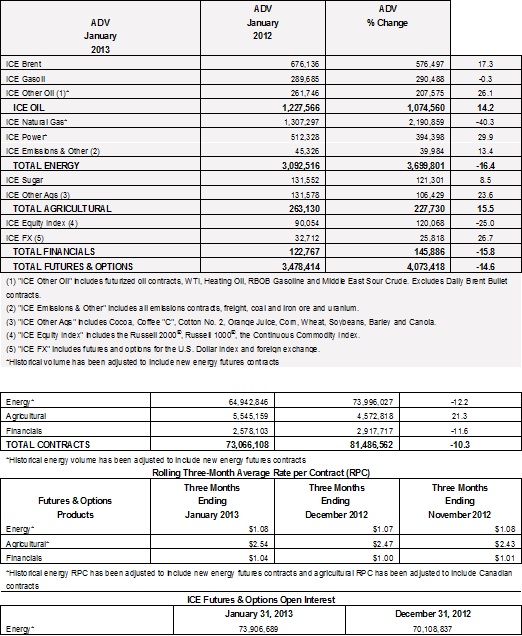
Like the CME the IntercontinentalExchange posted a solid month in FX trading, even as overall trading was lower year over year. During the month, average daily volume (ADV) was 32,712 contracts in the FX group, 25% higher YoY, but slightly below December's figures. While underperforming the CME, the ICE figures were still strong considering that December volume had risen over 30% from November.
Average Daily Volume (ADV) for futures and options was 3,478,414. Total contract volume in January 2013 was 73 million contracts. All prior period contract volumes have been adjusted to include the converted futures contracts, which previously traded in ICE's OTC markets.
IntercontinentalExhange Inc is a US-based exchange which is listed on the NYSE under the symbol ICE and operates global OTC markets and clearing houses in North America and Europe, with trading firms in 70 countries worldwide along with market data customers in 120 countries. The majority of instruments on the exchange are in the energy, agriculture, foreign exchange and equity index categories. As far as the energy sector is concerned, ICE has more than half of the world’s crude oil and refined petroleum product futures volume.
January 2013 Review
ICE received regulatory approval to provide portfolio margining relief for Buy-Side clearing of certain CDS, and ICE Clear Credit plans to launch clearing of North American single names and Latin American sovereigns and portfolio margining for the buy-side in the current quarter. ICE announced the February 11 launch of 16 new energy contracts to include new global oil, iron ore and China coal futures products. Volume records were set in January in ICE RBOB and Newcastle Coal futures, and open interest records were set in ICE Brent crude futures, Heating Oil futures, Cocoa futures and WTI options. Through January 25, ICE's CDS clearing houses have cleared $37 trillion in gross notional value on a cumulative basis across 1.16 million trades.
ICE Clear Credit has cleared $2.2 trillion in single-name CDS resulting in open interest of $737 billion. ICE Clear Europe has cleared €1.6 trillion ($2.1 trillion) in single-name CDS resulting in €362 billion ($484 billion) of open interest. ICE lists 375 CDS instruments for clearing. A complete summary of CDS clearing can be found at: https://www.theice.com/clear_credit.jhtml
Trading days in January 2013
ICE Futures Europe & U.S: 21
ICE Futures Canada: 22
As of October 15, 2012, ICE transitioned all of the open interest in OTC cleared energy Swaps contracts to futures contracts. All futures volumes in the tables above have been adjusted to treat, on a pro forma basis, the OTC cleared energy swaps contracts as futures contracts for all periods prior to October 2012. RPC is calculated by dividing transaction revenues by contract volume, and may vary based on pricing, customer and product mix.
Like the CME the IntercontinentalExchange posted a solid month in FX trading, even as overall trading was lower year over year. During the month, average daily volume (ADV) was 32,712 contracts in the FX group, 25% higher YoY, but slightly below December's figures. While underperforming the CME, the ICE figures were still strong considering that December volume had risen over 30% from November.
Average Daily Volume (ADV) for futures and options was 3,478,414. Total contract volume in January 2013 was 73 million contracts. All prior period contract volumes have been adjusted to include the converted futures contracts, which previously traded in ICE's OTC markets.
IntercontinentalExhange Inc is a US-based exchange which is listed on the NYSE under the symbol ICE and operates global OTC markets and clearing houses in North America and Europe, with trading firms in 70 countries worldwide along with market data customers in 120 countries. The majority of instruments on the exchange are in the energy, agriculture, foreign exchange and equity index categories. As far as the energy sector is concerned, ICE has more than half of the world’s crude oil and refined petroleum product futures volume.
January 2013 Review
ICE received regulatory approval to provide portfolio margining relief for Buy-Side clearing of certain CDS, and ICE Clear Credit plans to launch clearing of North American single names and Latin American sovereigns and portfolio margining for the buy-side in the current quarter. ICE announced the February 11 launch of 16 new energy contracts to include new global oil, iron ore and China coal futures products. Volume records were set in January in ICE RBOB and Newcastle Coal futures, and open interest records were set in ICE Brent crude futures, Heating Oil futures, Cocoa futures and WTI options. Through January 25, ICE's CDS clearing houses have cleared $37 trillion in gross notional value on a cumulative basis across 1.16 million trades.
ICE Clear Credit has cleared $2.2 trillion in single-name CDS resulting in open interest of $737 billion. ICE Clear Europe has cleared €1.6 trillion ($2.1 trillion) in single-name CDS resulting in €362 billion ($484 billion) of open interest. ICE lists 375 CDS instruments for clearing. A complete summary of CDS clearing can be found at: https://www.theice.com/clear_credit.jhtml
Trading days in January 2013
ICE Futures Europe & U.S: 21
ICE Futures Canada: 22
As of October 15, 2012, ICE transitioned all of the open interest in OTC cleared energy Swaps contracts to futures contracts. All futures volumes in the tables above have been adjusted to treat, on a pro forma basis, the OTC cleared energy swaps contracts as futures contracts for all periods prior to October 2012. RPC is calculated by dividing transaction revenues by contract volume, and may vary based on pricing, customer and product mix.
Singapore Independent Wealth Sector Has Less Than 10% Market Share, but Vast Room for Growth
FP Markets Winner Spotlight 🏆 | Global Broker of the Year 2025 #Trading #Broker #Innovation #Shorts
FP Markets Winner Spotlight 🏆 | Global Broker of the Year 2025 #Trading #Broker #Innovation #Shorts
FP Markets takes the spotlight as Global Broker of the Year 2025 at the Finance Magnates Awards.
Martin Stoilov, Head of Client Experience, shares that trust, innovation, and people played a key role in the company’s success, supported by a strong foundation of integrity and client-centricity.
Following this milestone, FP Markets continues to focus on growth, technology investment, and its core values of transparency and excellence.
👉 Be part of FM Awards 2026: https://awards.financemagnates.com/#nominate
FP Markets takes the spotlight as Global Broker of the Year 2025 at the Finance Magnates Awards.
Martin Stoilov, Head of Client Experience, shares that trust, innovation, and people played a key role in the company’s success, supported by a strong foundation of integrity and client-centricity.
Following this milestone, FP Markets continues to focus on growth, technology investment, and its core values of transparency and excellence.
👉 Be part of FM Awards 2026: https://awards.financemagnates.com/#nominate
In this video, we review @HolaPrimeMarketsOfficial, a multi-asset forex and CFDs broker offering different account types, trading platforms, and flexible trading conditions.
We cover the broker’s overall offering, including account options, trading environment, platforms like MT4 and MT5, and additional services such as managed accounts and fast withdrawals.
Watch the full video to see if Hola Prime Markets fits your trading needs.
📣 Stay up to date with the latest in finance and trading. Follow Finance Magnates for industry news, insights, and global event coverage.
Connect with us:
🔗 LinkedIn: /financemagnates
👍 Facebook: /financemagnates
📸 Instagram: https://www.instagram.com/financemagnates
🐦 X: https://x.com/financemagnates
🎥 TikTok: https://www.tiktok.com/tag/financemagnates
▶️ YouTube: /@financemagnates_official
#HolaPrime #ForexBroker #CFDTrading #FinanceMagnates #Trading #Forex #BrokerReview
In this video, we review @HolaPrimeMarketsOfficial, a multi-asset forex and CFDs broker offering different account types, trading platforms, and flexible trading conditions.
We cover the broker’s overall offering, including account options, trading environment, platforms like MT4 and MT5, and additional services such as managed accounts and fast withdrawals.
Watch the full video to see if Hola Prime Markets fits your trading needs.
📣 Stay up to date with the latest in finance and trading. Follow Finance Magnates for industry news, insights, and global event coverage.
Connect with us:
🔗 LinkedIn: /financemagnates
👍 Facebook: /financemagnates
📸 Instagram: https://www.instagram.com/financemagnates
🐦 X: https://x.com/financemagnates
🎥 TikTok: https://www.tiktok.com/tag/financemagnates
▶️ YouTube: /@financemagnates_official
#HolaPrime #ForexBroker #CFDTrading #FinanceMagnates #Trading #Forex #BrokerReview
Hola Prime Review: What You Need to Know | Full Breakdown by Finance Magnates
Hola Prime Review: What You Need to Know | Full Breakdown by Finance Magnates
In this video, we review @HolaPrime_Global, a proprietary trading firm offering evaluation programs and performance-based payouts in simulated market environments.
We cover how the challenge model works, including account types, profit splits (up to 95%), trading rules, and what it takes to reach a funded account. You’ll also learn about available platforms like MT4, MT5, cTrader, and more, along with insights into payouts, support, and trading conditions.
Watch the full video to see if Hola Prime fits your trading style.
📣 Stay up to date with the latest in finance and trading. Follow Finance Magnates for industry news, insights, and global event coverage.
Connect with us:
🔗 LinkedIn: /financemagnates
👍 Facebook: /financemagnates
📸 Instagram: https://www.instagram.com/financemagnates
🐦 X: https://x.com/financemagnates
🎥 TikTok: https://www.tiktok.com/tag/financemagnates
▶️ YouTube: /@financemagnates_official
#HolaPrime #PropFirm #Trading #FinanceMagnates #Forex #FuturesTrading #TradingReview #PropFirmReview
In this video, we review @HolaPrime_Global, a proprietary trading firm offering evaluation programs and performance-based payouts in simulated market environments.
We cover how the challenge model works, including account types, profit splits (up to 95%), trading rules, and what it takes to reach a funded account. You’ll also learn about available platforms like MT4, MT5, cTrader, and more, along with insights into payouts, support, and trading conditions.
Watch the full video to see if Hola Prime fits your trading style.
📣 Stay up to date with the latest in finance and trading. Follow Finance Magnates for industry news, insights, and global event coverage.
Connect with us:
🔗 LinkedIn: /financemagnates
👍 Facebook: /financemagnates
📸 Instagram: https://www.instagram.com/financemagnates
🐦 X: https://x.com/financemagnates
🎥 TikTok: https://www.tiktok.com/tag/financemagnates
▶️ YouTube: /@financemagnates_official
#HolaPrime #PropFirm #Trading #FinanceMagnates #Forex #FuturesTrading #TradingReview #PropFirmReview
Axi Winner Spotlight 🏆 | Global Most Innovative Broker 2025 #Innovation #Trading #Fintech #Broker
Axi Winner Spotlight 🏆 | Global Most Innovative Broker 2025 #Innovation #Trading #Fintech #Broker
Axi takes the spotlight at the Finance Magnates Awards, winning Global Most Innovative Broker 2025.
Olivia Xenofontos and Ivanna Openko share how the team will feel: proud, motivated, and ready to keep delivering.
They also describe the night as well-organized, focused, and enjoyable for all.
👉 Be part of FM Awards 2026.
Axi takes the spotlight at the Finance Magnates Awards, winning Global Most Innovative Broker 2025.
Olivia Xenofontos and Ivanna Openko share how the team will feel: proud, motivated, and ready to keep delivering.
They also describe the night as well-organized, focused, and enjoyable for all.
👉 Be part of FM Awards 2026.
Recognition that matters.
Built on transparency.
Driven by the industry.
The Finance Magnates Awards 2026.
Nominations are now open.
🔗 https://awards.financemagnates.com/?utm_source=SM&utm_medium=social&utm_campaign=recognition-matters
Recognition that matters.
Built on transparency.
Driven by the industry.
The Finance Magnates Awards 2026.
Nominations are now open.
🔗 https://awards.financemagnates.com/?utm_source=SM&utm_medium=social&utm_campaign=recognition-matters