Despite uncertain market conditions, Hong Kong's key bourse reported overall revenue held up comparatively well against Q1 2015.
Bloomberg
Stock Exchange group, Hong Kong Exchanges and Clearing Limited (HKEX), has announced its Q1 2016 financial metrics ending 31st March. The results reflect generally subdued market conditions, both locally and globally, highlighted in overall trading activity and the group’s overall revenue which fell marginally below that achieved in Q1 2015.
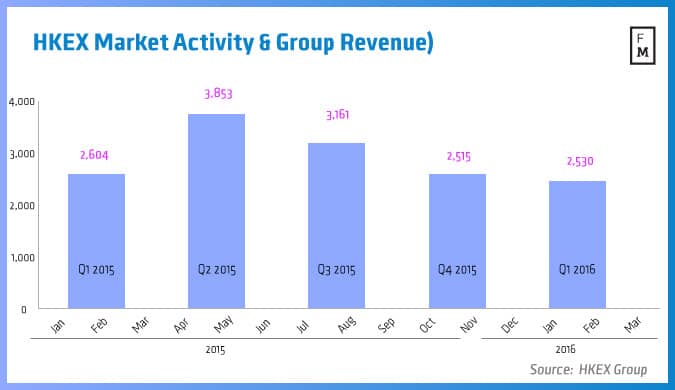
Revenue for Q1 2016 was $2,530 million, slightly lower than $2,604 million in Q1 2015 or a 2.8 percent fall. The numbers benefited from an exceptional gain on the sale of the group’s investment in LCH.Clearnet Group Limited.
One of the key drivers of the group’s revenue during the quarter was subdued activity on the Cash Market in Hong Kong and Commodities Market in the United Kingdom (UK). These returned to levels similar to Q4 2015 which were 16 percent and 9 percent respectively below Q1 2015.
In addition, significantly increased trading of derivatives contracts on the Hong Kong Futures Exchange Limited, at levels that were higher than both the previous quarter and Q1 2015 positively impacted on revenue.
Operating Expenses
Operating expenses for Q1 2016 were $854 million, reflecting an increase of 19 percent against $718 million in Q1 2015. The increase primarily reflected the cost of additional headcount and higher legal and professional fees incurred to support strategic initiatives in Q1 2016. The comparison of operating expenses with the previous year is distorted by a one-off recovery of $77 million from the liquidators of Lehman Brothers Securities Asia Limited (Lehman) which reduced the Q1 2015 operating expenses.
EBITDA
EBITDA of $1,897 million for Q1 2016 decreased 9 percent from $2,078 in Q1 2015. The EBITDA margin of 69 percent was 5 percent lower than Q1 2015 and 6 percent lower than the 75 per cent achieved for the year ended 31st December 2015.
Profit attributable to shareholders decreased by 9 percent to $1,432 million in line with EBITDA.
Overview
The board of directors has commented that despite the difficult conditions experienced in the various markets in which the group operates, overall revenue and other income has held up comparatively well, being broadly in line with Q1 2015.
In response to continued uncertainty in market conditions the group is adopting a prudent approach to expenditure control as it moves into Q2 2016. While it continues to move forward with strategic initiatives, a more cautious approach is being taken to the timing of less critical projects as a means to manage capital expenditure while facilitating a more modest increase in headcount during 2016.
Stock Exchange group, Hong Kong Exchanges and Clearing Limited (HKEX), has announced its Q1 2016 financial metrics ending 31st March. The results reflect generally subdued market conditions, both locally and globally, highlighted in overall trading activity and the group’s overall revenue which fell marginally below that achieved in Q1 2015.
Revenue for Q1 2016 was $2,530 million, slightly lower than $2,604 million in Q1 2015 or a 2.8 percent fall. The numbers benefited from an exceptional gain on the sale of the group’s investment in LCH.Clearnet Group Limited.
One of the key drivers of the group’s revenue during the quarter was subdued activity on the Cash Market in Hong Kong and Commodities Market in the United Kingdom (UK). These returned to levels similar to Q4 2015 which were 16 percent and 9 percent respectively below Q1 2015.
In addition, significantly increased trading of derivatives contracts on the Hong Kong Futures Exchange Limited, at levels that were higher than both the previous quarter and Q1 2015 positively impacted on revenue.
Operating Expenses
Operating expenses for Q1 2016 were $854 million, reflecting an increase of 19 percent against $718 million in Q1 2015. The increase primarily reflected the cost of additional headcount and higher legal and professional fees incurred to support strategic initiatives in Q1 2016. The comparison of operating expenses with the previous year is distorted by a one-off recovery of $77 million from the liquidators of Lehman Brothers Securities Asia Limited (Lehman) which reduced the Q1 2015 operating expenses.
EBITDA
EBITDA of $1,897 million for Q1 2016 decreased 9 percent from $2,078 in Q1 2015. The EBITDA margin of 69 percent was 5 percent lower than Q1 2015 and 6 percent lower than the 75 per cent achieved for the year ended 31st December 2015.
Profit attributable to shareholders decreased by 9 percent to $1,432 million in line with EBITDA.
Overview
The board of directors has commented that despite the difficult conditions experienced in the various markets in which the group operates, overall revenue and other income has held up comparatively well, being broadly in line with Q1 2015.
In response to continued uncertainty in market conditions the group is adopting a prudent approach to expenditure control as it moves into Q2 2016. While it continues to move forward with strategic initiatives, a more cautious approach is being taken to the timing of less critical projects as a means to manage capital expenditure while facilitating a more modest increase in headcount during 2016.
Flow Traders Opens 24-Hour OTC Desk for Tokenized Stocks And Gold
CMC Markets’ Artur Delijergijevs on Metals Demand, Volatility, & Stable Execution
CMC Markets’ Artur Delijergijevs on Metals Demand, Volatility, & Stable Execution
In this exclusive Executive Interview, Finance Magnates speaks with Artur Delijergijevs, Head of Systematic Market Making at CMC Markets, about the current state of metals demand and market volatility.
Delijergijevs offers a desk-level view on:
- Metals Demand: Why metals are seeing the strongest demand from both retail and institutional clients right now.
- The Safe-Haven Debate: Questioning whether gold still fits the classic safe-haven definition given large daily price movements.
- Volatile Market Prep: How a market-making desk prepares its systems and pricing for stressed market conditions and high-impact economic events.
- Hybrid Execution: Why the best execution model combines electronic speed with human relationship support, especially during volatility.
- AI in Workflow: Where CMC Markets is integrating machine learning for risk management and pricing, and the limitations of AI during stressed markets.
- Dubai's Role: The strategic importance of Dubai’s location for covering global trading sessions across Asia, Europe, and the US.
Watch to understand how CMC Markets maintains stable pricing and reliable execution quality in high-volatility environments.
#CMCmarkets #forex #metals #gold #trading #volatility #MarketMaking #iFXDubai #FinanceMagnates #Finance #Fintech #Execution #AlgorithmicTrading #RiskManagement
In this exclusive Executive Interview, Finance Magnates speaks with Artur Delijergijevs, Head of Systematic Market Making at CMC Markets, about the current state of metals demand and market volatility.
Delijergijevs offers a desk-level view on:
- Metals Demand: Why metals are seeing the strongest demand from both retail and institutional clients right now.
- The Safe-Haven Debate: Questioning whether gold still fits the classic safe-haven definition given large daily price movements.
- Volatile Market Prep: How a market-making desk prepares its systems and pricing for stressed market conditions and high-impact economic events.
- Hybrid Execution: Why the best execution model combines electronic speed with human relationship support, especially during volatility.
- AI in Workflow: Where CMC Markets is integrating machine learning for risk management and pricing, and the limitations of AI during stressed markets.
- Dubai's Role: The strategic importance of Dubai’s location for covering global trading sessions across Asia, Europe, and the US.
Watch to understand how CMC Markets maintains stable pricing and reliable execution quality in high-volatility environments.
#CMCmarkets #forex #metals #gold #trading #volatility #MarketMaking #iFXDubai #FinanceMagnates #Finance #Fintech #Execution #AlgorithmicTrading #RiskManagement
Finance Magnates Awards 2026 – Nominations Now Open
Finance Magnates Awards 2026 – Nominations Now Open
The Finance Magnates Awards 2026 nominations are now open. 🏆
From fintech innovators to leading brokers, this is where the finance industry celebrates its biggest achievements.
Winners will be announced at the Cyprus Gala Dinner on November 6, 2026.
Nominate your brand now.
https://awards.financemagnates.com/?utm_source=linkedin&utm_medium=video&utm_campaign=nominations-open
#FMAwards #FinanceMagnates #FintechAwards #Fintech #FinanceIndustry
The Finance Magnates Awards 2026 nominations are now open. 🏆
From fintech innovators to leading brokers, this is where the finance industry celebrates its biggest achievements.
Winners will be announced at the Cyprus Gala Dinner on November 6, 2026.
Nominate your brand now.
https://awards.financemagnates.com/?utm_source=linkedin&utm_medium=video&utm_campaign=nominations-open
#FMAwards #FinanceMagnates #FintechAwards #Fintech #FinanceIndustry
Finance Magnates Awards 2026 | Nominations Now Open 🏆#Fintech #FMAwards #TradingIndustry
Finance Magnates Awards 2026 | Nominations Now Open 🏆#Fintech #FMAwards #TradingIndustry
Lights on. Cameras ready. 🎬
Finance Magnates Awards 2026 nominations are now open. 🏆
#FMAwards #FinanceMagnates #FintechAwards #Fintech
Lights on. Cameras ready. 🎬
Finance Magnates Awards 2026 nominations are now open. 🏆
#FMAwards #FinanceMagnates #FintechAwards #Fintech
Exness sees trust as the key theme for growth in MENA Trading Growth for 2026
Exness sees trust as the key theme for growth in MENA Trading Growth for 2026
Mohammad Amer, Regional Commercial Director at Exness, sits down to discuss the booming MENA financial trading market. Find out why Dubai is key to the company's growth strategy, how a mobile-first generation is changing expectations, and why trust will be the defining theme for traders in 2026.
In this interview, you'll learn:
* Why Dubai and the MENA region are critical growth markets for fintech and online trading.
* How Exness is addressing the demands of mobile-first, younger traders through engineering, platform stability, and transparent conditions.
* The essential role local talent plays in providing a culturally relevant and compliant user experience.
* Mohammad Amer's outlook on the future of the online trading industry and why stronger controls and systems are necessary.
* Why "trust" isn't just a brand value, but has commercial value—and why he predicts 2026 will be the "Year of Trust."
Key Takeaways:
➡️ The MENA region is rapidly shaping global financial markets.
➡️ New traders expect stability, precise execution, and transparency.
➡️ Local expertise is key to regulatory compliance and user experience.
➡️ Future success belongs to firms capable of meeting rising standards across regulation and platform consistency.
Read the full article at: https://www.financemagnates.com/thought-leadership/exness-sees-trust-as-the-key-theme-for-growth-in-mena-trading-growth-for-2026/
#Exness #MENA #Trading #FinTech #Dubai #OnlineTrading #FinanceMagnates #MohammadAmer #Trust #MobileTrading
Mohammad Amer, Regional Commercial Director at Exness, sits down to discuss the booming MENA financial trading market. Find out why Dubai is key to the company's growth strategy, how a mobile-first generation is changing expectations, and why trust will be the defining theme for traders in 2026.
In this interview, you'll learn:
* Why Dubai and the MENA region are critical growth markets for fintech and online trading.
* How Exness is addressing the demands of mobile-first, younger traders through engineering, platform stability, and transparent conditions.
* The essential role local talent plays in providing a culturally relevant and compliant user experience.
* Mohammad Amer's outlook on the future of the online trading industry and why stronger controls and systems are necessary.
* Why "trust" isn't just a brand value, but has commercial value—and why he predicts 2026 will be the "Year of Trust."
Key Takeaways:
➡️ The MENA region is rapidly shaping global financial markets.
➡️ New traders expect stability, precise execution, and transparency.
➡️ Local expertise is key to regulatory compliance and user experience.
➡️ Future success belongs to firms capable of meeting rising standards across regulation and platform consistency.
Read the full article at: https://www.financemagnates.com/thought-leadership/exness-sees-trust-as-the-key-theme-for-growth-in-mena-trading-growth-for-2026/
#Exness #MENA #Trading #FinTech #Dubai #OnlineTrading #FinanceMagnates #MohammadAmer #Trust #MobileTrading
Paytiko CEO Razi Salih on Why Payment Orchestration is a MUST-HAVE for Brokers in 2026
Paytiko CEO Razi Salih on Why Payment Orchestration is a MUST-HAVE for Brokers in 2026
At iFX Expo Dubai, Finance Magnates spoke with Razi Salih, CEO at Paytiko, about the evolution of the payments ecosystem and why payment orchestration has shifted from an option to a necessity for brokers, prop firms, and exchanges.
Mr. Salih explains how global expansion, the need for deep localisation, and the sheer number of new payment methods, from instant banking to stablecoins, are driving this critical infrastructure shift.
#PaymentOrchestration #Fintech #Brokerage #TradingPayments #RaziSalih #Paytiko #iFXExpoDubai #Stablecoins #AIinFintech
At iFX Expo Dubai, Finance Magnates spoke with Razi Salih, CEO at Paytiko, about the evolution of the payments ecosystem and why payment orchestration has shifted from an option to a necessity for brokers, prop firms, and exchanges.
Mr. Salih explains how global expansion, the need for deep localisation, and the sheer number of new payment methods, from instant banking to stablecoins, are driving this critical infrastructure shift.
#PaymentOrchestration #Fintech #Brokerage #TradingPayments #RaziSalih #Paytiko #iFXExpoDubai #Stablecoins #AIinFintech