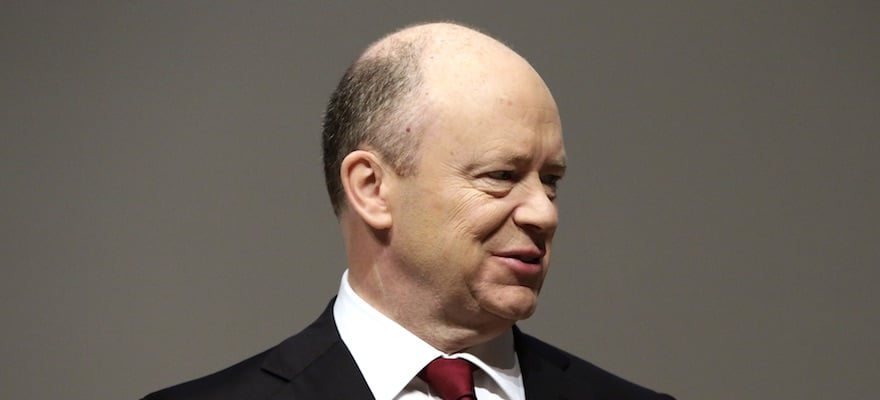
Deutsche Bank’s (NYSE:DB) Chief Executive John Cryan has been one of the company’s biggest proponents of job cuts over the past few years. However, the lender’s remaining 100,000 personnel may be facing a new threat from an unlikely source – robots.
Since late 2015, Deutsche Bank has embarked on a broad cost-cutting measure that has seen thousands of jobs gutted in a bid to restore profitability. Not unlike its industry rivals, the banking sector has been one of the hardest hit with profitability and revenues taking a recent dive – deep cuts have been viewed as a possible panacea.
Bloomberg, Deutsche Bank's CEO John Cryan
In parallel to this, Deutsche Bank and other lenders have been pursuing a variety of technological approaches and innovative strategies to help disrupt traditional banking. An unforeseen consequence may be further cuts to personnel because of a growing reliance on robotic employees.
Robots have several advantages over humans, especially when conducting even rudimentary cost-benefit analysis. For a business intent on profits and answering to its shareholders, the idea of no bonuses, no healthcare, and minimal considerations is quite appealing. At a recent banking event in Frankfurt, Mr. Cryan suggested that a large number of his current staff could be replaced by robots and that it was important to not impede this progress.
"We have to find new ways of employing people and maybe people need to find new ways of spending their time,” he commented in a recent report by the FT. Despite the sobering commentary, he did not explain any details of how many or precisely which jobs were in the crosshairs, only suggesting it would be a large number.
In order to sift for clues one only has to look at which jobs have already been cut en masse – this includes back-office, IT, and other traditional branch jobs. A future that includes robotic tellers at banks could be closer than some think however, especially if Deutsche Bank and other lenders are hell-bent on such a finality or invest strongly in this direction.
Mr. Cryan’s comments echoed a 2016 report from the World Economic Forum, which had predicted that Automation in the banking industry would result in the loss of 5 million jobs by 2020. This could be unwelcome news for banking employees looking to survive the job cuts.
Deutsche Bank’s (NYSE:DB) Chief Executive John Cryan has been one of the company’s biggest proponents of job cuts over the past few years. However, the lender’s remaining 100,000 personnel may be facing a new threat from an unlikely source – robots.
Since late 2015, Deutsche Bank has embarked on a broad cost-cutting measure that has seen thousands of jobs gutted in a bid to restore profitability. Not unlike its industry rivals, the banking sector has been one of the hardest hit with profitability and revenues taking a recent dive – deep cuts have been viewed as a possible panacea.
Bloomberg, Deutsche Bank's CEO John Cryan
In parallel to this, Deutsche Bank and other lenders have been pursuing a variety of technological approaches and innovative strategies to help disrupt traditional banking. An unforeseen consequence may be further cuts to personnel because of a growing reliance on robotic employees.
Robots have several advantages over humans, especially when conducting even rudimentary cost-benefit analysis. For a business intent on profits and answering to its shareholders, the idea of no bonuses, no healthcare, and minimal considerations is quite appealing. At a recent banking event in Frankfurt, Mr. Cryan suggested that a large number of his current staff could be replaced by robots and that it was important to not impede this progress.
"We have to find new ways of employing people and maybe people need to find new ways of spending their time,” he commented in a recent report by the FT. Despite the sobering commentary, he did not explain any details of how many or precisely which jobs were in the crosshairs, only suggesting it would be a large number.
In order to sift for clues one only has to look at which jobs have already been cut en masse – this includes back-office, IT, and other traditional branch jobs. A future that includes robotic tellers at banks could be closer than some think however, especially if Deutsche Bank and other lenders are hell-bent on such a finality or invest strongly in this direction.
Mr. Cryan’s comments echoed a 2016 report from the World Economic Forum, which had predicted that Automation in the banking industry would result in the loss of 5 million jobs by 2020. This could be unwelcome news for banking employees looking to survive the job cuts.
Singapore Independent Wealth Sector Has Less Than 10% Market Share, but Vast Room for Growth
FP Markets Winner Spotlight 🏆 | Global Broker of the Year 2025 #Trading #Broker #Innovation #Shorts
FP Markets Winner Spotlight 🏆 | Global Broker of the Year 2025 #Trading #Broker #Innovation #Shorts
FP Markets takes the spotlight as Global Broker of the Year 2025 at the Finance Magnates Awards.
Martin Stoilov, Head of Client Experience, shares that trust, innovation, and people played a key role in the company’s success, supported by a strong foundation of integrity and client-centricity.
Following this milestone, FP Markets continues to focus on growth, technology investment, and its core values of transparency and excellence.
👉 Be part of FM Awards 2026: https://awards.financemagnates.com/#nominate
FP Markets takes the spotlight as Global Broker of the Year 2025 at the Finance Magnates Awards.
Martin Stoilov, Head of Client Experience, shares that trust, innovation, and people played a key role in the company’s success, supported by a strong foundation of integrity and client-centricity.
Following this milestone, FP Markets continues to focus on growth, technology investment, and its core values of transparency and excellence.
👉 Be part of FM Awards 2026: https://awards.financemagnates.com/#nominate
In this video, we review @HolaPrimeMarketsOfficial, a multi-asset forex and CFDs broker offering different account types, trading platforms, and flexible trading conditions.
We cover the broker’s overall offering, including account options, trading environment, platforms like MT4 and MT5, and additional services such as managed accounts and fast withdrawals.
Watch the full video to see if Hola Prime Markets fits your trading needs.
📣 Stay up to date with the latest in finance and trading. Follow Finance Magnates for industry news, insights, and global event coverage.
Connect with us:
🔗 LinkedIn: /financemagnates
👍 Facebook: /financemagnates
📸 Instagram: https://www.instagram.com/financemagnates
🐦 X: https://x.com/financemagnates
🎥 TikTok: https://www.tiktok.com/tag/financemagnates
▶️ YouTube: /@financemagnates_official
#HolaPrime #ForexBroker #CFDTrading #FinanceMagnates #Trading #Forex #BrokerReview
In this video, we review @HolaPrimeMarketsOfficial, a multi-asset forex and CFDs broker offering different account types, trading platforms, and flexible trading conditions.
We cover the broker’s overall offering, including account options, trading environment, platforms like MT4 and MT5, and additional services such as managed accounts and fast withdrawals.
Watch the full video to see if Hola Prime Markets fits your trading needs.
📣 Stay up to date with the latest in finance and trading. Follow Finance Magnates for industry news, insights, and global event coverage.
Connect with us:
🔗 LinkedIn: /financemagnates
👍 Facebook: /financemagnates
📸 Instagram: https://www.instagram.com/financemagnates
🐦 X: https://x.com/financemagnates
🎥 TikTok: https://www.tiktok.com/tag/financemagnates
▶️ YouTube: /@financemagnates_official
#HolaPrime #ForexBroker #CFDTrading #FinanceMagnates #Trading #Forex #BrokerReview
Hola Prime Review: What You Need to Know | Full Breakdown by Finance Magnates
Hola Prime Review: What You Need to Know | Full Breakdown by Finance Magnates
In this video, we review @HolaPrime_Global, a proprietary trading firm offering evaluation programs and performance-based payouts in simulated market environments.
We cover how the challenge model works, including account types, profit splits (up to 95%), trading rules, and what it takes to reach a funded account. You’ll also learn about available platforms like MT4, MT5, cTrader, and more, along with insights into payouts, support, and trading conditions.
Watch the full video to see if Hola Prime fits your trading style.
📣 Stay up to date with the latest in finance and trading. Follow Finance Magnates for industry news, insights, and global event coverage.
Connect with us:
🔗 LinkedIn: /financemagnates
👍 Facebook: /financemagnates
📸 Instagram: https://www.instagram.com/financemagnates
🐦 X: https://x.com/financemagnates
🎥 TikTok: https://www.tiktok.com/tag/financemagnates
▶️ YouTube: /@financemagnates_official
#HolaPrime #PropFirm #Trading #FinanceMagnates #Forex #FuturesTrading #TradingReview #PropFirmReview
In this video, we review @HolaPrime_Global, a proprietary trading firm offering evaluation programs and performance-based payouts in simulated market environments.
We cover how the challenge model works, including account types, profit splits (up to 95%), trading rules, and what it takes to reach a funded account. You’ll also learn about available platforms like MT4, MT5, cTrader, and more, along with insights into payouts, support, and trading conditions.
Watch the full video to see if Hola Prime fits your trading style.
📣 Stay up to date with the latest in finance and trading. Follow Finance Magnates for industry news, insights, and global event coverage.
Connect with us:
🔗 LinkedIn: /financemagnates
👍 Facebook: /financemagnates
📸 Instagram: https://www.instagram.com/financemagnates
🐦 X: https://x.com/financemagnates
🎥 TikTok: https://www.tiktok.com/tag/financemagnates
▶️ YouTube: /@financemagnates_official
#HolaPrime #PropFirm #Trading #FinanceMagnates #Forex #FuturesTrading #TradingReview #PropFirmReview
Axi Winner Spotlight 🏆 | Global Most Innovative Broker 2025 #Innovation #Trading #Fintech #Broker
Axi Winner Spotlight 🏆 | Global Most Innovative Broker 2025 #Innovation #Trading #Fintech #Broker
Axi takes the spotlight at the Finance Magnates Awards, winning Global Most Innovative Broker 2025.
Olivia Xenofontos and Ivanna Openko share how the team will feel: proud, motivated, and ready to keep delivering.
They also describe the night as well-organized, focused, and enjoyable for all.
👉 Be part of FM Awards 2026.
Axi takes the spotlight at the Finance Magnates Awards, winning Global Most Innovative Broker 2025.
Olivia Xenofontos and Ivanna Openko share how the team will feel: proud, motivated, and ready to keep delivering.
They also describe the night as well-organized, focused, and enjoyable for all.
👉 Be part of FM Awards 2026.
Recognition that matters.
Built on transparency.
Driven by the industry.
The Finance Magnates Awards 2026.
Nominations are now open.
🔗 https://awards.financemagnates.com/?utm_source=SM&utm_medium=social&utm_campaign=recognition-matters
Recognition that matters.
Built on transparency.
Driven by the industry.
The Finance Magnates Awards 2026.
Nominations are now open.
🔗 https://awards.financemagnates.com/?utm_source=SM&utm_medium=social&utm_campaign=recognition-matters