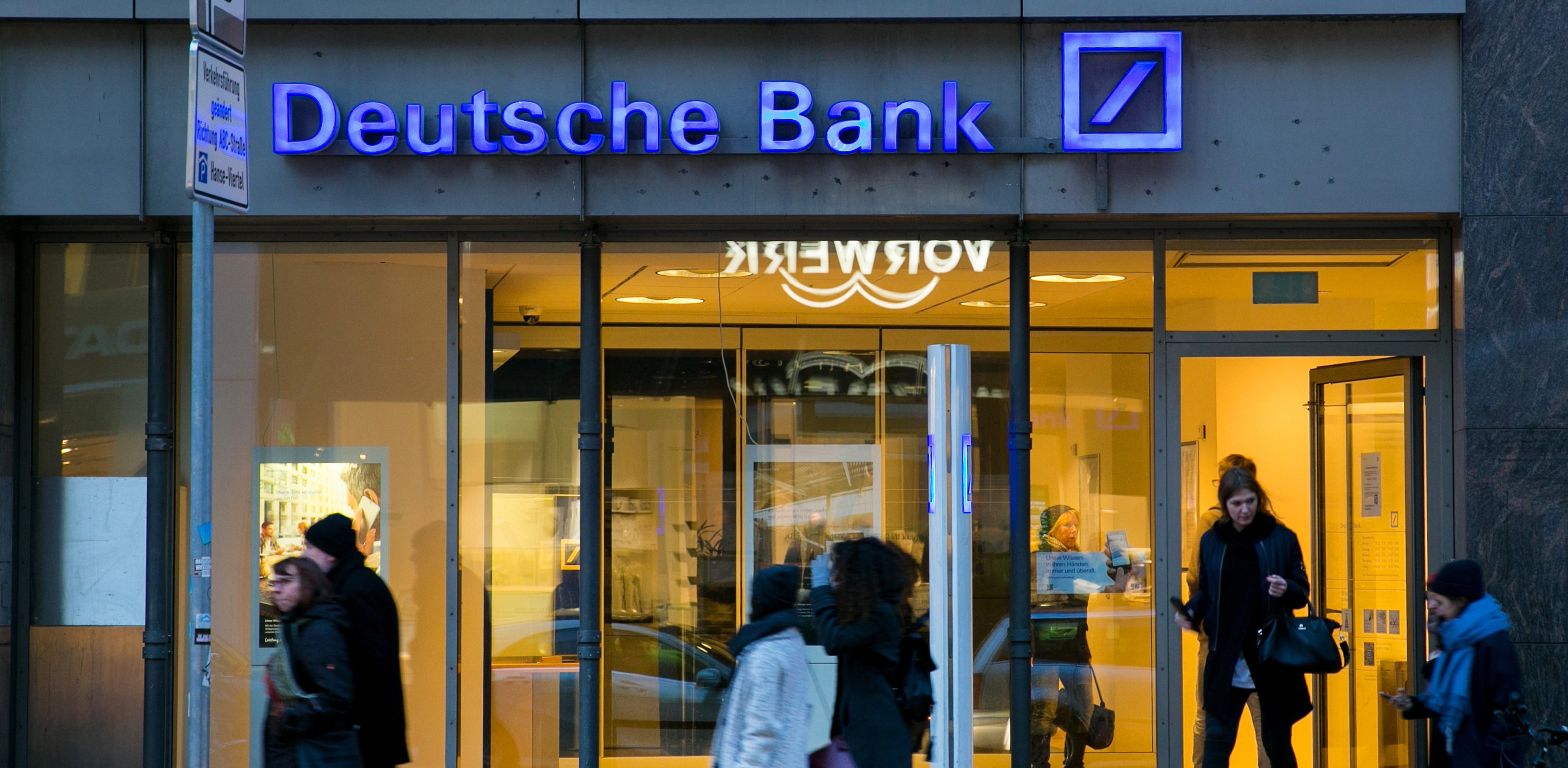
Last week saw rumors that Deutsche Bank might need a state bailout after the DOJ’s threat of a $14 billion penalty.
The allegations over residential mortgage-backed securities (RMBS) date back as far as 2005. The fine however was seen by many political analysts as a first step in more intricate negotiations to follow. Deutsche Bank is likely to see its prospective payment reduced in the end.
For the DOJ , it was important to show its tough stance at the beginning of the negotiations, as Deutsche Bank's case is one of the first cases of a European bank over RMBS. Barclays and Credit Suisse, among others, are to follow.
Nevertheless, with its stock price falling to €10 per share at the end of September, investors started to become wary of whether Deutsche Bank would be strong enough to cope with the financial burden of future litigation. Deutsche Bank’s market cap is around $19 billion and it has laid back $5.5 billion in provisions for legal settlements.
Bailout
Last week, German press speculated about a state bailout which was immediately denied by government officials. However, as several newspapers reported, employees at the German Finance Ministry are working on an emergency plan in case Deutsche Bank runs out of money.
The harsh and instant denials of these plans show the nervousness of the German government. Chancellor Merkel faces a dilemma in foreign as well as interior policy. In the EU Merkel has spoken out several times against a bailout of Italian banks which are still sitting on bad loans amounting to €360 billion.
Her harsh stance in this matter has not only brought her strong criticism from Italian premier Matteo Renzi but also from the French president Francois Hollande. A state bailout of Deutsche Bank now might be seen as hypocrisy and weakness. The consequence would definitely be a strengthening of the Southern European bloc and bank bailouts in further states. For Chancellor Merkel this is equal to opening Pandora's box and further derailing the stability of the eurozone.
Political Climate
Apart from the problems a Deutsche Bank bailout poses regarding foreign policy, one should not underestimate the domestic political climate.
As in the whole Western world, German voter sentiment regarding banks has become increasingly hostile since the financial crisis. In 2009, Germany’s second largest private bank, Commerzbank, was partly nationalized and up to today the state has not sold all of its shares. Additionally, several federal states had to step in with taxpayer money to save federal state banks which would have otherwise collapsed.
A bailout of Deutsche Bank would definitely cause uproar among Merkel`s traditional CDU voters. In 2017 Germany will hold elections for the Bundestag and although Merkel has not officially declared whether she will run again, it is widely expected. Therefore she would under no circumstance want to give the impression that she is frivolously wasting taxpayers’ money for saving 'greedy bankers'.
In the recent federal elections this year, the far-right anti-immigrant party AFD (Alternative for Germany) was able to score highly, thanks to a great degree to disappointed Merkel voters and nonvoters. Merkel`s CDU is thus under enormous pressure from the right.
Lehman Brothers
To come back to the headline, despite pressure from the national and international level, there might be under certain circumstance no other recourse for Germany than to bail out Deutsche Bank. The bank still has the biggest derivative exposure in the world, with around $47 trillion, and one would not want to imagine the effects on the financial markets if Deutsche goes down uncontrolled.
The experience with Lehman Brothers (which had a tiny derivative exposure compared to Deutsche Bank) has led many officials in Europe to believe that a bank bailout is the lesser evil, and pressure on Germany to bail out Deutsche Bank will substantially increase once the market has lost confidence.
The IMF in its latest summit branded Deutsche Bank as one of the biggest threats to the global economy. No matter how desperately the German government tries to give credible assurance that it does not consider any government intervention, in the end it will have to if Deutsche Bank cannot manage its problems on its own.
Nonetheless, it is clear that a potential government step-in will not only have consequences for Germany, but also be a blueprint for the newly created institutions in Europe for banking supervision following the financial crisis.
Last week saw rumors that Deutsche Bank might need a state bailout after the DOJ’s threat of a $14 billion penalty.
The allegations over residential mortgage-backed securities (RMBS) date back as far as 2005. The fine however was seen by many political analysts as a first step in more intricate negotiations to follow. Deutsche Bank is likely to see its prospective payment reduced in the end.
For the DOJ , it was important to show its tough stance at the beginning of the negotiations, as Deutsche Bank's case is one of the first cases of a European bank over RMBS. Barclays and Credit Suisse, among others, are to follow.
Nevertheless, with its stock price falling to €10 per share at the end of September, investors started to become wary of whether Deutsche Bank would be strong enough to cope with the financial burden of future litigation. Deutsche Bank’s market cap is around $19 billion and it has laid back $5.5 billion in provisions for legal settlements.
Bailout
Last week, German press speculated about a state bailout which was immediately denied by government officials. However, as several newspapers reported, employees at the German Finance Ministry are working on an emergency plan in case Deutsche Bank runs out of money.
The harsh and instant denials of these plans show the nervousness of the German government. Chancellor Merkel faces a dilemma in foreign as well as interior policy. In the EU Merkel has spoken out several times against a bailout of Italian banks which are still sitting on bad loans amounting to €360 billion.
Her harsh stance in this matter has not only brought her strong criticism from Italian premier Matteo Renzi but also from the French president Francois Hollande. A state bailout of Deutsche Bank now might be seen as hypocrisy and weakness. The consequence would definitely be a strengthening of the Southern European bloc and bank bailouts in further states. For Chancellor Merkel this is equal to opening Pandora's box and further derailing the stability of the eurozone.
Political Climate
Apart from the problems a Deutsche Bank bailout poses regarding foreign policy, one should not underestimate the domestic political climate.
As in the whole Western world, German voter sentiment regarding banks has become increasingly hostile since the financial crisis. In 2009, Germany’s second largest private bank, Commerzbank, was partly nationalized and up to today the state has not sold all of its shares. Additionally, several federal states had to step in with taxpayer money to save federal state banks which would have otherwise collapsed.
A bailout of Deutsche Bank would definitely cause uproar among Merkel`s traditional CDU voters. In 2017 Germany will hold elections for the Bundestag and although Merkel has not officially declared whether she will run again, it is widely expected. Therefore she would under no circumstance want to give the impression that she is frivolously wasting taxpayers’ money for saving 'greedy bankers'.
In the recent federal elections this year, the far-right anti-immigrant party AFD (Alternative for Germany) was able to score highly, thanks to a great degree to disappointed Merkel voters and nonvoters. Merkel`s CDU is thus under enormous pressure from the right.
Lehman Brothers
To come back to the headline, despite pressure from the national and international level, there might be under certain circumstance no other recourse for Germany than to bail out Deutsche Bank. The bank still has the biggest derivative exposure in the world, with around $47 trillion, and one would not want to imagine the effects on the financial markets if Deutsche goes down uncontrolled.
The experience with Lehman Brothers (which had a tiny derivative exposure compared to Deutsche Bank) has led many officials in Europe to believe that a bank bailout is the lesser evil, and pressure on Germany to bail out Deutsche Bank will substantially increase once the market has lost confidence.
The IMF in its latest summit branded Deutsche Bank as one of the biggest threats to the global economy. No matter how desperately the German government tries to give credible assurance that it does not consider any government intervention, in the end it will have to if Deutsche Bank cannot manage its problems on its own.
Nonetheless, it is clear that a potential government step-in will not only have consequences for Germany, but also be a blueprint for the newly created institutions in Europe for banking supervision following the financial crisis.
Prediction Markets Go Institutional as Galaxy Digital Moves Event Trading to the OTC Swap Market
Featured Videos
FM Daily Brief – 9 June 2026
Today’s Tuesday, the 9th of June 2026, and these are our main stories: eToro’s customer assets climbed back above $20 billion, Prop trading model in prediction markets, and Leverate launched a new AI assistant for brokers and traders.
War Stories: Lessons from 20 Years in Markets (the pain, the pitfalls and the profits)
The trades that taught me the most aren't the ones that worked. They're the ones that didn't — or the ones I almost caught and didn't have the nerve to ride. In this session, I'll tell you about the Brexit miss, the SNB shocker that nearly handed me a 5400% return, the BoJ surprise that punched me in the gut, and a few wins along the way. Each story carries a lesson, but the lessons aren't the point. Everyone who trades long enough collects a portfolio of moments like these; what separates the people who stay in the game is what they do with them.
The Engine and the Fuel: How AI & Data Drives African Future
If AI is the engine, data is the fuel. Without quality, accessible data, AI cannot work well; and without the right mindset, data remains just numbers instead of insight. In this session, leading experts will explore how AI and data are democratizing opportunities for businesses and personal growth. Discover practical ways to make AI accessible today, anticipate its transformative impact on African markets, and learn actionable steps to prepare for what's next. Let's talk about:
-How AI and data drive business efficiency and innovation in trading and fintech
-AI tools to elevate trading or business strategies
-How to access and maximise the power of data and AI
-Emerging AI and data trends in Africa and their economic ripple effects
If AI is the engine, data is the fuel. Without quality, accessible data, AI cannot work well; and without the right mindset, data remains just numbers instead of insight. In this session, leading experts will explore how AI and data are democratizing opportunities for businesses and personal growth. Discover practical ways to make AI accessible today, anticipate its transformative impact on African markets, and learn actionable steps to prepare for what's next. Let's talk about:
-How AI and data drive business efficiency and innovation in trading and fintech
-AI tools to elevate trading or business strategies
-How to access and maximise the power of data and AI
-Emerging AI and data trends in Africa and their economic ripple effects
If AI is the engine, data is the fuel. Without quality, accessible data, AI cannot work well; and without the right mindset, data remains just numbers instead of insight. In this session, leading experts will explore how AI and data are democratizing opportunities for businesses and personal growth. Discover practical ways to make AI accessible today, anticipate its transformative impact on African markets, and learn actionable steps to prepare for what's next. Let's talk about:
-How AI and data drive business efficiency and innovation in trading and fintech
-AI tools to elevate trading or business strategies
-How to access and maximise the power of data and AI
-Emerging AI and data trends in Africa and their economic ripple effects
If AI is the engine, data is the fuel. Without quality, accessible data, AI cannot work well; and without the right mindset, data remains just numbers instead of insight. In this session, leading experts will explore how AI and data are democratizing opportunities for businesses and personal growth. Discover practical ways to make AI accessible today, anticipate its transformative impact on African markets, and learn actionable steps to prepare for what's next. Let's talk about:
-How AI and data drive business efficiency and innovation in trading and fintech
-AI tools to elevate trading or business strategies
-How to access and maximise the power of data and AI
-Emerging AI and data trends in Africa and their economic ripple effects
If AI is the engine, data is the fuel. Without quality, accessible data, AI cannot work well; and without the right mindset, data remains just numbers instead of insight. In this session, leading experts will explore how AI and data are democratizing opportunities for businesses and personal growth. Discover practical ways to make AI accessible today, anticipate its transformative impact on African markets, and learn actionable steps to prepare for what's next. Let's talk about:
-How AI and data drive business efficiency and innovation in trading and fintech
-AI tools to elevate trading or business strategies
-How to access and maximise the power of data and AI
-Emerging AI and data trends in Africa and their economic ripple effects
If AI is the engine, data is the fuel. Without quality, accessible data, AI cannot work well; and without the right mindset, data remains just numbers instead of insight. In this session, leading experts will explore how AI and data are democratizing opportunities for businesses and personal growth. Discover practical ways to make AI accessible today, anticipate its transformative impact on African markets, and learn actionable steps to prepare for what's next. Let's talk about:
-How AI and data drive business efficiency and innovation in trading and fintech
-AI tools to elevate trading or business strategies
-How to access and maximise the power of data and AI
-Emerging AI and data trends in Africa and their economic ripple effects
Inside My Best Trade with Jimmy Moyaha
Most market post-mortems describe what happened to prices. Few describe what happened in the trading room while the position was open: the entry conviction, the moments that tested it, and the exit decision that closed the book.
This session brings one seasoned trader to the stage for an unfiltered account of the position that still defines how they think about markets.
Attendees will walk away with:
-A first-hand account of how a conviction trade is built, from thesis and entry through position management and exit
-Understanding of what turns a market observation into a live position, and what holds it when conditions shift
-Insight into how timing, execution quality, and market structure shaped the final result
-Perspective on what the trade revealed about edge, risk tolerance, and when to hold through a position moving against you
-Clarity on what separates a well-built trade from a well-timed one
Most market post-mortems describe what happened to prices. Few describe what happened in the trading room while the position was open: the entry conviction, the moments that tested it, and the exit decision that closed the book.
This session brings one seasoned trader to the stage for an unfiltered account of the position that still defines how they think about markets.
Attendees will walk away with:
-A first-hand account of how a conviction trade is built, from thesis and entry through position management and exit
-Understanding of what turns a market observation into a live position, and what holds it when conditions shift
-Insight into how timing, execution quality, and market structure shaped the final result
-Perspective on what the trade revealed about edge, risk tolerance, and when to hold through a position moving against you
-Clarity on what separates a well-built trade from a well-timed one
Most market post-mortems describe what happened to prices. Few describe what happened in the trading room while the position was open: the entry conviction, the moments that tested it, and the exit decision that closed the book.
This session brings one seasoned trader to the stage for an unfiltered account of the position that still defines how they think about markets.
Attendees will walk away with:
-A first-hand account of how a conviction trade is built, from thesis and entry through position management and exit
-Understanding of what turns a market observation into a live position, and what holds it when conditions shift
-Insight into how timing, execution quality, and market structure shaped the final result
-Perspective on what the trade revealed about edge, risk tolerance, and when to hold through a position moving against you
-Clarity on what separates a well-built trade from a well-timed one
Most market post-mortems describe what happened to prices. Few describe what happened in the trading room while the position was open: the entry conviction, the moments that tested it, and the exit decision that closed the book.
This session brings one seasoned trader to the stage for an unfiltered account of the position that still defines how they think about markets.
Attendees will walk away with:
-A first-hand account of how a conviction trade is built, from thesis and entry through position management and exit
-Understanding of what turns a market observation into a live position, and what holds it when conditions shift
-Insight into how timing, execution quality, and market structure shaped the final result
-Perspective on what the trade revealed about edge, risk tolerance, and when to hold through a position moving against you
-Clarity on what separates a well-built trade from a well-timed one
Most market post-mortems describe what happened to prices. Few describe what happened in the trading room while the position was open: the entry conviction, the moments that tested it, and the exit decision that closed the book.
This session brings one seasoned trader to the stage for an unfiltered account of the position that still defines how they think about markets.
Attendees will walk away with:
-A first-hand account of how a conviction trade is built, from thesis and entry through position management and exit
-Understanding of what turns a market observation into a live position, and what holds it when conditions shift
-Insight into how timing, execution quality, and market structure shaped the final result
-Perspective on what the trade revealed about edge, risk tolerance, and when to hold through a position moving against you
-Clarity on what separates a well-built trade from a well-timed one
Most market post-mortems describe what happened to prices. Few describe what happened in the trading room while the position was open: the entry conviction, the moments that tested it, and the exit decision that closed the book.
This session brings one seasoned trader to the stage for an unfiltered account of the position that still defines how they think about markets.
Attendees will walk away with:
-A first-hand account of how a conviction trade is built, from thesis and entry through position management and exit
-Understanding of what turns a market observation into a live position, and what holds it when conditions shift
-Insight into how timing, execution quality, and market structure shaped the final result
-Perspective on what the trade revealed about edge, risk tolerance, and when to hold through a position moving against you
-Clarity on what separates a well-built trade from a well-timed one
Agentic Inequality: Democratizing Financial Access Through AI & Blockchain
As crypto and CFD trading continue to expand across Africa, access to advanced tools and market insights remains uneven. This session explores how AI and blockchain can bridge that gap by empowering informal traders and underserved communities to participate more effectively in digital financial markets. The discussion will focus on practical applications of technology to improve accessibility, education, and investment outcomes in both formal and informal sectors.
In this discussion, we will explore:
-The role of AI in democratizing access to trading tools, insights, and strategy development
-How crypto and blockchain can enable broader participation beyond traditional financial systems
-Addressing access barriers: infrastructure, education, and affordability in underserved communities
-Opportunities for brokers and platforms to tap into the informal trading economy
As crypto and CFD trading continue to expand across Africa, access to advanced tools and market insights remains uneven. This session explores how AI and blockchain can bridge that gap by empowering informal traders and underserved communities to participate more effectively in digital financial markets. The discussion will focus on practical applications of technology to improve accessibility, education, and investment outcomes in both formal and informal sectors.
In this discussion, we will explore:
-The role of AI in democratizing access to trading tools, insights, and strategy development
-How crypto and blockchain can enable broader participation beyond traditional financial systems
-Addressing access barriers: infrastructure, education, and affordability in underserved communities
-Opportunities for brokers and platforms to tap into the informal trading economy
As crypto and CFD trading continue to expand across Africa, access to advanced tools and market insights remains uneven. This session explores how AI and blockchain can bridge that gap by empowering informal traders and underserved communities to participate more effectively in digital financial markets. The discussion will focus on practical applications of technology to improve accessibility, education, and investment outcomes in both formal and informal sectors.
In this discussion, we will explore:
-The role of AI in democratizing access to trading tools, insights, and strategy development
-How crypto and blockchain can enable broader participation beyond traditional financial systems
-Addressing access barriers: infrastructure, education, and affordability in underserved communities
-Opportunities for brokers and platforms to tap into the informal trading economy
As crypto and CFD trading continue to expand across Africa, access to advanced tools and market insights remains uneven. This session explores how AI and blockchain can bridge that gap by empowering informal traders and underserved communities to participate more effectively in digital financial markets. The discussion will focus on practical applications of technology to improve accessibility, education, and investment outcomes in both formal and informal sectors.
In this discussion, we will explore:
-The role of AI in democratizing access to trading tools, insights, and strategy development
-How crypto and blockchain can enable broader participation beyond traditional financial systems
-Addressing access barriers: infrastructure, education, and affordability in underserved communities
-Opportunities for brokers and platforms to tap into the informal trading economy
As crypto and CFD trading continue to expand across Africa, access to advanced tools and market insights remains uneven. This session explores how AI and blockchain can bridge that gap by empowering informal traders and underserved communities to participate more effectively in digital financial markets. The discussion will focus on practical applications of technology to improve accessibility, education, and investment outcomes in both formal and informal sectors.
In this discussion, we will explore:
-The role of AI in democratizing access to trading tools, insights, and strategy development
-How crypto and blockchain can enable broader participation beyond traditional financial systems
-Addressing access barriers: infrastructure, education, and affordability in underserved communities
-Opportunities for brokers and platforms to tap into the informal trading economy
As crypto and CFD trading continue to expand across Africa, access to advanced tools and market insights remains uneven. This session explores how AI and blockchain can bridge that gap by empowering informal traders and underserved communities to participate more effectively in digital financial markets. The discussion will focus on practical applications of technology to improve accessibility, education, and investment outcomes in both formal and informal sectors.
In this discussion, we will explore:
-The role of AI in democratizing access to trading tools, insights, and strategy development
-How crypto and blockchain can enable broader participation beyond traditional financial systems
-Addressing access barriers: infrastructure, education, and affordability in underserved communities
-Opportunities for brokers and platforms to tap into the informal trading economy