

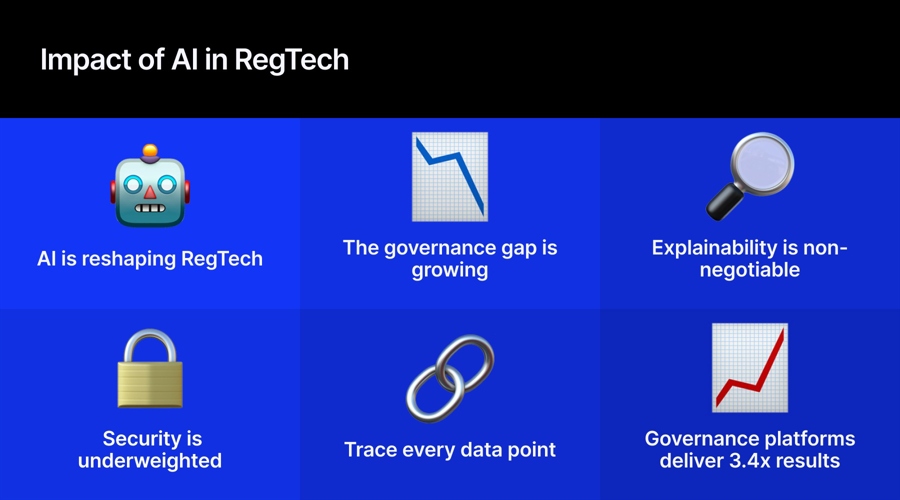
AI is everywhere in the RegTech conversation right now, and the promise is real. Smarter surveillance, faster reporting, sharper AML detection, better oversight of communications and financial promotions. The industry is right to be excited. But two things will ultimately decide whether any of it holds up under regulatory scrutiny: explainability and security.
Singapore Summit: Meet the largest APAC brokers you know (and those you still don't!)
The conversation about AI risk is well underway. Regulators, industry bodies, and compliance leaders are all engaged. But there is a meaningful gap between discussing these risks at conferences and building the operational infrastructure to manage them. That gap is where the industry is most exposed.
The pressure is real and growing. Gartner estimates that the regulation governing the use of AI will cover 75% of the world's economies by 2030, with spending on dedicated AI governance platforms alone forecast to surpass $1 billion by 2030, not counting the far larger investment in people, processes, and internal tooling.
The FSB's 2025 Annual Report confirms what many compliance professionals already feel: consistent implementation of regulatory reforms across jurisdictions remains a work in progress. For multi-jurisdictional trading firms, that fragmentation is the operating environment.
Explainability Is Where Firms Will Be Tested First
Explainability is where most firms will be tested first. The question at the centre of any AI evaluation in compliance is not only how accurate the model is, but whether the team behind it could walk a regulator through the full decision chain.
What data went in? What logic was applied? Why this output and not another? That demands architectural choices made early and deliberately. Bolting on explainability after deployment is like trying to add foundations to a building that is already standing.
Read more: Using Automated Compliance? This FCA Case Shows It Can Freeze Your Firm and Force Fund Returns
McKinsey's 2026 analysis of trusted AI found that automated RegTech solutions can lift compliance rates from around 75% to above 95%. That is significant. But automation without transparency does not eliminate failure. It makes failure harder to trace.
A regulator will not accept that a model performed well ninety-five times out of a hundred if the firm cannot explain what happened the other five. Leading regulators around the world have been clear on this point.
Security Deserves Equal Weight
Security deserves equal weight, and it does not always get it. regtech systems handle some of the most sensitive data a trading firm possesses: trading activity, client positions, transaction histories, communications records, identity data, and regulatory submissions. All of it increasingly flows through AI models that few people in the organisation fully understand. Who has access to this data? How are models protected against manipulation? What happens if adversarial inputs are designed to blind a detection system? These are architecture questions that need answering before deployment, not after an incident.
Data lineage ties both disciplines together. Any firm deploying AI-powered compliance will need to trace every data point feeding its models back to its source. Without that, there is no reliable way to assess whether alerts, risk scores, or regulatory reports stand on solid ground.
- Beyond the "Frankenstein Fraud": How IOSCO is Weaponizing RegTech Against a $17B AI Crime Wave
- A New Leader in Global Compliance and RegTech
- Pairing and Matching under EMIR Refit Has Gone Live: How Shall Brokers Prepare?
The encouraging news is that firms investing in this foundation are seeing results. Gartner's survey of 360 organisations found that those deploying dedicated AI governance platforms are 3.4 times more likely to achieve high effectiveness. The investment in transparency and security pays off in measurable ways.
The Road to RegTech Nirvana
AI will reshape RegTech for trading companies. But the firms that capture the most value will be the ones that treat explainability and security as design principles from the start, not compliance checkboxes to revisit later. The road to RegTech nirvana is real. It runs through these two disciplines, and there are no shortcuts.
Imagine what that nirvana actually looks like. Imagine a world where any compliance team member, with no coding background, can use plain language prompts to build the analysis, reporting, risk assessment, and surveillance solutions they have always needed but never had the resources to create. No dependency on internal engineering queues or vendor roadmaps.
Solutions built in days, not quarters, with a full audit trail in human-readable form and security baked in by design. When the industry gets there, regtech will never be the same. It will stop being a bottleneck and become a business-enabling catalyst. It will connect defence functions to commercial value. It will turn what has always been seen as a grey, back-office necessity into something genuinely powerful and creative. That future is nearer than most people think. The question is whether you will be the one building it or watching someone else do it for you.


