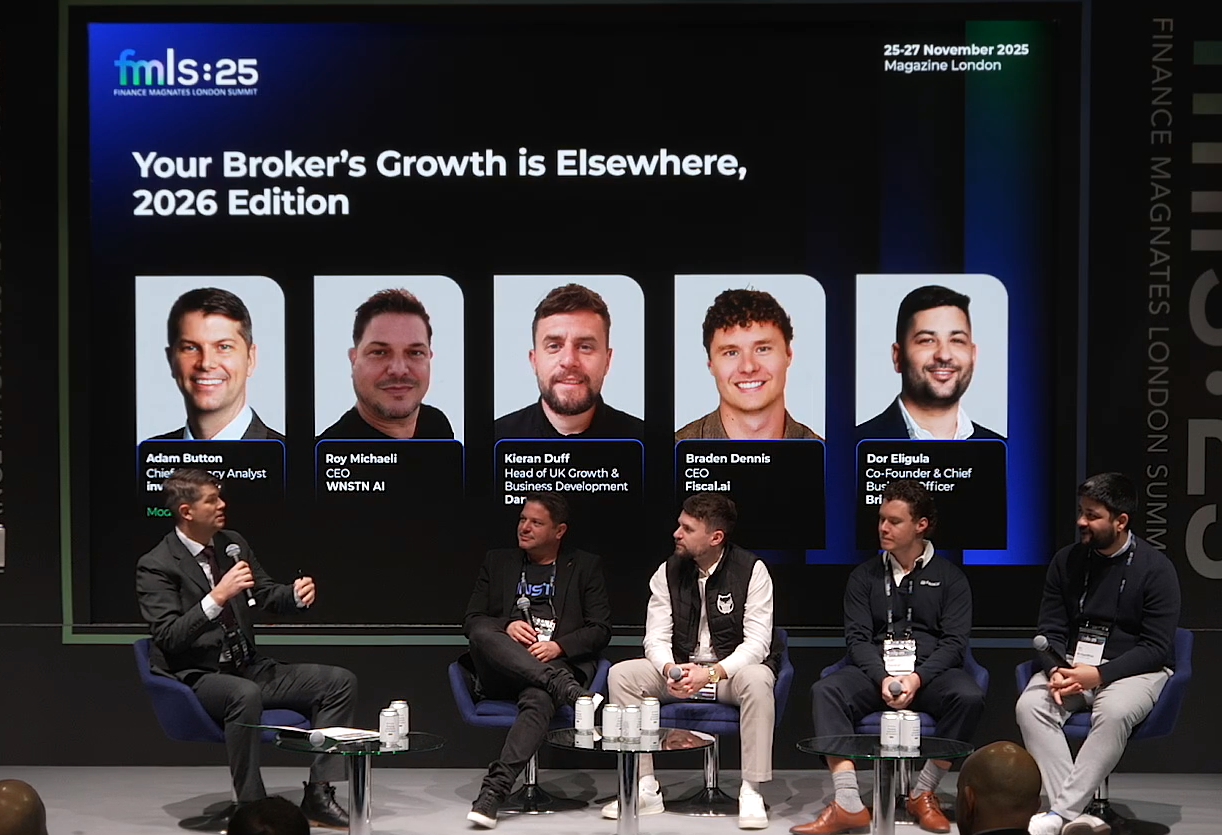
Panelists of “Your Broker’s Growth Is Elsewhere, 2026 Edition” debated AI’s impact on traders’ psychological and emotional challenges.
Brokers see AI primarily as a retention and monetisation tool, rather than a performance enhancer.
Watch the full video from Finance Magnates London Summit 2025.
Artificial intelligence is rapidly reshaping the tools
brokers offer traders, but it is unlikely to turn novices into market wizards
overnight. That was the uneasy consensus – and point of friction – at the Finance
Magnates London Summit 2025, where executives from AI firms, data providers, and
a regulated broker debated where broker growth will really come from heading
into 2026.
The panel, “Your Broker’s Growth Is Elsewhere, 2026
Edition,” centred on a core question confronting the brokerage industry: can AI genuinely improve trading
outcomes, or does its real value lie in boosting engagement, retention and
monetisation rather than performance itself?
The session brought together voices from across the trading
ecosystem to explore how brokers are recalibrating growth strategies amid rapid
advances in AI and data. Moderated by Adam Button, Chief Currency Analyst at
investingLive, the panel featured Roy Michaeli, CEO of WNSTN AI; Kieran Duff,
Head of UK Growth and Business Development at Darwinex; Braden Dennis, CEO of
Fiscal.ai; and Dor Eligula, Co-Founder and Chief Business Officer at
BridgeWise.
Traders Lag, Tools Race Ahead
Duff struck the most sceptical note. Despite the industry’s
AI enthusiasm, he said most retail traders are still struggling with the
basics.
“I speak to hundreds of traders a week and not one of them
really ever mentions AI,” Duff said. “They’re still learning how to trade.
There’s a massive learning curve before you even get to integrating something
like AI.”
For Duff, the hard truth is psychological, not
technological. “AI can’t help you manage the emotional trauma of losing a lot
of money,” he argued. Even the best tools cannot eliminate fear, greed or
overconfidence – forces that ensure most traders fail while a
minority succeed.
That realism resonated with the moderator, Button, who noted
that markets have always “whittled down” participants until only a few survive.
The question, he pressed, is whether AI can soften that brutal funnel.
Education Versus Emotion
Eligula pushed back directly. Drawing on data from more than
35 million end users across 90 brokers and banks, he
argued that AI-driven “investment intelligence” can materially change trader
behaviour.
“When users feel more educated about the decision they
made – even if they lost – they are more likely to come back and try again,”
Eligula said. BridgeWise has seen lower churn and higher engagement when users
interact with its AI tools before trading, he added.
In one recent deployment with a broker serving 3.5 million
users, Eligula said AI-driven insights tied to live events lifted trading volumes by about
15 percent, both in trade count and size. The key, he stressed, is not raw data
but interpretation: “Data alone has partial value. You need a layer on top of
it.”
Personalisation, Not Chatbots
Roy argued that much of the debate is distorted by a narrow
view of AI as a chatbot dispensing answers. The real breakthrough, he said,
lies in contextual, personalised support.
“Think of it as a bionic arm,” Michaeli said. “It’s not
telling you what to do. It’s empowering you with the right data, at the right
time, based on your portfolio
and preferences.”
From left: Adam Button, Roy Michaeli, Kieran Duff, Braden Dennis, and Dor Eligula at FMLS:25
Personalisation, he added, allows brokers to serve different
trader archetypes – those who lean on analyst ratings, technical analysis or
long-term fundamentals – without crossing regulatory red lines. The challenge is combining engagement
with compliance, not choosing one over the other.
The Data Arms Race
If AI is the interface, data remains the fuel. Braden
Dennis, CEO of financial data firm Fiscal.ai, highlighted how AI is collapsing
long-standing delays in fundamental information. During Nvidia’s most recent
earnings, he said, Fiscal.ai processed and standardised the full financials
within three minutes – far faster than the one-to-three-day lag traders have
historically endured.
“That’s completely changing what’s available,” Dennis said,
especially during emotionally charged moments such as earnings season, when retail investors see
positions drop 7 or 10 percent and scramble for answers.
He also pointed to demand for highly specific, non-GAAP
metrics – Spotify’s premium subscribers, for example – arguing that long-term
investors care less about headline EPS than about the numbers that actually
drive a business.
Eric Schmidt's take on AI and jobs raises eyebrows
"Automation always creates more jobs than it destroys—history proves it."
He highlights Asia's crashing birth rates (1.0 or lower): Countries automating fast as populations shrink.
Michaeli countered that compliance is not just about model
size but about how insights are framed. “You don’t give advice,” he said. “You
make people curious enough to ask the next question – within the rules.”
What Growth Really Looks Like
By the session’s end, one point was clear: broker growth is
less about making traders smarter overnight and more about keeping them
engaged, informed and emotionally resilient. AI’s commercial impact, panelists
agreed, is already visible in higher retention, increased trading activity and
better alignment between broker incentives and user behaviour.
Dennis closed with a reminder that technology cannot rewrite
human nature. Citing a well-known Fidelity study, he noted that the
best-performing accounts over decades belonged to investors who had either
forgotten their passwords – or passed away.
“What does that tell you?” Dennis asked. “Investing rewards
patience and good behaviour. It’s done with your stomach, not your brain.”
For brokers chasing growth into 2026, the message was
sobering but pragmatic: AI may not stop traders from making mistakes, but it
can help them understand those mistakes – and stick around long enough to make
the next trade.
Artificial intelligence is rapidly reshaping the tools
brokers offer traders, but it is unlikely to turn novices into market wizards
overnight. That was the uneasy consensus – and point of friction – at the Finance
Magnates London Summit 2025, where executives from AI firms, data providers, and
a regulated broker debated where broker growth will really come from heading
into 2026.
The panel, “Your Broker’s Growth Is Elsewhere, 2026
Edition,” centred on a core question confronting the brokerage industry: can AI genuinely improve trading
outcomes, or does its real value lie in boosting engagement, retention and
monetisation rather than performance itself?
The session brought together voices from across the trading
ecosystem to explore how brokers are recalibrating growth strategies amid rapid
advances in AI and data. Moderated by Adam Button, Chief Currency Analyst at
investingLive, the panel featured Roy Michaeli, CEO of WNSTN AI; Kieran Duff,
Head of UK Growth and Business Development at Darwinex; Braden Dennis, CEO of
Fiscal.ai; and Dor Eligula, Co-Founder and Chief Business Officer at
BridgeWise.
Traders Lag, Tools Race Ahead
Duff struck the most sceptical note. Despite the industry’s
AI enthusiasm, he said most retail traders are still struggling with the
basics.
“I speak to hundreds of traders a week and not one of them
really ever mentions AI,” Duff said. “They’re still learning how to trade.
There’s a massive learning curve before you even get to integrating something
like AI.”
For Duff, the hard truth is psychological, not
technological. “AI can’t help you manage the emotional trauma of losing a lot
of money,” he argued. Even the best tools cannot eliminate fear, greed or
overconfidence – forces that ensure most traders fail while a
minority succeed.
That realism resonated with the moderator, Button, who noted
that markets have always “whittled down” participants until only a few survive.
The question, he pressed, is whether AI can soften that brutal funnel.
Education Versus Emotion
Eligula pushed back directly. Drawing on data from more than
35 million end users across 90 brokers and banks, he
argued that AI-driven “investment intelligence” can materially change trader
behaviour.
“When users feel more educated about the decision they
made – even if they lost – they are more likely to come back and try again,”
Eligula said. BridgeWise has seen lower churn and higher engagement when users
interact with its AI tools before trading, he added.
In one recent deployment with a broker serving 3.5 million
users, Eligula said AI-driven insights tied to live events lifted trading volumes by about
15 percent, both in trade count and size. The key, he stressed, is not raw data
but interpretation: “Data alone has partial value. You need a layer on top of
it.”
Personalisation, Not Chatbots
Roy argued that much of the debate is distorted by a narrow
view of AI as a chatbot dispensing answers. The real breakthrough, he said,
lies in contextual, personalised support.
“Think of it as a bionic arm,” Michaeli said. “It’s not
telling you what to do. It’s empowering you with the right data, at the right
time, based on your portfolio
and preferences.”
From left: Adam Button, Roy Michaeli, Kieran Duff, Braden Dennis, and Dor Eligula at FMLS:25
Personalisation, he added, allows brokers to serve different
trader archetypes – those who lean on analyst ratings, technical analysis or
long-term fundamentals – without crossing regulatory red lines. The challenge is combining engagement
with compliance, not choosing one over the other.
The Data Arms Race
If AI is the interface, data remains the fuel. Braden
Dennis, CEO of financial data firm Fiscal.ai, highlighted how AI is collapsing
long-standing delays in fundamental information. During Nvidia’s most recent
earnings, he said, Fiscal.ai processed and standardised the full financials
within three minutes – far faster than the one-to-three-day lag traders have
historically endured.
“That’s completely changing what’s available,” Dennis said,
especially during emotionally charged moments such as earnings season, when retail investors see
positions drop 7 or 10 percent and scramble for answers.
He also pointed to demand for highly specific, non-GAAP
metrics – Spotify’s premium subscribers, for example – arguing that long-term
investors care less about headline EPS than about the numbers that actually
drive a business.
Eric Schmidt's take on AI and jobs raises eyebrows
"Automation always creates more jobs than it destroys—history proves it."
He highlights Asia's crashing birth rates (1.0 or lower): Countries automating fast as populations shrink.
Michaeli countered that compliance is not just about model
size but about how insights are framed. “You don’t give advice,” he said. “You
make people curious enough to ask the next question – within the rules.”
What Growth Really Looks Like
By the session’s end, one point was clear: broker growth is
less about making traders smarter overnight and more about keeping them
engaged, informed and emotionally resilient. AI’s commercial impact, panelists
agreed, is already visible in higher retention, increased trading activity and
better alignment between broker incentives and user behaviour.
Dennis closed with a reminder that technology cannot rewrite
human nature. Citing a well-known Fidelity study, he noted that the
best-performing accounts over decades belonged to investors who had either
forgotten their passwords – or passed away.
“What does that tell you?” Dennis asked. “Investing rewards
patience and good behaviour. It’s done with your stomach, not your brain.”
For brokers chasing growth into 2026, the message was
sobering but pragmatic: AI may not stop traders from making mistakes, but it
can help them understand those mistakes – and stick around long enough to make
the next trade.
Tareq is a financial writer with 15 years of experience covering global markets. His work spans technical analysis, forex broker reviews, and market sentiment, with a focus on topics relevant to retail traders. He joined Finance Magnates in 2023.
At Finance Magnates, he serves as News Editor, covering retail forex and CFD brokers, cryptocurrency exchanges, fintech firms, and regulatory developments shaping the trading industry. He holds an Honours degree in Information Technology from Anfell College, London.
Education:
Honours degree Information Technology, Anfell College, London
42% of Swiss Financial Firms Have No Digital Fraud Policy, FINMA Finds
Featured Videos
FP Markets Winner Spotlight 🏆 | Global Broker of the Year 2025 #Trading #Broker #Innovation #Shorts
FP Markets Winner Spotlight 🏆 | Global Broker of the Year 2025 #Trading #Broker #Innovation #Shorts
FP Markets Winner Spotlight 🏆 | Global Broker of the Year 2025 #Trading #Broker #Innovation #Shorts
FP Markets Winner Spotlight 🏆 | Global Broker of the Year 2025 #Trading #Broker #Innovation #Shorts
FP Markets takes the spotlight as Global Broker of the Year 2025 at the Finance Magnates Awards.
Martin Stoilov, Head of Client Experience, shares that trust, innovation, and people played a key role in the company’s success, supported by a strong foundation of integrity and client-centricity.
Following this milestone, FP Markets continues to focus on growth, technology investment, and its core values of transparency and excellence.
👉 Be part of FM Awards 2026: https://awards.financemagnates.com/#nominate
FP Markets takes the spotlight as Global Broker of the Year 2025 at the Finance Magnates Awards.
Martin Stoilov, Head of Client Experience, shares that trust, innovation, and people played a key role in the company’s success, supported by a strong foundation of integrity and client-centricity.
Following this milestone, FP Markets continues to focus on growth, technology investment, and its core values of transparency and excellence.
👉 Be part of FM Awards 2026: https://awards.financemagnates.com/#nominate
FP Markets takes the spotlight as Global Broker of the Year 2025 at the Finance Magnates Awards.
Martin Stoilov, Head of Client Experience, shares that trust, innovation, and people played a key role in the company’s success, supported by a strong foundation of integrity and client-centricity.
Following this milestone, FP Markets continues to focus on growth, technology investment, and its core values of transparency and excellence.
👉 Be part of FM Awards 2026: https://awards.financemagnates.com/#nominate
FP Markets takes the spotlight as Global Broker of the Year 2025 at the Finance Magnates Awards.
Martin Stoilov, Head of Client Experience, shares that trust, innovation, and people played a key role in the company’s success, supported by a strong foundation of integrity and client-centricity.
Following this milestone, FP Markets continues to focus on growth, technology investment, and its core values of transparency and excellence.
👉 Be part of FM Awards 2026: https://awards.financemagnates.com/#nominate
In this video, we review @HolaPrimeMarketsOfficial, a multi-asset forex and CFDs broker offering different account types, trading platforms, and flexible trading conditions.
We cover the broker’s overall offering, including account options, trading environment, platforms like MT4 and MT5, and additional services such as managed accounts and fast withdrawals.
Watch the full video to see if Hola Prime Markets fits your trading needs.
📣 Stay up to date with the latest in finance and trading. Follow Finance Magnates for industry news, insights, and global event coverage.
Connect with us:
🔗 LinkedIn: /financemagnates
👍 Facebook: /financemagnates
📸 Instagram: https://www.instagram.com/financemagnates
🐦 X: https://x.com/financemagnates
🎥 TikTok: https://www.tiktok.com/tag/financemagnates
▶️ YouTube: /@financemagnates_official
#HolaPrime #ForexBroker #CFDTrading #FinanceMagnates #Trading #Forex #BrokerReview
In this video, we review @HolaPrimeMarketsOfficial, a multi-asset forex and CFDs broker offering different account types, trading platforms, and flexible trading conditions.
We cover the broker’s overall offering, including account options, trading environment, platforms like MT4 and MT5, and additional services such as managed accounts and fast withdrawals.
Watch the full video to see if Hola Prime Markets fits your trading needs.
📣 Stay up to date with the latest in finance and trading. Follow Finance Magnates for industry news, insights, and global event coverage.
Connect with us:
🔗 LinkedIn: /financemagnates
👍 Facebook: /financemagnates
📸 Instagram: https://www.instagram.com/financemagnates
🐦 X: https://x.com/financemagnates
🎥 TikTok: https://www.tiktok.com/tag/financemagnates
▶️ YouTube: /@financemagnates_official
#HolaPrime #ForexBroker #CFDTrading #FinanceMagnates #Trading #Forex #BrokerReview
In this video, we review @HolaPrimeMarketsOfficial, a multi-asset forex and CFDs broker offering different account types, trading platforms, and flexible trading conditions.
We cover the broker’s overall offering, including account options, trading environment, platforms like MT4 and MT5, and additional services such as managed accounts and fast withdrawals.
Watch the full video to see if Hola Prime Markets fits your trading needs.
📣 Stay up to date with the latest in finance and trading. Follow Finance Magnates for industry news, insights, and global event coverage.
Connect with us:
🔗 LinkedIn: /financemagnates
👍 Facebook: /financemagnates
📸 Instagram: https://www.instagram.com/financemagnates
🐦 X: https://x.com/financemagnates
🎥 TikTok: https://www.tiktok.com/tag/financemagnates
▶️ YouTube: /@financemagnates_official
#HolaPrime #ForexBroker #CFDTrading #FinanceMagnates #Trading #Forex #BrokerReview
In this video, we review @HolaPrimeMarketsOfficial, a multi-asset forex and CFDs broker offering different account types, trading platforms, and flexible trading conditions.
We cover the broker’s overall offering, including account options, trading environment, platforms like MT4 and MT5, and additional services such as managed accounts and fast withdrawals.
Watch the full video to see if Hola Prime Markets fits your trading needs.
📣 Stay up to date with the latest in finance and trading. Follow Finance Magnates for industry news, insights, and global event coverage.
Connect with us:
🔗 LinkedIn: /financemagnates
👍 Facebook: /financemagnates
📸 Instagram: https://www.instagram.com/financemagnates
🐦 X: https://x.com/financemagnates
🎥 TikTok: https://www.tiktok.com/tag/financemagnates
▶️ YouTube: /@financemagnates_official
#HolaPrime #ForexBroker #CFDTrading #FinanceMagnates #Trading #Forex #BrokerReview
In this video, we review @HolaPrimeMarketsOfficial, a multi-asset forex and CFDs broker offering different account types, trading platforms, and flexible trading conditions.
We cover the broker’s overall offering, including account options, trading environment, platforms like MT4 and MT5, and additional services such as managed accounts and fast withdrawals.
Watch the full video to see if Hola Prime Markets fits your trading needs.
📣 Stay up to date with the latest in finance and trading. Follow Finance Magnates for industry news, insights, and global event coverage.
Connect with us:
🔗 LinkedIn: /financemagnates
👍 Facebook: /financemagnates
📸 Instagram: https://www.instagram.com/financemagnates
🐦 X: https://x.com/financemagnates
🎥 TikTok: https://www.tiktok.com/tag/financemagnates
▶️ YouTube: /@financemagnates_official
#HolaPrime #ForexBroker #CFDTrading #FinanceMagnates #Trading #Forex #BrokerReview
In this video, we review @HolaPrimeMarketsOfficial, a multi-asset forex and CFDs broker offering different account types, trading platforms, and flexible trading conditions.
We cover the broker’s overall offering, including account options, trading environment, platforms like MT4 and MT5, and additional services such as managed accounts and fast withdrawals.
Watch the full video to see if Hola Prime Markets fits your trading needs.
📣 Stay up to date with the latest in finance and trading. Follow Finance Magnates for industry news, insights, and global event coverage.
Connect with us:
🔗 LinkedIn: /financemagnates
👍 Facebook: /financemagnates
📸 Instagram: https://www.instagram.com/financemagnates
🐦 X: https://x.com/financemagnates
🎥 TikTok: https://www.tiktok.com/tag/financemagnates
▶️ YouTube: /@financemagnates_official
#HolaPrime #ForexBroker #CFDTrading #FinanceMagnates #Trading #Forex #BrokerReview
Hola Prime Review: What You Need to Know | Full Breakdown by Finance Magnates
Hola Prime Review: What You Need to Know | Full Breakdown by Finance Magnates
Hola Prime Review: What You Need to Know | Full Breakdown by Finance Magnates
Hola Prime Review: What You Need to Know | Full Breakdown by Finance Magnates
Hola Prime Review: What You Need to Know | Full Breakdown by Finance Magnates
Hola Prime Review: What You Need to Know | Full Breakdown by Finance Magnates
In this video, we review @HolaPrime_Global, a proprietary trading firm offering evaluation programs and performance-based payouts in simulated market environments.
We cover how the challenge model works, including account types, profit splits (up to 95%), trading rules, and what it takes to reach a funded account. You’ll also learn about available platforms like MT4, MT5, cTrader, and more, along with insights into payouts, support, and trading conditions.
Watch the full video to see if Hola Prime fits your trading style.
📣 Stay up to date with the latest in finance and trading. Follow Finance Magnates for industry news, insights, and global event coverage.
Connect with us:
🔗 LinkedIn: /financemagnates
👍 Facebook: /financemagnates
📸 Instagram: https://www.instagram.com/financemagnates
🐦 X: https://x.com/financemagnates
🎥 TikTok: https://www.tiktok.com/tag/financemagnates
▶️ YouTube: /@financemagnates_official
#HolaPrime #PropFirm #Trading #FinanceMagnates #Forex #FuturesTrading #TradingReview #PropFirmReview
In this video, we review @HolaPrime_Global, a proprietary trading firm offering evaluation programs and performance-based payouts in simulated market environments.
We cover how the challenge model works, including account types, profit splits (up to 95%), trading rules, and what it takes to reach a funded account. You’ll also learn about available platforms like MT4, MT5, cTrader, and more, along with insights into payouts, support, and trading conditions.
Watch the full video to see if Hola Prime fits your trading style.
📣 Stay up to date with the latest in finance and trading. Follow Finance Magnates for industry news, insights, and global event coverage.
Connect with us:
🔗 LinkedIn: /financemagnates
👍 Facebook: /financemagnates
📸 Instagram: https://www.instagram.com/financemagnates
🐦 X: https://x.com/financemagnates
🎥 TikTok: https://www.tiktok.com/tag/financemagnates
▶️ YouTube: /@financemagnates_official
#HolaPrime #PropFirm #Trading #FinanceMagnates #Forex #FuturesTrading #TradingReview #PropFirmReview
In this video, we review @HolaPrime_Global, a proprietary trading firm offering evaluation programs and performance-based payouts in simulated market environments.
We cover how the challenge model works, including account types, profit splits (up to 95%), trading rules, and what it takes to reach a funded account. You’ll also learn about available platforms like MT4, MT5, cTrader, and more, along with insights into payouts, support, and trading conditions.
Watch the full video to see if Hola Prime fits your trading style.
📣 Stay up to date with the latest in finance and trading. Follow Finance Magnates for industry news, insights, and global event coverage.
Connect with us:
🔗 LinkedIn: /financemagnates
👍 Facebook: /financemagnates
📸 Instagram: https://www.instagram.com/financemagnates
🐦 X: https://x.com/financemagnates
🎥 TikTok: https://www.tiktok.com/tag/financemagnates
▶️ YouTube: /@financemagnates_official
#HolaPrime #PropFirm #Trading #FinanceMagnates #Forex #FuturesTrading #TradingReview #PropFirmReview
In this video, we review @HolaPrime_Global, a proprietary trading firm offering evaluation programs and performance-based payouts in simulated market environments.
We cover how the challenge model works, including account types, profit splits (up to 95%), trading rules, and what it takes to reach a funded account. You’ll also learn about available platforms like MT4, MT5, cTrader, and more, along with insights into payouts, support, and trading conditions.
Watch the full video to see if Hola Prime fits your trading style.
📣 Stay up to date with the latest in finance and trading. Follow Finance Magnates for industry news, insights, and global event coverage.
Connect with us:
🔗 LinkedIn: /financemagnates
👍 Facebook: /financemagnates
📸 Instagram: https://www.instagram.com/financemagnates
🐦 X: https://x.com/financemagnates
🎥 TikTok: https://www.tiktok.com/tag/financemagnates
▶️ YouTube: /@financemagnates_official
#HolaPrime #PropFirm #Trading #FinanceMagnates #Forex #FuturesTrading #TradingReview #PropFirmReview
In this video, we review @HolaPrime_Global, a proprietary trading firm offering evaluation programs and performance-based payouts in simulated market environments.
We cover how the challenge model works, including account types, profit splits (up to 95%), trading rules, and what it takes to reach a funded account. You’ll also learn about available platforms like MT4, MT5, cTrader, and more, along with insights into payouts, support, and trading conditions.
Watch the full video to see if Hola Prime fits your trading style.
📣 Stay up to date with the latest in finance and trading. Follow Finance Magnates for industry news, insights, and global event coverage.
Connect with us:
🔗 LinkedIn: /financemagnates
👍 Facebook: /financemagnates
📸 Instagram: https://www.instagram.com/financemagnates
🐦 X: https://x.com/financemagnates
🎥 TikTok: https://www.tiktok.com/tag/financemagnates
▶️ YouTube: /@financemagnates_official
#HolaPrime #PropFirm #Trading #FinanceMagnates #Forex #FuturesTrading #TradingReview #PropFirmReview
In this video, we review @HolaPrime_Global, a proprietary trading firm offering evaluation programs and performance-based payouts in simulated market environments.
We cover how the challenge model works, including account types, profit splits (up to 95%), trading rules, and what it takes to reach a funded account. You’ll also learn about available platforms like MT4, MT5, cTrader, and more, along with insights into payouts, support, and trading conditions.
Watch the full video to see if Hola Prime fits your trading style.
📣 Stay up to date with the latest in finance and trading. Follow Finance Magnates for industry news, insights, and global event coverage.
Connect with us:
🔗 LinkedIn: /financemagnates
👍 Facebook: /financemagnates
📸 Instagram: https://www.instagram.com/financemagnates
🐦 X: https://x.com/financemagnates
🎥 TikTok: https://www.tiktok.com/tag/financemagnates
▶️ YouTube: /@financemagnates_official
#HolaPrime #PropFirm #Trading #FinanceMagnates #Forex #FuturesTrading #TradingReview #PropFirmReview
Axi Winner Spotlight 🏆 | Global Most Innovative Broker 2025 #Innovation #Trading #Fintech #Broker
Axi Winner Spotlight 🏆 | Global Most Innovative Broker 2025 #Innovation #Trading #Fintech #Broker
Axi Winner Spotlight 🏆 | Global Most Innovative Broker 2025 #Innovation #Trading #Fintech #Broker
Axi Winner Spotlight 🏆 | Global Most Innovative Broker 2025 #Innovation #Trading #Fintech #Broker
Axi Winner Spotlight 🏆 | Global Most Innovative Broker 2025 #Innovation #Trading #Fintech #Broker
Axi Winner Spotlight 🏆 | Global Most Innovative Broker 2025 #Innovation #Trading #Fintech #Broker
Axi takes the spotlight at the Finance Magnates Awards, winning Global Most Innovative Broker 2025.
Olivia Xenofontos and Ivanna Openko share how the team will feel: proud, motivated, and ready to keep delivering.
They also describe the night as well-organized, focused, and enjoyable for all.
👉 Be part of FM Awards 2026.
Axi takes the spotlight at the Finance Magnates Awards, winning Global Most Innovative Broker 2025.
Olivia Xenofontos and Ivanna Openko share how the team will feel: proud, motivated, and ready to keep delivering.
They also describe the night as well-organized, focused, and enjoyable for all.
👉 Be part of FM Awards 2026.
Axi takes the spotlight at the Finance Magnates Awards, winning Global Most Innovative Broker 2025.
Olivia Xenofontos and Ivanna Openko share how the team will feel: proud, motivated, and ready to keep delivering.
They also describe the night as well-organized, focused, and enjoyable for all.
👉 Be part of FM Awards 2026.
Axi takes the spotlight at the Finance Magnates Awards, winning Global Most Innovative Broker 2025.
Olivia Xenofontos and Ivanna Openko share how the team will feel: proud, motivated, and ready to keep delivering.
They also describe the night as well-organized, focused, and enjoyable for all.
👉 Be part of FM Awards 2026.
Axi takes the spotlight at the Finance Magnates Awards, winning Global Most Innovative Broker 2025.
Olivia Xenofontos and Ivanna Openko share how the team will feel: proud, motivated, and ready to keep delivering.
They also describe the night as well-organized, focused, and enjoyable for all.
👉 Be part of FM Awards 2026.
Axi takes the spotlight at the Finance Magnates Awards, winning Global Most Innovative Broker 2025.
Olivia Xenofontos and Ivanna Openko share how the team will feel: proud, motivated, and ready to keep delivering.
They also describe the night as well-organized, focused, and enjoyable for all.
👉 Be part of FM Awards 2026.
Recognition that matters.
Built on transparency.
Driven by the industry.
The Finance Magnates Awards 2026.
Nominations are now open.
🔗 https://awards.financemagnates.com/?utm_source=SM&utm_medium=social&utm_campaign=recognition-matters
Recognition that matters.
Built on transparency.
Driven by the industry.
The Finance Magnates Awards 2026.
Nominations are now open.
🔗 https://awards.financemagnates.com/?utm_source=SM&utm_medium=social&utm_campaign=recognition-matters
Recognition that matters.
Built on transparency.
Driven by the industry.
The Finance Magnates Awards 2026.
Nominations are now open.
🔗 https://awards.financemagnates.com/?utm_source=SM&utm_medium=social&utm_campaign=recognition-matters
Recognition that matters.
Built on transparency.
Driven by the industry.
The Finance Magnates Awards 2026.
Nominations are now open.
🔗 https://awards.financemagnates.com/?utm_source=SM&utm_medium=social&utm_campaign=recognition-matters
Recognition that matters.
Built on transparency.
Driven by the industry.
The Finance Magnates Awards 2026.
Nominations are now open.
🔗 https://awards.financemagnates.com/?utm_source=SM&utm_medium=social&utm_campaign=recognition-matters
Recognition that matters.
Built on transparency.
Driven by the industry.
The Finance Magnates Awards 2026.
Nominations are now open.
🔗 https://awards.financemagnates.com/?utm_source=SM&utm_medium=social&utm_campaign=recognition-matters