The retail trading industry changed in 2019. Finance Magnates looks at what brought the biggest impact to the whole FX/CFD scene
FM
Is it possible that one decision could have changed the image of the whole retail Forex and CFD industry? An example of how trading volumes fell in 2019 clearly shows this is not just an imaginary threat. The past year was clearly dominated by regulation and declining turnovers under the banner of the "Great Migration" of traders. The Finance Magnates Intelligence Department analyzed it in the latest edition of the Intelligence Report.
As a result of regulatory changes in Europe, retail clients have started to look for new opportunities in offshore jurisdictions like Vanuatu, Estonia, and the Bahamas, which have become the Holy Grail for investment firms. Market professionals in interviews with Finance Magnates confirmed that the change in the direction of the regulatory winds has visibly modified the strategy of the brokerage houses themselves. Companies regulated by ASIC, CySEC, and the FCA began to look towards more exotic locations to offer their clients less restrictive trading conditions, including access to higher leverage.
However, according to Daniel Byrne, Managing Director at easyMarkets APAC, ASIC is moving in the same direction as ESMA and "will imminently implement Product Intervention reforms along similar lines, centred around lowering the access to leverage for retail traders in Australia."
"While there is some conjecture as to what the precise changes will end up being, in our view, it will likely be significantly lower than it is today. We are open-minded to the changes and can see both upsides and downsides that will come with them (…) However, the regulators could ironically be placing some traders into even riskier territory by potentially driving them to less regulated jurisdictions in order to obtain their desired buying power, which they can no longer access in Australia. One thing is for sure, and that is that 2020 will be a year of enormous change for Australian Licensed FX and CFD providers," Byrne stated.
The numbers don't lie: volumes fell, Australia went up
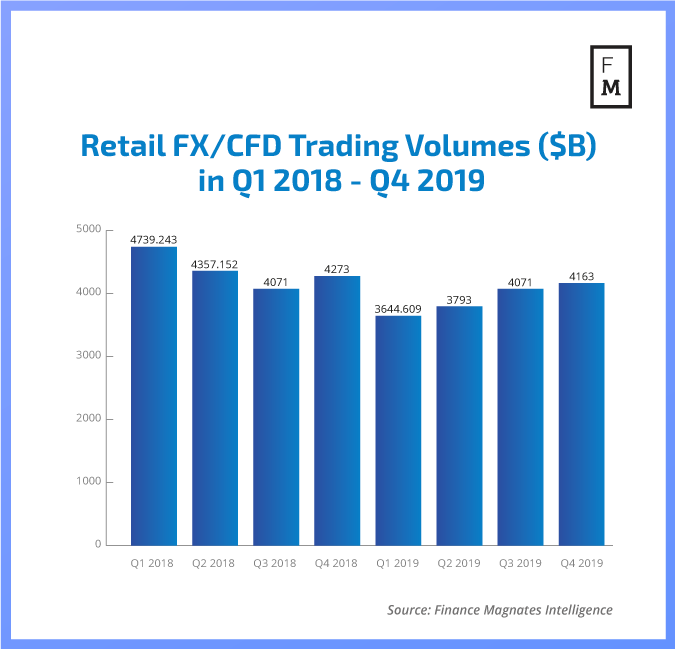
From the beginning of 2018, when world trading volumes reached a multi-month high (excluding Japanese brokers), activity began to decline gradually. As a result, the total volume stood at 5.508 billion dollars in Q1 2018 to drop to just 4.593 billion dollars in Q2 2019 (a decline of 17%).
The fact that the retail market should prepare for change was also noticed when IG Group had to give up its leading position among the 40 biggest FX/CFD retail brokers to Australian-based IC Markets. In the first quarter of last year, the total volume of the Australian broker amounted to 563 billion dollars, compared to 474 billion reported by IG Group in the same period.
Another example, Pepperstone, perfectly illustrates how the market power of Australian brokers has increased. The local giant fears that ASIC's powers will stifle innovation in Australia.
To get the full article and the bigger-picture perspective on how industry evolved in 2019, get our latest Quarterly Intelligence Report.
Is it possible that one decision could have changed the image of the whole retail Forex and CFD industry? An example of how trading volumes fell in 2019 clearly shows this is not just an imaginary threat. The past year was clearly dominated by regulation and declining turnovers under the banner of the "Great Migration" of traders. The Finance Magnates Intelligence Department analyzed it in the latest edition of the Intelligence Report.
As a result of regulatory changes in Europe, retail clients have started to look for new opportunities in offshore jurisdictions like Vanuatu, Estonia, and the Bahamas, which have become the Holy Grail for investment firms. Market professionals in interviews with Finance Magnates confirmed that the change in the direction of the regulatory winds has visibly modified the strategy of the brokerage houses themselves. Companies regulated by ASIC, CySEC, and the FCA began to look towards more exotic locations to offer their clients less restrictive trading conditions, including access to higher leverage.
However, according to Daniel Byrne, Managing Director at easyMarkets APAC, ASIC is moving in the same direction as ESMA and "will imminently implement Product Intervention reforms along similar lines, centred around lowering the access to leverage for retail traders in Australia."
"While there is some conjecture as to what the precise changes will end up being, in our view, it will likely be significantly lower than it is today. We are open-minded to the changes and can see both upsides and downsides that will come with them (…) However, the regulators could ironically be placing some traders into even riskier territory by potentially driving them to less regulated jurisdictions in order to obtain their desired buying power, which they can no longer access in Australia. One thing is for sure, and that is that 2020 will be a year of enormous change for Australian Licensed FX and CFD providers," Byrne stated.
The numbers don't lie: volumes fell, Australia went up
From the beginning of 2018, when world trading volumes reached a multi-month high (excluding Japanese brokers), activity began to decline gradually. As a result, the total volume stood at 5.508 billion dollars in Q1 2018 to drop to just 4.593 billion dollars in Q2 2019 (a decline of 17%).
The fact that the retail market should prepare for change was also noticed when IG Group had to give up its leading position among the 40 biggest FX/CFD retail brokers to Australian-based IC Markets. In the first quarter of last year, the total volume of the Australian broker amounted to 563 billion dollars, compared to 474 billion reported by IG Group in the same period.
Another example, Pepperstone, perfectly illustrates how the market power of Australian brokers has increased. The local giant fears that ASIC's powers will stifle innovation in Australia.
To get the full article and the bigger-picture perspective on how industry evolved in 2019, get our latest Quarterly Intelligence Report.
Sylwester is a graduate of the Warsaw School of Economics, holding an MA in Finance and Banking. He currently serves as Head of the Insights & Reporting Hub at Finance Magnates. He is also a former minority partner in an NFA-registered US forex broker and has been involved in numerous forex and trading industry projects since 2003.
Privately, Sylwester is a husband and father to a 7-year-old daughter, as well as an enthusiast of trading and Formula 1.
Italy’s Consob Tightens Net on AI-Fueled Scams With Fresh Website Bans
FP Markets Winner Spotlight 🏆 | Global Broker of the Year 2025 #Trading #Broker #Innovation #Shorts
FP Markets Winner Spotlight 🏆 | Global Broker of the Year 2025 #Trading #Broker #Innovation #Shorts
FP Markets takes the spotlight as Global Broker of the Year 2025 at the Finance Magnates Awards.
Martin Stoilov, Head of Client Experience, shares that trust, innovation, and people played a key role in the company’s success, supported by a strong foundation of integrity and client-centricity.
Following this milestone, FP Markets continues to focus on growth, technology investment, and its core values of transparency and excellence.
👉 Be part of FM Awards 2026: https://awards.financemagnates.com/#nominate
FP Markets takes the spotlight as Global Broker of the Year 2025 at the Finance Magnates Awards.
Martin Stoilov, Head of Client Experience, shares that trust, innovation, and people played a key role in the company’s success, supported by a strong foundation of integrity and client-centricity.
Following this milestone, FP Markets continues to focus on growth, technology investment, and its core values of transparency and excellence.
👉 Be part of FM Awards 2026: https://awards.financemagnates.com/#nominate
In this video, we review @HolaPrimeMarketsOfficial, a multi-asset forex and CFDs broker offering different account types, trading platforms, and flexible trading conditions.
We cover the broker’s overall offering, including account options, trading environment, platforms like MT4 and MT5, and additional services such as managed accounts and fast withdrawals.
Watch the full video to see if Hola Prime Markets fits your trading needs.
📣 Stay up to date with the latest in finance and trading. Follow Finance Magnates for industry news, insights, and global event coverage.
Connect with us:
🔗 LinkedIn: /financemagnates
👍 Facebook: /financemagnates
📸 Instagram: https://www.instagram.com/financemagnates
🐦 X: https://x.com/financemagnates
🎥 TikTok: https://www.tiktok.com/tag/financemagnates
▶️ YouTube: /@financemagnates_official
#HolaPrime #ForexBroker #CFDTrading #FinanceMagnates #Trading #Forex #BrokerReview
In this video, we review @HolaPrimeMarketsOfficial, a multi-asset forex and CFDs broker offering different account types, trading platforms, and flexible trading conditions.
We cover the broker’s overall offering, including account options, trading environment, platforms like MT4 and MT5, and additional services such as managed accounts and fast withdrawals.
Watch the full video to see if Hola Prime Markets fits your trading needs.
📣 Stay up to date with the latest in finance and trading. Follow Finance Magnates for industry news, insights, and global event coverage.
Connect with us:
🔗 LinkedIn: /financemagnates
👍 Facebook: /financemagnates
📸 Instagram: https://www.instagram.com/financemagnates
🐦 X: https://x.com/financemagnates
🎥 TikTok: https://www.tiktok.com/tag/financemagnates
▶️ YouTube: /@financemagnates_official
#HolaPrime #ForexBroker #CFDTrading #FinanceMagnates #Trading #Forex #BrokerReview
Hola Prime Review: What You Need to Know | Full Breakdown by Finance Magnates
Hola Prime Review: What You Need to Know | Full Breakdown by Finance Magnates
In this video, we review @HolaPrime_Global, a proprietary trading firm offering evaluation programs and performance-based payouts in simulated market environments.
We cover how the challenge model works, including account types, profit splits (up to 95%), trading rules, and what it takes to reach a funded account. You’ll also learn about available platforms like MT4, MT5, cTrader, and more, along with insights into payouts, support, and trading conditions.
Watch the full video to see if Hola Prime fits your trading style.
📣 Stay up to date with the latest in finance and trading. Follow Finance Magnates for industry news, insights, and global event coverage.
Connect with us:
🔗 LinkedIn: /financemagnates
👍 Facebook: /financemagnates
📸 Instagram: https://www.instagram.com/financemagnates
🐦 X: https://x.com/financemagnates
🎥 TikTok: https://www.tiktok.com/tag/financemagnates
▶️ YouTube: /@financemagnates_official
#HolaPrime #PropFirm #Trading #FinanceMagnates #Forex #FuturesTrading #TradingReview #PropFirmReview
In this video, we review @HolaPrime_Global, a proprietary trading firm offering evaluation programs and performance-based payouts in simulated market environments.
We cover how the challenge model works, including account types, profit splits (up to 95%), trading rules, and what it takes to reach a funded account. You’ll also learn about available platforms like MT4, MT5, cTrader, and more, along with insights into payouts, support, and trading conditions.
Watch the full video to see if Hola Prime fits your trading style.
📣 Stay up to date with the latest in finance and trading. Follow Finance Magnates for industry news, insights, and global event coverage.
Connect with us:
🔗 LinkedIn: /financemagnates
👍 Facebook: /financemagnates
📸 Instagram: https://www.instagram.com/financemagnates
🐦 X: https://x.com/financemagnates
🎥 TikTok: https://www.tiktok.com/tag/financemagnates
▶️ YouTube: /@financemagnates_official
#HolaPrime #PropFirm #Trading #FinanceMagnates #Forex #FuturesTrading #TradingReview #PropFirmReview
Axi Winner Spotlight 🏆 | Global Most Innovative Broker 2025 #Innovation #Trading #Fintech #Broker
Axi Winner Spotlight 🏆 | Global Most Innovative Broker 2025 #Innovation #Trading #Fintech #Broker
Axi takes the spotlight at the Finance Magnates Awards, winning Global Most Innovative Broker 2025.
Olivia Xenofontos and Ivanna Openko share how the team will feel: proud, motivated, and ready to keep delivering.
They also describe the night as well-organized, focused, and enjoyable for all.
👉 Be part of FM Awards 2026.
Axi takes the spotlight at the Finance Magnates Awards, winning Global Most Innovative Broker 2025.
Olivia Xenofontos and Ivanna Openko share how the team will feel: proud, motivated, and ready to keep delivering.
They also describe the night as well-organized, focused, and enjoyable for all.
👉 Be part of FM Awards 2026.
Recognition that matters.
Built on transparency.
Driven by the industry.
The Finance Magnates Awards 2026.
Nominations are now open.
🔗 https://awards.financemagnates.com/?utm_source=SM&utm_medium=social&utm_campaign=recognition-matters
Recognition that matters.
Built on transparency.
Driven by the industry.
The Finance Magnates Awards 2026.
Nominations are now open.
🔗 https://awards.financemagnates.com/?utm_source=SM&utm_medium=social&utm_campaign=recognition-matters