Exclusive: Japanese Financial Regulator Steps-up Game on Warning Non-Regulated JFSA Brokers
Friday,23/05/2014|19:22GMTby
Adil Siddiqui
Japan’s regulatory authority for financial services has been stepping-up its game in issuing warnings against firms attempting to market margin derivatives to Japanese residents without the necessary credentials.
Japan’s financial regulator, the Financial Services Authority (JFSA) is actively monitoring marketing activities of financial services firms which solicit or market their products to Japanese investors without holding the necessary authorization. The move comes as the recent tightening of the FX trading landscape in 2010/ 2011 witnessed major amendments to the amount of Leverage users can obtain from providers.
Japan's financial watchdog has communicated with a number of brokerage firms which it believes is unlawfully sourcing and dealing with Japanese resident investors. The regulator has a number of concerns primarily surrounding the safety of Japanese investors.
Japan's retail FX market is the largest and most established on the planet, with a distinct user base. As the market evolved over the last fifteen years, traders adopted new tools and resources to enhance their trading. The use of automated systems such as Expert Advisors (EAs) on the MT4 platform has been one of the recent trends, however with leverage restrictions in place, Japanese investors search for alternate solutions offshore to get the best out of their systems.
In jurisdictions such as the UK or Australia, regulated brokers offer leverage of 500 to 1 and 400 to 1, respectively. A higher amount of leverage reduces the amount of margin investors require to open positions.
The JFSA carries out regular surveillance of the trading environment to ensure firms are not soliciting its residents, if it becomes aware of unregistered operators, including overseas firms, it takes action to prevent any escalated harm to investors.
In a comment to Forex Magnates, a spokesperson for the regulator explained the steps it takes, these include: “Issuing a written warning to the unregistered operator calling on it to immediately cease its unlawful business activities. If required the regulator will make an announcement on the website, stating the fact that the FSA has issued the written warning in order to raise awareness among investors. And in some instances, the regulator will share information with the police on the unregistered operator subject to the written warning.”
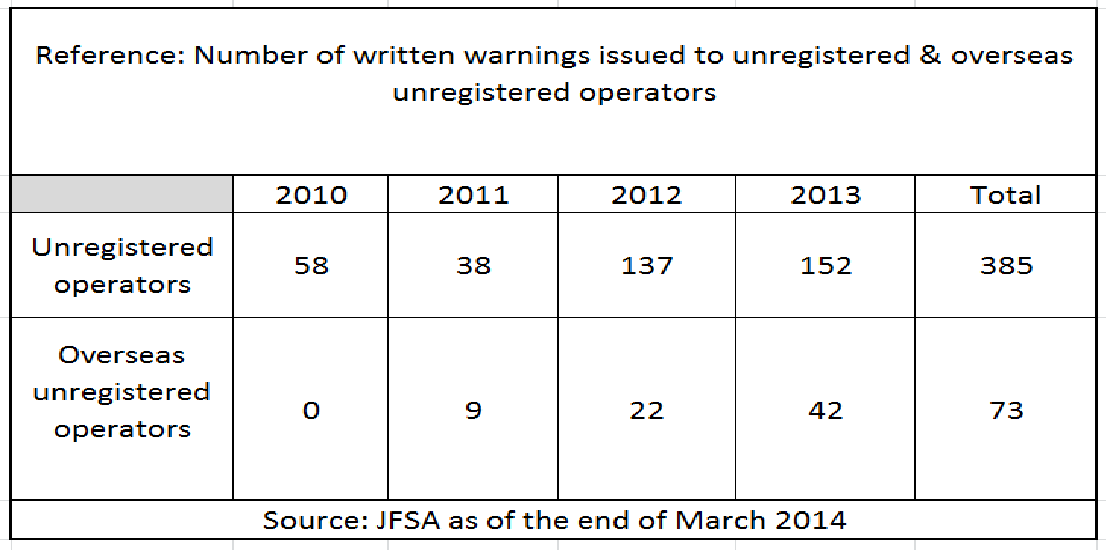
Since implementing the new leverage rules, the JFSA has seen a rise in the number of warnings it issues. In 2013 alone the highest number of warnings were issued to over 150 operators, with over a quarter being overseas operators.
The practice of raising awareness and setting out guidelines in the international domain is common; after the Dodd-Frank Act was implemented the US watchdog enforced a practice whereby non-US regulated broker-dealers could not accept US residents. Japan aims to repeat this principle, however to date its enforceability is limited to its own actions.
Japan doesn't stand alone in its fight against unregulated or unauthorized firms; several major regulators across the modern world have warned their residents about unauthorized firms. In the UK, the Financial Conduct Authority recently issued a warning against several unregulated firms acting without a licence.
As stated earlier, regulators have collaborated in the past and in light of the G20 summit which looked at the role of OTC derivatives in the global recession of 2008, co-operation between regulators is expected to rise. The US has been highlighting the FATCA rules relating to tax and a number of regulator and central banks have highlighted that they will be enforcing the rulings.
The JFSA operates in a similar fashion; if necessary the regulator will communicate with other regulators and/or bodies to examine the situation. The spokesperson commented: “With respect to cross-border problems, whether involving unregistered operators or not, the FSA has, when necessary, worked with overseas authorities in such ways as asking each other for and providing each other with information.”
So What Next?
Japanese clientèle is a sound source of revenue for a number of brokers, a recent case, looking at Australia as an example, showed that a number of FX brokers were accepting Japanese residents, this led the regulator to take matters in their own hands and start knocking on doors. As a result, regulators in Australia and Japan are believed to be in communication regarding the matter.
Forex Magnates believes that a change in rules is imminent, whereby ASIC brokers will not be allowed to solicit Japanese residents.
The FSA’s primary goal is to protect its investors, it concluded: “The FSA will continue working to protect investors through such activities.”
Japan’s financial regulator, the Financial Services Authority (JFSA) is actively monitoring marketing activities of financial services firms which solicit or market their products to Japanese investors without holding the necessary authorization. The move comes as the recent tightening of the FX trading landscape in 2010/ 2011 witnessed major amendments to the amount of Leverage users can obtain from providers.
Japan's financial watchdog has communicated with a number of brokerage firms which it believes is unlawfully sourcing and dealing with Japanese resident investors. The regulator has a number of concerns primarily surrounding the safety of Japanese investors.
Japan's retail FX market is the largest and most established on the planet, with a distinct user base. As the market evolved over the last fifteen years, traders adopted new tools and resources to enhance their trading. The use of automated systems such as Expert Advisors (EAs) on the MT4 platform has been one of the recent trends, however with leverage restrictions in place, Japanese investors search for alternate solutions offshore to get the best out of their systems.
In jurisdictions such as the UK or Australia, regulated brokers offer leverage of 500 to 1 and 400 to 1, respectively. A higher amount of leverage reduces the amount of margin investors require to open positions.
The JFSA carries out regular surveillance of the trading environment to ensure firms are not soliciting its residents, if it becomes aware of unregistered operators, including overseas firms, it takes action to prevent any escalated harm to investors.
In a comment to Forex Magnates, a spokesperson for the regulator explained the steps it takes, these include: “Issuing a written warning to the unregistered operator calling on it to immediately cease its unlawful business activities. If required the regulator will make an announcement on the website, stating the fact that the FSA has issued the written warning in order to raise awareness among investors. And in some instances, the regulator will share information with the police on the unregistered operator subject to the written warning.”
Since implementing the new leverage rules, the JFSA has seen a rise in the number of warnings it issues. In 2013 alone the highest number of warnings were issued to over 150 operators, with over a quarter being overseas operators.
The practice of raising awareness and setting out guidelines in the international domain is common; after the Dodd-Frank Act was implemented the US watchdog enforced a practice whereby non-US regulated broker-dealers could not accept US residents. Japan aims to repeat this principle, however to date its enforceability is limited to its own actions.
Japan doesn't stand alone in its fight against unregulated or unauthorized firms; several major regulators across the modern world have warned their residents about unauthorized firms. In the UK, the Financial Conduct Authority recently issued a warning against several unregulated firms acting without a licence.
As stated earlier, regulators have collaborated in the past and in light of the G20 summit which looked at the role of OTC derivatives in the global recession of 2008, co-operation between regulators is expected to rise. The US has been highlighting the FATCA rules relating to tax and a number of regulator and central banks have highlighted that they will be enforcing the rulings.
The JFSA operates in a similar fashion; if necessary the regulator will communicate with other regulators and/or bodies to examine the situation. The spokesperson commented: “With respect to cross-border problems, whether involving unregistered operators or not, the FSA has, when necessary, worked with overseas authorities in such ways as asking each other for and providing each other with information.”
So What Next?
Japanese clientèle is a sound source of revenue for a number of brokers, a recent case, looking at Australia as an example, showed that a number of FX brokers were accepting Japanese residents, this led the regulator to take matters in their own hands and start knocking on doors. As a result, regulators in Australia and Japan are believed to be in communication regarding the matter.
Forex Magnates believes that a change in rules is imminent, whereby ASIC brokers will not be allowed to solicit Japanese residents.
The FSA’s primary goal is to protect its investors, it concluded: “The FSA will continue working to protect investors through such activities.”
Italy’s Consob Tightens Net on AI-Fueled Scams With Fresh Website Bans
FP Markets Winner Spotlight 🏆 | Global Broker of the Year 2025 #Trading #Broker #Innovation #Shorts
FP Markets Winner Spotlight 🏆 | Global Broker of the Year 2025 #Trading #Broker #Innovation #Shorts
FP Markets takes the spotlight as Global Broker of the Year 2025 at the Finance Magnates Awards.
Martin Stoilov, Head of Client Experience, shares that trust, innovation, and people played a key role in the company’s success, supported by a strong foundation of integrity and client-centricity.
Following this milestone, FP Markets continues to focus on growth, technology investment, and its core values of transparency and excellence.
👉 Be part of FM Awards 2026: https://awards.financemagnates.com/#nominate
FP Markets takes the spotlight as Global Broker of the Year 2025 at the Finance Magnates Awards.
Martin Stoilov, Head of Client Experience, shares that trust, innovation, and people played a key role in the company’s success, supported by a strong foundation of integrity and client-centricity.
Following this milestone, FP Markets continues to focus on growth, technology investment, and its core values of transparency and excellence.
👉 Be part of FM Awards 2026: https://awards.financemagnates.com/#nominate
In this video, we review @HolaPrimeMarketsOfficial, a multi-asset forex and CFDs broker offering different account types, trading platforms, and flexible trading conditions.
We cover the broker’s overall offering, including account options, trading environment, platforms like MT4 and MT5, and additional services such as managed accounts and fast withdrawals.
Watch the full video to see if Hola Prime Markets fits your trading needs.
📣 Stay up to date with the latest in finance and trading. Follow Finance Magnates for industry news, insights, and global event coverage.
Connect with us:
🔗 LinkedIn: /financemagnates
👍 Facebook: /financemagnates
📸 Instagram: https://www.instagram.com/financemagnates
🐦 X: https://x.com/financemagnates
🎥 TikTok: https://www.tiktok.com/tag/financemagnates
▶️ YouTube: /@financemagnates_official
#HolaPrime #ForexBroker #CFDTrading #FinanceMagnates #Trading #Forex #BrokerReview
In this video, we review @HolaPrimeMarketsOfficial, a multi-asset forex and CFDs broker offering different account types, trading platforms, and flexible trading conditions.
We cover the broker’s overall offering, including account options, trading environment, platforms like MT4 and MT5, and additional services such as managed accounts and fast withdrawals.
Watch the full video to see if Hola Prime Markets fits your trading needs.
📣 Stay up to date with the latest in finance and trading. Follow Finance Magnates for industry news, insights, and global event coverage.
Connect with us:
🔗 LinkedIn: /financemagnates
👍 Facebook: /financemagnates
📸 Instagram: https://www.instagram.com/financemagnates
🐦 X: https://x.com/financemagnates
🎥 TikTok: https://www.tiktok.com/tag/financemagnates
▶️ YouTube: /@financemagnates_official
#HolaPrime #ForexBroker #CFDTrading #FinanceMagnates #Trading #Forex #BrokerReview
Hola Prime Review: What You Need to Know | Full Breakdown by Finance Magnates
Hola Prime Review: What You Need to Know | Full Breakdown by Finance Magnates
In this video, we review @HolaPrime_Global, a proprietary trading firm offering evaluation programs and performance-based payouts in simulated market environments.
We cover how the challenge model works, including account types, profit splits (up to 95%), trading rules, and what it takes to reach a funded account. You’ll also learn about available platforms like MT4, MT5, cTrader, and more, along with insights into payouts, support, and trading conditions.
Watch the full video to see if Hola Prime fits your trading style.
📣 Stay up to date with the latest in finance and trading. Follow Finance Magnates for industry news, insights, and global event coverage.
Connect with us:
🔗 LinkedIn: /financemagnates
👍 Facebook: /financemagnates
📸 Instagram: https://www.instagram.com/financemagnates
🐦 X: https://x.com/financemagnates
🎥 TikTok: https://www.tiktok.com/tag/financemagnates
▶️ YouTube: /@financemagnates_official
#HolaPrime #PropFirm #Trading #FinanceMagnates #Forex #FuturesTrading #TradingReview #PropFirmReview
In this video, we review @HolaPrime_Global, a proprietary trading firm offering evaluation programs and performance-based payouts in simulated market environments.
We cover how the challenge model works, including account types, profit splits (up to 95%), trading rules, and what it takes to reach a funded account. You’ll also learn about available platforms like MT4, MT5, cTrader, and more, along with insights into payouts, support, and trading conditions.
Watch the full video to see if Hola Prime fits your trading style.
📣 Stay up to date with the latest in finance and trading. Follow Finance Magnates for industry news, insights, and global event coverage.
Connect with us:
🔗 LinkedIn: /financemagnates
👍 Facebook: /financemagnates
📸 Instagram: https://www.instagram.com/financemagnates
🐦 X: https://x.com/financemagnates
🎥 TikTok: https://www.tiktok.com/tag/financemagnates
▶️ YouTube: /@financemagnates_official
#HolaPrime #PropFirm #Trading #FinanceMagnates #Forex #FuturesTrading #TradingReview #PropFirmReview
Axi Winner Spotlight 🏆 | Global Most Innovative Broker 2025 #Innovation #Trading #Fintech #Broker
Axi Winner Spotlight 🏆 | Global Most Innovative Broker 2025 #Innovation #Trading #Fintech #Broker
Axi takes the spotlight at the Finance Magnates Awards, winning Global Most Innovative Broker 2025.
Olivia Xenofontos and Ivanna Openko share how the team will feel: proud, motivated, and ready to keep delivering.
They also describe the night as well-organized, focused, and enjoyable for all.
👉 Be part of FM Awards 2026.
Axi takes the spotlight at the Finance Magnates Awards, winning Global Most Innovative Broker 2025.
Olivia Xenofontos and Ivanna Openko share how the team will feel: proud, motivated, and ready to keep delivering.
They also describe the night as well-organized, focused, and enjoyable for all.
👉 Be part of FM Awards 2026.
Recognition that matters.
Built on transparency.
Driven by the industry.
The Finance Magnates Awards 2026.
Nominations are now open.
🔗 https://awards.financemagnates.com/?utm_source=SM&utm_medium=social&utm_campaign=recognition-matters
Recognition that matters.
Built on transparency.
Driven by the industry.
The Finance Magnates Awards 2026.
Nominations are now open.
🔗 https://awards.financemagnates.com/?utm_source=SM&utm_medium=social&utm_campaign=recognition-matters