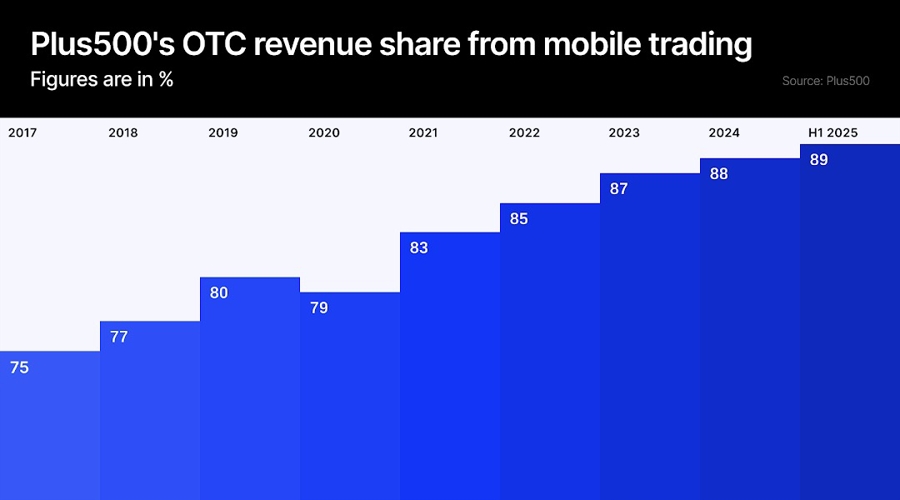
The Israeli broker generated 89 per cent of its H1 2025 OTC revenue from mobile devices.
The Israeli broker executed 84 per cent of its OTC trades on mobile devices in 2024, compared to 73 per cent in 2018.
Nearly nine out of ten contracts for diffrences (CFDs) trades at Plus500 now happen on a phone or tablet — a staggering 89 per cent of the broker’s H1 OTC revenue — compared to an industry average of just 55.5 per cent in Q2 2025. While the overall industry's mobile adoption remains almost stagnant, the Israeli broker's mobile trading share has grown steadily over the past decade, but how did it happen?
Plus500 appears to be an outlier when it comes to mobile trading. In 2024, the broker generated 88 per cent of its OTC revenue from mobile-based trades, with 84 per cent of OTC trades executed from phones or tablets.
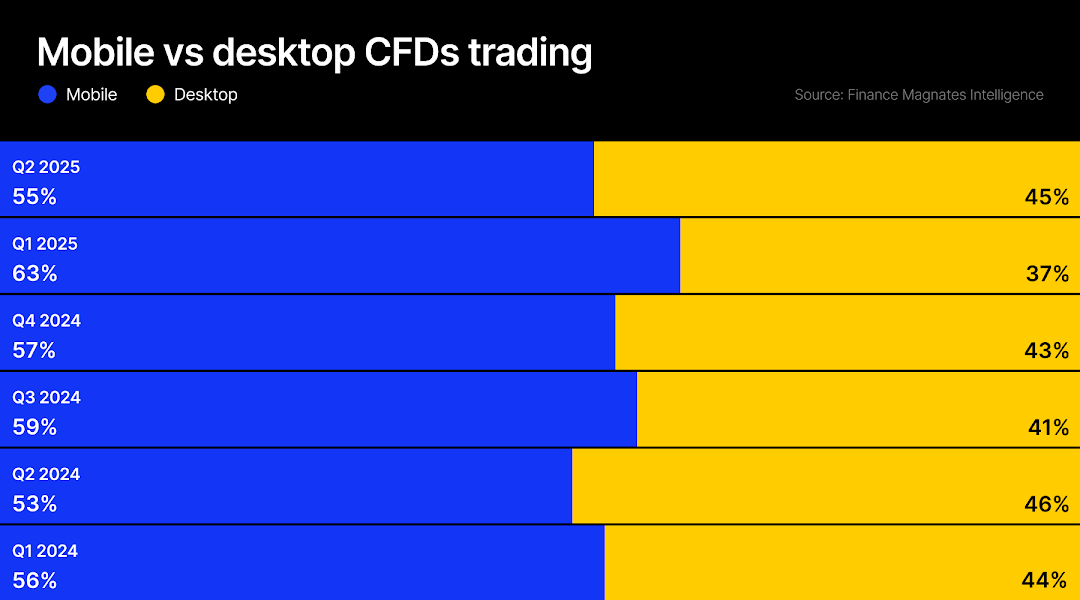
Finance Magnates Intelligence data show that 55.5 per cent of CFDs trades were executed on mobile devices in the second quarter of 2025, compared to 63 per cent in the previous three months.
According to figures disclosed in the Israeli broker’s financials, 73 per cent of its OTC trades were on mobile devices in 2018, which jumped to over 79 per cent in 2021 and more than 82 per cent in 2023.
The revenue share from these mobile-based trades also indicates that not only novice traders but also experienced ones are executing trades on smaller screens. The financials of the publicly listed broker revealed that it was generating over 75 per cent of its total revenue from mobile-based trading in 2018, which increased to over 79 per cent in 2020. In 2020, CFDs revenue from mobiles pushed beyond 83 per cent, hitting a record 89 per cent in the first six months of 2025.
Plus500’s Mobile Activities Outshine the Industry
However, the CFD industry's average mobile trading share remains much lower than Plus500’s dominance in the space.
Although almost none of the other brokers share mobile-specific numbers like Plus500, data from Finance Magnates Intelligence show that more traders are now executing trades on mobile apps.
Since 2021, the overall industry share of mobile trading crossed the 60 per cent mark only in Q1 2025.
It should be noted that the industry data compiled by Finance Magnates Intelligence does not represent the whole CFDs market.
Then the question arises – why do Plus500 users prefer mobile offerings? The broker has been very vocal about its strategic "mobile-first approach", which was first revealed in its 2024 annual report.
The broker further stated that, due to its "unique system architecture and mobile product offering… every customer interaction is designed to have the same look and feel” across phone, tablet, and web, resulting in very high mobile usage.
Additionally, Plus500 explicitly said its approach is aligned with mobile-centric marketing strategies, and that they “continue to focus on innovation in the mobile and tablet space.”
Smartphone Popularity Pushes CFD Brokers to Apps
CFD brokers became interested in launching mobile apps in the early days of smartphones. Saxo Bank was among the first to launch an iPhone app in 2008, allowing users “to manage fully their positions and orders across multiple asset classes and to check their account.”
Swissquote and City Index were other early adopters of mobile applications, followed by giants like CMC Markets, FXCM, OANDA, and IG Group. Plus500, which now likely dominates mobile trading, launched its iPhone app in 2011.
The two popular third-party forex and CFDs trading platforms, MetaTrader and cTrader, also launched mobile apps in the early days. Several CFDs brokers used these mobile apps for years to enter mobile trading but are now launching their own apps.
Many are even stuffing their mobile apps with unique features to engage traders.
When it comes to CFDs mobile apps, their popularity can also be correlated with the number of downloads and their rank among others in the category.
With over 10 million downloads, Exness and Plus500 apps lead on Google Play among CFD brokers. eToro also has 10 million downloads, but it has diversified away from CFDs over the years and is now positioning itself as a Robinhood rival.
In the UK, the Trading 212 app ranks number 5 in the finance category on iOS and number 12 on Android. However, Trading 212 is now more focused on trading physical shares than CFDs.
IG Group, which leads the CFDs trading space in the UK, ranks 167th on Apple’s App Store in the country and has over 1 million downloads on Android devices. The Capital.com app outperforms IG with a 134th rank in the UK’s finance category on the App Store and over 5 million downloads on Google Play.
Nearly nine out of ten contracts for diffrences (CFDs) trades at Plus500 now happen on a phone or tablet — a staggering 89 per cent of the broker’s H1 OTC revenue — compared to an industry average of just 55.5 per cent in Q2 2025. While the overall industry's mobile adoption remains almost stagnant, the Israeli broker's mobile trading share has grown steadily over the past decade, but how did it happen?
Plus500 appears to be an outlier when it comes to mobile trading. In 2024, the broker generated 88 per cent of its OTC revenue from mobile-based trades, with 84 per cent of OTC trades executed from phones or tablets.
Finance Magnates Intelligence data show that 55.5 per cent of CFDs trades were executed on mobile devices in the second quarter of 2025, compared to 63 per cent in the previous three months.
According to figures disclosed in the Israeli broker’s financials, 73 per cent of its OTC trades were on mobile devices in 2018, which jumped to over 79 per cent in 2021 and more than 82 per cent in 2023.
The revenue share from these mobile-based trades also indicates that not only novice traders but also experienced ones are executing trades on smaller screens. The financials of the publicly listed broker revealed that it was generating over 75 per cent of its total revenue from mobile-based trading in 2018, which increased to over 79 per cent in 2020. In 2020, CFDs revenue from mobiles pushed beyond 83 per cent, hitting a record 89 per cent in the first six months of 2025.
Plus500’s Mobile Activities Outshine the Industry
However, the CFD industry's average mobile trading share remains much lower than Plus500’s dominance in the space.
Although almost none of the other brokers share mobile-specific numbers like Plus500, data from Finance Magnates Intelligence show that more traders are now executing trades on mobile apps.
Since 2021, the overall industry share of mobile trading crossed the 60 per cent mark only in Q1 2025.
It should be noted that the industry data compiled by Finance Magnates Intelligence does not represent the whole CFDs market.
Then the question arises – why do Plus500 users prefer mobile offerings? The broker has been very vocal about its strategic "mobile-first approach", which was first revealed in its 2024 annual report.
The broker further stated that, due to its "unique system architecture and mobile product offering… every customer interaction is designed to have the same look and feel” across phone, tablet, and web, resulting in very high mobile usage.
Additionally, Plus500 explicitly said its approach is aligned with mobile-centric marketing strategies, and that they “continue to focus on innovation in the mobile and tablet space.”
Smartphone Popularity Pushes CFD Brokers to Apps
CFD brokers became interested in launching mobile apps in the early days of smartphones. Saxo Bank was among the first to launch an iPhone app in 2008, allowing users “to manage fully their positions and orders across multiple asset classes and to check their account.”
Swissquote and City Index were other early adopters of mobile applications, followed by giants like CMC Markets, FXCM, OANDA, and IG Group. Plus500, which now likely dominates mobile trading, launched its iPhone app in 2011.
The two popular third-party forex and CFDs trading platforms, MetaTrader and cTrader, also launched mobile apps in the early days. Several CFDs brokers used these mobile apps for years to enter mobile trading but are now launching their own apps.
Many are even stuffing their mobile apps with unique features to engage traders.
When it comes to CFDs mobile apps, their popularity can also be correlated with the number of downloads and their rank among others in the category.
With over 10 million downloads, Exness and Plus500 apps lead on Google Play among CFD brokers. eToro also has 10 million downloads, but it has diversified away from CFDs over the years and is now positioning itself as a Robinhood rival.
In the UK, the Trading 212 app ranks number 5 in the finance category on iOS and number 12 on Android. However, Trading 212 is now more focused on trading physical shares than CFDs.
IG Group, which leads the CFDs trading space in the UK, ranks 167th on Apple’s App Store in the country and has over 1 million downloads on Android devices. The Capital.com app outperforms IG with a 134th rank in the UK’s finance category on the App Store and over 5 million downloads on Google Play.
Arnab Shome is an electronics engineer-turned-financial editor. He holds a Bachelor of Technology from the National Institute of Technology, Agartala. He entered the retail trading industry about a decade ago, covering the cryptocurrency market for Finance Magnates, and later expanded his coverage to include forex and CFDs as well.
His work at Finance Magnates includes C-level interviews, data-driven analysis, opinion pieces, and scoops of industry exclusives. He also contributes to Finance Magnates’ quarterly industry report.
Area of coverage:
1. CFD broker-related news
2. Industry-related Regulatory updates and developments
3. New retail trading trends
4. Prop trading industry updates
5. Executive interviews
Education:
Bachelor of Technology - National Institute of Technology, Agartala (India)
Swiss Banks, Brokers and Fintechs Must Prove Online Clients Are Real People
Featured Videos
AvaTrade to Acquire Most of FXCM; NAGA Raises $8M
AvaTrade to Acquire Most of FXCM; NAGA Raises $8M
AvaTrade to Acquire Most of FXCM; NAGA Raises $8M
AvaTrade to Acquire Most of FXCM; NAGA Raises $8M
Today’s financial news recap covers AvaTrade agrees to acquire most of FXCM, NAGA secures eight million dollars in new financing, and Wise seeks a tax settlement in the UK.
Finance Magnates Daily Recap brings you the latest news from forex and CFD brokers, fintech, payments, cryptocurrency, digital assets, trading platforms, financial regulation and global markets.
Get the key company news, executive moves, deals, regulatory updates and market developments of the day, in just a few minutes. New episodes published every weekday.
Read more: https://www.financemagnates.com
#FinanceMagnates #ForexNews #FintechNews
Today’s financial news recap covers AvaTrade agrees to acquire most of FXCM, NAGA secures eight million dollars in new financing, and Wise seeks a tax settlement in the UK.
Finance Magnates Daily Recap brings you the latest news from forex and CFD brokers, fintech, payments, cryptocurrency, digital assets, trading platforms, financial regulation and global markets.
Get the key company news, executive moves, deals, regulatory updates and market developments of the day, in just a few minutes. New episodes published every weekday.
Read more: https://www.financemagnates.com
#FinanceMagnates #ForexNews #FintechNews
Today’s financial news recap covers AvaTrade agrees to acquire most of FXCM, NAGA secures eight million dollars in new financing, and Wise seeks a tax settlement in the UK.
Finance Magnates Daily Recap brings you the latest news from forex and CFD brokers, fintech, payments, cryptocurrency, digital assets, trading platforms, financial regulation and global markets.
Get the key company news, executive moves, deals, regulatory updates and market developments of the day, in just a few minutes. New episodes published every weekday.
Read more: https://www.financemagnates.com
#FinanceMagnates #ForexNews #FintechNews
Today’s financial news recap covers AvaTrade agrees to acquire most of FXCM, NAGA secures eight million dollars in new financing, and Wise seeks a tax settlement in the UK.
Finance Magnates Daily Recap brings you the latest news from forex and CFD brokers, fintech, payments, cryptocurrency, digital assets, trading platforms, financial regulation and global markets.
Get the key company news, executive moves, deals, regulatory updates and market developments of the day, in just a few minutes. New episodes published every weekday.
Read more: https://www.financemagnates.com
#FinanceMagnates #ForexNews #FintechNews
XTB Adds Overnight US Stock Trading; Nasdaq Ventures Invests in One Trading
XTB Adds Overnight US Stock Trading; Nasdaq Ventures Invests in One Trading
XTB Adds Overnight US Stock Trading; Nasdaq Ventures Invests in One Trading
XTB Adds Overnight US Stock Trading; Nasdaq Ventures Invests in One Trading
XTB Adds Overnight US Stock Trading; Nasdaq Ventures Invests in One Trading
XTB Adds Overnight US Stock Trading; Nasdaq Ventures Invests in One Trading
Today’s financial news recap covers XTB expands overnight US stock trading, Fortrade reports higher revenue, Nasdaq backs One Trading, and Vest Labs raises 13 million dollars.
Finance Magnates Daily Recap brings you the latest news from forex and CFD brokers, fintech, payments, cryptocurrency, digital assets, trading platforms, financial regulation and global markets.
Get the key company news, executive moves, deals, regulatory updates and market developments of the day, in just a few minutes. New episodes published every weekday.
Read more: https://www.financemagnates.com
#FinanceMagnates #ForexNews #FintechNews
Today’s financial news recap covers XTB expands overnight US stock trading, Fortrade reports higher revenue, Nasdaq backs One Trading, and Vest Labs raises 13 million dollars.
Finance Magnates Daily Recap brings you the latest news from forex and CFD brokers, fintech, payments, cryptocurrency, digital assets, trading platforms, financial regulation and global markets.
Get the key company news, executive moves, deals, regulatory updates and market developments of the day, in just a few minutes. New episodes published every weekday.
Read more: https://www.financemagnates.com
#FinanceMagnates #ForexNews #FintechNews
Today’s financial news recap covers XTB expands overnight US stock trading, Fortrade reports higher revenue, Nasdaq backs One Trading, and Vest Labs raises 13 million dollars.
Finance Magnates Daily Recap brings you the latest news from forex and CFD brokers, fintech, payments, cryptocurrency, digital assets, trading platforms, financial regulation and global markets.
Get the key company news, executive moves, deals, regulatory updates and market developments of the day, in just a few minutes. New episodes published every weekday.
Read more: https://www.financemagnates.com
#FinanceMagnates #ForexNews #FintechNews
Today’s financial news recap covers XTB expands overnight US stock trading, Fortrade reports higher revenue, Nasdaq backs One Trading, and Vest Labs raises 13 million dollars.
Finance Magnates Daily Recap brings you the latest news from forex and CFD brokers, fintech, payments, cryptocurrency, digital assets, trading platforms, financial regulation and global markets.
Get the key company news, executive moves, deals, regulatory updates and market developments of the day, in just a few minutes. New episodes published every weekday.
Read more: https://www.financemagnates.com
#FinanceMagnates #ForexNews #FintechNews
Today’s financial news recap covers XTB expands overnight US stock trading, Fortrade reports higher revenue, Nasdaq backs One Trading, and Vest Labs raises 13 million dollars.
Finance Magnates Daily Recap brings you the latest news from forex and CFD brokers, fintech, payments, cryptocurrency, digital assets, trading platforms, financial regulation and global markets.
Get the key company news, executive moves, deals, regulatory updates and market developments of the day, in just a few minutes. New episodes published every weekday.
Read more: https://www.financemagnates.com
#FinanceMagnates #ForexNews #FintechNews
Today’s financial news recap covers XTB expands overnight US stock trading, Fortrade reports higher revenue, Nasdaq backs One Trading, and Vest Labs raises 13 million dollars.
Finance Magnates Daily Recap brings you the latest news from forex and CFD brokers, fintech, payments, cryptocurrency, digital assets, trading platforms, financial regulation and global markets.
Get the key company news, executive moves, deals, regulatory updates and market developments of the day, in just a few minutes. New episodes published every weekday.
Read more: https://www.financemagnates.com
#FinanceMagnates #ForexNews #FintechNews
CMC Founder Downplays Volatility Hit; Devexperts Names CEO
CMC Founder Downplays Volatility Hit; Devexperts Names CEO
CMC Founder Downplays Volatility Hit; Devexperts Names CEO
CMC Founder Downplays Volatility Hit; Devexperts Names CEO
CMC Founder Downplays Volatility Hit; Devexperts Names CEO
CMC Founder Downplays Volatility Hit; Devexperts Names CEO
Today’s financial news recap covers low volatility pressures brokers, Devexperts names a new CEO, Saxo cuts onboarding time, and OKX reaches a 25 billion dollar valuation.
Finance Magnates Daily Recap brings you the latest news from forex and CFD brokers, fintech, payments, cryptocurrency, digital assets, trading platforms, financial regulation and global markets.
Get the key company news, executive moves, deals, regulatory updates and market developments of the day, in just a few minutes. New episodes published every weekday.
Read more: https://www.financemagnates.com
#FinanceMagnates #ForexNews #FintechNews
Today’s financial news recap covers low volatility pressures brokers, Devexperts names a new CEO, Saxo cuts onboarding time, and OKX reaches a 25 billion dollar valuation.
Finance Magnates Daily Recap brings you the latest news from forex and CFD brokers, fintech, payments, cryptocurrency, digital assets, trading platforms, financial regulation and global markets.
Get the key company news, executive moves, deals, regulatory updates and market developments of the day, in just a few minutes. New episodes published every weekday.
Read more: https://www.financemagnates.com
#FinanceMagnates #ForexNews #FintechNews
Today’s financial news recap covers low volatility pressures brokers, Devexperts names a new CEO, Saxo cuts onboarding time, and OKX reaches a 25 billion dollar valuation.
Finance Magnates Daily Recap brings you the latest news from forex and CFD brokers, fintech, payments, cryptocurrency, digital assets, trading platforms, financial regulation and global markets.
Get the key company news, executive moves, deals, regulatory updates and market developments of the day, in just a few minutes. New episodes published every weekday.
Read more: https://www.financemagnates.com
#FinanceMagnates #ForexNews #FintechNews
Today’s financial news recap covers low volatility pressures brokers, Devexperts names a new CEO, Saxo cuts onboarding time, and OKX reaches a 25 billion dollar valuation.
Finance Magnates Daily Recap brings you the latest news from forex and CFD brokers, fintech, payments, cryptocurrency, digital assets, trading platforms, financial regulation and global markets.
Get the key company news, executive moves, deals, regulatory updates and market developments of the day, in just a few minutes. New episodes published every weekday.
Read more: https://www.financemagnates.com
#FinanceMagnates #ForexNews #FintechNews
Today’s financial news recap covers low volatility pressures brokers, Devexperts names a new CEO, Saxo cuts onboarding time, and OKX reaches a 25 billion dollar valuation.
Finance Magnates Daily Recap brings you the latest news from forex and CFD brokers, fintech, payments, cryptocurrency, digital assets, trading platforms, financial regulation and global markets.
Get the key company news, executive moves, deals, regulatory updates and market developments of the day, in just a few minutes. New episodes published every weekday.
Read more: https://www.financemagnates.com
#FinanceMagnates #ForexNews #FintechNews
Today’s financial news recap covers low volatility pressures brokers, Devexperts names a new CEO, Saxo cuts onboarding time, and OKX reaches a 25 billion dollar valuation.
Finance Magnates Daily Recap brings you the latest news from forex and CFD brokers, fintech, payments, cryptocurrency, digital assets, trading platforms, financial regulation and global markets.
Get the key company news, executive moves, deals, regulatory updates and market developments of the day, in just a few minutes. New episodes published every weekday.
Read more: https://www.financemagnates.com
#FinanceMagnates #ForexNews #FintechNews
Today’s financial news recap covers Trade Nation buys FXCM's UK client book, Trading 212 reports higher revenue, the CFTC's move to allow perpetual index futures.
Finance Magnates Daily Recap brings you the latest news from forex and CFD brokers, fintech, payments, cryptocurrency, digital assets, trading platforms, financial regulation and global markets.
Get the key company news, executive moves, deals, regulatory updates and market developments of the day, in just a few minutes. New episodes published every weekday.
Read more: https://www.financemagnates.com
#FinanceMagnates #ForexNews #FintechNews
Today’s financial news recap covers Trade Nation buys FXCM's UK client book, Trading 212 reports higher revenue, the CFTC's move to allow perpetual index futures.
Finance Magnates Daily Recap brings you the latest news from forex and CFD brokers, fintech, payments, cryptocurrency, digital assets, trading platforms, financial regulation and global markets.
Get the key company news, executive moves, deals, regulatory updates and market developments of the day, in just a few minutes. New episodes published every weekday.
Read more: https://www.financemagnates.com
#FinanceMagnates #ForexNews #FintechNews
Today’s financial news recap covers Trade Nation buys FXCM's UK client book, Trading 212 reports higher revenue, the CFTC's move to allow perpetual index futures.
Finance Magnates Daily Recap brings you the latest news from forex and CFD brokers, fintech, payments, cryptocurrency, digital assets, trading platforms, financial regulation and global markets.
Get the key company news, executive moves, deals, regulatory updates and market developments of the day, in just a few minutes. New episodes published every weekday.
Read more: https://www.financemagnates.com
#FinanceMagnates #ForexNews #FintechNews
Today’s financial news recap covers Trade Nation buys FXCM's UK client book, Trading 212 reports higher revenue, the CFTC's move to allow perpetual index futures.
Finance Magnates Daily Recap brings you the latest news from forex and CFD brokers, fintech, payments, cryptocurrency, digital assets, trading platforms, financial regulation and global markets.
Get the key company news, executive moves, deals, regulatory updates and market developments of the day, in just a few minutes. New episodes published every weekday.
Read more: https://www.financemagnates.com
#FinanceMagnates #ForexNews #FintechNews
Today’s financial news recap covers Trade Nation buys FXCM's UK client book, Trading 212 reports higher revenue, the CFTC's move to allow perpetual index futures.
Finance Magnates Daily Recap brings you the latest news from forex and CFD brokers, fintech, payments, cryptocurrency, digital assets, trading platforms, financial regulation and global markets.
Get the key company news, executive moves, deals, regulatory updates and market developments of the day, in just a few minutes. New episodes published every weekday.
Read more: https://www.financemagnates.com
#FinanceMagnates #ForexNews #FintechNews
Today’s financial news recap covers Trade Nation buys FXCM's UK client book, Trading 212 reports higher revenue, the CFTC's move to allow perpetual index futures.
Finance Magnates Daily Recap brings you the latest news from forex and CFD brokers, fintech, payments, cryptocurrency, digital assets, trading platforms, financial regulation and global markets.
Get the key company news, executive moves, deals, regulatory updates and market developments of the day, in just a few minutes. New episodes published every weekday.
Read more: https://www.financemagnates.com
#FinanceMagnates #ForexNews #FintechNews
Your career isn’t a linear path.
Your career isn’t a linear path.
Your career isn’t a linear path.
Your career isn’t a linear path.
Your career isn’t a linear path.
Your career isn’t a linear path.
Roles change. Career goals change. Sometimes you want a completely new challenge.
But the skills and knowledge you build along the way can stay with you and give you something to build on.
For Jeff Patterson, that continued growth is key to long-term career development.
You bring the skills. FM Academy helps you build the knowledge.
#FMAcademy #FinanceMagnates #FinanceCareers #ProfessionalDevelopment #Fintech
Roles change. Career goals change. Sometimes you want a completely new challenge.
But the skills and knowledge you build along the way can stay with you and give you something to build on.
For Jeff Patterson, that continued growth is key to long-term career development.
You bring the skills. FM Academy helps you build the knowledge.
#FMAcademy #FinanceMagnates #FinanceCareers #ProfessionalDevelopment #Fintech
Roles change. Career goals change. Sometimes you want a completely new challenge.
But the skills and knowledge you build along the way can stay with you and give you something to build on.
For Jeff Patterson, that continued growth is key to long-term career development.
You bring the skills. FM Academy helps you build the knowledge.
#FMAcademy #FinanceMagnates #FinanceCareers #ProfessionalDevelopment #Fintech
Roles change. Career goals change. Sometimes you want a completely new challenge.
But the skills and knowledge you build along the way can stay with you and give you something to build on.
For Jeff Patterson, that continued growth is key to long-term career development.
You bring the skills. FM Academy helps you build the knowledge.
#FMAcademy #FinanceMagnates #FinanceCareers #ProfessionalDevelopment #Fintech
Roles change. Career goals change. Sometimes you want a completely new challenge.
But the skills and knowledge you build along the way can stay with you and give you something to build on.
For Jeff Patterson, that continued growth is key to long-term career development.
You bring the skills. FM Academy helps you build the knowledge.
#FMAcademy #FinanceMagnates #FinanceCareers #ProfessionalDevelopment #Fintech
Roles change. Career goals change. Sometimes you want a completely new challenge.
But the skills and knowledge you build along the way can stay with you and give you something to build on.
For Jeff Patterson, that continued growth is key to long-term career development.
You bring the skills. FM Academy helps you build the knowledge.
#FMAcademy #FinanceMagnates #FinanceCareers #ProfessionalDevelopment #Fintech