
Pepperstone CEO: “We’re Taking Down Scam Sites Almost Every Day”

Wednesday, 12/11/2025 | 19:03 GMT by Jared Kirui
  • Tamas Szabo said it is becoming “depressingly part of daily business,” despite Pepperstone having purchased over 100 domain name variants to prevent misuse.
  • He also criticized domain registrars for not doing enough to stop deceptive registrations linked to impersonation schemes.
Tamas

Pepperstone’s Group CEO, Tamas Szabo, said the broker is forced to take down scam websites and fake social media accounts impersonating the firm almost every day. In a LinkedIn post on Wednesday, Szabo said the impersonation attempts target both Pepperstone’s clients and brand, creating an ongoing challenge for its fraud team.

Join IG, CMC, and Robinhood at London’s leading trading industry event!

“We are having to take down scam websites and social media accounts impersonating Pepperstone on an almost daily basis to protect both our clients and brand,” Szabo said. “We've purchased over a hundred variants of our domain but haven't been able to capture them all. It has become a full time job for our fraud team to take these sites down.”

Szabo Calls Out Domain Registrars

According to Szabo, Pepperstone has purchased more than a hundred domain variants in an effort to prevent misuse, but fraudulent sites continue to appear.

Szabo criticized domain registrars for failing to curb the problem, suggesting that some may be allowing illegal activities by approving deceptive registrations. “Surely domain registrants should be doing more to stop this. I can only assume what they are facilitating is all just out and out illegal behaviour.”

Cybersquatting Cases Highlight Broader Problem

The CEO cited several examples of misspelt domains – including pepperston.com, peppersone.com, and pepperstoe.com – that attempt to redirect traffic away from Pepperstone’s official site.

Keep reading: Google Takes Cybercrime Group to Court Over “Smishing” Involving 115M Credit Cards: Report

“To top this off we have firms cybersquatting on misspelt domains trying to direct traffic away from Pepperstone – here are a few examples: www.pepperston.com , www.peppersone.com , www.pepperstoe.com.” Szabo described the situation as “frustrating” and “depressingly part of daily business,” reflecting a broader trend of online impersonation targeting financial service providers.

Pepperstone is not the only broker to face the menace of clones. Exante earlier revealed to FinanceMagnates.com that scammers cloned its platform and even managed to open a JPMorgan account, while duping at least one person.

Cases of fraudulent domains are on the rise. Notably, the Australian Securities and Investments Commission (ASIC) recently obtained a court order to shut down 95 companies linked to online investment and romance baiting scams, commonly referred to as “pig butchering” scams.

These scams involve fraudsters posing as someone else on social media, building trust with victims over time, and then promoting risky investments such as contracts for differences or cryptocurrencies .

More recently, ASIC also reported that it removed 6,900 investment scam and phishing websites in the year ending June 30, as part of increased efforts to shield consumers from online fraud. The actions targeted a range of illicit operations, including around 2,800 fake investment platforms, 2,400 cryptocurrency scams, 1,400 phishing links, and 250 fraudulent online advertisements.
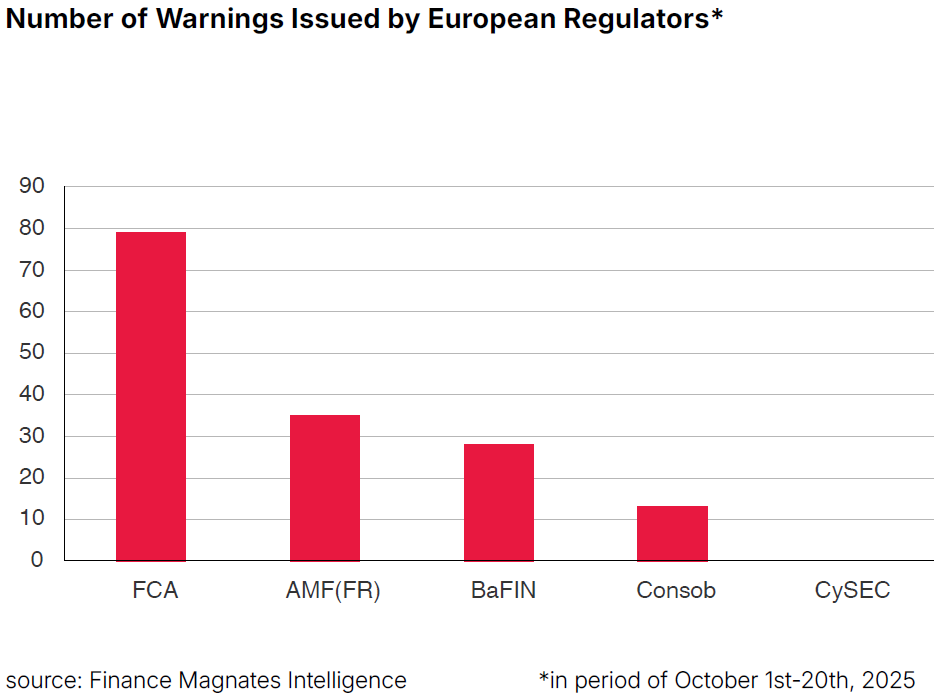
Number of warnings by European regulators in October
Number of warnings by European regulators in October (Source: Finance Magnates Intelligence)

In addition to takedowns, ASIC added 1,035 warnings to its Investor Alert List and issued consumer advisories highlighting schemes aimed at retirement savings. The regulator emphasized these measures as part of its ongoing campaign to protect investors and raise awareness of online financial threats.

The Aussie broker is not the only regulator to flag clones. The regulators globally, including the ones in the UK, Cyprus, Malta and other countries, are actively flagging the names of clones and other fraudulent brands.

However, it is not the brokers that are being cloned - regulators also face the tail end of this menace. The Cypriot regulator issued multiple warnings on its staff and representatives being impersonated by fraudsters. Recently, the financial regulator in Malta said that fraudsters are falsely claiming to be MFSA Officials with forged documents bearing the name and false signature of the regualtor's CEO.

Pepperstone’s Group CEO, Tamas Szabo, said the broker is forced to take down scam websites and fake social media accounts impersonating the firm almost every day. In a LinkedIn post on Wednesday, Szabo said the impersonation attempts target both Pepperstone’s clients and brand, creating an ongoing challenge for its fraud team.

Join IG, CMC, and Robinhood at London’s leading trading industry event!

“We are having to take down scam websites and social media accounts impersonating Pepperstone on an almost daily basis to protect both our clients and brand,” Szabo said. “We've purchased over a hundred variants of our domain but haven't been able to capture them all. It has become a full time job for our fraud team to take these sites down.”

Szabo Calls Out Domain Registrars

According to Szabo, Pepperstone has purchased more than a hundred domain variants in an effort to prevent misuse, but fraudulent sites continue to appear.

Szabo criticized domain registrars for failing to curb the problem, suggesting that some may be allowing illegal activities by approving deceptive registrations. “Surely domain registrants should be doing more to stop this. I can only assume what they are facilitating is all just out and out illegal behaviour.”

Cybersquatting Cases Highlight Broader Problem

The CEO cited several examples of misspelt domains – including pepperston.com, peppersone.com, and pepperstoe.com – that attempt to redirect traffic away from Pepperstone’s official site.

Keep reading: Google Takes Cybercrime Group to Court Over “Smishing” Involving 115M Credit Cards: Report

“To top this off we have firms cybersquatting on misspelt domains trying to direct traffic away from Pepperstone – here are a few examples: www.pepperston.com , www.peppersone.com , www.pepperstoe.com.” Szabo described the situation as “frustrating” and “depressingly part of daily business,” reflecting a broader trend of online impersonation targeting financial service providers.

Pepperstone is not the only broker to face the menace of clones. Exante earlier revealed to FinanceMagnates.com that scammers cloned its platform and even managed to open a JPMorgan account, while duping at least one person.

Cases of fraudulent domains are on the rise. Notably, the Australian Securities and Investments Commission (ASIC) recently obtained a court order to shut down 95 companies linked to online investment and romance baiting scams, commonly referred to as “pig butchering” scams.

These scams involve fraudsters posing as someone else on social media, building trust with victims over time, and then promoting risky investments such as contracts for differences or cryptocurrencies .

More recently, ASIC also reported that it removed 6,900 investment scam and phishing websites in the year ending June 30, as part of increased efforts to shield consumers from online fraud. The actions targeted a range of illicit operations, including around 2,800 fake investment platforms, 2,400 cryptocurrency scams, 1,400 phishing links, and 250 fraudulent online advertisements.

Number of warnings by European regulators in October
Number of warnings by European regulators in October (Source: Finance Magnates Intelligence)

In addition to takedowns, ASIC added 1,035 warnings to its Investor Alert List and issued consumer advisories highlighting schemes aimed at retirement savings. The regulator emphasized these measures as part of its ongoing campaign to protect investors and raise awareness of online financial threats.

The Aussie broker is not the only regulator to flag clones. The regulators globally, including the ones in the UK, Cyprus, Malta and other countries, are actively flagging the names of clones and other fraudulent brands.

However, it is not the brokers that are being cloned - regulators also face the tail end of this menace. The Cypriot regulator issued multiple warnings on its staff and representatives being impersonated by fraudsters. Recently, the financial regulator in Malta said that fraudsters are falsely claiming to be MFSA Officials with forged documents bearing the name and false signature of the regualtor's CEO.

About the Author: Jared Kirui
Jared Kirui
  • 2471 Articles
  • 50 Followers
About the Author: Jared Kirui
Jared is an experienced financial journalist passionate about all things forex and CFDs.
  • 2471 Articles
  • 50 Followers

More from the Author

Retail FX

!"#$%&'()*+,-./0123456789:;<=>?@ABCDEFGHIJKLMNOPQRSTUVWXYZ[\]^_`abcdefghijklmnopqrstuvwxyz{|} !"#$%&'()*+,-./0123456789:;<=>?@ABCDEFGHIJKLMNOPQRSTUVWXYZ[\]^_`abcdefghijklmnopqrstuvwxyz{|}