

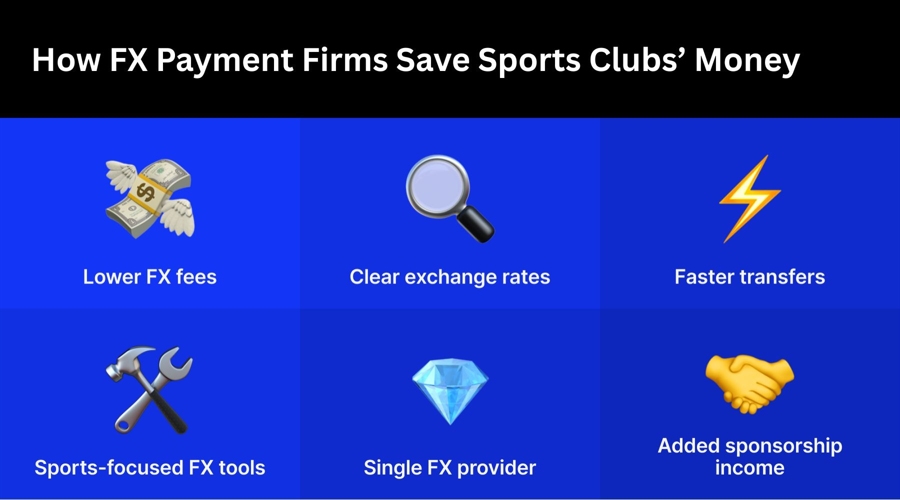
There is a huge gap in forex services for sports clubs. For instance, English Premier League clubs lost about £22 million in FX fees in only last player transfer window. This has opened the door for forex payments companies like Airwallex, Corpay and a few others to ink a unique promotional deal with sports teams, including football.
The New Found Value in Sports Deals
While sports sponsorships have long been a preferred marketing channel for financial services firms, payments firms are adding a new angle to it – they are easing FX transfers for sports teams.
These companies are becoming “FX partners” or similar for sports clubs, helping them with their foreign exchange transactions. These deals are more than branding, as they also bring real value to the clubs’ operations.
You may also like: How Much Fancy Sport Sponsorships Actually Cost?
In football, where many players are bought, sold and transferred across clubs worldwide, millions of dollars in cross-border transactions are involved.
English Premier League clubs alone spent more than £1.7 billion on players from leagues operating in the Eurozone last transfer season. These transactions involve legacy FX brokers exchanging GBP for EUR through FX brokerages to support moves from European leagues such as the Bundesliga, La Liga and Serie A.
A study by currency platform Glyde showed that legacy FX brokers skimmed the Premier League for more than £22 million on European transfers, with the 10 worst-hit clubs losing almost £17 million in just 89 days.
Skimming or FX scalping involves brokers adding hidden mark-ups to exchange rates.

These FX partners are using their transparency around these skimming tactics of legacy banks to the benefit of sports clubs.
“Football transfers are negotiated down to the last detail, but what clubs don’t see is the hidden cost eating away at their budgets when they move money across borders,” said Ellis Taylor, CEO and Co-Founder of Glyde.
Companies like Wise have built a strong business by offering transparency around these practices of legacy players.
- EC Markets Enters Anfield: Inks Multi-Year Sponsorship Deal with Liverpool FC
- eToro Extends Deal with Dutch Club AZ Alkmaar as Betting Brands to Exit Premier League
- Crypto.com’s Annual Sports Spending at $213M Is 3x That of Coinbase
Handling the FX Payments during Transfers
Sports business is massive and involves clubs to handle payments in many areas, which include ticket sales to merchandise. When it comes to FX firms’ partnerships with sports teams, the term “payment” is clearly defined and involves only foreign exchange transactions.

“‘Payments’ [for these clubs] generally refers to corporate FX and international transactions,” explained Matt House, CEO of sports deal broker SportQuake, “for example, the transfer of funds by wire, ACH, SEPA or similar systems involving multiple currencies.”
He added that in the deal between TransferMate and Haas Formula 1, where SportQuake was involved, the term “payments” was defined as international currency transfers across multiple markets.
House also noted that “these deals are often exclusive, meaning the FX/payment firm becomes the sole provider of international payment services to the club, though the exact definition and rights can vary from club to club.”
The value of such sports partnerships can also be seen in the fact that a forex payment firm, which is expected to become a public company as well, has a dedicated payment solution for sports clubs.
The strategy seems to have worked, as that firm has partnered with several football clubs, including Aston Villa, Southampton, Rangers and PSV Eindhoven. It also has deals with other sports teams.
A look at the partnership announcements shows that firm offers its “online payments platform, currency exchange solutions and money transfer services” to the clubs.
No Deal Template: Negotiation Comes in Handy
However, the partnerships are not limited to FX transfers – these payment companies also negotiate branding deals.
Labelled as “Official Foreign Exchange Payments Supplier” or even “Official Fintech Partner,” branding for these payments companies also appears across the infrastructure of sports venues.
Due to the branding angle, the payment companies also pay sponsorship fees to the sports clubs.
“Fees for these deals are directly linked to the amount of FX flow the sports org has,” House added. “Deals are typically funded out of FX margin.”
Read more: CFDs Sport Sponsorships Go beyond Football
These deals can also be structured based on the needs of the payment firm and the sports organisation. The payment can be simple, and its size depends on how much the FX firm is willing to invest in the FX flow or the partnership with the sports organisation. In such cases, the FX firm may aim to make a profit on the sports organisation’s FX flow or may break even, or even take a loss, due to the value of the marketing rights received in return.
In another case, the FX company might offer the sports organisation the best possible rate and not pay any extra sponsorship fee. There can also be a hybrid model, which combines competitive FX fees and sponsorship fees.
“Nowadays, the big global sports organisations that generate significant FX flow are generally more switched on about how to manage their FX needs, including securing the best rates, so FX providers can’t beat rates in the old way,” the SportQuake CEO added.


