

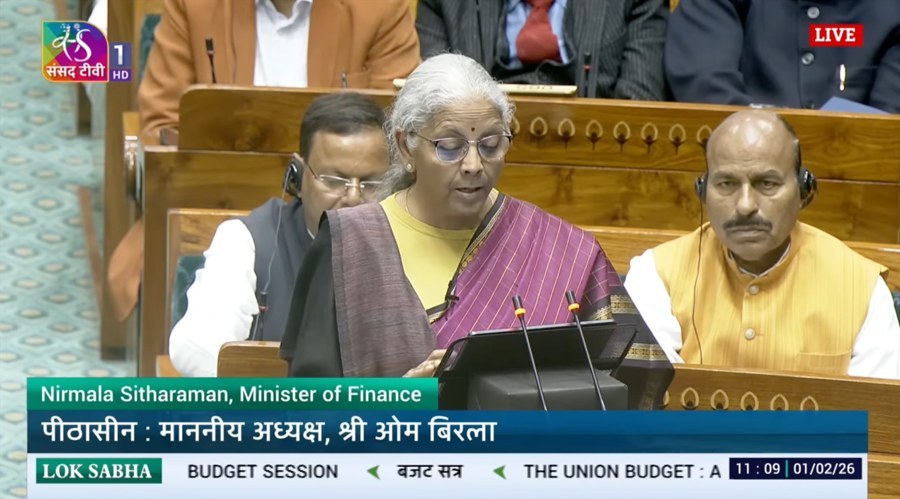
The Indian government has decided to raise the securities transaction tax (STT) on locally regulated derivatives. For futures, the trading-related tax has been raised to 0.05 per cent from 0.02 per cent, and for options, to 0.15 per cent from 0.01 per cent. It now remains to be seen whether these tax changes drive more Indian derivatives traders towards contracts for difference (CFDs), like XM, iForex and several others, which are locally unregulated. Also, will it potentially encourage brokers like Exness and FBS that recently left or restricted services in the country to revise their decision?
The new tax rates will come into effect from 1 April. The implications of the taxes were directly reflected in the Indian stock market, which was open yesterday (Sunday) for the budget session. The two primary indices, Sensex and Nifty 50, ended the day down 1.88 per cent and 1.96 per cent, respectively.
Derivatives Trading Frenzy in India
When it comes to regulated futures and options trading, India leads the way. According to Securities and Exchange Board of India (SEBI) and FIA data, the retail share of derivatives volume on exchanges climbed from about 2 per cent in 2018 to around 40–41 per cent by 2023–24.
The average daily turnover (ADTV) of the Indian derivatives market also rose to a 12-month high last October, reaching 506 trillion Indian rupees (about $5.5 trillion), a 46 per cent increase since June, when it had fallen to its lowest level since the previous November.
The market peak, however, was recorded in September 2024, when the ADTV touched 516 trillion Indian rupees (over $5.6 trillion), making it the world’s largest derivatives market, with close to 75 per cent of global ADTV. The National Stock Exchange (NSE) was the preferred venue for Indian traders, handling 95 per cent of trades.
However, the majority of retail Indian derivatives traders remain loss-making. The local regulator earlier revealed that the net loss of individual traders in the last financial year widened by 41 per cent to around $12.37 billion. Nearly 91 per cent of individual Indian futures and options traders lost money.
🚨 SEBI Alert on F&O Trading:
— Value Investor (@ValueBuying_) July 8, 2025
📉 FY25 loss: ₹1.05L Cr (+41%)
👥 91% traders lost money
💸 Avg. loss: ₹1.1L per trader
Retail investors, beware! F&O is not wealth creation — it’s wealth destruction for most#SEBI #FandO #StockMarket #RetailInvestors#indianstockmarket #nifty pic.twitter.com/oziRxMx8L6
India became the largest retail options market globally, with over 150 billion options contracts traded in FY24, up from 85.3 billion contracts the year before. In comparison, the US, which has the second-largest market, handled 12.3 billion options contracts in 2024.
The Indian government also benefits heavily from this derivatives trading surge. It collected approximately 420 billion Indian rupees (about $4.58 billion) from STT in the last fiscal year, while revising its STT collection estimate for the ongoing year upwards from the originally budgeted 370 billion Indian rupees to 550 billion Indian rupees.
While the exact breakdown between futures and options and equity (cash market) STT is not publicly stated, the futures and options segment accounts for the majority of STT collections.
- The Non-Resident Mirage: How CFD Brokers Turn India’s Rules into Opportunity
- Two Prop Firms and ThinkMarkets Added to India's Central Bank Warning List
- Plus500 to Enter Indian Derivatives Market, but 9 out of 10 Traders There Lose Money
An Opportunity for CFD Brokers?
The 150 per cent hike in futures STT and the 50 per cent increase in options STT from the next fiscal year are expected to have a heavy impact on Indian derivatives traders. This has opened up a potential opportunity for CFD brokers.
Although CFD trading remains unregulated in India, the sector has grown over the last several years.
Read more: How Prop Firms Win India Without Saying ‘Forex’ or ‘CFDs’
Web traffic from India to FX and CFD-related brokers surged to 55 per cent of global visits in Q3 2024, according to Finance Magnates Intelligence. A year later, however, the figure declined, showing a 21.4 per cent year-on-year drop.
CFD traders do not need to pay STT, as the Indian regulator and the government do not oversee these instruments.
It appears that a handful of large CFD brokers terminated or reduced their presence in India after the government’s crackdown on a major industry brand under money-laundering laws. However, the majority of offshore CFD brokers continue to operate in the country.
For example, homepage visits to XM, a major CFD broker, from India rose to 70 per cent last December, up from around 40 per cent a few months earlier.
Related: CFD Broker FBS Suspends All Marketing Activities Months After India Exit
Much of the CFD industry continues to rely on local affiliates and introducing brokers (IBs).
India-specific data from brokers is rarely disclosed. However, iForex, which is preparing for a public listing in London, has stated that India is its second-largest market, with 17 per cent of its revenue coming from the country in 2024.
Meanwhile, the Indian unit of OctaFX, which is facing enforcement action in the country, generated around $93.4 million from its Indian operations over a nine-month period, according to authorities. There are also estimates that OctaFX earned more than $568.1 million from India.
Although India does not explicitly ban CFDs, local currency control laws make the operations of offshore brokers illegal.
Notably, Plus500 chose to enter India through a fully legal route and agreed to acquire an India-regulated derivatives broker for $20 million. A few other brokers, including IG Group and Axi, have also set up local offices for technology development, but not for offering trading services.


