In forex, six trading styles vary as short, medium or long-term. The experience you gain will teach you which style is best suited to your trading methodology, but for starters, here are the primary forex trading types:
Day Trader - Day traders bridge the gap between scalping (short-term) to swing trading (medium-term) and trade during intraday time frames. Generally, positions are not overnight, while day traders need to be well-versed in fundamental, technical and correlational analysis. Day traders trade positions are as short as one minute to as long as end-of-day. The Relative Strength Index (RSI) is a critical tool in a day trader’s arsenal as it helps reveal when markets are overbought or oversold.
Position Trader - Position traders execute forex trades that range between several weeks to a handful of years. The primary goal of a position trader is to generate substantial returns by trading more long-term positions. Both fundamental and technical analysis knowledge is critical, while many position traders base their trade positions on short-term trends within broader market ranges.
Event-Driven Trader - Fundamental analysis is the wheel-house of an event-driven trader. Event-driven traders aim to make gains from volatility spikes from public news events (such as the GDP, Non-Farm Payroll, political elections and unemployment data). A successful event-driven trader is continuously up-to-date with world events and can accurately predict how local and global events may impact a market.
Algorithmic Trader - Algorithmic traders bridge the gap between computer science and trading. Algorithmic trading is associated with high-frequency trading, an algorithmic-powered trading algorithm that can autonomously invest a myriad of trade commands, strategies, market exemptions and trade execution within milliseconds. Algorithmic traders either program their software or outsource to experience programmers and chartists to procure algorithmic-based trading programs.
Scalping Trader - There are numerable factors that go into being a scalper. Scalpers are among the fastest of short-term traders, with trade positions lasting between a few seconds to a few minutes. Due to the forex market’s high liquidity, scalper traders have inherent advantages during colliding market hours. The core objective of scalping is to make numerous small gains throughout the day. Scalping is not for inexperienced or uneducated traders and requires a firm grasp of forex knowledge and the ability to thrive under pressure.
Forex Trading Strategies (Top 3)
Price Action Support & Resistance
Price action is a forex trader’s bread and butter. Applicable for short-term, medium-term and long-term strategies, price action is effective alone, but sometimes it is more robust when equipped with no-lagging indicators.
Depending upon market conditions, there are multiple variations of price action trading strategies that exist. We will go over the rudimentary steps involved in both a buy and sell price action trade involving support and resistance levels.
As seen below, support and resistance levels occur when horizontal price levels connect price highs or lows to lows. Support and resistance levels are market reversals that leave swing points in price action. In most short-term cases, the price stays contained within support and resistance levels.
Price Action Buy Trade
Here is a textbook example of a price action buy entry around a support level. Support levels are created when the EUR/USD reaches resistance and heads back in the opposite direction, often made from the high low of a new bullish trend (noted as the first resistance level).
To prime this trading strategy, a second resistance level needs identifying. Support levels do not have to be the same price levels but are within a few pips for day traders. Once the price breaks the support level, traders place forex buy trade with 1% to 3% capital. To reduce risk, traders may use an associated stop at a specific price, pip variable or price/loss value.
Price Action Sell Trade
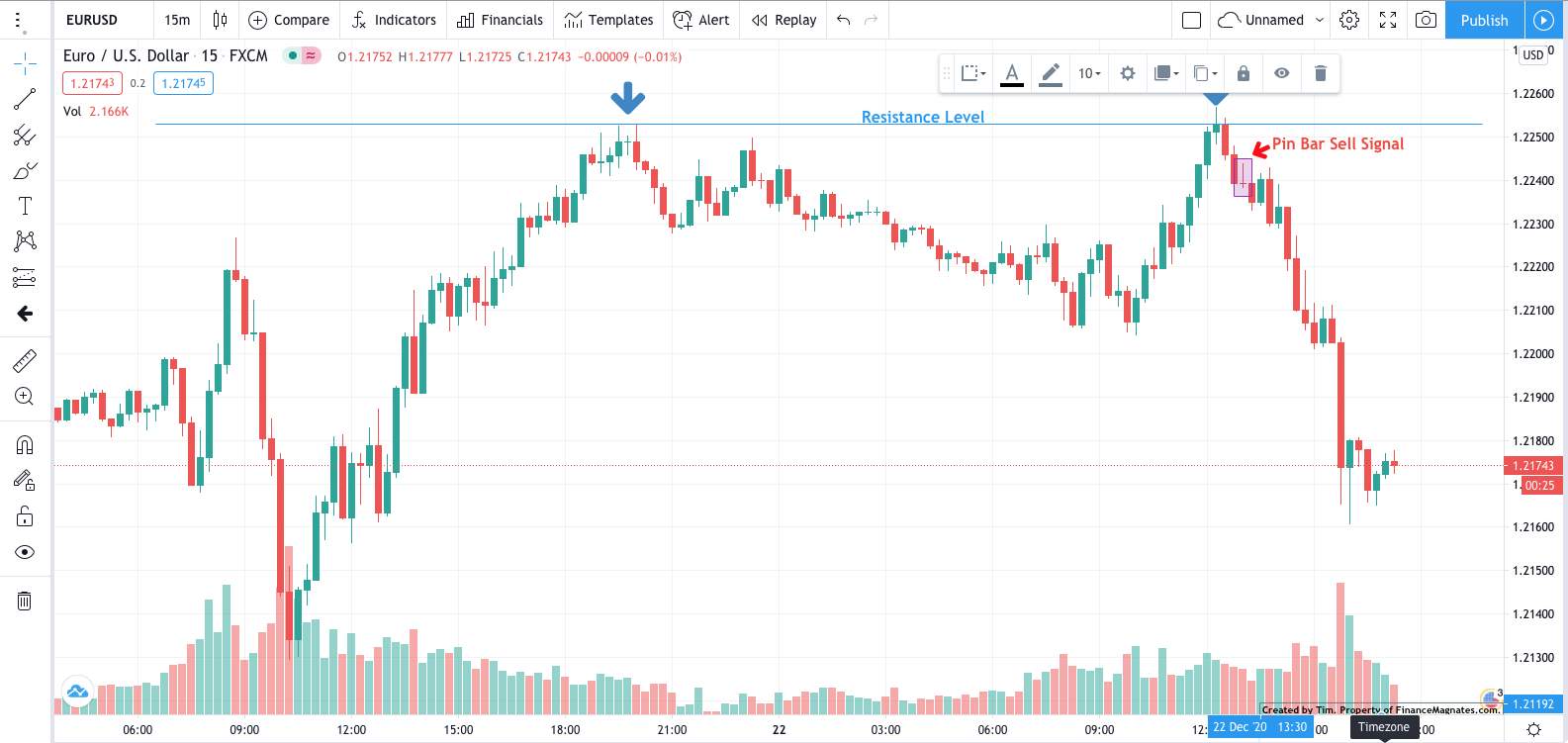
Like support levels, resistance levels can be created around comparable price levels distinguished from candle bodies (the best form of resistance candlesticks) or by wicks (volatile and drastic price changes, not as influential). Generally, this trading strategy is most potent when formed out of a bullish trend with full-body candlestick resistance levels.
Our first strong resistance level was created by matching resistance price levels. The next step includes a bearish market reversal, as seen, followed by another test in the same resistance level previously established. Our sell trade is nearly ready; we just need another trade confirmation. Additionally, we receive the sell trade confirmation with the pin bar candlestick formation.
These price action trading examples can use multiple time frames, but the best time frame would be 15 to 30 minutes.
Forex Trend Trading
Forex trend trading is a trading methodology centered around yielding market gains by placing trades that exploit a market’s price momentum. Generally, trend traders use a medium to long-term time frame, while this strategy applies to traders of all experience levels.
To better understand market conditions, traders use technical analysis indicators like the Commodity Channel Index (CCI), Relative Strength Index (RSI) and Moving Averages (MA). As a trend trader, the stronger the bullish (upward) or bearish (downward) trend, the better.
Commonly, successful trend traders exploit market zones of highs and lows (price levels) in both strong bullish and bearish trends.
Using the Commodity Channel Index, trend traders can confirm whether the price is rallying or plummeting in agreement with the market trend. Should the CCI dip below level -125, this signifies that the price is responding with a rally.
To strengthen this trading approach, combine the trend trading methodology with the price action support and resistance trading to take advantage of trend trades, reversal trades and market swings.
Setting risk and trade parameters and following without compromise is a challenging feat for novice day traders. Be clear and concise regarding your time commitment, define and visualize your trading goals and use appropriate risk-reward trade volumes to mitigate risk. From there, you can employ the following steps to craft a forex trading approach:
1. Money Management - Register an account with a regulated forex brokerage, as non-regulated trading platforms are susceptible to privacy and financial fraud. Verify that the broker offers a free demo account to learn the trading platform risk-free and make your initial investment into your trading account. When trading, trade no more than 3% of your account balance per trade and no more than 5% at once. 2. Trade Experimentation - Time availability and commitment will dictate which type of trader you will become. Short, medium or long-term, and your trading approach (day trader, scalper, algorithmic, event-based, algorithmic, etc.) is best discovered when practicing trades on a demo account. 3. Create Trading Rules - Abiding by a strict set of trading parameters helps ensure long-term market participation and significantly mitigates risk. A few trade rules to consider would be:
Discontinuing trading after two consecutive losses.
Utilizing stop and limit orders to mitigate risk on medium to long-term positions.
Never chasing losing trades with larger trade positions to offset losses.
4. Treat Trading Professionally - The foreign exchange market renders worldwide market access and does not require an economic degree to leverage market volatility gains. As there is no entry barrier (apart from governmental and age restrictions), many novice traders mistake forex trading as a hobby instead of a business. This is a fatal trading mistake. Like businesses, traders need a strategy, commitment and discipline to succeed. 5. Receive Professional Support - Many traders fail to understand the level of commitment needed to become a successful forex trader. In such cases, it may be more advantageous for those traders to research and commit with reputable forex service providers (trader copiers, signal services and trade management services). Here is a list of the Top Forex Service Providers of 2021.
Becoming a Forex Trader
There is no Holy Grail to forex trading or some magic trading formula to catapult one to the ranks of a forex millionaire, just consistency, resourcefulness and a strategy. Do not rush the process of familiarizing yourself with various trading approaches, and make sure to follow your trade rules to curb risk exposure. Visualize reaching your short and long-term trading goals, and keep your trading lens scoped on long-term market participation rather than short-term riches. Learn how to Master Forex Trading Psychology to become an elite forex trader.
In forex, six trading styles vary as short, medium or long-term. The experience you gain will teach you which style is best suited to your trading methodology, but for starters, here are the primary forex trading types:
Day Trader - Day traders bridge the gap between scalping (short-term) to swing trading (medium-term) and trade during intraday time frames. Generally, positions are not overnight, while day traders need to be well-versed in fundamental, technical and correlational analysis. Day traders trade positions are as short as one minute to as long as end-of-day. The Relative Strength Index (RSI) is a critical tool in a day trader’s arsenal as it helps reveal when markets are overbought or oversold.
Position Trader - Position traders execute forex trades that range between several weeks to a handful of years. The primary goal of a position trader is to generate substantial returns by trading more long-term positions. Both fundamental and technical analysis knowledge is critical, while many position traders base their trade positions on short-term trends within broader market ranges.
Event-Driven Trader - Fundamental analysis is the wheel-house of an event-driven trader. Event-driven traders aim to make gains from volatility spikes from public news events (such as the GDP, Non-Farm Payroll, political elections and unemployment data). A successful event-driven trader is continuously up-to-date with world events and can accurately predict how local and global events may impact a market.
Algorithmic Trader - Algorithmic traders bridge the gap between computer science and trading. Algorithmic trading is associated with high-frequency trading, an algorithmic-powered trading algorithm that can autonomously invest a myriad of trade commands, strategies, market exemptions and trade execution within milliseconds. Algorithmic traders either program their software or outsource to experience programmers and chartists to procure algorithmic-based trading programs.
Scalping Trader - There are numerable factors that go into being a scalper. Scalpers are among the fastest of short-term traders, with trade positions lasting between a few seconds to a few minutes. Due to the forex market’s high liquidity, scalper traders have inherent advantages during colliding market hours. The core objective of scalping is to make numerous small gains throughout the day. Scalping is not for inexperienced or uneducated traders and requires a firm grasp of forex knowledge and the ability to thrive under pressure.
Forex Trading Strategies (Top 3)
Price Action Support & Resistance
Price action is a forex trader’s bread and butter. Applicable for short-term, medium-term and long-term strategies, price action is effective alone, but sometimes it is more robust when equipped with no-lagging indicators.
Depending upon market conditions, there are multiple variations of price action trading strategies that exist. We will go over the rudimentary steps involved in both a buy and sell price action trade involving support and resistance levels.
As seen below, support and resistance levels occur when horizontal price levels connect price highs or lows to lows. Support and resistance levels are market reversals that leave swing points in price action. In most short-term cases, the price stays contained within support and resistance levels.
Price Action Buy Trade
Here is a textbook example of a price action buy entry around a support level. Support levels are created when the EUR/USD reaches resistance and heads back in the opposite direction, often made from the high low of a new bullish trend (noted as the first resistance level).
To prime this trading strategy, a second resistance level needs identifying. Support levels do not have to be the same price levels but are within a few pips for day traders. Once the price breaks the support level, traders place forex buy trade with 1% to 3% capital. To reduce risk, traders may use an associated stop at a specific price, pip variable or price/loss value.
Price Action Sell Trade
Like support levels, resistance levels can be created around comparable price levels distinguished from candle bodies (the best form of resistance candlesticks) or by wicks (volatile and drastic price changes, not as influential). Generally, this trading strategy is most potent when formed out of a bullish trend with full-body candlestick resistance levels.
Our first strong resistance level was created by matching resistance price levels. The next step includes a bearish market reversal, as seen, followed by another test in the same resistance level previously established. Our sell trade is nearly ready; we just need another trade confirmation. Additionally, we receive the sell trade confirmation with the pin bar candlestick formation.
These price action trading examples can use multiple time frames, but the best time frame would be 15 to 30 minutes.
Forex Trend Trading
Forex trend trading is a trading methodology centered around yielding market gains by placing trades that exploit a market’s price momentum. Generally, trend traders use a medium to long-term time frame, while this strategy applies to traders of all experience levels.
To better understand market conditions, traders use technical analysis indicators like the Commodity Channel Index (CCI), Relative Strength Index (RSI) and Moving Averages (MA). As a trend trader, the stronger the bullish (upward) or bearish (downward) trend, the better.
Commonly, successful trend traders exploit market zones of highs and lows (price levels) in both strong bullish and bearish trends.
Using the Commodity Channel Index, trend traders can confirm whether the price is rallying or plummeting in agreement with the market trend. Should the CCI dip below level -125, this signifies that the price is responding with a rally.
To strengthen this trading approach, combine the trend trading methodology with the price action support and resistance trading to take advantage of trend trades, reversal trades and market swings.
Setting risk and trade parameters and following without compromise is a challenging feat for novice day traders. Be clear and concise regarding your time commitment, define and visualize your trading goals and use appropriate risk-reward trade volumes to mitigate risk. From there, you can employ the following steps to craft a forex trading approach:
1. Money Management - Register an account with a regulated forex brokerage, as non-regulated trading platforms are susceptible to privacy and financial fraud. Verify that the broker offers a free demo account to learn the trading platform risk-free and make your initial investment into your trading account. When trading, trade no more than 3% of your account balance per trade and no more than 5% at once. 2. Trade Experimentation - Time availability and commitment will dictate which type of trader you will become. Short, medium or long-term, and your trading approach (day trader, scalper, algorithmic, event-based, algorithmic, etc.) is best discovered when practicing trades on a demo account. 3. Create Trading Rules - Abiding by a strict set of trading parameters helps ensure long-term market participation and significantly mitigates risk. A few trade rules to consider would be:
Discontinuing trading after two consecutive losses.
Utilizing stop and limit orders to mitigate risk on medium to long-term positions.
Never chasing losing trades with larger trade positions to offset losses.
4. Treat Trading Professionally - The foreign exchange market renders worldwide market access and does not require an economic degree to leverage market volatility gains. As there is no entry barrier (apart from governmental and age restrictions), many novice traders mistake forex trading as a hobby instead of a business. This is a fatal trading mistake. Like businesses, traders need a strategy, commitment and discipline to succeed. 5. Receive Professional Support - Many traders fail to understand the level of commitment needed to become a successful forex trader. In such cases, it may be more advantageous for those traders to research and commit with reputable forex service providers (trader copiers, signal services and trade management services). Here is a list of the Top Forex Service Providers of 2021.
Becoming a Forex Trader
There is no Holy Grail to forex trading or some magic trading formula to catapult one to the ranks of a forex millionaire, just consistency, resourcefulness and a strategy. Do not rush the process of familiarizing yourself with various trading approaches, and make sure to follow your trade rules to curb risk exposure. Visualize reaching your short and long-term trading goals, and keep your trading lens scoped on long-term market participation rather than short-term riches. Learn how to Master Forex Trading Psychology to become an elite forex trader.
42% of Swiss Financial Firms Have No Digital Fraud Policy, FINMA Finds
Featured Videos
FP Markets Winner Spotlight 🏆 | Global Broker of the Year 2025 #Trading #Broker #Innovation #Shorts
FP Markets Winner Spotlight 🏆 | Global Broker of the Year 2025 #Trading #Broker #Innovation #Shorts
FP Markets Winner Spotlight 🏆 | Global Broker of the Year 2025 #Trading #Broker #Innovation #Shorts
FP Markets Winner Spotlight 🏆 | Global Broker of the Year 2025 #Trading #Broker #Innovation #Shorts
FP Markets takes the spotlight as Global Broker of the Year 2025 at the Finance Magnates Awards.
Martin Stoilov, Head of Client Experience, shares that trust, innovation, and people played a key role in the company’s success, supported by a strong foundation of integrity and client-centricity.
Following this milestone, FP Markets continues to focus on growth, technology investment, and its core values of transparency and excellence.
👉 Be part of FM Awards 2026: https://awards.financemagnates.com/#nominate
FP Markets takes the spotlight as Global Broker of the Year 2025 at the Finance Magnates Awards.
Martin Stoilov, Head of Client Experience, shares that trust, innovation, and people played a key role in the company’s success, supported by a strong foundation of integrity and client-centricity.
Following this milestone, FP Markets continues to focus on growth, technology investment, and its core values of transparency and excellence.
👉 Be part of FM Awards 2026: https://awards.financemagnates.com/#nominate
FP Markets takes the spotlight as Global Broker of the Year 2025 at the Finance Magnates Awards.
Martin Stoilov, Head of Client Experience, shares that trust, innovation, and people played a key role in the company’s success, supported by a strong foundation of integrity and client-centricity.
Following this milestone, FP Markets continues to focus on growth, technology investment, and its core values of transparency and excellence.
👉 Be part of FM Awards 2026: https://awards.financemagnates.com/#nominate
FP Markets takes the spotlight as Global Broker of the Year 2025 at the Finance Magnates Awards.
Martin Stoilov, Head of Client Experience, shares that trust, innovation, and people played a key role in the company’s success, supported by a strong foundation of integrity and client-centricity.
Following this milestone, FP Markets continues to focus on growth, technology investment, and its core values of transparency and excellence.
👉 Be part of FM Awards 2026: https://awards.financemagnates.com/#nominate
In this video, we review @HolaPrimeMarketsOfficial, a multi-asset forex and CFDs broker offering different account types, trading platforms, and flexible trading conditions.
We cover the broker’s overall offering, including account options, trading environment, platforms like MT4 and MT5, and additional services such as managed accounts and fast withdrawals.
Watch the full video to see if Hola Prime Markets fits your trading needs.
📣 Stay up to date with the latest in finance and trading. Follow Finance Magnates for industry news, insights, and global event coverage.
Connect with us:
🔗 LinkedIn: /financemagnates
👍 Facebook: /financemagnates
📸 Instagram: https://www.instagram.com/financemagnates
🐦 X: https://x.com/financemagnates
🎥 TikTok: https://www.tiktok.com/tag/financemagnates
▶️ YouTube: /@financemagnates_official
#HolaPrime #ForexBroker #CFDTrading #FinanceMagnates #Trading #Forex #BrokerReview
In this video, we review @HolaPrimeMarketsOfficial, a multi-asset forex and CFDs broker offering different account types, trading platforms, and flexible trading conditions.
We cover the broker’s overall offering, including account options, trading environment, platforms like MT4 and MT5, and additional services such as managed accounts and fast withdrawals.
Watch the full video to see if Hola Prime Markets fits your trading needs.
📣 Stay up to date with the latest in finance and trading. Follow Finance Magnates for industry news, insights, and global event coverage.
Connect with us:
🔗 LinkedIn: /financemagnates
👍 Facebook: /financemagnates
📸 Instagram: https://www.instagram.com/financemagnates
🐦 X: https://x.com/financemagnates
🎥 TikTok: https://www.tiktok.com/tag/financemagnates
▶️ YouTube: /@financemagnates_official
#HolaPrime #ForexBroker #CFDTrading #FinanceMagnates #Trading #Forex #BrokerReview
In this video, we review @HolaPrimeMarketsOfficial, a multi-asset forex and CFDs broker offering different account types, trading platforms, and flexible trading conditions.
We cover the broker’s overall offering, including account options, trading environment, platforms like MT4 and MT5, and additional services such as managed accounts and fast withdrawals.
Watch the full video to see if Hola Prime Markets fits your trading needs.
📣 Stay up to date with the latest in finance and trading. Follow Finance Magnates for industry news, insights, and global event coverage.
Connect with us:
🔗 LinkedIn: /financemagnates
👍 Facebook: /financemagnates
📸 Instagram: https://www.instagram.com/financemagnates
🐦 X: https://x.com/financemagnates
🎥 TikTok: https://www.tiktok.com/tag/financemagnates
▶️ YouTube: /@financemagnates_official
#HolaPrime #ForexBroker #CFDTrading #FinanceMagnates #Trading #Forex #BrokerReview
In this video, we review @HolaPrimeMarketsOfficial, a multi-asset forex and CFDs broker offering different account types, trading platforms, and flexible trading conditions.
We cover the broker’s overall offering, including account options, trading environment, platforms like MT4 and MT5, and additional services such as managed accounts and fast withdrawals.
Watch the full video to see if Hola Prime Markets fits your trading needs.
📣 Stay up to date with the latest in finance and trading. Follow Finance Magnates for industry news, insights, and global event coverage.
Connect with us:
🔗 LinkedIn: /financemagnates
👍 Facebook: /financemagnates
📸 Instagram: https://www.instagram.com/financemagnates
🐦 X: https://x.com/financemagnates
🎥 TikTok: https://www.tiktok.com/tag/financemagnates
▶️ YouTube: /@financemagnates_official
#HolaPrime #ForexBroker #CFDTrading #FinanceMagnates #Trading #Forex #BrokerReview
In this video, we review @HolaPrimeMarketsOfficial, a multi-asset forex and CFDs broker offering different account types, trading platforms, and flexible trading conditions.
We cover the broker’s overall offering, including account options, trading environment, platforms like MT4 and MT5, and additional services such as managed accounts and fast withdrawals.
Watch the full video to see if Hola Prime Markets fits your trading needs.
📣 Stay up to date with the latest in finance and trading. Follow Finance Magnates for industry news, insights, and global event coverage.
Connect with us:
🔗 LinkedIn: /financemagnates
👍 Facebook: /financemagnates
📸 Instagram: https://www.instagram.com/financemagnates
🐦 X: https://x.com/financemagnates
🎥 TikTok: https://www.tiktok.com/tag/financemagnates
▶️ YouTube: /@financemagnates_official
#HolaPrime #ForexBroker #CFDTrading #FinanceMagnates #Trading #Forex #BrokerReview
In this video, we review @HolaPrimeMarketsOfficial, a multi-asset forex and CFDs broker offering different account types, trading platforms, and flexible trading conditions.
We cover the broker’s overall offering, including account options, trading environment, platforms like MT4 and MT5, and additional services such as managed accounts and fast withdrawals.
Watch the full video to see if Hola Prime Markets fits your trading needs.
📣 Stay up to date with the latest in finance and trading. Follow Finance Magnates for industry news, insights, and global event coverage.
Connect with us:
🔗 LinkedIn: /financemagnates
👍 Facebook: /financemagnates
📸 Instagram: https://www.instagram.com/financemagnates
🐦 X: https://x.com/financemagnates
🎥 TikTok: https://www.tiktok.com/tag/financemagnates
▶️ YouTube: /@financemagnates_official
#HolaPrime #ForexBroker #CFDTrading #FinanceMagnates #Trading #Forex #BrokerReview
Hola Prime Review: What You Need to Know | Full Breakdown by Finance Magnates
Hola Prime Review: What You Need to Know | Full Breakdown by Finance Magnates
Hola Prime Review: What You Need to Know | Full Breakdown by Finance Magnates
Hola Prime Review: What You Need to Know | Full Breakdown by Finance Magnates
Hola Prime Review: What You Need to Know | Full Breakdown by Finance Magnates
Hola Prime Review: What You Need to Know | Full Breakdown by Finance Magnates
In this video, we review @HolaPrime_Global, a proprietary trading firm offering evaluation programs and performance-based payouts in simulated market environments.
We cover how the challenge model works, including account types, profit splits (up to 95%), trading rules, and what it takes to reach a funded account. You’ll also learn about available platforms like MT4, MT5, cTrader, and more, along with insights into payouts, support, and trading conditions.
Watch the full video to see if Hola Prime fits your trading style.
📣 Stay up to date with the latest in finance and trading. Follow Finance Magnates for industry news, insights, and global event coverage.
Connect with us:
🔗 LinkedIn: /financemagnates
👍 Facebook: /financemagnates
📸 Instagram: https://www.instagram.com/financemagnates
🐦 X: https://x.com/financemagnates
🎥 TikTok: https://www.tiktok.com/tag/financemagnates
▶️ YouTube: /@financemagnates_official
#HolaPrime #PropFirm #Trading #FinanceMagnates #Forex #FuturesTrading #TradingReview #PropFirmReview
In this video, we review @HolaPrime_Global, a proprietary trading firm offering evaluation programs and performance-based payouts in simulated market environments.
We cover how the challenge model works, including account types, profit splits (up to 95%), trading rules, and what it takes to reach a funded account. You’ll also learn about available platforms like MT4, MT5, cTrader, and more, along with insights into payouts, support, and trading conditions.
Watch the full video to see if Hola Prime fits your trading style.
📣 Stay up to date with the latest in finance and trading. Follow Finance Magnates for industry news, insights, and global event coverage.
Connect with us:
🔗 LinkedIn: /financemagnates
👍 Facebook: /financemagnates
📸 Instagram: https://www.instagram.com/financemagnates
🐦 X: https://x.com/financemagnates
🎥 TikTok: https://www.tiktok.com/tag/financemagnates
▶️ YouTube: /@financemagnates_official
#HolaPrime #PropFirm #Trading #FinanceMagnates #Forex #FuturesTrading #TradingReview #PropFirmReview
In this video, we review @HolaPrime_Global, a proprietary trading firm offering evaluation programs and performance-based payouts in simulated market environments.
We cover how the challenge model works, including account types, profit splits (up to 95%), trading rules, and what it takes to reach a funded account. You’ll also learn about available platforms like MT4, MT5, cTrader, and more, along with insights into payouts, support, and trading conditions.
Watch the full video to see if Hola Prime fits your trading style.
📣 Stay up to date with the latest in finance and trading. Follow Finance Magnates for industry news, insights, and global event coverage.
Connect with us:
🔗 LinkedIn: /financemagnates
👍 Facebook: /financemagnates
📸 Instagram: https://www.instagram.com/financemagnates
🐦 X: https://x.com/financemagnates
🎥 TikTok: https://www.tiktok.com/tag/financemagnates
▶️ YouTube: /@financemagnates_official
#HolaPrime #PropFirm #Trading #FinanceMagnates #Forex #FuturesTrading #TradingReview #PropFirmReview
In this video, we review @HolaPrime_Global, a proprietary trading firm offering evaluation programs and performance-based payouts in simulated market environments.
We cover how the challenge model works, including account types, profit splits (up to 95%), trading rules, and what it takes to reach a funded account. You’ll also learn about available platforms like MT4, MT5, cTrader, and more, along with insights into payouts, support, and trading conditions.
Watch the full video to see if Hola Prime fits your trading style.
📣 Stay up to date with the latest in finance and trading. Follow Finance Magnates for industry news, insights, and global event coverage.
Connect with us:
🔗 LinkedIn: /financemagnates
👍 Facebook: /financemagnates
📸 Instagram: https://www.instagram.com/financemagnates
🐦 X: https://x.com/financemagnates
🎥 TikTok: https://www.tiktok.com/tag/financemagnates
▶️ YouTube: /@financemagnates_official
#HolaPrime #PropFirm #Trading #FinanceMagnates #Forex #FuturesTrading #TradingReview #PropFirmReview
In this video, we review @HolaPrime_Global, a proprietary trading firm offering evaluation programs and performance-based payouts in simulated market environments.
We cover how the challenge model works, including account types, profit splits (up to 95%), trading rules, and what it takes to reach a funded account. You’ll also learn about available platforms like MT4, MT5, cTrader, and more, along with insights into payouts, support, and trading conditions.
Watch the full video to see if Hola Prime fits your trading style.
📣 Stay up to date with the latest in finance and trading. Follow Finance Magnates for industry news, insights, and global event coverage.
Connect with us:
🔗 LinkedIn: /financemagnates
👍 Facebook: /financemagnates
📸 Instagram: https://www.instagram.com/financemagnates
🐦 X: https://x.com/financemagnates
🎥 TikTok: https://www.tiktok.com/tag/financemagnates
▶️ YouTube: /@financemagnates_official
#HolaPrime #PropFirm #Trading #FinanceMagnates #Forex #FuturesTrading #TradingReview #PropFirmReview
In this video, we review @HolaPrime_Global, a proprietary trading firm offering evaluation programs and performance-based payouts in simulated market environments.
We cover how the challenge model works, including account types, profit splits (up to 95%), trading rules, and what it takes to reach a funded account. You’ll also learn about available platforms like MT4, MT5, cTrader, and more, along with insights into payouts, support, and trading conditions.
Watch the full video to see if Hola Prime fits your trading style.
📣 Stay up to date with the latest in finance and trading. Follow Finance Magnates for industry news, insights, and global event coverage.
Connect with us:
🔗 LinkedIn: /financemagnates
👍 Facebook: /financemagnates
📸 Instagram: https://www.instagram.com/financemagnates
🐦 X: https://x.com/financemagnates
🎥 TikTok: https://www.tiktok.com/tag/financemagnates
▶️ YouTube: /@financemagnates_official
#HolaPrime #PropFirm #Trading #FinanceMagnates #Forex #FuturesTrading #TradingReview #PropFirmReview
Axi Winner Spotlight 🏆 | Global Most Innovative Broker 2025 #Innovation #Trading #Fintech #Broker
Axi Winner Spotlight 🏆 | Global Most Innovative Broker 2025 #Innovation #Trading #Fintech #Broker
Axi Winner Spotlight 🏆 | Global Most Innovative Broker 2025 #Innovation #Trading #Fintech #Broker
Axi Winner Spotlight 🏆 | Global Most Innovative Broker 2025 #Innovation #Trading #Fintech #Broker
Axi Winner Spotlight 🏆 | Global Most Innovative Broker 2025 #Innovation #Trading #Fintech #Broker
Axi Winner Spotlight 🏆 | Global Most Innovative Broker 2025 #Innovation #Trading #Fintech #Broker
Axi takes the spotlight at the Finance Magnates Awards, winning Global Most Innovative Broker 2025.
Olivia Xenofontos and Ivanna Openko share how the team will feel: proud, motivated, and ready to keep delivering.
They also describe the night as well-organized, focused, and enjoyable for all.
👉 Be part of FM Awards 2026.
Axi takes the spotlight at the Finance Magnates Awards, winning Global Most Innovative Broker 2025.
Olivia Xenofontos and Ivanna Openko share how the team will feel: proud, motivated, and ready to keep delivering.
They also describe the night as well-organized, focused, and enjoyable for all.
👉 Be part of FM Awards 2026.
Axi takes the spotlight at the Finance Magnates Awards, winning Global Most Innovative Broker 2025.
Olivia Xenofontos and Ivanna Openko share how the team will feel: proud, motivated, and ready to keep delivering.
They also describe the night as well-organized, focused, and enjoyable for all.
👉 Be part of FM Awards 2026.
Axi takes the spotlight at the Finance Magnates Awards, winning Global Most Innovative Broker 2025.
Olivia Xenofontos and Ivanna Openko share how the team will feel: proud, motivated, and ready to keep delivering.
They also describe the night as well-organized, focused, and enjoyable for all.
👉 Be part of FM Awards 2026.
Axi takes the spotlight at the Finance Magnates Awards, winning Global Most Innovative Broker 2025.
Olivia Xenofontos and Ivanna Openko share how the team will feel: proud, motivated, and ready to keep delivering.
They also describe the night as well-organized, focused, and enjoyable for all.
👉 Be part of FM Awards 2026.
Axi takes the spotlight at the Finance Magnates Awards, winning Global Most Innovative Broker 2025.
Olivia Xenofontos and Ivanna Openko share how the team will feel: proud, motivated, and ready to keep delivering.
They also describe the night as well-organized, focused, and enjoyable for all.
👉 Be part of FM Awards 2026.
Recognition that matters.
Built on transparency.
Driven by the industry.
The Finance Magnates Awards 2026.
Nominations are now open.
🔗 https://awards.financemagnates.com/?utm_source=SM&utm_medium=social&utm_campaign=recognition-matters
Recognition that matters.
Built on transparency.
Driven by the industry.
The Finance Magnates Awards 2026.
Nominations are now open.
🔗 https://awards.financemagnates.com/?utm_source=SM&utm_medium=social&utm_campaign=recognition-matters
Recognition that matters.
Built on transparency.
Driven by the industry.
The Finance Magnates Awards 2026.
Nominations are now open.
🔗 https://awards.financemagnates.com/?utm_source=SM&utm_medium=social&utm_campaign=recognition-matters
Recognition that matters.
Built on transparency.
Driven by the industry.
The Finance Magnates Awards 2026.
Nominations are now open.
🔗 https://awards.financemagnates.com/?utm_source=SM&utm_medium=social&utm_campaign=recognition-matters
Recognition that matters.
Built on transparency.
Driven by the industry.
The Finance Magnates Awards 2026.
Nominations are now open.
🔗 https://awards.financemagnates.com/?utm_source=SM&utm_medium=social&utm_campaign=recognition-matters
Recognition that matters.
Built on transparency.
Driven by the industry.
The Finance Magnates Awards 2026.
Nominations are now open.
🔗 https://awards.financemagnates.com/?utm_source=SM&utm_medium=social&utm_campaign=recognition-matters