Elaborating on client activity's correlation with financial markets volatility
As I have discussed in my Ph.D. thesis titled “Heterogeneity and skill in the retail EUR/USD FX market – Investigating the impact of uncertainty and behavioural biases of trader skills,” there exists extensive evidence showing a positive relationship between market volatility and trader participation.
The underlying reason would seem to be that heightened market volatility produces large price swings, which traders interpret as potentially highly profitable. However, high volatility can also be detrimental to performance, especially for highly-leveraged trading positions. As a result, the higher the market volatility, the less the trader can gauge the direction of the market, and therefore, the less likely the individual becomes in being able to demonstrate their skill.
In other words, heightened levels of volatility will negatively impact a trader’s skill and performance over time.
To determine where the current volatility is with respect to financial brokers, one could gauge the FX EURO VIX Volatility indicator. Since the majority of order flow amongst FX brokers occurs within the EUR/USD currency pair, market volatility directly reflects bottom-line profitability. By extension, one could assume that the higher the market volatility, the higher the profitability of the broker.
How can we gauge ‘quality’ amongst brokers?
Quality investing is a new investment strategy which can teach us whether an investment is worth pursuing over time.
Here are five key attributes:
Market Positioning: Does the industry have growth potential?
Business Model: Is the company healthy (growing turnover, low debt, and competitive products)?
Corporate Governance: Does the company have the appropriate top-level management personnel and size?
Financial Strength: Does the company have financial momentum (revenue, cash flow and earnings)?
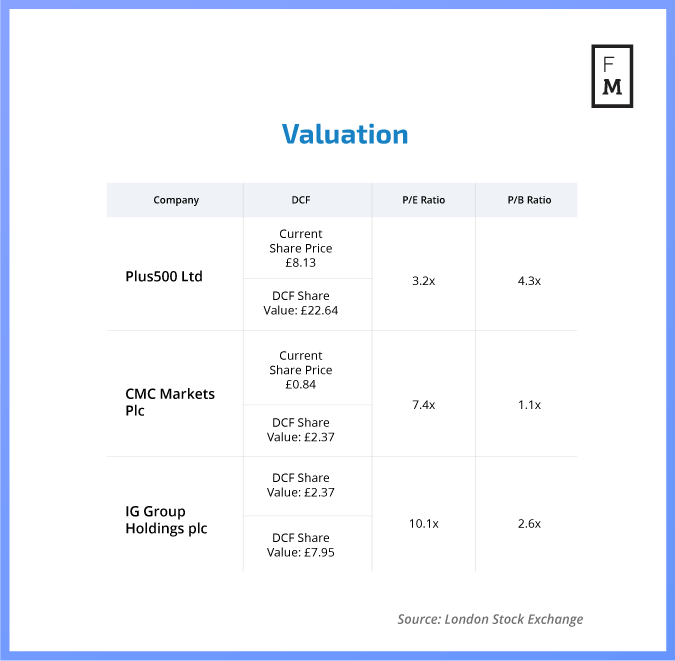
Attractive Valuation shown as:
High Discounted Cash Flow (DCF);
Low Price to Earnings Ratio (P/E ratio);
Low Price to Book Value Ratio (P/B ratio).
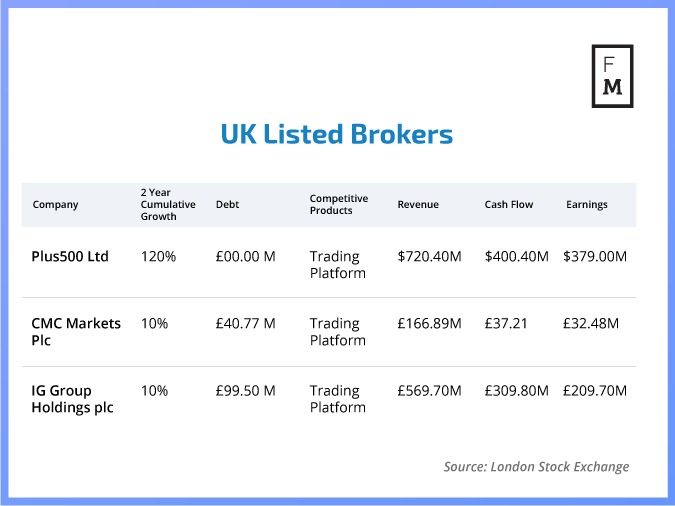
If we were to apply the ‘quality strategy’ to the largest UK brokers, we could obtain the following results.
Bank of International Settlements – A Growing Market
Is the retail FX market growing?
To answer this question, we can refer to the most recent BIS report to discover that from 2013 to 2016 the FX market experienced a negative rate of growth in terms of spot FX transactions.
If this is true, we would expect to see further market consolidation (regulation, higher CPAs, etc.) – and this is precisely what we have seen in the past three years.
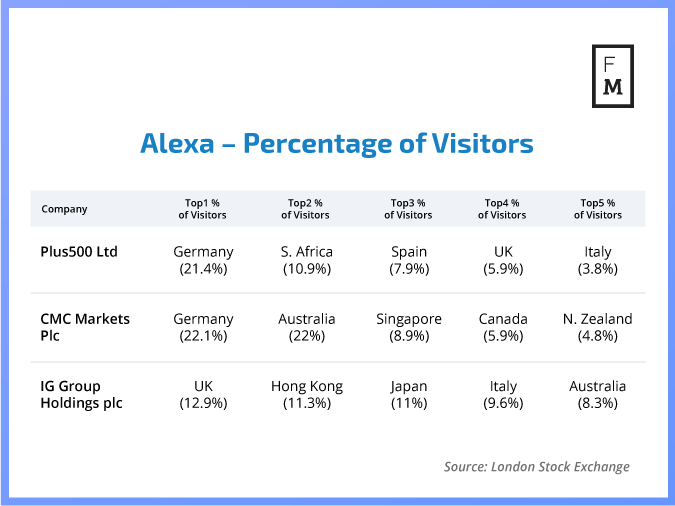
Alexa – Percentage of Visitors
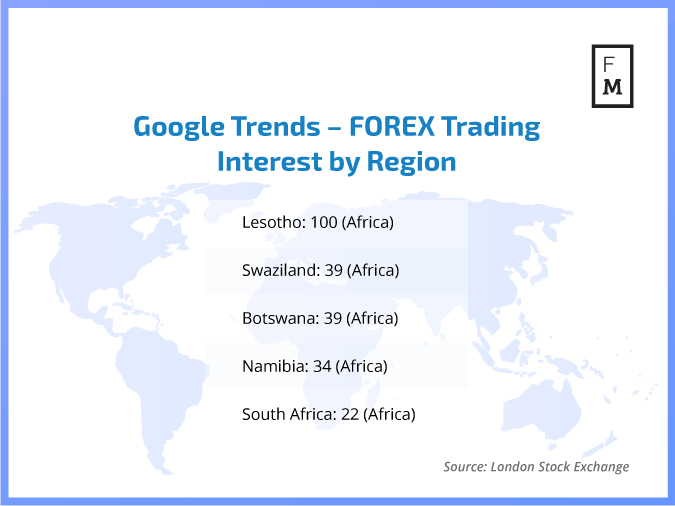
Google Trends – FOREX Trading Interest by Region
Business Model
A snapshot of the current state of the companies as of 08.03.2019 including turnover growth, debt, and competitive products.
When it comes to leading a company, holistic thinking is very important, especially in a leadership role. Some companies may exhibit this in the beginning (accelerated growth) but need to continue doing it over time.
In some respects, the exception to this rule is Plus500. The company has struggled to introduce new products that have appealed to retail traders. This could potentially indicate that a change in Management is required, and product innovation needs to be promoted. Its current predicament could mean that the company is forced to unveil a slew of new products in the near future.
CMC markets could potentially be in a position to demonstrate its tenacity by hiring or promoting one of its own into a marketing leadership role. This move would be in sharp contrast to the modus operandi implemented by lower-tier high growth companies such as Forextime and XM and would seek to seize the current market opportunity to extend its growth in emerging markets. CMC Management may decide to include marketing and product innovation rather than just a cost-cutting model.
Finally, IG Group should maintain its dominance by keeping a close eye on the current competition and not becoming distracted by the proverbial ‘American Dream.’ New market entrants such as IQ Option, Olymp Trade, and XM have been grabbing market share, but IG is well-positioned to respond. The bad news for the UK broker is that it has become preoccupied with internal politics instead of staying focused on innovation and maintaining its strategic objectives.
In many respects, IG has become a marketing factory with a monolithic bureaucracy that resembles the Hollywood series House of Cards. Just like in the series, it could be time for an old elite to be supplanted by a leaner and more ambitious leadership team that is modern and progressive. This was the developmental path taken by Plus500 and could be a move that IG’s board considers.
When brokers encounter low market volatility, a variety of mitigative measures can be implemented to reduce the knock-on effect on performance:
Restructuring, including cost reduction and competition analysis;
Simplifying and promoting innovative products;
Investing in digital marketing and obtaining exposure in new markets;
Greater focus on client retention and reducing cost-heavy client acquisition initiatives.
Demetrios Zamboglou is the COO of ICON Capital Reserve
As I have discussed in my Ph.D. thesis titled “Heterogeneity and skill in the retail EUR/USD FX market – Investigating the impact of uncertainty and behavioural biases of trader skills,” there exists extensive evidence showing a positive relationship between market volatility and trader participation.
The underlying reason would seem to be that heightened market volatility produces large price swings, which traders interpret as potentially highly profitable. However, high volatility can also be detrimental to performance, especially for highly-leveraged trading positions. As a result, the higher the market volatility, the less the trader can gauge the direction of the market, and therefore, the less likely the individual becomes in being able to demonstrate their skill.
In other words, heightened levels of volatility will negatively impact a trader’s skill and performance over time.
To determine where the current volatility is with respect to financial brokers, one could gauge the FX EURO VIX Volatility indicator. Since the majority of order flow amongst FX brokers occurs within the EUR/USD currency pair, market volatility directly reflects bottom-line profitability. By extension, one could assume that the higher the market volatility, the higher the profitability of the broker.
How can we gauge ‘quality’ amongst brokers?
Quality investing is a new investment strategy which can teach us whether an investment is worth pursuing over time.
Here are five key attributes:
Market Positioning: Does the industry have growth potential?
Business Model: Is the company healthy (growing turnover, low debt, and competitive products)?
Corporate Governance: Does the company have the appropriate top-level management personnel and size?
Financial Strength: Does the company have financial momentum (revenue, cash flow and earnings)?
Attractive Valuation shown as:
High Discounted Cash Flow (DCF);
Low Price to Earnings Ratio (P/E ratio);
Low Price to Book Value Ratio (P/B ratio).
If we were to apply the ‘quality strategy’ to the largest UK brokers, we could obtain the following results.
Bank of International Settlements – A Growing Market
Is the retail FX market growing?
To answer this question, we can refer to the most recent BIS report to discover that from 2013 to 2016 the FX market experienced a negative rate of growth in terms of spot FX transactions.
If this is true, we would expect to see further market consolidation (regulation, higher CPAs, etc.) – and this is precisely what we have seen in the past three years.
Alexa – Percentage of Visitors
Google Trends – FOREX Trading Interest by Region
Business Model
A snapshot of the current state of the companies as of 08.03.2019 including turnover growth, debt, and competitive products.
When it comes to leading a company, holistic thinking is very important, especially in a leadership role. Some companies may exhibit this in the beginning (accelerated growth) but need to continue doing it over time.
In some respects, the exception to this rule is Plus500. The company has struggled to introduce new products that have appealed to retail traders. This could potentially indicate that a change in Management is required, and product innovation needs to be promoted. Its current predicament could mean that the company is forced to unveil a slew of new products in the near future.
CMC markets could potentially be in a position to demonstrate its tenacity by hiring or promoting one of its own into a marketing leadership role. This move would be in sharp contrast to the modus operandi implemented by lower-tier high growth companies such as Forextime and XM and would seek to seize the current market opportunity to extend its growth in emerging markets. CMC Management may decide to include marketing and product innovation rather than just a cost-cutting model.
Finally, IG Group should maintain its dominance by keeping a close eye on the current competition and not becoming distracted by the proverbial ‘American Dream.’ New market entrants such as IQ Option, Olymp Trade, and XM have been grabbing market share, but IG is well-positioned to respond. The bad news for the UK broker is that it has become preoccupied with internal politics instead of staying focused on innovation and maintaining its strategic objectives.
In many respects, IG has become a marketing factory with a monolithic bureaucracy that resembles the Hollywood series House of Cards. Just like in the series, it could be time for an old elite to be supplanted by a leaner and more ambitious leadership team that is modern and progressive. This was the developmental path taken by Plus500 and could be a move that IG’s board considers.
When brokers encounter low market volatility, a variety of mitigative measures can be implemented to reduce the knock-on effect on performance:
Restructuring, including cost reduction and competition analysis;
Simplifying and promoting innovative products;
Investing in digital marketing and obtaining exposure in new markets;
Greater focus on client retention and reducing cost-heavy client acquisition initiatives.
Demetrios Zamboglou is the COO of ICON Capital Reserve
Demetrios Zamboglou is an online retail trading veteran with almost two decades of experience in financial markets, including as a C-level executive and via his academic research at King’s College London University.
Italy’s Consob Tightens Net on AI-Fueled Scams With Fresh Website Bans
Featured Videos
FP Markets Winner Spotlight 🏆 | Global Broker of the Year 2025 #Trading #Broker #Innovation #Shorts
FP Markets Winner Spotlight 🏆 | Global Broker of the Year 2025 #Trading #Broker #Innovation #Shorts
FP Markets Winner Spotlight 🏆 | Global Broker of the Year 2025 #Trading #Broker #Innovation #Shorts
FP Markets Winner Spotlight 🏆 | Global Broker of the Year 2025 #Trading #Broker #Innovation #Shorts
FP Markets takes the spotlight as Global Broker of the Year 2025 at the Finance Magnates Awards.
Martin Stoilov, Head of Client Experience, shares that trust, innovation, and people played a key role in the company’s success, supported by a strong foundation of integrity and client-centricity.
Following this milestone, FP Markets continues to focus on growth, technology investment, and its core values of transparency and excellence.
👉 Be part of FM Awards 2026: https://awards.financemagnates.com/#nominate
FP Markets takes the spotlight as Global Broker of the Year 2025 at the Finance Magnates Awards.
Martin Stoilov, Head of Client Experience, shares that trust, innovation, and people played a key role in the company’s success, supported by a strong foundation of integrity and client-centricity.
Following this milestone, FP Markets continues to focus on growth, technology investment, and its core values of transparency and excellence.
👉 Be part of FM Awards 2026: https://awards.financemagnates.com/#nominate
FP Markets takes the spotlight as Global Broker of the Year 2025 at the Finance Magnates Awards.
Martin Stoilov, Head of Client Experience, shares that trust, innovation, and people played a key role in the company’s success, supported by a strong foundation of integrity and client-centricity.
Following this milestone, FP Markets continues to focus on growth, technology investment, and its core values of transparency and excellence.
👉 Be part of FM Awards 2026: https://awards.financemagnates.com/#nominate
FP Markets takes the spotlight as Global Broker of the Year 2025 at the Finance Magnates Awards.
Martin Stoilov, Head of Client Experience, shares that trust, innovation, and people played a key role in the company’s success, supported by a strong foundation of integrity and client-centricity.
Following this milestone, FP Markets continues to focus on growth, technology investment, and its core values of transparency and excellence.
👉 Be part of FM Awards 2026: https://awards.financemagnates.com/#nominate
In this video, we review @HolaPrimeMarketsOfficial, a multi-asset forex and CFDs broker offering different account types, trading platforms, and flexible trading conditions.
We cover the broker’s overall offering, including account options, trading environment, platforms like MT4 and MT5, and additional services such as managed accounts and fast withdrawals.
Watch the full video to see if Hola Prime Markets fits your trading needs.
📣 Stay up to date with the latest in finance and trading. Follow Finance Magnates for industry news, insights, and global event coverage.
Connect with us:
🔗 LinkedIn: /financemagnates
👍 Facebook: /financemagnates
📸 Instagram: https://www.instagram.com/financemagnates
🐦 X: https://x.com/financemagnates
🎥 TikTok: https://www.tiktok.com/tag/financemagnates
▶️ YouTube: /@financemagnates_official
#HolaPrime #ForexBroker #CFDTrading #FinanceMagnates #Trading #Forex #BrokerReview
In this video, we review @HolaPrimeMarketsOfficial, a multi-asset forex and CFDs broker offering different account types, trading platforms, and flexible trading conditions.
We cover the broker’s overall offering, including account options, trading environment, platforms like MT4 and MT5, and additional services such as managed accounts and fast withdrawals.
Watch the full video to see if Hola Prime Markets fits your trading needs.
📣 Stay up to date with the latest in finance and trading. Follow Finance Magnates for industry news, insights, and global event coverage.
Connect with us:
🔗 LinkedIn: /financemagnates
👍 Facebook: /financemagnates
📸 Instagram: https://www.instagram.com/financemagnates
🐦 X: https://x.com/financemagnates
🎥 TikTok: https://www.tiktok.com/tag/financemagnates
▶️ YouTube: /@financemagnates_official
#HolaPrime #ForexBroker #CFDTrading #FinanceMagnates #Trading #Forex #BrokerReview
In this video, we review @HolaPrimeMarketsOfficial, a multi-asset forex and CFDs broker offering different account types, trading platforms, and flexible trading conditions.
We cover the broker’s overall offering, including account options, trading environment, platforms like MT4 and MT5, and additional services such as managed accounts and fast withdrawals.
Watch the full video to see if Hola Prime Markets fits your trading needs.
📣 Stay up to date with the latest in finance and trading. Follow Finance Magnates for industry news, insights, and global event coverage.
Connect with us:
🔗 LinkedIn: /financemagnates
👍 Facebook: /financemagnates
📸 Instagram: https://www.instagram.com/financemagnates
🐦 X: https://x.com/financemagnates
🎥 TikTok: https://www.tiktok.com/tag/financemagnates
▶️ YouTube: /@financemagnates_official
#HolaPrime #ForexBroker #CFDTrading #FinanceMagnates #Trading #Forex #BrokerReview
In this video, we review @HolaPrimeMarketsOfficial, a multi-asset forex and CFDs broker offering different account types, trading platforms, and flexible trading conditions.
We cover the broker’s overall offering, including account options, trading environment, platforms like MT4 and MT5, and additional services such as managed accounts and fast withdrawals.
Watch the full video to see if Hola Prime Markets fits your trading needs.
📣 Stay up to date with the latest in finance and trading. Follow Finance Magnates for industry news, insights, and global event coverage.
Connect with us:
🔗 LinkedIn: /financemagnates
👍 Facebook: /financemagnates
📸 Instagram: https://www.instagram.com/financemagnates
🐦 X: https://x.com/financemagnates
🎥 TikTok: https://www.tiktok.com/tag/financemagnates
▶️ YouTube: /@financemagnates_official
#HolaPrime #ForexBroker #CFDTrading #FinanceMagnates #Trading #Forex #BrokerReview
In this video, we review @HolaPrimeMarketsOfficial, a multi-asset forex and CFDs broker offering different account types, trading platforms, and flexible trading conditions.
We cover the broker’s overall offering, including account options, trading environment, platforms like MT4 and MT5, and additional services such as managed accounts and fast withdrawals.
Watch the full video to see if Hola Prime Markets fits your trading needs.
📣 Stay up to date with the latest in finance and trading. Follow Finance Magnates for industry news, insights, and global event coverage.
Connect with us:
🔗 LinkedIn: /financemagnates
👍 Facebook: /financemagnates
📸 Instagram: https://www.instagram.com/financemagnates
🐦 X: https://x.com/financemagnates
🎥 TikTok: https://www.tiktok.com/tag/financemagnates
▶️ YouTube: /@financemagnates_official
#HolaPrime #ForexBroker #CFDTrading #FinanceMagnates #Trading #Forex #BrokerReview
In this video, we review @HolaPrimeMarketsOfficial, a multi-asset forex and CFDs broker offering different account types, trading platforms, and flexible trading conditions.
We cover the broker’s overall offering, including account options, trading environment, platforms like MT4 and MT5, and additional services such as managed accounts and fast withdrawals.
Watch the full video to see if Hola Prime Markets fits your trading needs.
📣 Stay up to date with the latest in finance and trading. Follow Finance Magnates for industry news, insights, and global event coverage.
Connect with us:
🔗 LinkedIn: /financemagnates
👍 Facebook: /financemagnates
📸 Instagram: https://www.instagram.com/financemagnates
🐦 X: https://x.com/financemagnates
🎥 TikTok: https://www.tiktok.com/tag/financemagnates
▶️ YouTube: /@financemagnates_official
#HolaPrime #ForexBroker #CFDTrading #FinanceMagnates #Trading #Forex #BrokerReview
Hola Prime Review: What You Need to Know | Full Breakdown by Finance Magnates
Hola Prime Review: What You Need to Know | Full Breakdown by Finance Magnates
Hola Prime Review: What You Need to Know | Full Breakdown by Finance Magnates
Hola Prime Review: What You Need to Know | Full Breakdown by Finance Magnates
Hola Prime Review: What You Need to Know | Full Breakdown by Finance Magnates
Hola Prime Review: What You Need to Know | Full Breakdown by Finance Magnates
In this video, we review @HolaPrime_Global, a proprietary trading firm offering evaluation programs and performance-based payouts in simulated market environments.
We cover how the challenge model works, including account types, profit splits (up to 95%), trading rules, and what it takes to reach a funded account. You’ll also learn about available platforms like MT4, MT5, cTrader, and more, along with insights into payouts, support, and trading conditions.
Watch the full video to see if Hola Prime fits your trading style.
📣 Stay up to date with the latest in finance and trading. Follow Finance Magnates for industry news, insights, and global event coverage.
Connect with us:
🔗 LinkedIn: /financemagnates
👍 Facebook: /financemagnates
📸 Instagram: https://www.instagram.com/financemagnates
🐦 X: https://x.com/financemagnates
🎥 TikTok: https://www.tiktok.com/tag/financemagnates
▶️ YouTube: /@financemagnates_official
#HolaPrime #PropFirm #Trading #FinanceMagnates #Forex #FuturesTrading #TradingReview #PropFirmReview
In this video, we review @HolaPrime_Global, a proprietary trading firm offering evaluation programs and performance-based payouts in simulated market environments.
We cover how the challenge model works, including account types, profit splits (up to 95%), trading rules, and what it takes to reach a funded account. You’ll also learn about available platforms like MT4, MT5, cTrader, and more, along with insights into payouts, support, and trading conditions.
Watch the full video to see if Hola Prime fits your trading style.
📣 Stay up to date with the latest in finance and trading. Follow Finance Magnates for industry news, insights, and global event coverage.
Connect with us:
🔗 LinkedIn: /financemagnates
👍 Facebook: /financemagnates
📸 Instagram: https://www.instagram.com/financemagnates
🐦 X: https://x.com/financemagnates
🎥 TikTok: https://www.tiktok.com/tag/financemagnates
▶️ YouTube: /@financemagnates_official
#HolaPrime #PropFirm #Trading #FinanceMagnates #Forex #FuturesTrading #TradingReview #PropFirmReview
In this video, we review @HolaPrime_Global, a proprietary trading firm offering evaluation programs and performance-based payouts in simulated market environments.
We cover how the challenge model works, including account types, profit splits (up to 95%), trading rules, and what it takes to reach a funded account. You’ll also learn about available platforms like MT4, MT5, cTrader, and more, along with insights into payouts, support, and trading conditions.
Watch the full video to see if Hola Prime fits your trading style.
📣 Stay up to date with the latest in finance and trading. Follow Finance Magnates for industry news, insights, and global event coverage.
Connect with us:
🔗 LinkedIn: /financemagnates
👍 Facebook: /financemagnates
📸 Instagram: https://www.instagram.com/financemagnates
🐦 X: https://x.com/financemagnates
🎥 TikTok: https://www.tiktok.com/tag/financemagnates
▶️ YouTube: /@financemagnates_official
#HolaPrime #PropFirm #Trading #FinanceMagnates #Forex #FuturesTrading #TradingReview #PropFirmReview
In this video, we review @HolaPrime_Global, a proprietary trading firm offering evaluation programs and performance-based payouts in simulated market environments.
We cover how the challenge model works, including account types, profit splits (up to 95%), trading rules, and what it takes to reach a funded account. You’ll also learn about available platforms like MT4, MT5, cTrader, and more, along with insights into payouts, support, and trading conditions.
Watch the full video to see if Hola Prime fits your trading style.
📣 Stay up to date with the latest in finance and trading. Follow Finance Magnates for industry news, insights, and global event coverage.
Connect with us:
🔗 LinkedIn: /financemagnates
👍 Facebook: /financemagnates
📸 Instagram: https://www.instagram.com/financemagnates
🐦 X: https://x.com/financemagnates
🎥 TikTok: https://www.tiktok.com/tag/financemagnates
▶️ YouTube: /@financemagnates_official
#HolaPrime #PropFirm #Trading #FinanceMagnates #Forex #FuturesTrading #TradingReview #PropFirmReview
In this video, we review @HolaPrime_Global, a proprietary trading firm offering evaluation programs and performance-based payouts in simulated market environments.
We cover how the challenge model works, including account types, profit splits (up to 95%), trading rules, and what it takes to reach a funded account. You’ll also learn about available platforms like MT4, MT5, cTrader, and more, along with insights into payouts, support, and trading conditions.
Watch the full video to see if Hola Prime fits your trading style.
📣 Stay up to date with the latest in finance and trading. Follow Finance Magnates for industry news, insights, and global event coverage.
Connect with us:
🔗 LinkedIn: /financemagnates
👍 Facebook: /financemagnates
📸 Instagram: https://www.instagram.com/financemagnates
🐦 X: https://x.com/financemagnates
🎥 TikTok: https://www.tiktok.com/tag/financemagnates
▶️ YouTube: /@financemagnates_official
#HolaPrime #PropFirm #Trading #FinanceMagnates #Forex #FuturesTrading #TradingReview #PropFirmReview
In this video, we review @HolaPrime_Global, a proprietary trading firm offering evaluation programs and performance-based payouts in simulated market environments.
We cover how the challenge model works, including account types, profit splits (up to 95%), trading rules, and what it takes to reach a funded account. You’ll also learn about available platforms like MT4, MT5, cTrader, and more, along with insights into payouts, support, and trading conditions.
Watch the full video to see if Hola Prime fits your trading style.
📣 Stay up to date with the latest in finance and trading. Follow Finance Magnates for industry news, insights, and global event coverage.
Connect with us:
🔗 LinkedIn: /financemagnates
👍 Facebook: /financemagnates
📸 Instagram: https://www.instagram.com/financemagnates
🐦 X: https://x.com/financemagnates
🎥 TikTok: https://www.tiktok.com/tag/financemagnates
▶️ YouTube: /@financemagnates_official
#HolaPrime #PropFirm #Trading #FinanceMagnates #Forex #FuturesTrading #TradingReview #PropFirmReview
Axi Winner Spotlight 🏆 | Global Most Innovative Broker 2025 #Innovation #Trading #Fintech #Broker
Axi Winner Spotlight 🏆 | Global Most Innovative Broker 2025 #Innovation #Trading #Fintech #Broker
Axi Winner Spotlight 🏆 | Global Most Innovative Broker 2025 #Innovation #Trading #Fintech #Broker
Axi Winner Spotlight 🏆 | Global Most Innovative Broker 2025 #Innovation #Trading #Fintech #Broker
Axi Winner Spotlight 🏆 | Global Most Innovative Broker 2025 #Innovation #Trading #Fintech #Broker
Axi Winner Spotlight 🏆 | Global Most Innovative Broker 2025 #Innovation #Trading #Fintech #Broker
Axi takes the spotlight at the Finance Magnates Awards, winning Global Most Innovative Broker 2025.
Olivia Xenofontos and Ivanna Openko share how the team will feel: proud, motivated, and ready to keep delivering.
They also describe the night as well-organized, focused, and enjoyable for all.
👉 Be part of FM Awards 2026.
Axi takes the spotlight at the Finance Magnates Awards, winning Global Most Innovative Broker 2025.
Olivia Xenofontos and Ivanna Openko share how the team will feel: proud, motivated, and ready to keep delivering.
They also describe the night as well-organized, focused, and enjoyable for all.
👉 Be part of FM Awards 2026.
Axi takes the spotlight at the Finance Magnates Awards, winning Global Most Innovative Broker 2025.
Olivia Xenofontos and Ivanna Openko share how the team will feel: proud, motivated, and ready to keep delivering.
They also describe the night as well-organized, focused, and enjoyable for all.
👉 Be part of FM Awards 2026.
Axi takes the spotlight at the Finance Magnates Awards, winning Global Most Innovative Broker 2025.
Olivia Xenofontos and Ivanna Openko share how the team will feel: proud, motivated, and ready to keep delivering.
They also describe the night as well-organized, focused, and enjoyable for all.
👉 Be part of FM Awards 2026.
Axi takes the spotlight at the Finance Magnates Awards, winning Global Most Innovative Broker 2025.
Olivia Xenofontos and Ivanna Openko share how the team will feel: proud, motivated, and ready to keep delivering.
They also describe the night as well-organized, focused, and enjoyable for all.
👉 Be part of FM Awards 2026.
Axi takes the spotlight at the Finance Magnates Awards, winning Global Most Innovative Broker 2025.
Olivia Xenofontos and Ivanna Openko share how the team will feel: proud, motivated, and ready to keep delivering.
They also describe the night as well-organized, focused, and enjoyable for all.
👉 Be part of FM Awards 2026.
Recognition that matters.
Built on transparency.
Driven by the industry.
The Finance Magnates Awards 2026.
Nominations are now open.
🔗 https://awards.financemagnates.com/?utm_source=SM&utm_medium=social&utm_campaign=recognition-matters
Recognition that matters.
Built on transparency.
Driven by the industry.
The Finance Magnates Awards 2026.
Nominations are now open.
🔗 https://awards.financemagnates.com/?utm_source=SM&utm_medium=social&utm_campaign=recognition-matters
Recognition that matters.
Built on transparency.
Driven by the industry.
The Finance Magnates Awards 2026.
Nominations are now open.
🔗 https://awards.financemagnates.com/?utm_source=SM&utm_medium=social&utm_campaign=recognition-matters
Recognition that matters.
Built on transparency.
Driven by the industry.
The Finance Magnates Awards 2026.
Nominations are now open.
🔗 https://awards.financemagnates.com/?utm_source=SM&utm_medium=social&utm_campaign=recognition-matters
Recognition that matters.
Built on transparency.
Driven by the industry.
The Finance Magnates Awards 2026.
Nominations are now open.
🔗 https://awards.financemagnates.com/?utm_source=SM&utm_medium=social&utm_campaign=recognition-matters
Recognition that matters.
Built on transparency.
Driven by the industry.
The Finance Magnates Awards 2026.
Nominations are now open.
🔗 https://awards.financemagnates.com/?utm_source=SM&utm_medium=social&utm_campaign=recognition-matters