>
TradeSmarter Takes Stock of Future With Offer of $3 Million in Funding
TradeSmarter Takes Stock of Future With Offer of $3 Million in Funding
Tuesday,03/09/2013|10:25GMTby
Andrew Saks McLeod
After 3 and a half years without investment, TradeSmarter has spoken to Forex Magnates in order to detail its means of moving forward, including potential investment of $3 million from a major FX firm and new corporate direction.
The relative ubiquity of a handful of firms which provide binary options companies with trading platforms has created something of an eclipse over those with different business objectives.
Whilst TechFinancials, MarketsPulse and SpotOption take a high profile approach in order to garner market share from retail binary options brokers and FX companies, with a degree of success worldwide, there are other firms which are seen and heard less, but are able to adapt to change of circumstance in a timely manner and utilize different methods of approaching their prospective partners.
Expansion of R&D Overseas
Binary options platform provider TradeSmarter is indeed a case in point. Since the company’s inception, it retained a relatively low dependence on manpower, and utilized a proprietary system with which to reach its target audience.
Whilst this is efficient, by the time that the rival firms were launching their new Japan-compliant platforms at the Forex Magnates Tokyo Summit in the summer of this year amid high-profile advertising and marketing campaigns, TradeSmarter’s strategy and future plans remained somewhat of an anomaly.
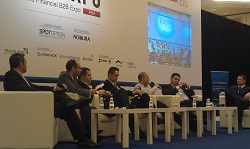
Yoni Avital, CEO and Founder, TradeSmarter, (4th From Left), Binary Options Panel, Forex Magnates Summit, Macau
Yesterday, TradeSmarter’s founder and CEO Yoni Avital spoke to Forex Magnates in order to bring to light the company’s methodology and rationale behind this.
Mr. Avital explained that over recent months the company had taken a decision to remain on the side of the scene and take a strategic step to work on distribution. Within the last 10 months, the company has added 33 white labels which brings the total to 40, a growth that it had been concentrating on since the Forex Magnates Summit in London last year. There are now 17 white labels on the site.
The company has this year opened a facility overseas, help with growth worldwide, although Mr. Avital preferred not to reveal the exact location at this stage. The idea behind the increasing of development operations is that the company can now provide a full facility in which it can develop a customized product for a white label partner within a week, including the affiliate program, CRM, back office, trading platform, advertising and media tools, mobile application and mobile web product.
Almost Out of The Wilderness - $3 Million Investment on The Cards
TradeSmarter considers that keeping the cost of operating to a minimum and providing a simplified platform which brokers can customize and support locally is a great advantage.
Mr. Avital believes that transparency and good ethics are the only way in which this business can survive into the future. As other companies gained market share and competition increased, TradeSmarter had concentrated on development and providing a fully transparent, flexible model but found itself in a situation whereby it had received no investment for 3 and a half years. It got to the point had to take further investment or merge with another firm.
“The binary options industry has developed a less than clean reputation over the past few years as a result of many service providers offering wrong entry pricing and expiry prices” said Mr. Avital.
He spoke out that companies can no longer get away with offering non-transparent pricing, and therefore a whole different approach should be taken if the entire industry is to survive and grow.
Sticking rigidly to this principle created a difficult developmental period, however, is now beginning to bear fruit. Mr. Avital confirmed to Forex Magnates that at the moment there are two major players in the market, one is a retail FX firm, the other is B2B Institutional FX company, that are willing to invest more than $3 million in the business, in return for a 51% share.
Once on board, TradeSmarter will gain a distribution benefit by either number of brokers or by volume. The company which becomes the investor will be expected to create a strong partnership between itself and TradeSmarter, and one of the main prerequisites is that TradeSmarter is looking for a partner with strong distribution channels.
Small operations have the benefit of ease of adaptation with changes or cost. In exchange for 51% of the business, TradeSmarter aims to leverage the distribution channels already in place with the established FX firm, which will be marketed as a unique selling point that should encourage binary options companies to select TradeSmarter as a provider.
“Having a strategic entity means that all cost is in one place” explained Mr. Avital. “When binary options brokers go into partnership with FX firms, they often do so by using their own platform, and operating it via a shared wallet which allows the existing and new clients on an FX company’s CRM to trade binary options. The downside of this is that the cost is very high to the white label partner or broker, as they have to pay for the binary platform, the bridge, the FX firm’s platform/CRM and marketing. The added issue is that the FX company is interested in its own volume and therefore will drive a hard bargain wth the binary options provider when linking to their CRM via a shared wallet”.
“Conversely, having an FX company purchase a majority stake in a binary options platform company brings them innovative products and removes the costs. A unified system is cheaper and makes a stronger synergy for effort on both sides, removes all the costs of using different companies and support costs and support issues dealing with bridge provider. Effectively it can all be offered on one platform without any costly links in the chain” explained Mr. Avital.
User Experience and Engagement
As with the majority of binary options platform firms, TradeSmarter has taken steps to ensure that it engages the users of its platform further, and for longer periods of time, therefore maximizing volume without the ever-increasing cost of buying more media advertising to bring new clients to replace ones which have a short lifetime value.
The company operates an in house CRM and outsources nothing taken to any third party developer. Mr. Avital considers that the recent increase in growth of new white labels is down to the new infrastructure which simplifies the start up process by offering a locally-hosted turnkey solution.
In this case, Mr. Avital explained that the white label partner is involved in the development of the platform and can create tools for client to set up and customize the trading environment and site. There is no need for IT hosting or any reliance on a support company at all, as everything is hosted locally at the broker, which reduces their operating costs.
After customization of the site, trading environment, banners and CRM, the broker can save it locally to a file and send the whole thing to TradeSmarter for it to be approved and uploaded. Focus on user experience and engagement.
Pricing – Emphasis on Transparency
In congruence with Mr. Avital’s aforementioned dismay at the lack of transparency which has proliferated across the entire industry since its gaining of popularity, TradeSmarter has adopted a transparent pricing methodology in which all prices on the platform must equal the entry market price of the feeds.
As regulatory scope around the world has tightened up on binary options firms, Mr. Avital believes that the regulators in all jurisdictions will begin to check entry market prices and expiry prices, and for this reason they shouldn’t be one pip away. TradeSmarter has adopted a system whereby expiry prices can be seen on a minute by minute basis whilst the trade is open, and the trader can cancel trades at any time.
Social Trading Built Into Platform
Social trading has become a vital tool for not only retention, but increasing the lifetime value of binary options traders. Users of TradeSmarter’s system can view all other people’s trades via the platform. It shows other users on the graph and the position at where their trade is, in the form of a symbol shaped as a head within a circle. The traders can see whether the trades are open or closed, and when a user makes a losing trade, the head symbol representing that user disappears. When the circle lights to green, that means that the trader represented by that signal closed a trade in profit.
Mr. Avital believes that often it is not possible to make social trading an integral part of the actual platform because prices get changed all the time by the market maker. In this case, the social trading feature is a full layer, whereby under the account settings menu, there is a ‘Social’ tab. Users can enable and disable social trading via that tab. If enabled, the user agrees to show his trades and it enables him to see others. If disabled, the user doesn’t see other trades.
On the trading platform, users can sell back the position both ways, whether out of the money or in the money. The valuation is profit and doesn’t include initial capital as the principle is kept aside.
The firm does provide a bonus facility, however it operates it on a pending bonus basis, therefore displaying on the platform how many lots have to be completed in order to validate it.
As an example, if a deposit of $1000 is made, and the bonus is $500, the system calculates the required volume to validate the bonus. The bonus is displayed as pending, and does not show in the balance. There is a progress bar showing how many percent of the bonus is validated and how much volume has been completed. Mr. Avital considers this an important sales tool so that brokers can show their clients that they are providing all of the detail in figures, instilling confidence that the broker is not trading against the client. He believes that there has been a lot of demand in the past for platforms which make the client lose, but sees no future in this model.
“If a system becomes used by regulatory authorities which can check all the prices, even on 60 second options which until now have been impossible to check, like the Australian surveillance system can do, then it will figure out the irregularities on a real time basis and therefore the industry is making a mistake by running non-transparent bucket shops” enthused Mr. Avital
“The CFTC goes after platform providers as well as white labels which manipulate prices, but often they do this as a result of complaints and still it is very hard to catch those who manipulate prices on very short term options. The adoption of surveillance systems in Australia, part of the Asia Pacific region which is a huge market for binary options, may signal the end for such practices”.
No Plan For Japan, America Awaits
On that note, whilst other platform providers have been rallying to enter the Japanese market, TradeSmarter has eschewed entry into the largest market for trading FX and binary options completely. Mr. Avital does not see enough merit in the overcrowded market, and he considers the variable pricing to be infra dig, and as results have not yet been provided, he considers the investment required to develop these platforms superfluous to the demand.
Instead, the company wishes to find a partner with which to establish a binary options exchange of its own and enter the US market, which Mr. Avital understands to be a very costly business when bearing in mind the requirements of the National Futures Association and the operating capital required to satisfy such regulations as well as the running of an exchange in America. He believes this to be a lucrative market, and due to the US government's insistence on pricing transparency, worth the cost long term, which is a very controversial view indeed.
Certainly the binary options industry is becoming fiercely competitive, and with big FX companies constantly bringing binary options on board as exemplified further by today's announcement by Alpari that it will provide binary options via two platforms depending on region, the work of platform providers is becoming ever more burdensome in order to stay ahead of the competition, and to remain, most of all, profitable.
The relative ubiquity of a handful of firms which provide binary options companies with trading platforms has created something of an eclipse over those with different business objectives.
Whilst TechFinancials, MarketsPulse and SpotOption take a high profile approach in order to garner market share from retail binary options brokers and FX companies, with a degree of success worldwide, there are other firms which are seen and heard less, but are able to adapt to change of circumstance in a timely manner and utilize different methods of approaching their prospective partners.
Expansion of R&D Overseas
Binary options platform provider TradeSmarter is indeed a case in point. Since the company’s inception, it retained a relatively low dependence on manpower, and utilized a proprietary system with which to reach its target audience.
Whilst this is efficient, by the time that the rival firms were launching their new Japan-compliant platforms at the Forex Magnates Tokyo Summit in the summer of this year amid high-profile advertising and marketing campaigns, TradeSmarter’s strategy and future plans remained somewhat of an anomaly.
Yoni Avital, CEO and Founder, TradeSmarter, (4th From Left), Binary Options Panel, Forex Magnates Summit, Macau
Yesterday, TradeSmarter’s founder and CEO Yoni Avital spoke to Forex Magnates in order to bring to light the company’s methodology and rationale behind this.
Mr. Avital explained that over recent months the company had taken a decision to remain on the side of the scene and take a strategic step to work on distribution. Within the last 10 months, the company has added 33 white labels which brings the total to 40, a growth that it had been concentrating on since the Forex Magnates Summit in London last year. There are now 17 white labels on the site.
The company has this year opened a facility overseas, help with growth worldwide, although Mr. Avital preferred not to reveal the exact location at this stage. The idea behind the increasing of development operations is that the company can now provide a full facility in which it can develop a customized product for a white label partner within a week, including the affiliate program, CRM, back office, trading platform, advertising and media tools, mobile application and mobile web product.
Almost Out of The Wilderness - $3 Million Investment on The Cards
TradeSmarter considers that keeping the cost of operating to a minimum and providing a simplified platform which brokers can customize and support locally is a great advantage.
Mr. Avital believes that transparency and good ethics are the only way in which this business can survive into the future. As other companies gained market share and competition increased, TradeSmarter had concentrated on development and providing a fully transparent, flexible model but found itself in a situation whereby it had received no investment for 3 and a half years. It got to the point had to take further investment or merge with another firm.
“The binary options industry has developed a less than clean reputation over the past few years as a result of many service providers offering wrong entry pricing and expiry prices” said Mr. Avital.
He spoke out that companies can no longer get away with offering non-transparent pricing, and therefore a whole different approach should be taken if the entire industry is to survive and grow.
Sticking rigidly to this principle created a difficult developmental period, however, is now beginning to bear fruit. Mr. Avital confirmed to Forex Magnates that at the moment there are two major players in the market, one is a retail FX firm, the other is B2B Institutional FX company, that are willing to invest more than $3 million in the business, in return for a 51% share.
Once on board, TradeSmarter will gain a distribution benefit by either number of brokers or by volume. The company which becomes the investor will be expected to create a strong partnership between itself and TradeSmarter, and one of the main prerequisites is that TradeSmarter is looking for a partner with strong distribution channels.
Small operations have the benefit of ease of adaptation with changes or cost. In exchange for 51% of the business, TradeSmarter aims to leverage the distribution channels already in place with the established FX firm, which will be marketed as a unique selling point that should encourage binary options companies to select TradeSmarter as a provider.
“Having a strategic entity means that all cost is in one place” explained Mr. Avital. “When binary options brokers go into partnership with FX firms, they often do so by using their own platform, and operating it via a shared wallet which allows the existing and new clients on an FX company’s CRM to trade binary options. The downside of this is that the cost is very high to the white label partner or broker, as they have to pay for the binary platform, the bridge, the FX firm’s platform/CRM and marketing. The added issue is that the FX company is interested in its own volume and therefore will drive a hard bargain wth the binary options provider when linking to their CRM via a shared wallet”.
“Conversely, having an FX company purchase a majority stake in a binary options platform company brings them innovative products and removes the costs. A unified system is cheaper and makes a stronger synergy for effort on both sides, removes all the costs of using different companies and support costs and support issues dealing with bridge provider. Effectively it can all be offered on one platform without any costly links in the chain” explained Mr. Avital.
User Experience and Engagement
As with the majority of binary options platform firms, TradeSmarter has taken steps to ensure that it engages the users of its platform further, and for longer periods of time, therefore maximizing volume without the ever-increasing cost of buying more media advertising to bring new clients to replace ones which have a short lifetime value.
The company operates an in house CRM and outsources nothing taken to any third party developer. Mr. Avital considers that the recent increase in growth of new white labels is down to the new infrastructure which simplifies the start up process by offering a locally-hosted turnkey solution.
In this case, Mr. Avital explained that the white label partner is involved in the development of the platform and can create tools for client to set up and customize the trading environment and site. There is no need for IT hosting or any reliance on a support company at all, as everything is hosted locally at the broker, which reduces their operating costs.
After customization of the site, trading environment, banners and CRM, the broker can save it locally to a file and send the whole thing to TradeSmarter for it to be approved and uploaded. Focus on user experience and engagement.
Pricing – Emphasis on Transparency
In congruence with Mr. Avital’s aforementioned dismay at the lack of transparency which has proliferated across the entire industry since its gaining of popularity, TradeSmarter has adopted a transparent pricing methodology in which all prices on the platform must equal the entry market price of the feeds.
As regulatory scope around the world has tightened up on binary options firms, Mr. Avital believes that the regulators in all jurisdictions will begin to check entry market prices and expiry prices, and for this reason they shouldn’t be one pip away. TradeSmarter has adopted a system whereby expiry prices can be seen on a minute by minute basis whilst the trade is open, and the trader can cancel trades at any time.
Social Trading Built Into Platform
Social trading has become a vital tool for not only retention, but increasing the lifetime value of binary options traders. Users of TradeSmarter’s system can view all other people’s trades via the platform. It shows other users on the graph and the position at where their trade is, in the form of a symbol shaped as a head within a circle. The traders can see whether the trades are open or closed, and when a user makes a losing trade, the head symbol representing that user disappears. When the circle lights to green, that means that the trader represented by that signal closed a trade in profit.
Mr. Avital believes that often it is not possible to make social trading an integral part of the actual platform because prices get changed all the time by the market maker. In this case, the social trading feature is a full layer, whereby under the account settings menu, there is a ‘Social’ tab. Users can enable and disable social trading via that tab. If enabled, the user agrees to show his trades and it enables him to see others. If disabled, the user doesn’t see other trades.
On the trading platform, users can sell back the position both ways, whether out of the money or in the money. The valuation is profit and doesn’t include initial capital as the principle is kept aside.
The firm does provide a bonus facility, however it operates it on a pending bonus basis, therefore displaying on the platform how many lots have to be completed in order to validate it.
As an example, if a deposit of $1000 is made, and the bonus is $500, the system calculates the required volume to validate the bonus. The bonus is displayed as pending, and does not show in the balance. There is a progress bar showing how many percent of the bonus is validated and how much volume has been completed. Mr. Avital considers this an important sales tool so that brokers can show their clients that they are providing all of the detail in figures, instilling confidence that the broker is not trading against the client. He believes that there has been a lot of demand in the past for platforms which make the client lose, but sees no future in this model.
“If a system becomes used by regulatory authorities which can check all the prices, even on 60 second options which until now have been impossible to check, like the Australian surveillance system can do, then it will figure out the irregularities on a real time basis and therefore the industry is making a mistake by running non-transparent bucket shops” enthused Mr. Avital
“The CFTC goes after platform providers as well as white labels which manipulate prices, but often they do this as a result of complaints and still it is very hard to catch those who manipulate prices on very short term options. The adoption of surveillance systems in Australia, part of the Asia Pacific region which is a huge market for binary options, may signal the end for such practices”.
No Plan For Japan, America Awaits
On that note, whilst other platform providers have been rallying to enter the Japanese market, TradeSmarter has eschewed entry into the largest market for trading FX and binary options completely. Mr. Avital does not see enough merit in the overcrowded market, and he considers the variable pricing to be infra dig, and as results have not yet been provided, he considers the investment required to develop these platforms superfluous to the demand.
Instead, the company wishes to find a partner with which to establish a binary options exchange of its own and enter the US market, which Mr. Avital understands to be a very costly business when bearing in mind the requirements of the National Futures Association and the operating capital required to satisfy such regulations as well as the running of an exchange in America. He believes this to be a lucrative market, and due to the US government's insistence on pricing transparency, worth the cost long term, which is a very controversial view indeed.
Certainly the binary options industry is becoming fiercely competitive, and with big FX companies constantly bringing binary options on board as exemplified further by today's announcement by Alpari that it will provide binary options via two platforms depending on region, the work of platform providers is becoming ever more burdensome in order to stay ahead of the competition, and to remain, most of all, profitable.
FTMO Says Monthly Rewards Near $15 Million in September
Featured Videos
AvaTrade to Acquire Most of FXCM; NAGA Raises $8M
AvaTrade to Acquire Most of FXCM; NAGA Raises $8M
AvaTrade to Acquire Most of FXCM; NAGA Raises $8M
AvaTrade to Acquire Most of FXCM; NAGA Raises $8M
Today’s financial news recap covers AvaTrade agrees to acquire most of FXCM, NAGA secures eight million dollars in new financing, and Wise seeks a tax settlement in the UK.
Finance Magnates Daily Recap brings you the latest news from forex and CFD brokers, fintech, payments, cryptocurrency, digital assets, trading platforms, financial regulation and global markets.
Get the key company news, executive moves, deals, regulatory updates and market developments of the day, in just a few minutes. New episodes published every weekday.
Read more: https://www.financemagnates.com
#FinanceMagnates #ForexNews #FintechNews
Today’s financial news recap covers AvaTrade agrees to acquire most of FXCM, NAGA secures eight million dollars in new financing, and Wise seeks a tax settlement in the UK.
Finance Magnates Daily Recap brings you the latest news from forex and CFD brokers, fintech, payments, cryptocurrency, digital assets, trading platforms, financial regulation and global markets.
Get the key company news, executive moves, deals, regulatory updates and market developments of the day, in just a few minutes. New episodes published every weekday.
Read more: https://www.financemagnates.com
#FinanceMagnates #ForexNews #FintechNews
Today’s financial news recap covers AvaTrade agrees to acquire most of FXCM, NAGA secures eight million dollars in new financing, and Wise seeks a tax settlement in the UK.
Finance Magnates Daily Recap brings you the latest news from forex and CFD brokers, fintech, payments, cryptocurrency, digital assets, trading platforms, financial regulation and global markets.
Get the key company news, executive moves, deals, regulatory updates and market developments of the day, in just a few minutes. New episodes published every weekday.
Read more: https://www.financemagnates.com
#FinanceMagnates #ForexNews #FintechNews
Today’s financial news recap covers AvaTrade agrees to acquire most of FXCM, NAGA secures eight million dollars in new financing, and Wise seeks a tax settlement in the UK.
Finance Magnates Daily Recap brings you the latest news from forex and CFD brokers, fintech, payments, cryptocurrency, digital assets, trading platforms, financial regulation and global markets.
Get the key company news, executive moves, deals, regulatory updates and market developments of the day, in just a few minutes. New episodes published every weekday.
Read more: https://www.financemagnates.com
#FinanceMagnates #ForexNews #FintechNews
XTB Adds Overnight US Stock Trading; Nasdaq Ventures Invests in One Trading
XTB Adds Overnight US Stock Trading; Nasdaq Ventures Invests in One Trading
XTB Adds Overnight US Stock Trading; Nasdaq Ventures Invests in One Trading
XTB Adds Overnight US Stock Trading; Nasdaq Ventures Invests in One Trading
XTB Adds Overnight US Stock Trading; Nasdaq Ventures Invests in One Trading
XTB Adds Overnight US Stock Trading; Nasdaq Ventures Invests in One Trading
Today’s financial news recap covers XTB expands overnight US stock trading, Fortrade reports higher revenue, Nasdaq backs One Trading, and Vest Labs raises 13 million dollars.
Finance Magnates Daily Recap brings you the latest news from forex and CFD brokers, fintech, payments, cryptocurrency, digital assets, trading platforms, financial regulation and global markets.
Get the key company news, executive moves, deals, regulatory updates and market developments of the day, in just a few minutes. New episodes published every weekday.
Read more: https://www.financemagnates.com
#FinanceMagnates #ForexNews #FintechNews
Today’s financial news recap covers XTB expands overnight US stock trading, Fortrade reports higher revenue, Nasdaq backs One Trading, and Vest Labs raises 13 million dollars.
Finance Magnates Daily Recap brings you the latest news from forex and CFD brokers, fintech, payments, cryptocurrency, digital assets, trading platforms, financial regulation and global markets.
Get the key company news, executive moves, deals, regulatory updates and market developments of the day, in just a few minutes. New episodes published every weekday.
Read more: https://www.financemagnates.com
#FinanceMagnates #ForexNews #FintechNews
Today’s financial news recap covers XTB expands overnight US stock trading, Fortrade reports higher revenue, Nasdaq backs One Trading, and Vest Labs raises 13 million dollars.
Finance Magnates Daily Recap brings you the latest news from forex and CFD brokers, fintech, payments, cryptocurrency, digital assets, trading platforms, financial regulation and global markets.
Get the key company news, executive moves, deals, regulatory updates and market developments of the day, in just a few minutes. New episodes published every weekday.
Read more: https://www.financemagnates.com
#FinanceMagnates #ForexNews #FintechNews
Today’s financial news recap covers XTB expands overnight US stock trading, Fortrade reports higher revenue, Nasdaq backs One Trading, and Vest Labs raises 13 million dollars.
Finance Magnates Daily Recap brings you the latest news from forex and CFD brokers, fintech, payments, cryptocurrency, digital assets, trading platforms, financial regulation and global markets.
Get the key company news, executive moves, deals, regulatory updates and market developments of the day, in just a few minutes. New episodes published every weekday.
Read more: https://www.financemagnates.com
#FinanceMagnates #ForexNews #FintechNews
Today’s financial news recap covers XTB expands overnight US stock trading, Fortrade reports higher revenue, Nasdaq backs One Trading, and Vest Labs raises 13 million dollars.
Finance Magnates Daily Recap brings you the latest news from forex and CFD brokers, fintech, payments, cryptocurrency, digital assets, trading platforms, financial regulation and global markets.
Get the key company news, executive moves, deals, regulatory updates and market developments of the day, in just a few minutes. New episodes published every weekday.
Read more: https://www.financemagnates.com
#FinanceMagnates #ForexNews #FintechNews
Today’s financial news recap covers XTB expands overnight US stock trading, Fortrade reports higher revenue, Nasdaq backs One Trading, and Vest Labs raises 13 million dollars.
Finance Magnates Daily Recap brings you the latest news from forex and CFD brokers, fintech, payments, cryptocurrency, digital assets, trading platforms, financial regulation and global markets.
Get the key company news, executive moves, deals, regulatory updates and market developments of the day, in just a few minutes. New episodes published every weekday.
Read more: https://www.financemagnates.com
#FinanceMagnates #ForexNews #FintechNews
CMC Founder Downplays Volatility Hit; Devexperts Names CEO
CMC Founder Downplays Volatility Hit; Devexperts Names CEO
CMC Founder Downplays Volatility Hit; Devexperts Names CEO
CMC Founder Downplays Volatility Hit; Devexperts Names CEO
CMC Founder Downplays Volatility Hit; Devexperts Names CEO
CMC Founder Downplays Volatility Hit; Devexperts Names CEO
Today’s financial news recap covers low volatility pressures brokers, Devexperts names a new CEO, Saxo cuts onboarding time, and OKX reaches a 25 billion dollar valuation.
Finance Magnates Daily Recap brings you the latest news from forex and CFD brokers, fintech, payments, cryptocurrency, digital assets, trading platforms, financial regulation and global markets.
Get the key company news, executive moves, deals, regulatory updates and market developments of the day, in just a few minutes. New episodes published every weekday.
Read more: https://www.financemagnates.com
#FinanceMagnates #ForexNews #FintechNews
Today’s financial news recap covers low volatility pressures brokers, Devexperts names a new CEO, Saxo cuts onboarding time, and OKX reaches a 25 billion dollar valuation.
Finance Magnates Daily Recap brings you the latest news from forex and CFD brokers, fintech, payments, cryptocurrency, digital assets, trading platforms, financial regulation and global markets.
Get the key company news, executive moves, deals, regulatory updates and market developments of the day, in just a few minutes. New episodes published every weekday.
Read more: https://www.financemagnates.com
#FinanceMagnates #ForexNews #FintechNews
Today’s financial news recap covers low volatility pressures brokers, Devexperts names a new CEO, Saxo cuts onboarding time, and OKX reaches a 25 billion dollar valuation.
Finance Magnates Daily Recap brings you the latest news from forex and CFD brokers, fintech, payments, cryptocurrency, digital assets, trading platforms, financial regulation and global markets.
Get the key company news, executive moves, deals, regulatory updates and market developments of the day, in just a few minutes. New episodes published every weekday.
Read more: https://www.financemagnates.com
#FinanceMagnates #ForexNews #FintechNews
Today’s financial news recap covers low volatility pressures brokers, Devexperts names a new CEO, Saxo cuts onboarding time, and OKX reaches a 25 billion dollar valuation.
Finance Magnates Daily Recap brings you the latest news from forex and CFD brokers, fintech, payments, cryptocurrency, digital assets, trading platforms, financial regulation and global markets.
Get the key company news, executive moves, deals, regulatory updates and market developments of the day, in just a few minutes. New episodes published every weekday.
Read more: https://www.financemagnates.com
#FinanceMagnates #ForexNews #FintechNews
Today’s financial news recap covers low volatility pressures brokers, Devexperts names a new CEO, Saxo cuts onboarding time, and OKX reaches a 25 billion dollar valuation.
Finance Magnates Daily Recap brings you the latest news from forex and CFD brokers, fintech, payments, cryptocurrency, digital assets, trading platforms, financial regulation and global markets.
Get the key company news, executive moves, deals, regulatory updates and market developments of the day, in just a few minutes. New episodes published every weekday.
Read more: https://www.financemagnates.com
#FinanceMagnates #ForexNews #FintechNews
Today’s financial news recap covers low volatility pressures brokers, Devexperts names a new CEO, Saxo cuts onboarding time, and OKX reaches a 25 billion dollar valuation.
Finance Magnates Daily Recap brings you the latest news from forex and CFD brokers, fintech, payments, cryptocurrency, digital assets, trading platforms, financial regulation and global markets.
Get the key company news, executive moves, deals, regulatory updates and market developments of the day, in just a few minutes. New episodes published every weekday.
Read more: https://www.financemagnates.com
#FinanceMagnates #ForexNews #FintechNews
Today’s financial news recap covers Trade Nation buys FXCM's UK client book, Trading 212 reports higher revenue, the CFTC's move to allow perpetual index futures.
Finance Magnates Daily Recap brings you the latest news from forex and CFD brokers, fintech, payments, cryptocurrency, digital assets, trading platforms, financial regulation and global markets.
Get the key company news, executive moves, deals, regulatory updates and market developments of the day, in just a few minutes. New episodes published every weekday.
Read more: https://www.financemagnates.com
#FinanceMagnates #ForexNews #FintechNews
Today’s financial news recap covers Trade Nation buys FXCM's UK client book, Trading 212 reports higher revenue, the CFTC's move to allow perpetual index futures.
Finance Magnates Daily Recap brings you the latest news from forex and CFD brokers, fintech, payments, cryptocurrency, digital assets, trading platforms, financial regulation and global markets.
Get the key company news, executive moves, deals, regulatory updates and market developments of the day, in just a few minutes. New episodes published every weekday.
Read more: https://www.financemagnates.com
#FinanceMagnates #ForexNews #FintechNews
Today’s financial news recap covers Trade Nation buys FXCM's UK client book, Trading 212 reports higher revenue, the CFTC's move to allow perpetual index futures.
Finance Magnates Daily Recap brings you the latest news from forex and CFD brokers, fintech, payments, cryptocurrency, digital assets, trading platforms, financial regulation and global markets.
Get the key company news, executive moves, deals, regulatory updates and market developments of the day, in just a few minutes. New episodes published every weekday.
Read more: https://www.financemagnates.com
#FinanceMagnates #ForexNews #FintechNews
Today’s financial news recap covers Trade Nation buys FXCM's UK client book, Trading 212 reports higher revenue, the CFTC's move to allow perpetual index futures.
Finance Magnates Daily Recap brings you the latest news from forex and CFD brokers, fintech, payments, cryptocurrency, digital assets, trading platforms, financial regulation and global markets.
Get the key company news, executive moves, deals, regulatory updates and market developments of the day, in just a few minutes. New episodes published every weekday.
Read more: https://www.financemagnates.com
#FinanceMagnates #ForexNews #FintechNews
Today’s financial news recap covers Trade Nation buys FXCM's UK client book, Trading 212 reports higher revenue, the CFTC's move to allow perpetual index futures.
Finance Magnates Daily Recap brings you the latest news from forex and CFD brokers, fintech, payments, cryptocurrency, digital assets, trading platforms, financial regulation and global markets.
Get the key company news, executive moves, deals, regulatory updates and market developments of the day, in just a few minutes. New episodes published every weekday.
Read more: https://www.financemagnates.com
#FinanceMagnates #ForexNews #FintechNews
Today’s financial news recap covers Trade Nation buys FXCM's UK client book, Trading 212 reports higher revenue, the CFTC's move to allow perpetual index futures.
Finance Magnates Daily Recap brings you the latest news from forex and CFD brokers, fintech, payments, cryptocurrency, digital assets, trading platforms, financial regulation and global markets.
Get the key company news, executive moves, deals, regulatory updates and market developments of the day, in just a few minutes. New episodes published every weekday.
Read more: https://www.financemagnates.com
#FinanceMagnates #ForexNews #FintechNews
Your career isn’t a linear path.
Your career isn’t a linear path.
Your career isn’t a linear path.
Your career isn’t a linear path.
Your career isn’t a linear path.
Your career isn’t a linear path.
Roles change. Career goals change. Sometimes you want a completely new challenge.
But the skills and knowledge you build along the way can stay with you and give you something to build on.
For Jeff Patterson, that continued growth is key to long-term career development.
You bring the skills. FM Academy helps you build the knowledge.
#FMAcademy #FinanceMagnates #FinanceCareers #ProfessionalDevelopment #Fintech
Roles change. Career goals change. Sometimes you want a completely new challenge.
But the skills and knowledge you build along the way can stay with you and give you something to build on.
For Jeff Patterson, that continued growth is key to long-term career development.
You bring the skills. FM Academy helps you build the knowledge.
#FMAcademy #FinanceMagnates #FinanceCareers #ProfessionalDevelopment #Fintech
Roles change. Career goals change. Sometimes you want a completely new challenge.
But the skills and knowledge you build along the way can stay with you and give you something to build on.
For Jeff Patterson, that continued growth is key to long-term career development.
You bring the skills. FM Academy helps you build the knowledge.
#FMAcademy #FinanceMagnates #FinanceCareers #ProfessionalDevelopment #Fintech
Roles change. Career goals change. Sometimes you want a completely new challenge.
But the skills and knowledge you build along the way can stay with you and give you something to build on.
For Jeff Patterson, that continued growth is key to long-term career development.
You bring the skills. FM Academy helps you build the knowledge.
#FMAcademy #FinanceMagnates #FinanceCareers #ProfessionalDevelopment #Fintech
Roles change. Career goals change. Sometimes you want a completely new challenge.
But the skills and knowledge you build along the way can stay with you and give you something to build on.
For Jeff Patterson, that continued growth is key to long-term career development.
You bring the skills. FM Academy helps you build the knowledge.
#FMAcademy #FinanceMagnates #FinanceCareers #ProfessionalDevelopment #Fintech
Roles change. Career goals change. Sometimes you want a completely new challenge.
But the skills and knowledge you build along the way can stay with you and give you something to build on.
For Jeff Patterson, that continued growth is key to long-term career development.
You bring the skills. FM Academy helps you build the knowledge.
#FMAcademy #FinanceMagnates #FinanceCareers #ProfessionalDevelopment #Fintech