In the latest Quarterly Industry Report, Finance Magnates takes a closer look at the Southeast Asian industry,.
FM
Just a few years ago, brokers that wanted to set up shop in Asia would invariably choose Japan. However, strong competition and market density have led companies to turn their attention to other locations on that continent in the search for better entry conditions.[gptAdvertisement]
Southeast Asia, which is home to more than 600 million people, benefits from this and is now an important part of the global financial system. This is one of the reasons that increasing numbers of retail brokers are looking for opportunities to open an office in this part of the world, particularly in Thailand, Malaysia, Singapore and Indonesia.
In the latest Quarterly Industry Report, Finance Magnates takes a closer look at the Southeast Asian industry, highlighting the main advantages and difficulties of starting up in this rapidly growing market.
What is the profile of the average investor?
Although only 100,000 people can be identified as active Forex and binary options traders in this heavily populated region, the last few years have brought a significant increase in the popularity of the derivatives market - especially in Malaysia, where at least 30,000 out of the 32 million citizens regularly deposit funds in their trading accounts. The average first deposit value (FTD) varies from $250 - $300 and is comparable to results in a few European countries (e.g. Ireland, Poland). Of course, in the case of developed economies, the averages are much higher – in the UK for example the average FTD stands at approximately $600.
The relatively low initial deposit values may provide guidance for investment firms regarding the profile of the average trader. Local investors are looking for brokerage accounts with a minimum entry level, and micro-lots, which do not require large funds.
The average value of all deposits in the Southeast Asia region is much higher, and oscillating around $1200, double the average payout. At the same time, it should be noted that investors are depositing larger amounts of money in binary options than in the forex market. This is perfectly illustrated by the example of Thailand, where the difference can be as much as three times.
Cheap marketing and the importance of education
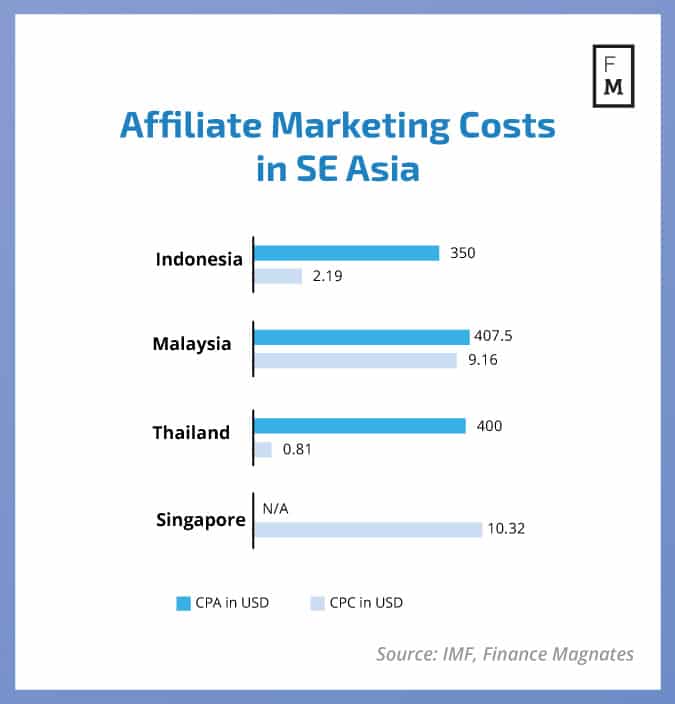
One of the greatest advantages of conducting brokerage activities in Southeast Asia is the relatively low cost of marketing. Cost per click (CPC) is much lower than in Europe, Africa and South America, as well as cost per acquisition (CPA), which amounts to approximately $400. For comparison, in the UK, a broker would pay $140 more for obtaining a customer.
In order to make the best use of cost-effective promotional activities, brokers operating in the local market should focus on providing clients with free, high quality education. According to Roberto d' Ambrosio, CEO of Alpari Research and Analysis, every company looking to succeed in Southeast Asia: "…has to establish a strong local presence and carefully design partnership programs, which has to be not only economically beneficial to the partners, but also focus on support strategies carefully tailored on their needs."
There are significant differences in the regulation of local derivatives markets. The highest entry barrier is visible in Malaysia, Indonesia imposes a maximum limit on Leverage of 1:200, and in Singapore and Thailand forex brokers are fully permitted.
At the same time, it should not be forgotten that brokers operating in Southeast Asia have an opportunity to attract traders from China, who generate substantial trading volumes - twice as high as in the Middle East. Thanks to widespread internet penetration and the relatively low costs of doing business in Thailand, Malaysia, Singapore and Indonesia, these countries could indeed become interesting development destinations for FX/CFD retail brokers.
Just a few years ago, brokers that wanted to set up shop in Asia would invariably choose Japan. However, strong competition and market density have led companies to turn their attention to other locations on that continent in the search for better entry conditions.[gptAdvertisement]
Southeast Asia, which is home to more than 600 million people, benefits from this and is now an important part of the global financial system. This is one of the reasons that increasing numbers of retail brokers are looking for opportunities to open an office in this part of the world, particularly in Thailand, Malaysia, Singapore and Indonesia.
In the latest Quarterly Industry Report, Finance Magnates takes a closer look at the Southeast Asian industry, highlighting the main advantages and difficulties of starting up in this rapidly growing market.
What is the profile of the average investor?
Although only 100,000 people can be identified as active Forex and binary options traders in this heavily populated region, the last few years have brought a significant increase in the popularity of the derivatives market - especially in Malaysia, where at least 30,000 out of the 32 million citizens regularly deposit funds in their trading accounts. The average first deposit value (FTD) varies from $250 - $300 and is comparable to results in a few European countries (e.g. Ireland, Poland). Of course, in the case of developed economies, the averages are much higher – in the UK for example the average FTD stands at approximately $600.
The relatively low initial deposit values may provide guidance for investment firms regarding the profile of the average trader. Local investors are looking for brokerage accounts with a minimum entry level, and micro-lots, which do not require large funds.
The average value of all deposits in the Southeast Asia region is much higher, and oscillating around $1200, double the average payout. At the same time, it should be noted that investors are depositing larger amounts of money in binary options than in the forex market. This is perfectly illustrated by the example of Thailand, where the difference can be as much as three times.
Cheap marketing and the importance of education
One of the greatest advantages of conducting brokerage activities in Southeast Asia is the relatively low cost of marketing. Cost per click (CPC) is much lower than in Europe, Africa and South America, as well as cost per acquisition (CPA), which amounts to approximately $400. For comparison, in the UK, a broker would pay $140 more for obtaining a customer.
In order to make the best use of cost-effective promotional activities, brokers operating in the local market should focus on providing clients with free, high quality education. According to Roberto d' Ambrosio, CEO of Alpari Research and Analysis, every company looking to succeed in Southeast Asia: "…has to establish a strong local presence and carefully design partnership programs, which has to be not only economically beneficial to the partners, but also focus on support strategies carefully tailored on their needs."
There are significant differences in the regulation of local derivatives markets. The highest entry barrier is visible in Malaysia, Indonesia imposes a maximum limit on Leverage of 1:200, and in Singapore and Thailand forex brokers are fully permitted.
At the same time, it should not be forgotten that brokers operating in Southeast Asia have an opportunity to attract traders from China, who generate substantial trading volumes - twice as high as in the Middle East. Thanks to widespread internet penetration and the relatively low costs of doing business in Thailand, Malaysia, Singapore and Indonesia, these countries could indeed become interesting development destinations for FX/CFD retail brokers.
Damian Chmiel is a Senior Analyst & Editor at Finance Magnates with more than 15 years of experience in the CFD and online trading industry. Active as both a trader and journalist since 2010, he focuses on broker coverage, fintech innovation, and regulatory developments across Europe, the Middle East, and Asia.
His work includes interviews with C-level leaders at major brokerages and fintech platforms, as well as co-authoring Finance Magnates’ quarterly industry benchmarking reports. Damian’s reporting is data-driven, market-aware, and grounded in direct industry engagement. His analysis and commentary have also been cited by external media outlets, including Investing.com, Binance, The Asset, Stockhead, and Dispatch.
Education:
MA in Finance and Accounting, Cracow University of Economics
Italy’s Consob Tightens Net on AI-Fueled Scams With Fresh Website Bans
FP Markets Winner Spotlight 🏆 | Global Broker of the Year 2025 #Trading #Broker #Innovation #Shorts
FP Markets Winner Spotlight 🏆 | Global Broker of the Year 2025 #Trading #Broker #Innovation #Shorts
FP Markets takes the spotlight as Global Broker of the Year 2025 at the Finance Magnates Awards.
Martin Stoilov, Head of Client Experience, shares that trust, innovation, and people played a key role in the company’s success, supported by a strong foundation of integrity and client-centricity.
Following this milestone, FP Markets continues to focus on growth, technology investment, and its core values of transparency and excellence.
👉 Be part of FM Awards 2026: https://awards.financemagnates.com/#nominate
FP Markets takes the spotlight as Global Broker of the Year 2025 at the Finance Magnates Awards.
Martin Stoilov, Head of Client Experience, shares that trust, innovation, and people played a key role in the company’s success, supported by a strong foundation of integrity and client-centricity.
Following this milestone, FP Markets continues to focus on growth, technology investment, and its core values of transparency and excellence.
👉 Be part of FM Awards 2026: https://awards.financemagnates.com/#nominate
In this video, we review @HolaPrimeMarketsOfficial, a multi-asset forex and CFDs broker offering different account types, trading platforms, and flexible trading conditions.
We cover the broker’s overall offering, including account options, trading environment, platforms like MT4 and MT5, and additional services such as managed accounts and fast withdrawals.
Watch the full video to see if Hola Prime Markets fits your trading needs.
📣 Stay up to date with the latest in finance and trading. Follow Finance Magnates for industry news, insights, and global event coverage.
Connect with us:
🔗 LinkedIn: /financemagnates
👍 Facebook: /financemagnates
📸 Instagram: https://www.instagram.com/financemagnates
🐦 X: https://x.com/financemagnates
🎥 TikTok: https://www.tiktok.com/tag/financemagnates
▶️ YouTube: /@financemagnates_official
#HolaPrime #ForexBroker #CFDTrading #FinanceMagnates #Trading #Forex #BrokerReview
In this video, we review @HolaPrimeMarketsOfficial, a multi-asset forex and CFDs broker offering different account types, trading platforms, and flexible trading conditions.
We cover the broker’s overall offering, including account options, trading environment, platforms like MT4 and MT5, and additional services such as managed accounts and fast withdrawals.
Watch the full video to see if Hola Prime Markets fits your trading needs.
📣 Stay up to date with the latest in finance and trading. Follow Finance Magnates for industry news, insights, and global event coverage.
Connect with us:
🔗 LinkedIn: /financemagnates
👍 Facebook: /financemagnates
📸 Instagram: https://www.instagram.com/financemagnates
🐦 X: https://x.com/financemagnates
🎥 TikTok: https://www.tiktok.com/tag/financemagnates
▶️ YouTube: /@financemagnates_official
#HolaPrime #ForexBroker #CFDTrading #FinanceMagnates #Trading #Forex #BrokerReview
Hola Prime Review: What You Need to Know | Full Breakdown by Finance Magnates
Hola Prime Review: What You Need to Know | Full Breakdown by Finance Magnates
In this video, we review @HolaPrime_Global, a proprietary trading firm offering evaluation programs and performance-based payouts in simulated market environments.
We cover how the challenge model works, including account types, profit splits (up to 95%), trading rules, and what it takes to reach a funded account. You’ll also learn about available platforms like MT4, MT5, cTrader, and more, along with insights into payouts, support, and trading conditions.
Watch the full video to see if Hola Prime fits your trading style.
📣 Stay up to date with the latest in finance and trading. Follow Finance Magnates for industry news, insights, and global event coverage.
Connect with us:
🔗 LinkedIn: /financemagnates
👍 Facebook: /financemagnates
📸 Instagram: https://www.instagram.com/financemagnates
🐦 X: https://x.com/financemagnates
🎥 TikTok: https://www.tiktok.com/tag/financemagnates
▶️ YouTube: /@financemagnates_official
#HolaPrime #PropFirm #Trading #FinanceMagnates #Forex #FuturesTrading #TradingReview #PropFirmReview
In this video, we review @HolaPrime_Global, a proprietary trading firm offering evaluation programs and performance-based payouts in simulated market environments.
We cover how the challenge model works, including account types, profit splits (up to 95%), trading rules, and what it takes to reach a funded account. You’ll also learn about available platforms like MT4, MT5, cTrader, and more, along with insights into payouts, support, and trading conditions.
Watch the full video to see if Hola Prime fits your trading style.
📣 Stay up to date with the latest in finance and trading. Follow Finance Magnates for industry news, insights, and global event coverage.
Connect with us:
🔗 LinkedIn: /financemagnates
👍 Facebook: /financemagnates
📸 Instagram: https://www.instagram.com/financemagnates
🐦 X: https://x.com/financemagnates
🎥 TikTok: https://www.tiktok.com/tag/financemagnates
▶️ YouTube: /@financemagnates_official
#HolaPrime #PropFirm #Trading #FinanceMagnates #Forex #FuturesTrading #TradingReview #PropFirmReview
Axi Winner Spotlight 🏆 | Global Most Innovative Broker 2025 #Innovation #Trading #Fintech #Broker
Axi Winner Spotlight 🏆 | Global Most Innovative Broker 2025 #Innovation #Trading #Fintech #Broker
Axi takes the spotlight at the Finance Magnates Awards, winning Global Most Innovative Broker 2025.
Olivia Xenofontos and Ivanna Openko share how the team will feel: proud, motivated, and ready to keep delivering.
They also describe the night as well-organized, focused, and enjoyable for all.
👉 Be part of FM Awards 2026.
Axi takes the spotlight at the Finance Magnates Awards, winning Global Most Innovative Broker 2025.
Olivia Xenofontos and Ivanna Openko share how the team will feel: proud, motivated, and ready to keep delivering.
They also describe the night as well-organized, focused, and enjoyable for all.
👉 Be part of FM Awards 2026.
Recognition that matters.
Built on transparency.
Driven by the industry.
The Finance Magnates Awards 2026.
Nominations are now open.
🔗 https://awards.financemagnates.com/?utm_source=SM&utm_medium=social&utm_campaign=recognition-matters
Recognition that matters.
Built on transparency.
Driven by the industry.
The Finance Magnates Awards 2026.
Nominations are now open.
🔗 https://awards.financemagnates.com/?utm_source=SM&utm_medium=social&utm_campaign=recognition-matters