Russia's plan to float its currency by 2015 is becoming a reality and will lessen the degree of intervention in its managed foreign exchange regime and follows its new role of financial markets watchdog.
The Central Bank of Russia (CBR) has announced an increase in the range that its currency the ruble (RUB) can trade, effective from October 7, 2013, as part of a gradual transition towards a free floating exchange rate by 2015.
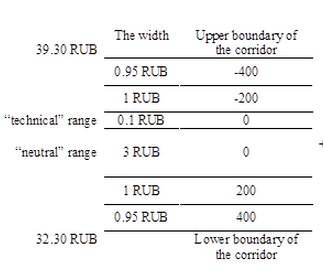
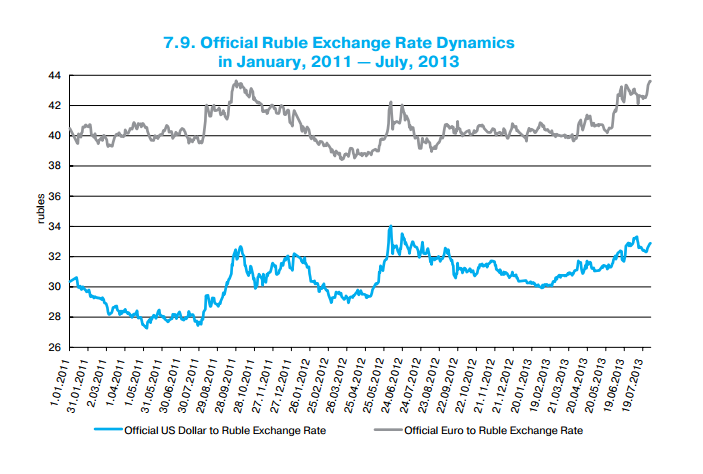
The increase was from 1 to 3.1 rubles in the "neutral" range of the USD-EURO dual-currency basket (the basket consists of 0.45 euros and 0.55 US dollars for each ruble) will enable the pegged currency to float freely within that new widened range. As prices deviate away from either side of the neutral range (towards the upper/lower boundaries), the floating operational band boundaries are automatically adjusted depending on the amount of FX interventions required, which forms the range of admitted values for the dual-currency basket.
Thanks to the new widened neutral range the degree and frequency of intervention needed has been mitigated slightly since the central bank does not intervene in the neutral range. The required level of interventions that had taken place previously, has since been shifted towards both ends of the 7 ruble wide corridor of RUB 32.30 - 39.30 (which has not widened or changed since July) . The further the ruble moves away from the 3.1 ruble neutral range toward the the center, the greater the level of intervention required. This is currently targeted near $120mln to as much as $400mln, in order to smooth excess volatility in the ruble exchange rate which is set by the CBR on a managed basis.
Step Towards Modernized FX Monetary Policy
As per the official statement, the changes implemented by the CBR should contribute to strengthening the effectiveness of the interest rate policy it conducts, ensuring price stability in the countries native currency. Figure 3 below shows the revised neutral range that the currency can now float freely within:
In addition, the central bank has increased efforts towards greater transparency by also broadening the number of parameters and information disclosed pertaining to its FX policy implementation. Originally known as the Central Bank of the Russian Federation (Also known as Bank of Russia) the CBR was founded on July 13, 1990, and today maintains the federation’s monetary reserves of nearly $523bln (USD).
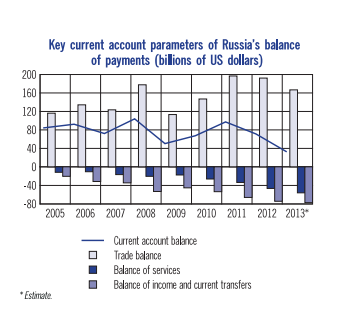
Change in Regulatory Authority
This new shift in monetary policy may allow the currency to weaken in order to more accurately reflect Russia's present economic condition. This in turn may stabilize the economy if a more modernized monetary policy can be consistently applied, while bringing balance to inflationary drivers. The CBR's board of directors recently revised its inflation target from 4.5% to 5% in 2014.
The CBR reported average daily trading volumes of $74.12bln worth of FX Spot transactions across all traded currencies in April 2013. According to the latest survey from the CBR in April 2013, which gathered totals for Forex exchange activity, there was $1.63 trillion worth of currency traded in April (over 22 trading days) reported from 40 dealers, with 75% of the volumes concentrated in the top 16 dealers. Of the 40 reporting dealers, 27 had reported retail-driven flows and at least 3 were prime-brokered.
The average daily FX spot volumes were $74.12bln per day over the 22 trading days in April 2013. These totals were submitted by the central bank to the Bank on International Settlements (BIS) which concluded its most recent triennial survey using April’s volumes from central banks in more than 53 jurisdictions worldwide. By comparison, Russia’s average daily FX volumes account for roughly 1.3% of average global daily turnover (in comparison to the BIS reported statistics). Last week, Forex Magnates covered volumes figures reported in September 2013 by the Moscow Interbank Currency Exchange (MICEX).
IMF Perspective
According to a transcript from the International Monetary Fund (IMF), on its speech about the World Economic Outlook at the annual meeting with the World Bank Group in Washington on October 8 2013, the revised GDP forecast for Russia was lowered (along with many other regions in the world) as described below. Questions were posed to the IMF during the session, as to the reason for its lowered revision to 1.5% growth forecasted for this year in Russia, and how the Russian authorities have taken the unusual step of publicly disputing the projection by saying the forecast should be closer to 2% growth.
As for the reasons for the more pessimistic view for Russia in 2013 by the IMF, cyclical and structural issues were to blame. Specifically, the structural issue was related to low potential growth and a business climate that has not been very supportive of investment, both of which had been weighing on activity. The first half of this year was noted as below previous expectations (and "not good"). However, the second half is expected to see a modest recovery, according to the IMF, partly helped by stronger demand from abroad, and with growth expected to move back up around 3% in the start of 2014.
_________
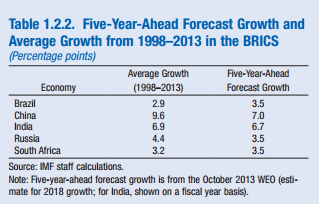
Excerpt from the World Economic Outlook Report, table 1.2.2. forecasts Russia's 5 year GDP at 3.5% or 1.1 basis point lower than the previous 5 year average (of 4.4%):
The Central Bank of Russia (CBR) has announced an increase in the range that its currency the ruble (RUB) can trade, effective from October 7, 2013, as part of a gradual transition towards a free floating exchange rate by 2015.
The increase was from 1 to 3.1 rubles in the "neutral" range of the USD-EURO dual-currency basket (the basket consists of 0.45 euros and 0.55 US dollars for each ruble) will enable the pegged currency to float freely within that new widened range. As prices deviate away from either side of the neutral range (towards the upper/lower boundaries), the floating operational band boundaries are automatically adjusted depending on the amount of FX interventions required, which forms the range of admitted values for the dual-currency basket.
Thanks to the new widened neutral range the degree and frequency of intervention needed has been mitigated slightly since the central bank does not intervene in the neutral range. The required level of interventions that had taken place previously, has since been shifted towards both ends of the 7 ruble wide corridor of RUB 32.30 - 39.30 (which has not widened or changed since July) . The further the ruble moves away from the 3.1 ruble neutral range toward the the center, the greater the level of intervention required. This is currently targeted near $120mln to as much as $400mln, in order to smooth excess volatility in the ruble exchange rate which is set by the CBR on a managed basis.
Step Towards Modernized FX Monetary Policy
As per the official statement, the changes implemented by the CBR should contribute to strengthening the effectiveness of the interest rate policy it conducts, ensuring price stability in the countries native currency. Figure 3 below shows the revised neutral range that the currency can now float freely within:
In addition, the central bank has increased efforts towards greater transparency by also broadening the number of parameters and information disclosed pertaining to its FX policy implementation. Originally known as the Central Bank of the Russian Federation (Also known as Bank of Russia) the CBR was founded on July 13, 1990, and today maintains the federation’s monetary reserves of nearly $523bln (USD).
Change in Regulatory Authority
This new shift in monetary policy may allow the currency to weaken in order to more accurately reflect Russia's present economic condition. This in turn may stabilize the economy if a more modernized monetary policy can be consistently applied, while bringing balance to inflationary drivers. The CBR's board of directors recently revised its inflation target from 4.5% to 5% in 2014.
The CBR reported average daily trading volumes of $74.12bln worth of FX Spot transactions across all traded currencies in April 2013. According to the latest survey from the CBR in April 2013, which gathered totals for Forex exchange activity, there was $1.63 trillion worth of currency traded in April (over 22 trading days) reported from 40 dealers, with 75% of the volumes concentrated in the top 16 dealers. Of the 40 reporting dealers, 27 had reported retail-driven flows and at least 3 were prime-brokered.
The average daily FX spot volumes were $74.12bln per day over the 22 trading days in April 2013. These totals were submitted by the central bank to the Bank on International Settlements (BIS) which concluded its most recent triennial survey using April’s volumes from central banks in more than 53 jurisdictions worldwide. By comparison, Russia’s average daily FX volumes account for roughly 1.3% of average global daily turnover (in comparison to the BIS reported statistics). Last week, Forex Magnates covered volumes figures reported in September 2013 by the Moscow Interbank Currency Exchange (MICEX).
IMF Perspective
According to a transcript from the International Monetary Fund (IMF), on its speech about the World Economic Outlook at the annual meeting with the World Bank Group in Washington on October 8 2013, the revised GDP forecast for Russia was lowered (along with many other regions in the world) as described below. Questions were posed to the IMF during the session, as to the reason for its lowered revision to 1.5% growth forecasted for this year in Russia, and how the Russian authorities have taken the unusual step of publicly disputing the projection by saying the forecast should be closer to 2% growth.
As for the reasons for the more pessimistic view for Russia in 2013 by the IMF, cyclical and structural issues were to blame. Specifically, the structural issue was related to low potential growth and a business climate that has not been very supportive of investment, both of which had been weighing on activity. The first half of this year was noted as below previous expectations (and "not good"). However, the second half is expected to see a modest recovery, according to the IMF, partly helped by stronger demand from abroad, and with growth expected to move back up around 3% in the start of 2014.
_________
Excerpt from the World Economic Outlook Report, table 1.2.2. forecasts Russia's 5 year GDP at 3.5% or 1.1 basis point lower than the previous 5 year average (of 4.4%):
73% of Young Investors Say Traditional Wealth Building Is Broken – Here’s How They Trade Instead
Featured Videos
Executive Interview | Charlotte Bullock | Chief Product Officer, Bank of London | FMLS:25
In this interview, we sat down with Charlotte Bullock, Head of Product at The Bank of London, previously at SAP and now shaping product at one of the sector’s most ambitious new banking players.
Charlotte reflects on the Summit so far and talks about the culture inside fintech banks today. We look at the pressures that come with scaling, and how firms can hold onto the nimble approach that made them stand out early on.
We also cover the state of payments ahead of her appearance on the payments roundtable: the blockages financial firms face, the areas that still need fixing, and what a realistic solution looks like in 2026.
In this interview, we sat down with Charlotte Bullock, Head of Product at The Bank of London, previously at SAP and now shaping product at one of the sector’s most ambitious new banking players.
Charlotte reflects on the Summit so far and talks about the culture inside fintech banks today. We look at the pressures that come with scaling, and how firms can hold onto the nimble approach that made them stand out early on.
We also cover the state of payments ahead of her appearance on the payments roundtable: the blockages financial firms face, the areas that still need fixing, and what a realistic solution looks like in 2026.
In this interview, we sat down with Charlotte Bullock, Head of Product at The Bank of London, previously at SAP and now shaping product at one of the sector’s most ambitious new banking players.
Charlotte reflects on the Summit so far and talks about the culture inside fintech banks today. We look at the pressures that come with scaling, and how firms can hold onto the nimble approach that made them stand out early on.
We also cover the state of payments ahead of her appearance on the payments roundtable: the blockages financial firms face, the areas that still need fixing, and what a realistic solution looks like in 2026.
In this interview, we sat down with Charlotte Bullock, Head of Product at The Bank of London, previously at SAP and now shaping product at one of the sector’s most ambitious new banking players.
Charlotte reflects on the Summit so far and talks about the culture inside fintech banks today. We look at the pressures that come with scaling, and how firms can hold onto the nimble approach that made them stand out early on.
We also cover the state of payments ahead of her appearance on the payments roundtable: the blockages financial firms face, the areas that still need fixing, and what a realistic solution looks like in 2026.
In this conversation, we sit down with Drew Niv, CSO at ATFX Connect and one of the most influential figures in modern FX.
We speak about market structure, the institutional view on liquidity, and the sharp rise of prop trading, a sector Drew has been commenting on in recent months. Drew explains why he once dismissed prop trading, why his view changed, and what he now thinks the model means for brokers, clients and risk managers.
We explore subscription-fee dependency, the high reneging rate, and the long-term challenge: how brokers can build a more stable and honest version of the model. Drew also talks about the traffic advantage standalone prop firms have built and why brokers may still win in the long run if they take the right approach.
In this conversation, we sit down with Drew Niv, CSO at ATFX Connect and one of the most influential figures in modern FX.
We speak about market structure, the institutional view on liquidity, and the sharp rise of prop trading, a sector Drew has been commenting on in recent months. Drew explains why he once dismissed prop trading, why his view changed, and what he now thinks the model means for brokers, clients and risk managers.
We explore subscription-fee dependency, the high reneging rate, and the long-term challenge: how brokers can build a more stable and honest version of the model. Drew also talks about the traffic advantage standalone prop firms have built and why brokers may still win in the long run if they take the right approach.
In this conversation, we sit down with Drew Niv, CSO at ATFX Connect and one of the most influential figures in modern FX.
We speak about market structure, the institutional view on liquidity, and the sharp rise of prop trading, a sector Drew has been commenting on in recent months. Drew explains why he once dismissed prop trading, why his view changed, and what he now thinks the model means for brokers, clients and risk managers.
We explore subscription-fee dependency, the high reneging rate, and the long-term challenge: how brokers can build a more stable and honest version of the model. Drew also talks about the traffic advantage standalone prop firms have built and why brokers may still win in the long run if they take the right approach.
In this conversation, we sit down with Drew Niv, CSO at ATFX Connect and one of the most influential figures in modern FX.
We speak about market structure, the institutional view on liquidity, and the sharp rise of prop trading, a sector Drew has been commenting on in recent months. Drew explains why he once dismissed prop trading, why his view changed, and what he now thinks the model means for brokers, clients and risk managers.
We explore subscription-fee dependency, the high reneging rate, and the long-term challenge: how brokers can build a more stable and honest version of the model. Drew also talks about the traffic advantage standalone prop firms have built and why brokers may still win in the long run if they take the right approach.
In this conversation, we sit down with Drew Niv, CSO at ATFX Connect and one of the most influential figures in modern FX.
We speak about market structure, the institutional view on liquidity, and the sharp rise of prop trading, a sector Drew has been commenting on in recent months. Drew explains why he once dismissed prop trading, why his view changed, and what he now thinks the model means for brokers, clients and risk managers.
We explore subscription-fee dependency, the high reneging rate, and the long-term challenge: how brokers can build a more stable and honest version of the model. Drew also talks about the traffic advantage standalone prop firms have built and why brokers may still win in the long run if they take the right approach.
In this conversation, we sit down with Drew Niv, CSO at ATFX Connect and one of the most influential figures in modern FX.
We speak about market structure, the institutional view on liquidity, and the sharp rise of prop trading, a sector Drew has been commenting on in recent months. Drew explains why he once dismissed prop trading, why his view changed, and what he now thinks the model means for brokers, clients and risk managers.
We explore subscription-fee dependency, the high reneging rate, and the long-term challenge: how brokers can build a more stable and honest version of the model. Drew also talks about the traffic advantage standalone prop firms have built and why brokers may still win in the long run if they take the right approach.
Executive Interview | Remonda Z. Kirketerp Møller| CEO & Founder Muinmos | FMLS:25
In this interview, Remonda Z. Kirketerp Møller, founder of Muinmos, breaks down the state of AI in regtech and what responsible adoption really looks like for brokers. We talk about rising fragmentation, the pressures around compliance accuracy, and why most firms are still in the early stages of AI maturity.
Ramanda also shares insights on regulator sandboxes, shifting expectations around accountability, and the current reality of MiCA licensing and passporting in Europe.
A concise look at where compliance, onboarding, and AI-driven processes are heading next.
In this interview, Remonda Z. Kirketerp Møller, founder of Muinmos, breaks down the state of AI in regtech and what responsible adoption really looks like for brokers. We talk about rising fragmentation, the pressures around compliance accuracy, and why most firms are still in the early stages of AI maturity.
Ramanda also shares insights on regulator sandboxes, shifting expectations around accountability, and the current reality of MiCA licensing and passporting in Europe.
A concise look at where compliance, onboarding, and AI-driven processes are heading next.
In this interview, Remonda Z. Kirketerp Møller, founder of Muinmos, breaks down the state of AI in regtech and what responsible adoption really looks like for brokers. We talk about rising fragmentation, the pressures around compliance accuracy, and why most firms are still in the early stages of AI maturity.
Ramanda also shares insights on regulator sandboxes, shifting expectations around accountability, and the current reality of MiCA licensing and passporting in Europe.
A concise look at where compliance, onboarding, and AI-driven processes are heading next.
In this interview, Remonda Z. Kirketerp Møller, founder of Muinmos, breaks down the state of AI in regtech and what responsible adoption really looks like for brokers. We talk about rising fragmentation, the pressures around compliance accuracy, and why most firms are still in the early stages of AI maturity.
Ramanda also shares insights on regulator sandboxes, shifting expectations around accountability, and the current reality of MiCA licensing and passporting in Europe.
A concise look at where compliance, onboarding, and AI-driven processes are heading next.
In this interview, Remonda Z. Kirketerp Møller, founder of Muinmos, breaks down the state of AI in regtech and what responsible adoption really looks like for brokers. We talk about rising fragmentation, the pressures around compliance accuracy, and why most firms are still in the early stages of AI maturity.
Ramanda also shares insights on regulator sandboxes, shifting expectations around accountability, and the current reality of MiCA licensing and passporting in Europe.
A concise look at where compliance, onboarding, and AI-driven processes are heading next.
In this interview, Remonda Z. Kirketerp Møller, founder of Muinmos, breaks down the state of AI in regtech and what responsible adoption really looks like for brokers. We talk about rising fragmentation, the pressures around compliance accuracy, and why most firms are still in the early stages of AI maturity.
Ramanda also shares insights on regulator sandboxes, shifting expectations around accountability, and the current reality of MiCA licensing and passporting in Europe.
A concise look at where compliance, onboarding, and AI-driven processes are heading next.
In this conversation, we speak with Aydin Bonabi, CEO and co-founder of Surveill, a firm focused on fraud detection and AI-driven compliance tools for financial institutions.
We start with Aydin’s view of the Summit and the challenges brokers face as fraud tactics grow more complex. He explains how firms can stay ahead through real-time signals, data patterns, and early-stage detection.
We also talk about AI training and why compliance teams often struggle to keep models accurate, fair, and aligned with regulatory expectations. Aydin breaks down what “good” AI training looks like inside a financial environment, including the importance of clean data, domain expertise, and human oversight.
He closes with a clear message: fraud is scaling, and so must the tools that stop it.
In this conversation, we speak with Aydin Bonabi, CEO and co-founder of Surveill, a firm focused on fraud detection and AI-driven compliance tools for financial institutions.
We start with Aydin’s view of the Summit and the challenges brokers face as fraud tactics grow more complex. He explains how firms can stay ahead through real-time signals, data patterns, and early-stage detection.
We also talk about AI training and why compliance teams often struggle to keep models accurate, fair, and aligned with regulatory expectations. Aydin breaks down what “good” AI training looks like inside a financial environment, including the importance of clean data, domain expertise, and human oversight.
He closes with a clear message: fraud is scaling, and so must the tools that stop it.
In this conversation, we speak with Aydin Bonabi, CEO and co-founder of Surveill, a firm focused on fraud detection and AI-driven compliance tools for financial institutions.
We start with Aydin’s view of the Summit and the challenges brokers face as fraud tactics grow more complex. He explains how firms can stay ahead through real-time signals, data patterns, and early-stage detection.
We also talk about AI training and why compliance teams often struggle to keep models accurate, fair, and aligned with regulatory expectations. Aydin breaks down what “good” AI training looks like inside a financial environment, including the importance of clean data, domain expertise, and human oversight.
He closes with a clear message: fraud is scaling, and so must the tools that stop it.
In this conversation, we speak with Aydin Bonabi, CEO and co-founder of Surveill, a firm focused on fraud detection and AI-driven compliance tools for financial institutions.
We start with Aydin’s view of the Summit and the challenges brokers face as fraud tactics grow more complex. He explains how firms can stay ahead through real-time signals, data patterns, and early-stage detection.
We also talk about AI training and why compliance teams often struggle to keep models accurate, fair, and aligned with regulatory expectations. Aydin breaks down what “good” AI training looks like inside a financial environment, including the importance of clean data, domain expertise, and human oversight.
He closes with a clear message: fraud is scaling, and so must the tools that stop it.
In this conversation, we speak with Aydin Bonabi, CEO and co-founder of Surveill, a firm focused on fraud detection and AI-driven compliance tools for financial institutions.
We start with Aydin’s view of the Summit and the challenges brokers face as fraud tactics grow more complex. He explains how firms can stay ahead through real-time signals, data patterns, and early-stage detection.
We also talk about AI training and why compliance teams often struggle to keep models accurate, fair, and aligned with regulatory expectations. Aydin breaks down what “good” AI training looks like inside a financial environment, including the importance of clean data, domain expertise, and human oversight.
He closes with a clear message: fraud is scaling, and so must the tools that stop it.
In this conversation, we speak with Aydin Bonabi, CEO and co-founder of Surveill, a firm focused on fraud detection and AI-driven compliance tools for financial institutions.
We start with Aydin’s view of the Summit and the challenges brokers face as fraud tactics grow more complex. He explains how firms can stay ahead through real-time signals, data patterns, and early-stage detection.
We also talk about AI training and why compliance teams often struggle to keep models accurate, fair, and aligned with regulatory expectations. Aydin breaks down what “good” AI training looks like inside a financial environment, including the importance of clean data, domain expertise, and human oversight.
He closes with a clear message: fraud is scaling, and so must the tools that stop it.
Exness expands its presence in Africa: Inside our interview with Paul Margarites in Cape Town
Finance Magnates met with Paul Margarites, Exness regional commercial director for Sub-Saharan Africa, during a visit to the firm’s office opening in Cape Town. In this talk, led by Andrea Badiola Mateos, Co-CEO at Finance Magnates, Paul shares views on the South African trading space, local user behavior, mobile trends, regulation, team growth, and how Exness plans to grow in more markets across the region. @Exness
Read the article at: https://www.financemagnates.com/thought-leadership/exness-expands-its-presence-in-africa-inside-our-interview-with-paul-margarites/
#exness #financemagnates #exnesstrading #CFDtrading #tradeonline #africanews #capetown
Finance Magnates met with Paul Margarites, Exness regional commercial director for Sub-Saharan Africa, during a visit to the firm’s office opening in Cape Town. In this talk, led by Andrea Badiola Mateos, Co-CEO at Finance Magnates, Paul shares views on the South African trading space, local user behavior, mobile trends, regulation, team growth, and how Exness plans to grow in more markets across the region. @Exness
Read the article at: https://www.financemagnates.com/thought-leadership/exness-expands-its-presence-in-africa-inside-our-interview-with-paul-margarites/
#exness #financemagnates #exnesstrading #CFDtrading #tradeonline #africanews #capetown
Finance Magnates met with Paul Margarites, Exness regional commercial director for Sub-Saharan Africa, during a visit to the firm’s office opening in Cape Town. In this talk, led by Andrea Badiola Mateos, Co-CEO at Finance Magnates, Paul shares views on the South African trading space, local user behavior, mobile trends, regulation, team growth, and how Exness plans to grow in more markets across the region. @Exness
Read the article at: https://www.financemagnates.com/thought-leadership/exness-expands-its-presence-in-africa-inside-our-interview-with-paul-margarites/
#exness #financemagnates #exnesstrading #CFDtrading #tradeonline #africanews #capetown
Finance Magnates met with Paul Margarites, Exness regional commercial director for Sub-Saharan Africa, during a visit to the firm’s office opening in Cape Town. In this talk, led by Andrea Badiola Mateos, Co-CEO at Finance Magnates, Paul shares views on the South African trading space, local user behavior, mobile trends, regulation, team growth, and how Exness plans to grow in more markets across the region. @Exness
Read the article at: https://www.financemagnates.com/thought-leadership/exness-expands-its-presence-in-africa-inside-our-interview-with-paul-margarites/
#exness #financemagnates #exnesstrading #CFDtrading #tradeonline #africanews #capetown
Finance Magnates met with Paul Margarites, Exness regional commercial director for Sub-Saharan Africa, during a visit to the firm’s office opening in Cape Town. In this talk, led by Andrea Badiola Mateos, Co-CEO at Finance Magnates, Paul shares views on the South African trading space, local user behavior, mobile trends, regulation, team growth, and how Exness plans to grow in more markets across the region. @Exness
Read the article at: https://www.financemagnates.com/thought-leadership/exness-expands-its-presence-in-africa-inside-our-interview-with-paul-margarites/
#exness #financemagnates #exnesstrading #CFDtrading #tradeonline #africanews #capetown
Finance Magnates met with Paul Margarites, Exness regional commercial director for Sub-Saharan Africa, during a visit to the firm’s office opening in Cape Town. In this talk, led by Andrea Badiola Mateos, Co-CEO at Finance Magnates, Paul shares views on the South African trading space, local user behavior, mobile trends, regulation, team growth, and how Exness plans to grow in more markets across the region. @Exness
Read the article at: https://www.financemagnates.com/thought-leadership/exness-expands-its-presence-in-africa-inside-our-interview-with-paul-margarites/
#exness #financemagnates #exnesstrading #CFDtrading #tradeonline #africanews #capetown